Tread & Tone

HitGo H2 Walking Pad Review

A walking pad with rails on both sides and — unusually — both belt dimensions published. The 7 extra inches of belt length are there for a reason worth understanding.

By Stephen V.Last updated How we choose

How this is funded: we earn a commission if you buy through our links, at no extra cost to you. It never changes what we recommend, and every page here names at least one thing we would not buy. Full disclosure.

HitGo Walking Pad with Handrails

A published belt length

The only walking machine here that publishes both belt dimensions — 43.3 by 15.5 inches — and its own weight, 59.5 lb. A published belt length matters because a short belt shortens your stride and puts the back edge closer than you think.

HitGo does not publish 4 of the 10 measurements we look for. The panel below names which.

$277.77 · Check price on Amazon

$299.007% off

Price as of July 24, 2026. #ad How we’re funded

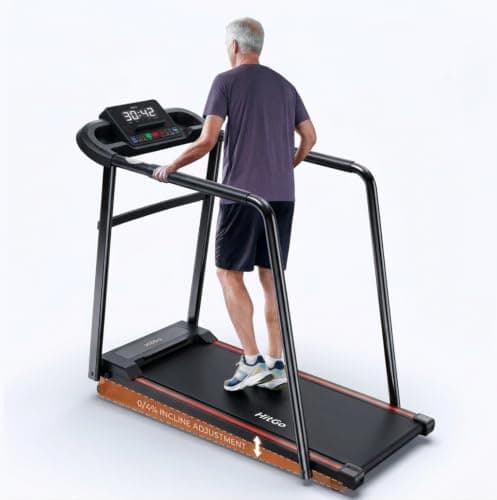
This is the hybrid category that barely existed a few years ago: a flat walking pad with proper handrails bolted to it. For a senior buyer it is arguably the most useful shape in the whole walking market — the low deck of a pad with something to hold.

What makes the H2 worth a review of its own is the disclosure. It publishes both belt dimensions — 43.3 by 15.5 inches — and its own weight at 59.5 lb. Two machines on this site publish a belt width and not a length. Two publish neither. On a walking pad, where stepping off the back is the failure mode that matters, the length is the number you most want.

It also explains why the belt is that long, which is rarer still: about 7 inches longer than a standard pad, as a buffer zone so you do not step off the rear while concentrating on something else. That is a specification written by someone who understood the risk rather than someone filling in a template.

Fit-to-You: the nine measurements

HitGo does not publish 4 of 10 of these. Where that is the case, this panel says so rather than guessing. How we compile these

Step-up heightHow high you have to lift your foot to get onto the deck, every single time.
Not published by the manufacturer
HandrailsThe difference between a treadmill a nervous walker will use and one they won't.
Full-length carbon steel rails on both sides. Length in inches not published separately from the 50.8 in overall length

Source: Amazon product listing data (Creators API) · read 2026-07-24

Weight capacitySearched directly, and two of the senior-focused competitors omit it entirely.
Not published by the manufacturer
Minimum speedThe slowest the belt will go. A machine that starts at 1 mph is unusable if your walking pace is slower than that.
Not published by the manufacturer
Belt sizeA short belt means a shortened stride and a real risk of stepping off the back.
43.3 in long × 15.5 in wide; stated to suit users up to 6 ft 2 in

Source: Amazon product listing data (Creators API) · read 2026-07-24

Display character heightCharacter height and contrast. Presbyopia is close to universal past 60.
Console described as extra-large, eye-level and high-contrast; character height not published

Source: Amazon product listing data (Creators API) · read 2026-07-24

Controls and reachCan it be operated one-handed, by feel, while seated? This is where low-strength and low-vision buyers get stranded.
Eye-level console; 4% manual incline; Bluetooth to Zwift and Kinomap

Source: Amazon product listing data (Creators API) · read 2026-07-24

Assembly and box weightBox weight and how many people it needs. A 130 lb box is a real barrier, not a footnote.
Stated 90% pre-assembled, 12 bolts to tighten; 59.5 lb machine weight

Source: Amazon product listing data (Creators API) · read 2026-07-24

Noise (dB)Apartments, shared walls, and a sleeping partner in the next room.
Not published by the manufacturer
FootprintWhether it actually fits the room you have in mind, with clearance to get on and off.
50.8 in long × 24 in wide × 43.3 in high

Source: Amazon product listing data (Creators API) · read 2026-07-24

We have not used this machine. Everything above comes from the manufacturer’s published documentation and the dated retailer listing, with the source given for each figure. Where they don’t publish a number, we say so. We can’t tell you how it feels to ride, how quiet it really is, or how it holds up after two years — and anyone who tells you otherwise without owning one is guessing.

The rails, and what full-length actually means here

HitGo publishes heavy-duty carbon steel rails on both sides, described as offering 360-degree support and aimed explicitly at seniors, physical therapy and people with back or knee concerns.

Rails on both sides is the important part. A single side rail, or a front bar, leaves one hand with nothing — and a stumble is not a symmetrical event. Both sides means whichever way you sway, there is something under the hand nearest the problem.

What is not published is the rail length in inches. The machine’s overall length is 50.8 inches and the belt is 43.3, so the rails plausibly run most of the deck, but that is inference and we mark it as unpublished rather than presenting a deduction as a figure.

The check to run at home: stand on the stationary belt in your normal walking position, let your arms hang, and see whether a hand rests on a rail without reaching or leaning. If not, it is the wrong machine for you.

The console at eye level

HitGo publishes an extra-large, eye-level, high-contrast console showing time, speed, distance, calories and pulse, and states the design reason: so you do not have to bend down or squint.

On a flat pad the console is usually at floor level or on a mat-mounted panel, which means looking down at your feet while walking — the opposite of what you want when balance is the concern. Putting it at eye level on the rail assembly is a small, sensible decision.

Character height is not published, so we cannot tell you the digits are big enough. “Extra-large” and “high-contrast” are descriptions rather than measurements. But this is the same gap every machine on this site has, and at least the position of the display has been thought about.

The 4% manual incline is a set-before-you-start affair rather than something adjustable mid-walk, which for this audience is fine — most people will set it to zero and leave it.

Assembly and moving it: the most complete disclosure here

HitGo publishes 90% pre-assembly with twelve bolts to tighten, a 59.5 lb machine weight, and built-in wheels. That is genuinely more useful assembly information than the $800 machine on this site provides, which publishes none at all.

Twelve bolts is a real job but a bounded one, and it needs a person who can kneel and use a spanner. 59.5 lb with wheels means one person can move it against a wall or into a closet, which is the practical difference between a machine that gets stored and one that lives in the middle of the room.

But note the honest limit: at 43.3 inches tall with rails, this does notslide under a sofa. If the appeal of a walking pad for you was that it disappears, the rails cost you that — and it is a direct trade-off rather than something a manufacturer can engineer away.

The two gaps that matter

No published step-up height.Frustrating on a machine whose whole appeal is the low deck. It publishes an overall height of 43.3 inches, but with a rail assembly on top you cannot derive the deck height from that the way you can on a flat pad. So on the single measurement this category is bought for, it is silent — and the Sunny treadmill on this site publishes 4 inches.

No published weight capacity. Not the maximum, and not a minimum. Two machines on our walking pages publish 300 lb, two publish 245 lb, and one publishes a 99 lb minimum below which the belt stops. This one publishes nothing at either end, which on a load-bearing machine you walk on is a real omission.

No speed range either, only a 2.5 hp motor. The minimum speed is the specification that decides whether a machine works in the first five minutes of a session, and three cheaper machines here publish 0.5 or 0.6 mph.

And, like everything else in this category, no noise figure — “whisper-quiet” is a phrase, not a measurement.
Who this suits

Anyone who wants a pad but needs rails. This is the hybrid shape, and rails on both sides is the right implementation of it.

Taller walkers. The published 43.3-inch belt suits users up to 6 ft 2 in per HitGo, and it is the longest belt published on this site by several inches.

Anyone worried about stepping off the back. The 7 inches of extra length over a standard pad exists for exactly that, and the manufacturer says so.

Anyone who has to move the machine themselves. 59.5 lb with wheels is manageable for one person, and the weight is published rather than left to guesswork.

Who should skip it

Anyone whose deciding constraint is step-up height. It is not published here. The Sunny treadmill publishes 4 inches and has rails.

Anyone near a weight limit. None is published at either end, so there is nothing to check against. Ask before ordering.

Anyone who needs a very slow minimum speed. No range is published. The Redliro publishes 0.5 mph and the Sunny pads 0.5 to 3.7 mph.

Anyone who wanted the pad to slide under a sofa. At 43.3 inches tall with the rails, it will not. That is the price of having something to hold.

$277.77 · Check price on Amazon

$299.007% off

Price as of July 24, 2026. #ad How we’re funded

General information, not medical advice. Tread & Tone is written by an enthusiast, not a clinician. Nobody here is a doctor, a physical therapist or a trainer, and nothing on this site has been medically reviewed. Talk to your doctor or physical therapist before starting something new, particularly after surgery, a fall, or a change in medication.

Questions people ask

Does the HitGo H2 have handrails?

Yes — heavy-duty carbon steel rails on both sides, published as offering 360-degree support and aimed explicitly at seniors and physical therapy use. Rails on both sides matters, because a stumble is not a symmetrical event and a single rail leaves one hand with nothing. The rail length in inches is not published, so check at home whether a hand rests on one without reaching.

How long is the walking belt?

43.3 by 15.5 inches, published — and HitGo explains why it is that long: about 7 inches more than a standard pad, as a buffer so you do not step off the rear. It is the longest belt published on this site, and it is the only walking machine here that publishes both dimensions. HitGo states it suits users up to 6 ft 2 in.

What is the weight limit?

Not published, at either end — no maximum and no minimum. That is a real omission on a machine you walk on. For comparison, two machines on our walking pages publish 300 lb, two publish 245 lb, and one publishes a 99 lb minimum below which the belt stops. Ask the retailer before ordering if you are near any limit.

How much assembly is needed?

HitGo publishes 90% pre-assembly with twelve bolts to tighten, which is the most complete assembly disclosure of any walking machine on this site — the $800 Sunny treadmill publishes none. It needs someone who can kneel and use a spanner. Once built it weighs a published 59.5 lb and has wheels, so one person can move it.

Will it fit under a sofa?

No. At 43.3 inches tall with the rail assembly, it stays where you put it — it has wheels so you can roll it against a wall or into a closet, but it does not slide under furniture. That is the direct trade-off for having rails, and it is the main reason someone would choose a flat pad instead.

How slow does it go?

Not published, which is the most useful thing it fails to tell you. HitGo publishes a 2.5 hp motor and a 4% manual incline but no speed range. Minimum speed is what determines whether a machine is usable in the first five minutes of a session, and three cheaper machines on this site publish theirs at 0.5 or 0.6 mph.

Sources

Product measurements are cited individually inside each Fit-to-You panel, against the manufacturer page or dated retailer listing they were read from.

Read next