Step-Over Height: The Spec Nobody Publishes
What it is, how to measure it yourself in about a minute, and why almost no manufacturer will tell you the number.
Read the guideWe have not ridden, walked on or stood on any of the equipment on this site. This page is the alternative we offer instead — a method you can check, applied the same way to every product.
Most sites in this category open by telling you how many bikes they tested. Some of them genuinely did. We did not test any, we do not own any, and there is no lab behind this site. There is one person who reads manuals.
That sounds like a weakness and in one specific way it is: we cannot tell you how a seat feels after forty minutes, how loud a machine really is through a shared wall, or whether a frame is still solid in three years. Anyone who tells you those things without having owned the machine is guessing, and you should treat their whole page accordingly.
What we can do is the thing nobody else in this category bothers with. Across the 52 machines on this site we went looking for the same 9measurements — the ones that decide whether an older adult can physically get on, reach the controls, read the screen, and get the box into the house. 170 of the 429 measurements we looked for, about 40%, are not published by anybody. We publish that gap rather than filling it in.
These are not chosen because they are easy to find. They are chosen because each one can independently make a machine unusable for the person buying it, and a spec sheet full of flywheel weights will not tell you about any of them.
For balance equipment, walking pads and wearables the same principle applies with the relevant fields swapped in: pad thickness and standing area rather than step-over height; step-up height, belt size and handrail length on a treadmill; detection method, alert routing and the monthly subscription on a fall-alert device. The panel on each page names its own fields.
Every value in a Fit-to-You panel carries its source, with a live link and the date we read it. There are exactly three kinds of entry and they look different on purpose:
For anything physiological — how long to ride, how far to walk, whether cycling helps arthritic joints — the source is a named public-health authority cited inline with a live link: the CDC, the National Institute on Aging, or the Arthritis Foundation. Never our own opinion dressed up as guidance.
Three filters, applied in this order:
Because we have not used these machines. A number implies an evaluation, and an evaluation implies use. Publishing “8.4/10” when the entire basis is a spec sheet would dress spec-reading up as testing, which is the exact thing this page exists to avoid. So the comparison tables rank by argument and carry a column you can verify instead: how many of the nine measurements the manufacturer withheld.
For the same reason you will not find star ratings in this site’s structured data. Search engines will not be told we rated something we did not test.
There are currently 9machines on this site that we explicitly tell you to skip, and they are in the tables rather than quietly left out — because “why not this one?” is a real question and an empty page is not an answer. A shortlist with no rejections is a sales sheet.
No price is written into any page on this site. It is structurally impossible: the product data has no price field. Prices are fetched live from Amazon, stamped with the date they were read, and they expire on their ownafter 48 hours. If the refresh stops running, every number on the site quietly turns into “Check price on Amazon” rather than sitting there going stale.
Right now 55 products carry a live price, last verified October 22, 2026.
We earn a commission when you buy through our links, as an Amazon Associate under the tag t5fitness-20. It costs you nothing extra. It does not change what we recommend, and the structural proof of that is the previous section: the cheapest machine on several of these pages is the one we put first, and the ones we tell you to skip earn exactly the same rate as the ones we recommend.
We accept no sponsored placements, no paid rankings, and no free products from manufacturers. Nobody has offered, but the answer is set in advance. The full disclosure is here.
If a number on this site is wrong, tell us and we will fix it within seven days and change the “last updated” date on the page. Manufacturers revise models without renaming them, so this happens. Our correction policy and update cadence are on the editorial policy page, and the contact form is here.
We re-check every published spec against the current manual quarterly, sweep for machines that have gone out of stock monthly, and re-read every authority citation twice a year, because CDC and NIA guidance does change.
Product measurements are cited individually inside each Fit-to-You panel, against the manufacturer page or dated retailer listing they were read from.
What it is, how to measure it yourself in about a minute, and why almost no manufacturer will tell you the number.
Read the guideBest for Seniors
Eleven bikes ranked on the measurements that decide whether you can get on — with the count of specs each manufacturer refuses to publish.
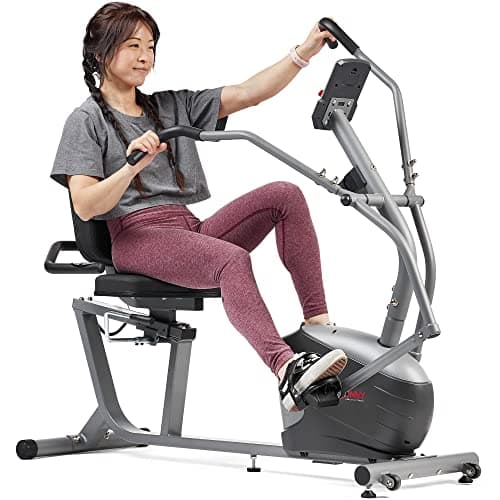
Top pick: Sunny Health & Fitness Smart Recumbent Bike with Dual-Motion Arm Exercisers
Best Treadmill
Step-up height, minimum speed and handrail length — the three numbers that decide it, and which machines publish them.
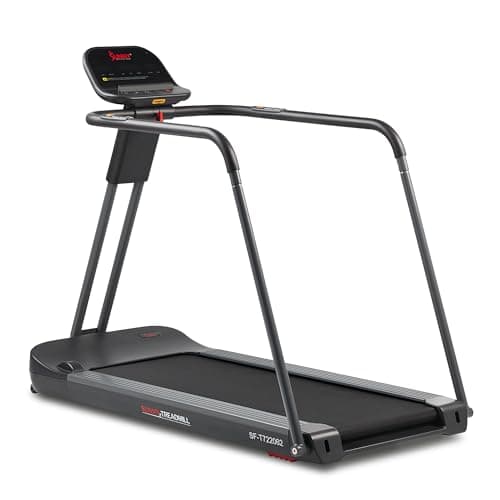
Top pick: Sunny Health & Fitness Treadmill with Extended Safety Handrails, Low Deck
Price as of October 22, 2026. #ad How we’re funded