Tread & Tone

Sunny Health & Fitness SF-T722062 Review

A 4-inch floor-to-deck height, published as a figure. It is the most expensive walking machine on this site and the only one that answers the question that decides the purchase.

By Stephen V.Last updated How we choose

How this is funded: we earn a commission if you buy through our links, at no extra cost to you. It never changes what we recommend, and every page here names at least one thing we would not buy. Full disclosure.

Sunny Health & Fitness Treadmill with Extended Safety Handrails, Low Deck

The lowest published step-up

Four inches from the floor to the deck, published as a number rather than described as 'low'. That is the measurement that decides whether stepping on feels like a step or like a climb, and this is the only treadmill here that states it.

Sunny Health & Fitness does not publish 4 of the 10 measurements we look for. The panel below names which.

Every treadmill marketed at older buyers describes itself as low-profile. This is the only one on this site that says how low: 4 inches from the floor to the deck, published as a stated accessibility feature.

That is the measurement that decides whether stepping on feels like a step or a climb, and you perform it twice per session, often with your weight on one leg while the belt is stationary. Four inches is roughly half a stair riser. On the machines that will not tell you, the figure could be anything.

It is paired with extended handrails running alongside the deck rather than a single bar across the front, and an 18.9-inch belt width — three to five inches wider than the walking pads on this site. For someone whose gait is not perfectly straight, that width is not a luxury.

It is also, by a wide margin, the most expensive walking machine we cover, and it publishes no weight capacity at all. Both of those are worth taking seriously before you buy.

Fit-to-You: the nine measurements

Sunny Health & Fitness does not publish 4 of 10 of these. Where that is the case, this panel says so rather than guessing. How we compile these

Step-up heightHow high you have to lift your foot to get onto the deck, every single time.
4 in floor-to-deck

Source: Amazon product listing data (Creators API) · read 2026-07-24

HandrailsThe difference between a treadmill a nervous walker will use and one they won't.
Extended safety handrails running alongside the deck, plus a safety clip for emergency stops. Length in inches not published

Source: Amazon product listing data (Creators API) · read 2026-07-24

Weight capacitySearched directly, and two of the senior-focused competitors omit it entirely.
Not published by the manufacturer
Minimum speedThe slowest the belt will go. A machine that starts at 1 mph is unusable if your walking pace is slower than that.
Top speed published as 8.5 mph; the minimum speed is not published

Source: Amazon product listing data (Creators API) · read 2026-07-24

Belt sizeA short belt means a shortened stride and a real risk of stepping off the back.
18.9 in wide; belt length not published

Source: Amazon product listing data (Creators API) · read 2026-07-24

Display character heightCharacter height and contrast. Presbyopia is close to universal past 60.
Not published by the manufacturer
Controls and reachCan it be operated one-handed, by feel, while seated? This is where low-strength and low-vision buyers get stranded.
Console with larger, easier-to-press buttons; pulse sensors; safety clip

Source: Amazon product listing data (Creators API) · read 2026-07-24

Assembly and box weightBox weight and how many people it needs. A 130 lb box is a real barrier, not a footnote.
Not published by the manufacturer
Noise (dB)Apartments, shared walls, and a sleeping partner in the next room.
Not published by the manufacturer
FootprintWhether it actually fits the room you have in mind, with clearance to get on and off.
62.6 in long × 30.5 in wide × 48.8 in high

Source: Amazon product listing data (Creators API) · read 2026-07-24

We have not used this machine. Everything above comes from the manufacturer’s published documentation and the dated retailer listing, with the source given for each figure. Where they don’t publish a number, we say so. We can’t tell you how it feels to ride, how quiet it really is, or how it holds up after two years — and anyone who tells you otherwise without owning one is guessing.

The 4 inches, and why one number carries this much weight

It seems disproportionate to build a recommendation on a single published figure, so here is the reasoning.

A conventional home treadmill deck typically sits somewhere between 6 and 9 inches off the floor. Nobody publishes it, so that range is inference rather than measurement — which is precisely the problem. At the top of that range you are stepping up most of a stair riser, unsupported, twice a session, before you have warmed up.

Four inches is a curb. It is a step you already make without thinking, dozens of times a day. And because Sunny publishes it, you can check it against something in your house rather than finding out after delivery.

For context on the alternative: the flat walking pads on this site work out at about 4.3 and 5.2 inches, derived from their overall heights. So this machine has a lower step-up than a flat pad, and it has handrails, which is the combination that page exists to look for.
The handrails and the console

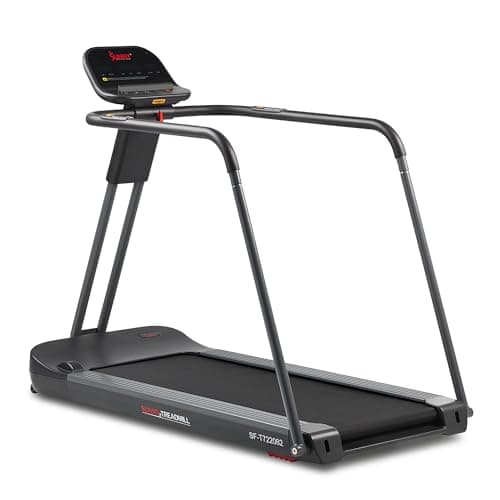
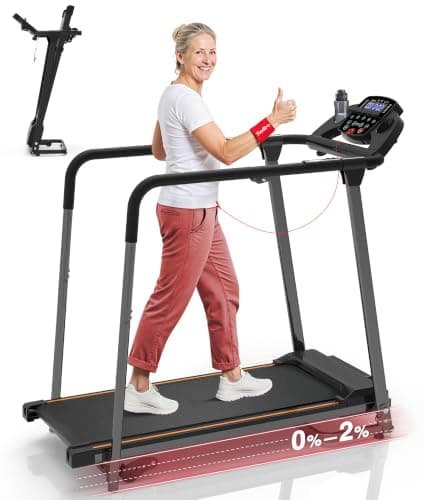
Sunny publishes extended safety handrails running alongside the deck, plus a safety clip for emergency stops and a non-slip deck surface. What it does not publish is the rail length in inches — and no manufacturer on this site does, so the check happens at home.

Stand on the stationary belt in your normal walking position, let your arms hang, and see whether a hand rests on a rail without reaching or leaning. If it does not, the rails are wrong for you and that is a return rather than something to adapt to.

The console is published as having deliberately bigger, easier-to-press buttons, plus pulse sensors. That is a genuine accessibility decision and it is rarer than it should be — but the controls are on the front console, not on the rails. The Redliro on our handrail page puts its speed buttons on the rails themselves, so you change pace without letting go. On that one dimension a $300 machine beats this $800 one.

Character height on the display is not published, which for a console whose selling point is usability is a gap.

What 8.5 mph tells you, and what it doesn't

Sunny publishes speeds up to 8.5 mph — a running speed, on a machine sold for recovery and senior use. Nobody buying this for indoor walking will use the top half of that range.

And the number that would matter, the minimum speed, is not published at all. That is the single most annoying omission on this machine. A comfortable indoor pace past 70 is often 1.5 to 2.5 mph, a warm-up should be slower, and a post-surgical pace can be well under 1 mph. Three cheaper machines on this site publish 0.5 mph minimums; this one publishes nothing.

If the slowest possible speed is critical for you — recovery, a very cautious walker, someone using a machine on a physical therapist’s advice — buy a machine that publishes it. The Redliro publishes 0.5 to 5 mph, which is a walking-shaped range with a genuinely slow bottom end.

The shock absorption system and the 18.9-inch deck width are both published and both genuinely useful, particularly the width.

No published weight capacity, at this price

We could not find a maximum user weight for this machine anywhere: not on the retailer listing features, not in the specification fields.

On an $800 treadmill that is poor. It is the most-searched specification in home fitness equipment, and the machines a third of this price publish 300 lb without difficulty. Weight capacity on a treadmill is also a dynamic question rather than a static one — walking involves impact, so the frame sees more than your body weight on each step.

If you are above roughly 250 lb, we would want that figure confirmed before ordering, and the sensible route is to ask the retailer or Sunny directly rather than assume.

No box weight is published either, and no assembly information, on a machine measuring 62.6 by 30.5 by 48.8 inches assembled. Compare that with the HitGo, which publishes 90% pre-assembly, twelve bolts and a 59.5 lb machine weight — considerably more useful disclosure from a cheaper product.

Who this suits

Anyone for whom the step onto the deck is the barrier. Four inches, published, with rails. That combination does not exist elsewhere on this site.

Anyone whose gait is not perfectly straight. The published 18.9-inch belt width is three to five inches more than the walking pads here, and width is what stops a wandering foot finding the edge.

Anyone who needs the machine to be usable now and later. The 8.5 mph ceiling is over-specified for walking, but it means the machine will not become the limiting factor if someone in the household progresses.

Anyone who finds small buttons difficult. The larger, easier-to-press console buttons are a published design decision, not an accident.

Who should skip it

Anyone who needs a very slow minimum speed. It is not published. The Redliro publishes 0.5 mph and costs a third as much.

Anyone above about 250 lb, until the capacity is confirmed. No published figure on a machine at this price is a reason to ask before ordering.

Anyone who wants the controls on the rails. The Redliro puts speed buttons on the handrails; this machine keeps them on the front console.

Anyone who needs the machine to store away. 62.6 by 30.5 inches with no published folded dimension. If it has to disappear between uses, buy a flat pad and accept the trade-off.

General information, not medical advice. Tread & Tone is written by an enthusiast, not a clinician. Nobody here is a doctor, a physical therapist or a trainer, and nothing on this site has been medically reviewed. Talk to your doctor or physical therapist before starting something new, particularly after surgery, a fall, or a change in medication.

Questions people ask

How high is the step onto this treadmill?

Four inches from the floor to the deck, published by Sunny as a stated accessibility feature. It is the only full treadmill on this site to publish the figure at all, and it is actually lower than the flat walking pads here, which work out at about 4.3 and 5.2 inches from their published overall heights.

What is the weight capacity?

Not published anywhere we could find, which on an $800 machine is genuinely poor — it is the most-searched specification in this category and machines a third of the price publish 300 lb. If you are above roughly 250 lb, ask the retailer or Sunny directly before ordering rather than assuming.

How slow will it go?

Sunny publishes a maximum of 8.5 mph and no minimum, which is the wrong way round for this audience. If a very slow speed matters — recovery, a cautious walker, a therapist's recommendation — buy a machine that publishes it. The Redliro publishes 0.5 to 5 mph and costs a third as much.

Are the handrails long enough?

Sunny publishes extended handrails running alongside the deck rather than a front bar, which is the right design, but does not publish a length — and no manufacturer on this site does. Check it at home: stand on the stationary belt in your walking position, let your arms hang, and see whether a hand rests on a rail without reaching. If not, return it.

How wide is the walking belt?

18.9 inches, published. That is three to five inches wider than the walking pads on this site, and belt width is what stops a wandering foot finding the edge. For anyone whose gait is not perfectly straight, this is one of the more valuable published figures on the machine.

Is it worth twice the price of the alternatives?

If the step onto the deck is your barrier, the published 4 inches plus proper rails is a combination nothing else here offers, and that is worth paying for. If your constraint is a very slow minimum speed, a confirmed weight capacity, or controls you can reach without letting go of a rail, cheaper machines publish those and this one does not.

Sources

Product measurements are cited individually inside each Fit-to-You panel, against the manufacturer page or dated retailer listing they were read from.

Read next