Tread & Tone

Seated and Compact Cardio for Seniors

For when a full bike is too much machine, too much money, or too much room. These work from the armchair you already own, and one of them will move your legs for you.

By Stephen V.Last updated How we choose

How this is funded: we earn a commission if you buy through our links, at no extra cost to you. It never changes what we recommend, and every page here names at least one thing we would not buy. Full disclosure.

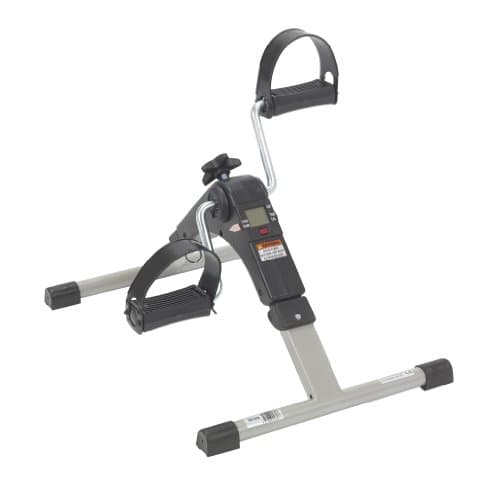
This is the category people arrive at second, usually after pricing a recumbent bike and measuring the spare room. A pedal unit costs between about $50 and $170, weighs 13 lb, and lives under a chair. It is the same seated motion as a bike without the frame, the seat or the floor space.

It is also, honestly, less exercise. Nobody should pretend a set of pedals under a recliner is equivalent to a bike, and the useful comparison is not against a bike — it is against the sitting you would otherwise be doing. On that comparison it wins easily, and it wins again on the only metric that finally matters: whether you use it.

Two specifications decide everything here, and almost nobody publishes the first one: pedal height and whether the machine is motorized.

Every page in this section

Pedal height, and why exactly one maker publishes it

Put a 10-inch pedal unit under a desk with 26 inches of knee clearance and your knees hit the underside on every stroke. Put an 18-inch unit under the same desk and it does not fit at all. This is the single most common reason a pedal exerciser gets returned, and it is entirely predictable from two measurements.

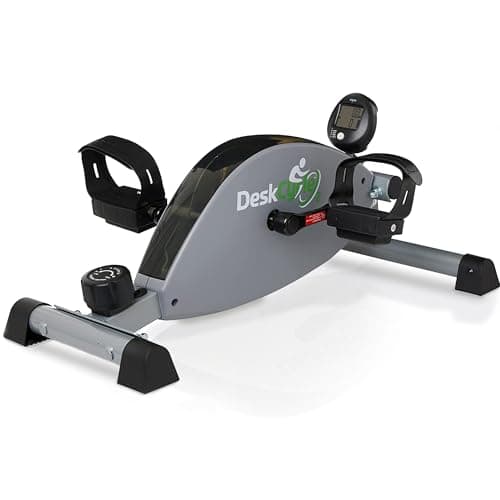
Published heights on this site run from 7.4 inches to 18 inches — a two-and-a-half-fold range in a category that looks homogeneous on a shelf. And only DeskCycle publishes its height as an adjustable range (9 to 10 inches) and states the desk height it clears (27 inches). It is the most expensive pedal unit here and that one published pair of numbers is most of why it leads our shortlist.

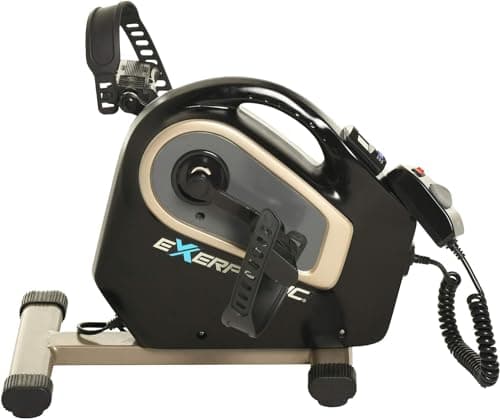
One machine publishes two contradictory heights in the same listing — 7.6 inches in its specification field and 17 inches in its own description text. We print both, because we cannot resolve it and pretending otherwise would be worse.

Measure your own clearance before buying: floor to the underside of the desk, or floor to the front edge of the armchair seat if that is where it is going.

Motorized or self-powered: two different products

This is not a features comparison, it is a fork in the road, and the listings blur it badly.

A self-poweredunit — every pedal exerciser here, plus the Cubii — needs you to turn the pedals. You supply the force, magnetic resistance opposes it, and the work is yours. That is exercise in the ordinary sense.

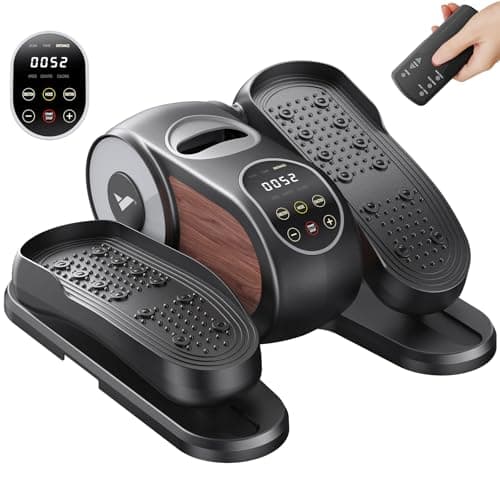
A motorizedunit — the MERACH under-desk elliptical — has a 60 W motor that moves your legs through the stride whether you push or not, forwards or in reverse, across twelve programs. If starting the motion yourself is the barrier — very low leg strength, recovering from surgery, a long period of inactivity — that is a genuinely different and useful product.

But be clear about what it is. A motor moving your legs is passive movement, which is not the same as exercise you perform. It keeps joints moving and helps circulation. It does not build strength the way pedaling against resistance does. Both are legitimate; buying the wrong one for your situation is the mistake. The full comparison is here.

Resistance at the bottom of the range

As with bikes, the lowest setting matters far more than the highest. Two units here publish resistance in pounds — both DeskCycles, 8 settings up to 39 lb — which is unusually specific for this category. One offers stepless resistance, meaning a continuous dial rather than fixed levels, so you can find something between level one and level two. For an arthritic knee that is worth more than a wider range.

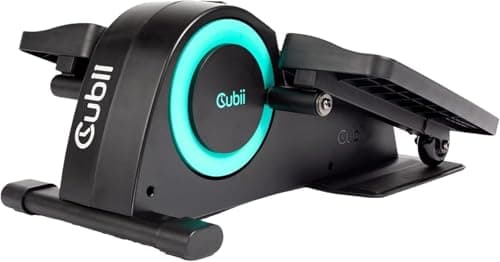
Three units publish no resistance information at all beyond “adjustable”, including the Cubii, which is at the top of this price band. That is poor, and we say so on its card.

Also worth knowing: a heavier flywheel makes the stroke even rather than lurching. DeskCycle publishes that its flywheel spins 14 times per pedal stroke, which is the closest anything in this category comes to a smoothness specification.

The things that decide whether it gets used

Three practical details that matter more than the specification sheet:

  • Does it stay put? The commonest complaint about cheap pedal units is that they walk away across a hard floor while you pedal. Two units here publish four anti-slip rubber pads. On carpet it matters less; on laminate it is the difference between usable and infuriating.
  • Does it come assembled?One arrives completely assembled and publishes its own weight at 13 lb. If a box of parts is the barrier, that is worth paying for — though we note on its card that it is also 18 inches tall, which rules out most desks, and costs more than a folding unit that does the same job.
  • Can you read the display from where you sit? A detachable LCD, as on the DeskCycle, can be put on the desk in front of you rather than left on the floor at your feet. Looking down at a floor-level display while pedaling is a small indignity that quietly ends the habit.

And the honest limit, stated plainly: what a $50 set of pedals can and cannot do, measured against the CDC’s weekly activity target rather than against nothing.

Who should buy a bike instead

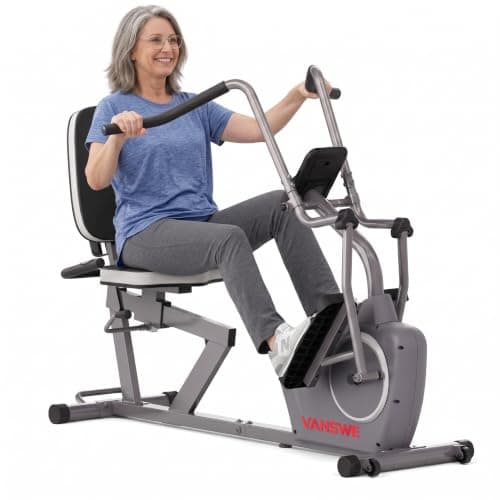
If you have the room, the budget and the ability to get on and off, a recumbent bike is more exercise, more comfortable for a longer session, and supports your back while you do it. A pedal unit under a dining chair supports nothing.

The pedal unit is the right buy when one of these is true: the budget is under about $100, there is genuinely no floor space, the machine has to be invisible between uses, or the point is to break up long periods of sitting rather than to complete a workout. All four are common and none is a compromise to apologize for.

General information, not medical advice. Tread & Tone is written by an enthusiast, not a clinician. Nobody here is a doctor, a physical therapist or a trainer, and nothing on this site has been medically reviewed. Talk to your doctor or physical therapist before starting something new, particularly after surgery, a fall, or a change in medication.

Questions people ask

Does a pedal exerciser count as real exercise?

Pedaling against resistance is aerobic activity, and the CDC's guidance for adults 65 and over is written in minutes of moderate-intensity activity rather than by machine type. Whether your session reaches moderate intensity depends on the resistance you set and how hard you work — pedaling gently while reading is closer to breaking up sitting than to a workout. That is still worth doing; it is just not the same claim.

What pedal height do I need?

Measure from the floor to the underside of your desk, or to the front edge of the armchair seat if that is where it will live, and leave clearance for your knees to travel. Published heights on this site range from 7.4 to 18 inches. Only DeskCycle publishes an adjustable range and states the desk height it clears, which is why it leads our shortlist despite the price.

Should I get a motorized one?

Only if starting the pedal motion yourself is the actual barrier — very low leg strength, post-surgical recovery, a long period of inactivity. A motor moving your legs is passive movement: it keeps joints moving and helps circulation, but it does not build strength the way pedaling against resistance does. If you can turn the pedals yourself, a self-powered unit gives you more.

Can I use these for my arms too?

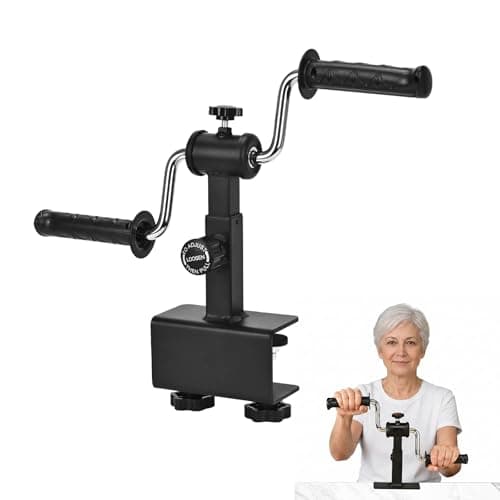
Several are designed for it — you put the unit on a table and pedal with your hands. Three products here publish that as a stated 2-in-1 use. It is genuinely useful for shoulder range of motion and it is one of the few things this equipment does that a bike does not.

Will it slide around on a hard floor?

Cheap ones do, and it is the most common complaint in this category. Two units here specifically publish four anti-slip rubber pads, and both are worth preferring if you are on laminate, tile or wood. On carpet it matters much less. A rubber mat underneath solves it either way.

Under-desk elliptical or pedal exerciser?

An elliptical path keeps the knee angle shallower than a circular pedal stroke, which is gentler if the knee is the reason you are shopping. A pedal unit is cheaper, simpler and usually smaller. The bigger question is motorized versus self-powered, which cuts across both types — our comparison page lays out both distinctions in a table.

Sources

Product measurements are cited individually inside each Fit-to-You panel, against the manufacturer page or dated retailer listing they were read from.