Tread & Tone

The Best Exercise Pedals for Disabled Adults

Almost every pedal exerciser on sale assumes one thing about you: that you can turn the cranks. These nine are ranked on what happens when you can’t — whether a motor drives the pedals, whether anything holds your feet on them, and whether you can reach the control without bending down.

By Stephen V.Last updated How we choose

How this is funded: we earn a commission if you buy through our links, at no extra cost to you. It never changes what we recommend, and every page here names at least one thing we would not buy. Full disclosure.

There is a whole aisle of cheap pedal units sold on the promise of gentle movement for people with limited mobility, and nearly all of them are built on an assumption nobody states out loud: that the person sitting in front of the pedals can push them round. If that is true for you, our main pedal exerciser shortlist is the better page — it ranks the self-powered units on published pedal height, which is the measurement that decides whether your knees hit the desk.

This page is for when that assumption does not hold. After a stroke, with advanced arthritis, with a spinal cord injury, with the profound leg weakness that follows weeks in a hospital bed, or with a hemiplegic side that will not take instruction, the barrier is not resistance settings. It is starting the motion at all, and then keeping a foot on a pedal that is already moving.

So the ranking here runs on four published things, in this order: whether a motor drives the cranks, what the unit does when a leg locks up or stops rotating, what holds the limb in place, and whether the controls can be reached from where the user actually sits. Price is a distant fifth. Pedal height, the spec that decides the rest of this category, barely matters here — a motorized unit lives in front of an armchair, not under a desk.

One number worth having before you read on: of the nine units below, only twopublish what the machine does when a leg stops rotating, and only one of those names the leg rather than the resistance. That single sentence on the Exerpeutic’s listing is most of why it leads this page, and the silence from the other seven is the finding.

Quick picks

Ranked on the published accessibility measurements and on who each machine actually suits. Select a row to jump to the full write-up. The last column is the number of the nine measurements the manufacturer will not publish — we have not used any of these machines, and here is exactly what we did instead.

#MachineBest forSpecs withheldPrice
1
Exerpeutic 2000M Motorized Under Desk Exercise Bike

Exerpeutic 2000M Motorized Under Desk Exercise Bike

When the legs may not rotate freely

Published overload cutoff2of 7
$156.04 · Check price on Amazon

$171.109% off

Price as of October 4, 2026. #ad How we’re funded

2
PHYCISER Electric Pedal Exercise Bike with Leg Support

PHYCISER Electric Pedal Exercise Bike with Leg Support

Holding the legs in place

Three named modes1of 7
3
MOMODA Electric Pedal Exerciser with Leg Support MC51

MOMODA Electric Pedal Exerciser with Leg Support MC51

A leg support you can remove

Leg support that detaches2of 7
4
MERACH Under Desk Elliptical MR-E32

MERACH Under Desk Elliptical MR-E32

When starting the motion yourself is the problem

Smallest published footprint2of 7
$89.99 · Check price on Amazon

$99.9910% off

Price as of October 4, 2026. #ad How we’re funded

5
EasyVibe Motorized Arm and Leg Exerciser with Adjustable Base

EasyVibe Motorized Arm and Leg Exerciser with Adjustable Base

Use from a bed, not a chair

Works from a bed5of 7
6
LUBBYGIM Electric Mini Exercise Bike, Arm and Leg Pedal Exerciser

LUBBYGIM Electric Mini Exercise Bike, Arm and Leg Pedal Exerciser

The lowest price with a motor

Lowest price with a motor2of 7
$59.99 · Check price on Amazon

Price as of October 4, 2026. #ad How we’re funded

7
KEAJVXT Arm Bike with Desktop Clamp

KEAJVXT Arm Bike with Desktop Clamp

Arms only, bolted down

Arms only, bolted down3of 7
$43.69 · Check price on Amazon

$49.9913% off

Price as of October 4, 2026. #ad How we’re funded

8
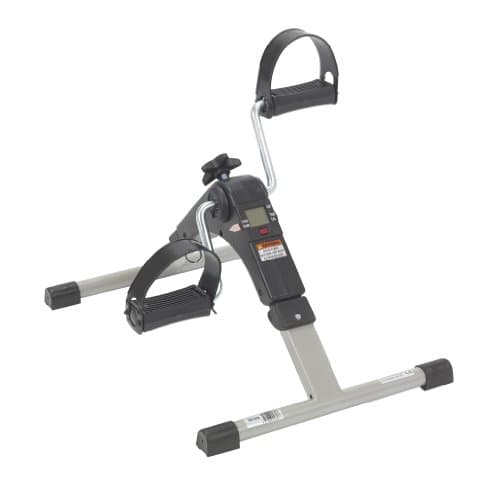
Drive Medical Deluxe Folding Pedal Exerciser RTL10273

Drive Medical Deluxe Folding Pedal Exerciser RTL10273

Staying put on a hard floor

If you can pedal unaided2of 7
$44.40 · Check price on Amazon

$47.426% off

Price as of October 4, 2026. #ad How we’re funded

9
RECOVION Electric Pedal Exerciser with Remote Control AGL-JTC

RECOVION Electric Pedal Exerciser with Remote Control AGL-JTC

We would skip this one — see below

Publishes the least2of 7
1.Published overload cutoff

Exerpeutic 2000M Motorized Under Desk Exercise Bike(4107)
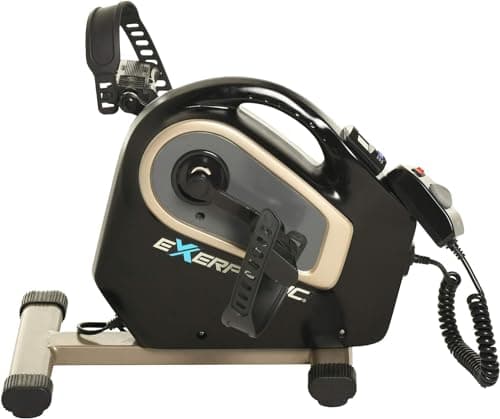
Exerpeutic 2000M Motorized Under Desk Exercise Bike
$156.04 · Check price on Amazon

$171.109% off

Price as of October 4, 2026. #ad How we’re funded

The only unit here whose listing describes what happens when the legs stop cooperating: an overload protection that halts the cranks if the pedals cannot rotate freely. That is the specific failure a motorized pedal unit can cause and almost nobody addresses it in writing. Add adjustable foot straps and a named manufacturer behind the brand, and it is the one we would put a relative on.

What it gets right

  • Published overload protection that stops the cranks on excessive speed or when the legs cannot rotate freely — the one safety behavior that matters most on a motorized unit
  • Adjustable straps on large foldable pedals, published, so the feet are held rather than balanced
  • Speed controller on a published 6 ft cord, so settings change without bending down
  • A named manufacturer (Paradigm Health and Wellness) and a published 1-year limited warranty, which most of this category does not have
  • Published floor mat and a built-in carry handle

What to know first

  • The controller is corded, not wireless — 6 ft of cable across the floor near someone unsteady on their feet
  • Published 15-minute automatic session timer when the motor is running, so a longer powered session means restarting it
  • No published user weight capacity
  • At 14.5 in tall it is the second-tallest unit here, which rules out most desks
  • No decibel figure, and no calf or leg supports

Fit-to-You: the nine measurements

Exerpeutic does not publish 2 of 7 of these. Where that is the case, this panel says so rather than guessing. How we compile these

Pedal heightThe clearance under your desk or chair. Get this wrong and the pedals hit your knees.
14.5 in overall height, not adjustable

Source: Amazon product listing data (Creators API) · read 2026-10-03

Resistance rangeHow gently it can be set. The lowest setting matters far more than the highest.
No numbered resistance levels. The listing states the bike "offers more resistance when the motor is off" and that speed is set on the hand-held controller

Source: Amazon product listing data (Creators API) · read 2026-10-03

Weight capacitySearched directly, and two of the senior-focused competitors omit it entirely.
Not published by the manufacturer
Motorized or self-poweredWhether the machine moves your legs or you move it. For very low leg strength that is the whole decision.
Motorized, with published overload protection that stops the cranks on excessive speed or when the legs cannot rotate freely; auto 15-minute session timer when powered

Source: Amazon product listing data (Creators API) · read 2026-10-03

Display and controlsCharacter height and contrast. Presbyopia is close to universal past 60.
Multi-function LCD showing distance, time, calories and total repetitions; hand-held speed controller on a 6 ft cord

Source: Amazon product listing data (Creators API) · read 2026-10-03

FootprintWhether it actually fits the room you have in mind, with clearance to get on and off.
18.2 in × 21 in × 14.5 in

Source: Amazon product listing data (Creators API) · read 2026-10-03

Noise (dB)Apartments, shared walls, and a sleeping partner in the next room.
Not published by the manufacturer

We have not used this machine. Everything above comes from the manufacturer’s published documentation and the dated retailer listing, with the source given for each figure. Where they don’t publish a number, we say so. We can’t tell you how it feels to ride, how quiet it really is, or how it holds up after two years — and anyone who tells you otherwise without owning one is guessing.
2.Three named modes

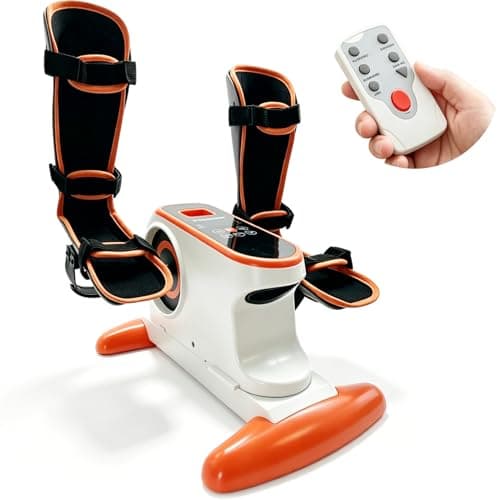
PHYCISER Electric Pedal Exercise Bike with Leg Support(QH-032026)

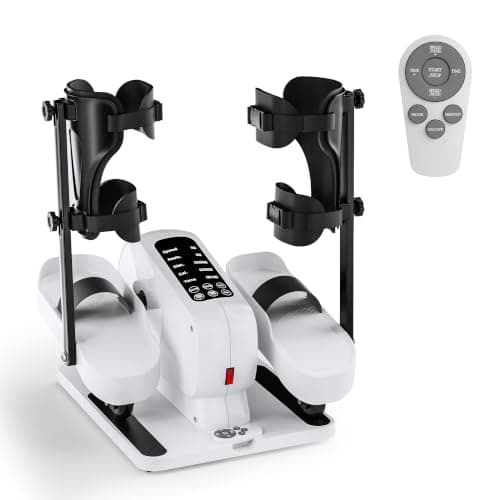
The most complete published spec sheet in this group, and the only one that separates passive cycling, motor-assisted movement and active resistance into three named modes rather than blurring them into "auto and manual". High calf supports hold the legs on the pedals. It is also the only unit here with a decibel figure on the listing, though that figure is the seller's and comes with no test method.

What it gets right

  • Three named modes published — passive cycling, motor-assisted movement, and an active resistance mode — rather than one vague "auto" setting
  • High calf leg supports, published, which hold the lower leg rather than relying on the foot staying put
  • Published auto-pause the listing calls Anti-Spasm: it stops on excessive resistance and resumes after 5 seconds
  • Published as requiring no assembly, with a long-range remote and a high-contrast LCD
  • 20 speed levels and published forward and reverse rotation
  • Published weight of 13.8 lb with a built-in handle

What to know first

  • No published user weight capacity
  • "Anti-Spasm" is the seller's term with no published trigger threshold, so there is no way to know how much resistance it tolerates before it stops
  • The under-40 dB figure is a seller claim with no stated test method
  • The leg supports are a frame you live with — nothing on the listing says they detach, unlike the MOMODA's
  • Its own listing styles the brand two ways, PHY CISER and phyciser, which is a sign of how young the brand is

Fit-to-You: the nine measurements

PHYCISER does not publish 1 of 7 of these. Where that is the case, this panel says so rather than guessing. How we compile these

Pedal heightThe clearance under your desk or chair. Get this wrong and the pedals hit your knees.
9.8 in overall height, not adjustable

Source: Amazon product listing data (Creators API) · read 2026-10-03

Resistance rangeHow gently it can be set. The lowest setting matters far more than the highest.
20 speed levels across three published modes — passive cycling, motor-assisted, and an active resistance mode. No resistance figure in pounds or newtons

Source: Amazon product listing data (Creators API) · read 2026-10-03

Weight capacitySearched directly, and two of the senior-focused competitors omit it entirely.
Not published by the manufacturer
Motorized or self-poweredWhether the machine moves your legs or you move it. For very low leg strength that is the whole decision.
Motorized, forward and reverse, continuous-duty copper motor with no wattage published; auto-pause on excessive resistance resuming after 5 seconds

Source: Amazon product listing data (Creators API) · read 2026-10-03

Display and controlsCharacter height and contrast. Presbyopia is close to universal past 60.
High-contrast LCD plus a long-range remote, so no bending to change settings

Source: Amazon product listing data (Creators API) · read 2026-10-03

FootprintWhether it actually fits the room you have in mind, with clearance to get on and off.
17.7 in × 11.8 in × 9.8 in; 13.8 lb with a built-in handle

Source: Amazon product listing data (Creators API) · read 2026-10-03

Noise (dB)Apartments, shared walls, and a sleeping partner in the next room.
Listing states under 40 dB. A seller claim with no stated test method

Source: Amazon product listing data (Creators API) · read 2026-10-03

We have not used this machine. Everything above comes from the manufacturer’s published documentation and the dated retailer listing, with the source given for each figure. Where they don’t publish a number, we say so. We can’t tell you how it feels to ride, how quiet it really is, or how it holds up after two years — and anyone who tells you otherwise without owning one is guessing.
3.Leg support that detaches

MOMODA Electric Pedal Exerciser with Leg Support MC51(MC51)

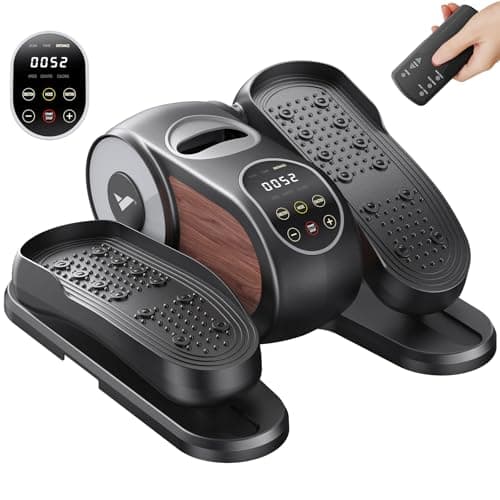
The leg support comes off. That sounds minor and it is not: it is the difference between a unit that suits someone whose legs need holding today and nobody else, and one that carries on being useful when they do not. It also publishes a weighted base specifically for hard floors and arrives fully assembled, which is the other barrier in this category.

What it gets right

  • Published removable leg support frame — the only unit here that states the supports detach
  • Published 100% pre-assembled, out of the box ready to use
  • Published weighted base for floor grip, stated for both carpet and hardwood, plus extra-large non-slip footplates
  • 70 W motor with published Auto and Active modes, forward and reverse, and 6 resistance levels in Active mode
  • Touchscreen LCD plus a wireless remote, so settings change without bending
  • Published 12-month warranty

What to know first

  • No published user weight capacity
  • No published unit weight, which matters if somebody else has to lift it into place
  • Footplates with no straps — the feet rest rather than being held, unlike the Exerpeutic's
  • No decibel figure
  • The listed manufacturer is an unbranded trading company rather than a named equipment maker, so there is no service history to look up

Fit-to-You: the nine measurements

MOMODA does not publish 2 of 7 of these. Where that is the case, this panel says so rather than guessing. How we compile these

Pedal heightThe clearance under your desk or chair. Get this wrong and the pedals hit your knees.
9.8 in overall height, not adjustable

Source: Amazon product listing data (Creators API) · read 2026-10-03

Resistance rangeHow gently it can be set. The lowest setting matters far more than the highest.
Auto mode drives the pedals; Active mode has 6 adjustable resistance levels. No resistance figure published

Source: Amazon product listing data (Creators API) · read 2026-10-03

Weight capacitySearched directly, and two of the senior-focused competitors omit it entirely.
Not published by the manufacturer
Motorized or self-poweredWhether the machine moves your legs or you move it. For very low leg strength that is the whole decision.
Motorized, 70 W, forward and reverse. Auto mode turns the pedals for you; Active mode is self-powered against resistance

Source: Amazon product listing data (Creators API) · read 2026-10-03

Display and controlsCharacter height and contrast. Presbyopia is close to universal past 60.
Touchscreen LCD the listing describes as extra-large, plus a wireless remote so settings change without bending

Source: Amazon product listing data (Creators API) · read 2026-10-03

FootprintWhether it actually fits the room you have in mind, with clearance to get on and off.
15 in × 15 in × 9.8 in

Source: Amazon product listing data (Creators API) · read 2026-10-03

Noise (dB)Apartments, shared walls, and a sleeping partner in the next room.
Not published by the manufacturer

We have not used this machine. Everything above comes from the manufacturer’s published documentation and the dated retailer listing, with the source given for each figure. Where they don’t publish a number, we say so. We can’t tell you how it feels to ride, how quiet it really is, or how it holds up after two years — and anyone who tells you otherwise without owning one is guessing.
4.Smallest published footprint

MERACH Under Desk Elliptical MR-E32(MR-E32)

MERACH Under Desk Elliptical MR-E32
$89.99 · Check price on Amazon

$99.9910% off

Price as of October 4, 2026. #ad How we’re funded

Motorized, and that is the whole point: a 60 W motor moves your legs through the stride so you do not need the strength to start the motion yourself. For someone recovering strength or sitting for long stretches, that is a different product category from a pedal exerciser, not a fancier version of one.

What it gets right

  • Motorized — 12 automatic programs will move your legs for you, which self-powered pedals cannot
  • Forward and reverse motion, published
  • Remote control as well as a touch screen, so no bending to change settings
  • The smallest published footprint of any seated unit here at 15.6 in × 14.9 in

What to know first

  • No published weight capacity or maximum user weight
  • A motorized machine moving your legs is passive movement, which is not the same as exercise you perform
  • 7.4 in tall with no adjustment, so desk clearance is fixed
  • 'Whisper-quiet' with no decibel figure

Fit-to-You: the nine measurements

MERACH does not publish 2 of 7 of these. Where that is the case, this panel says so rather than guessing. How we compile these

Pedal heightThe clearance under your desk or chair. Get this wrong and the pedals hit your knees.
7.4 in overall height, not adjustable

Source: Amazon product listing data (Creators API) · read 2026-07-24

Resistance rangeHow gently it can be set. The lowest setting matters far more than the highest.
12 manual speed levels plus 12 automatic programs (P1–P12)

Source: Amazon product listing data (Creators API) · read 2026-07-24

Weight capacitySearched directly, and two of the senior-focused competitors omit it entirely.
Not published by the manufacturer
Motorized or self-poweredWhether the machine moves your legs or you move it. For very low leg strength that is the whole decision.
Motorized, 60 W, with forward and reverse

Source: Amazon product listing data (Creators API) · read 2026-07-24

Display and controlsCharacter height and contrast. Presbyopia is close to universal past 60.
Touch screen plus remote control; LED shows time, distance, speed and calories

Source: Amazon product listing data (Creators API) · read 2026-07-24

FootprintWhether it actually fits the room you have in mind, with clearance to get on and off.
15.6 in × 14.9 in × 7.4 in

Source: Amazon product listing data (Creators API) · read 2026-07-24

Noise (dB)Apartments, shared walls, and a sleeping partner in the next room.
Not published by the manufacturer

We have not used this machine. Everything above comes from the manufacturer’s published documentation and the dated retailer listing, with the source given for each figure. Where they don’t publish a number, we say so. We can’t tell you how it feels to ride, how quiet it really is, or how it holds up after two years — and anyone who tells you otherwise without owning one is guessing.
5.Works from a bed

EasyVibe Motorized Arm and Leg Exerciser with Adjustable Base

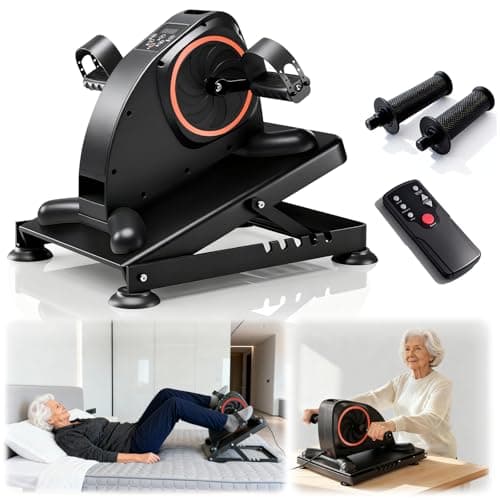
The one unit here that publishes being usable lying down, with a base that tilts through five angles and grips that swap for the foot pedals. If the person using it cannot transfer into a chair, that is not a convenience feature — it is the only thing on this page that works. It is also the thinnest spec sheet on the page by a wide margin, and we would rather you knew that before you paid a mid-range price for it.

What it gets right

  • Published for use sitting or lying down, which no other unit here states
  • Published 5-angle adjustable base, so the cranks can be met at a workable height from a bed or a recliner
  • Detachable hand grips and foot pedals, published, so the same unit covers arms and legs
  • Published Active and Passive modes — in Passive the motor moves the limb, in Active you work against resistance
  • Published adjustable non-slip base, and the base detaches for storage

What to know first

  • Publishes no dimensions of any kind, which for a unit meant to sit on a bed is the measurement you most need
  • No published unit weight, no motor wattage, no number of speed levels, and no model number
  • The listing describes no display and no remote, so there is nothing to read and nothing to adjust from a distance
  • No published user weight capacity and no decibel figure
  • It publishes less than the MOMODA and the PHYCISER while costing about the same, and five of the seven fields below are blank because of it

Fit-to-You: the nine measurements

EasyVibe does not publish 5 of 7 of these. Where that is the case, this panel says so rather than guessing. How we compile these

Pedal heightThe clearance under your desk or chair. Get this wrong and the pedals hit your knees.
Not published by the manufacturer
Resistance rangeHow gently it can be set. The lowest setting matters far more than the highest.
Active mode has adjustable resistance. No number of levels and no resistance figure published

Source: Amazon product listing data (Creators API) · read 2026-10-03

Weight capacitySearched directly, and two of the senior-focused competitors omit it entirely.
Not published by the manufacturer
Motorized or self-poweredWhether the machine moves your legs or you move it. For very low leg strength that is the whole decision.
Motorized, with a published Passive mode in which the motor moves the legs or arms with no effort required, and an Active mode you drive yourself. No motor wattage published

Source: Amazon product listing data (Creators API) · read 2026-10-03

Display and controlsCharacter height and contrast. Presbyopia is close to universal past 60.
Not published by the manufacturer
FootprintWhether it actually fits the room you have in mind, with clearance to get on and off.
Not published by the manufacturer
Noise (dB)Apartments, shared walls, and a sleeping partner in the next room.
Not published by the manufacturer

We have not used this machine. Everything above comes from the manufacturer’s published documentation and the dated retailer listing, with the source given for each figure. Where they don’t publish a number, we say so. We can’t tell you how it feels to ride, how quiet it really is, or how it holds up after two years — and anyone who tells you otherwise without owning one is guessing.
6.Lowest price with a motor

LUBBYGIM Electric Mini Exercise Bike, Arm and Leg Pedal Exerciser(LUB-DPEDAL-GRAY)

LUBBYGIM Electric Mini Exercise Bike, Arm and Leg Pedal Exerciser
$59.99 · Check price on Amazon

Price as of October 4, 2026. #ad How we’re funded

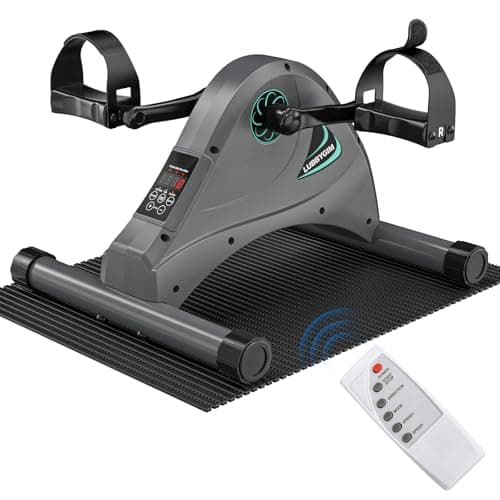
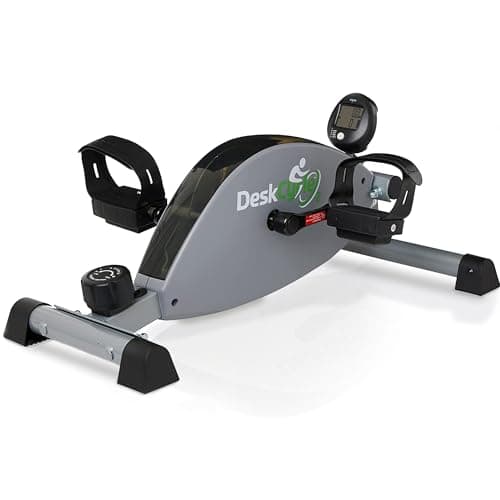
The cheapest way to get a motor, by a wide margin, and at 5 in tall the lowest-profile unit on this page. The trade is that it publishes less than anything above it and its own listing contradicts itself on what its modes do — it calls the self-powered option "Passive mode", which is the reverse of the clinical meaning. Worth having anyway if the budget is the constraint, as long as nobody is relying on the mode labels.

What it gets right

  • Published 5 in overall height — the lowest-profile unit on this page, and the only one likely to clear a low desk
  • Published motorized or manual-assisted pedaling, forward and backward
  • Published ergonomic adjustable pedals stated for use with either feet or hands
  • Remote plus on-unit buttons, and a multi-function LED showing time, speed and calories
  • Published weight of 9.24 lb, light enough for one person to reposition
  • Published 1-year warranty

What to know first

  • Its own listing calls the self-powered option "Passive mode" — the exact reverse of how the word is used clinically, so the mode names cannot be taken at face value
  • The listing says "easy to install" and "in a few minutes", so it does not arrive ready to use
  • No straps and no leg supports published — the feet sit on the pedals unheld
  • No published user weight capacity and no decibel figure
  • 6 speed levels is the smallest range of any motorized unit here

Fit-to-You: the nine measurements

LUBBYGIM does not publish 2 of 7 of these. Where that is the case, this panel says so rather than guessing. How we compile these

Pedal heightThe clearance under your desk or chair. Get this wrong and the pedals hit your knees.
5 in overall height, not adjustable — the lowest on this page

Source: Amazon product listing data (Creators API) · read 2026-10-03

Resistance rangeHow gently it can be set. The lowest setting matters far more than the highest.
6 speed levels. No resistance figure published, and the listing's own mode names invert the usual meanings

Source: Amazon product listing data (Creators API) · read 2026-10-03

Weight capacitySearched directly, and two of the senior-focused competitors omit it entirely.
Not published by the manufacturer
Motorized or self-poweredWhether the machine moves your legs or you move it. For very low leg strength that is the whole decision.
Motorized, forward and backward, with a manual-assisted option. The listing calls the self-powered option "Passive mode", which is the reverse of normal usage

Source: Amazon product listing data (Creators API) · read 2026-10-03

Display and controlsCharacter height and contrast. Presbyopia is close to universal past 60.
Multi-function LED showing time, speed and calories; a remote plus buttons on the unit itself

Source: Amazon product listing data (Creators API) · read 2026-10-03

FootprintWhether it actually fits the room you have in mind, with clearance to get on and off.
15 in × 12 in × 5 in; 9.24 lb

Source: Amazon product listing data (Creators API) · read 2026-10-03

Noise (dB)Apartments, shared walls, and a sleeping partner in the next room.
Not published by the manufacturer

We have not used this machine. Everything above comes from the manufacturer’s published documentation and the dated retailer listing, with the source given for each figure. Where they don’t publish a number, we say so. We can’t tell you how it feels to ride, how quiet it really is, or how it holds up after two years — and anyone who tells you otherwise without owning one is guessing.
7.Arms only, bolted down

KEAJVXT Arm Bike with Desktop Clamp

KEAJVXT Arm Bike with Desktop Clamp
$43.69 · Check price on Amazon

$49.9913% off

Price as of October 4, 2026. #ad How we’re funded

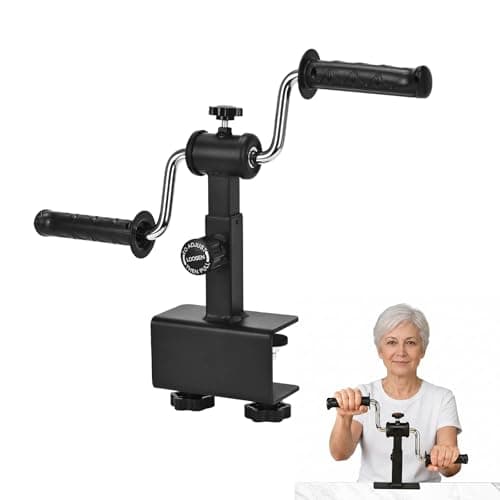
It bolts to the table. Every other unit that advertises arm use is a floor unit you lift onto a surface and then chase around it, and the sliding is the reason arm sessions stop. This one clamps to a tabletop between 0.4 and 1.95 in thick and does not move. It is arms only, it has no motor and no display, and for somebody whose legs are not the part that needs work it is still the best value on this page.

What it gets right

  • Published desktop clamp for tabletops 0.4–1.95 in thick — the listing specifically contrasts it with suction-cup units that move
  • Silicone pad on the clamp, published, to protect the table surface
  • Resistance by tension knob, so the lowest setting is continuous rather than a step
  • Published 3.3 lb and metal construction — light enough to move room to room, heavy-duty enough to clamp
  • Cheapest route in on this page, and the only one that needs no power outlet

What to know first

  • Arms only. No leg use at all, which is most of what this page is about
  • Self-powered, so it does nothing for somebody who cannot turn the cranks themselves
  • The listing describes no display or monitor of any kind — the tension knob is the only control
  • No published resistance range and no published user weight capacity
  • Needs a table edge in the published thickness range; a thick farmhouse table or a glass top rules it out

Fit-to-You: the nine measurements

KEAJVXT does not publish 3 of 7 of these. Where that is the case, this panel says so rather than guessing. How we compile these

Pedal heightThe clearance under your desk or chair. Get this wrong and the pedals hit your knees.
8.5 in high, and it clamps to a table edge rather than standing on the floor, so the crank height is set by your table

Source: Amazon product listing data (Creators API) · read 2026-10-03

Resistance rangeHow gently it can be set. The lowest setting matters far more than the highest.
Adjustable by tension knob; no range published

Source: Amazon product listing data (Creators API) · read 2026-10-03

Weight capacitySearched directly, and two of the senior-focused competitors omit it entirely.
Not published by the manufacturer
Motorized or self-poweredWhether the machine moves your legs or you move it. For very low leg strength that is the whole decision.
Self-powered. You turn the cranks with your hands

Source: Amazon product listing data (Creators API) · read 2026-10-03

Display and controlsCharacter height and contrast. Presbyopia is close to universal past 60.
Not published by the manufacturer
FootprintWhether it actually fits the room you have in mind, with clearance to get on and off.
16 in × 4.7 in × 8.5 in; 3.3 lb. Clamps to tabletops 0.4–1.95 in thick

Source: Amazon product listing data (Creators API) · read 2026-10-03

Noise (dB)Apartments, shared walls, and a sleeping partner in the next room.
Not published by the manufacturer

We have not used this machine. Everything above comes from the manufacturer’s published documentation and the dated retailer listing, with the source given for each figure. Where they don’t publish a number, we say so. We can’t tell you how it feels to ride, how quiet it really is, or how it holds up after two years — and anyone who tells you otherwise without owning one is guessing.
8.If you can pedal unaided

Drive Medical Deluxe Folding Pedal Exerciser RTL10273(RTL10273)

Drive Medical Deluxe Folding Pedal Exerciser RTL10273
$44.40 · Check price on Amazon

$47.426% off

Price as of October 4, 2026. #ad How we’re funded

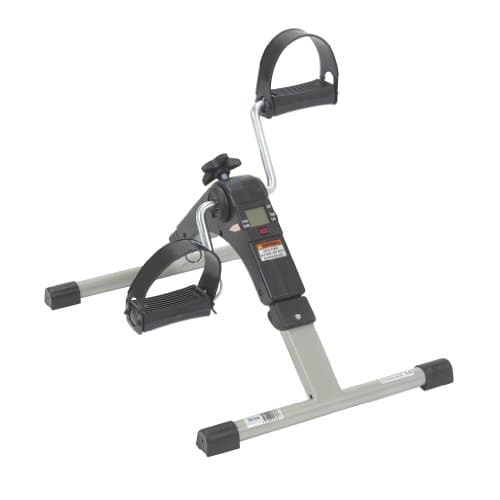
The medical-supply option: four anti-slip pads so it stays put on a hard floor, a tension knob rather than electronics, and it folds. Drive publishes two different sets of dimensions for it, which is the sort of thing we would rather tell you than tidy away.

What it gets right

  • Four anti-slip rubber pads, published — the most common complaint about cheap pedals is that they walk away across the floor
  • Folds for storage
  • Works for arms on a table as well as legs on the floor
  • Simple tension knob with nothing to fail electronically

What to know first

  • The listing gives 15.4 × 13 × 7.6 in in its dimension field and 15 × 6.5 × 17 in in its own description. We report both because we cannot resolve them
  • No published weight capacity
  • No published resistance range — just 'adjustable'
  • Not motorized

Fit-to-You: the nine measurements

Drive Medical does not publish 2 of 7 of these. Where that is the case, this panel says so rather than guessing. How we compile these

Pedal heightThe clearance under your desk or chair. Get this wrong and the pedals hit your knees.
Listing dimension field says 7.6 in high; the same listing's text says 17 in high. Both are published and they disagree

Source: Amazon product listing data (Creators API) · read 2026-07-24

Resistance rangeHow gently it can be set. The lowest setting matters far more than the highest.
Adjustable via a tension knob; no range published

Source: Amazon product listing data (Creators API) · read 2026-07-24

Weight capacitySearched directly, and two of the senior-focused competitors omit it entirely.
Not published by the manufacturer
Motorized or self-poweredWhether the machine moves your legs or you move it. For very low leg strength that is the whole decision.
Self-powered

Source: Amazon product listing data (Creators API) · read 2026-07-24

Display and controlsCharacter height and contrast. Presbyopia is close to universal past 60.
Five-function display: time, revolutions, rpm, calories, and scan

Source: Amazon product listing data (Creators API) · read 2026-07-24

FootprintWhether it actually fits the room you have in mind, with clearance to get on and off.
Reported as both 15.4 × 13 in and 15 × 6.5 in by the same listing

Source: Amazon product listing data (Creators API) · read 2026-07-24

Noise (dB)Apartments, shared walls, and a sleeping partner in the next room.
Not published by the manufacturer

We have not used this machine. Everything above comes from the manufacturer’s published documentation and the dated retailer listing, with the source given for each figure. Where they don’t publish a number, we say so. We can’t tell you how it feels to ride, how quiet it really is, or how it holds up after two years — and anyone who tells you otherwise without owning one is guessing.
9.We would skip this one

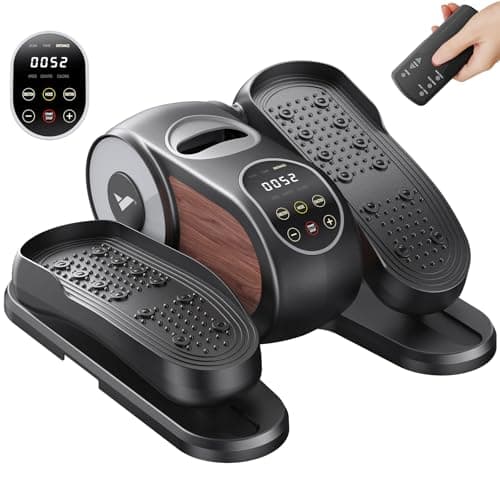
RECOVION Electric Pedal Exerciser with Remote Control AGL-JTC(AGL-JTC)

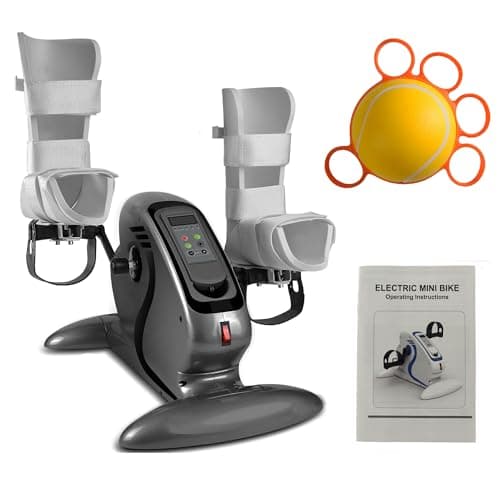
A competent-looking motorized unit at close to the top price on this page that publishes almost none of the things the price ought to buy. No leg supports, no straps, no assembly statement, no unit weight, no motor wattage. The MOMODA costs less and publishes a weighted base, pre-assembly and a removable leg support; the PHYCISER costs a little more and publishes three named modes and a safety pause.

Why we would skip it

Skip it. Not because anything on the listing is wrong, but because at this price it publishes the least of any motorized unit here that publishes anything at all — and in a category where the published detail is the only thing standing between you and a return, that is the whole decision. Two units on this page cost the same or less and tell you considerably more.

What it gets right

  • 10 speed levels plus auto modes, published
  • Remote control published for speed, direction and mode, so nothing needs reaching for
  • Published forward and reverse rotation
  • Published dimensions, which three units on this page do not manage

What to know first

  • No leg supports and no foot straps published — nothing holds the limb in place
  • No published assembly statement, so there is no way to know whether it arrives ready to use
  • No published unit weight and no motor wattage
  • No published user weight capacity
  • "Quiet motor" with no decibel figure
  • At 11 in tall and 19 in long it is bulkier than the MOMODA while publishing less about it

Fit-to-You: the nine measurements

RECOVION does not publish 2 of 7 of these. Where that is the case, this panel says so rather than guessing. How we compile these

Pedal heightThe clearance under your desk or chair. Get this wrong and the pedals hit your knees.
11 in overall height, not adjustable

Source: Amazon product listing data (Creators API) · read 2026-10-03

Resistance rangeHow gently it can be set. The lowest setting matters far more than the highest.
10 speed levels plus auto modes. No resistance figure published

Source: Amazon product listing data (Creators API) · read 2026-10-03

Weight capacitySearched directly, and two of the senior-focused competitors omit it entirely.
Not published by the manufacturer
Motorized or self-poweredWhether the machine moves your legs or you move it. For very low leg strength that is the whole decision.
Motorized, forward and reverse. No motor wattage, and the listing does not say whether a self-powered mode exists

Source: Amazon product listing data (Creators API) · read 2026-10-03

Display and controlsCharacter height and contrast. Presbyopia is close to universal past 60.
LCD display plus a remote for speed, direction and mode

Source: Amazon product listing data (Creators API) · read 2026-10-03

FootprintWhether it actually fits the room you have in mind, with clearance to get on and off.
19 in × 12 in × 11 in

Source: Amazon product listing data (Creators API) · read 2026-10-03

Noise (dB)Apartments, shared walls, and a sleeping partner in the next room.
Not published by the manufacturer

We have not used this machine. Everything above comes from the manufacturer’s published documentation and the dated retailer listing, with the source given for each figure. Where they don’t publish a number, we say so. We can’t tell you how it feels to ride, how quiet it really is, or how it holds up after two years — and anyone who tells you otherwise without owning one is guessing.

What we found looking for these numbers

We went looking for 63 measurements across the 9machines on this page — the nine that decide whether an older adult can get on, reach the controls, read the screen and hear themselves think. 21 of those 63 are not published by anybody. Not one manufacturer here publishes the full set.

Step-over height is the worst of them. It is the single measurement that decides whether you can get onto a machine at all, and across everything we checked, not one manufacturer states it. That is not an oversight in a category explicitly marketed to seniors, and the count in each panel above is there so you can see who is doing it.

Where a figure exists, we cite it and date it. Where it doesn’t, the panel says Not published by the manufacturer rather than an estimate dressed up as a fact. You can measure step-over height yourself in about a minute — and if a machine is already in your house, that is the fastest way to settle it.

The four questions, in the order they actually decide it

Work through these before you look at a single product. Three of the four are about the person, not the machine, and getting them in the wrong order is how people end up with a returned box in the hallway.

1. Can the cranks be turned at all, on a good day?If yes, buy a self-powered unit and keep the money. You will get more out of pedaling against light resistance than out of a motor doing it for you, and the self-powered units are simpler, cheaper and have nothing electrical to fail. If no — or if the answer is “sometimes, and not reliably” — a motor is not a luxury version of the same product. It is the only version that gets used.

2. What happens when a leg stops rotating? This is the question the category almost entirely ignores, and it is the one that matters most. A motor that keeps driving against a leg that has locked, cramped or gone into spasm is pushing a joint through a range it is actively resisting. Two units here publish an answer: the Exerpeutic states an overload protection that stops the cranks if the pedals cannot rotate freely, and the PHYCISER states an auto-pause that triggers on excessive resistance and resumes after five seconds. Seven publish nothing at all. If spasticity or contracture is part of the picture, that narrows this page to two products before you have looked at anything else.

3. Will the feet stay on?A foot that slides off a moving pedal is the second most common reason these units stop being used, and there are three different published answers to it — straps, calf supports, and nothing. The section below sorts them.

4. Can the controls be reached from the chair? If starting a session means somebody has to bend to the floor, somebody has to be there. A remote or a corded controller is the difference between equipment the user operates and equipment a caregiver operates.

Everything else — speed levels, display functions, forward and reverse — is secondary. Twenty speeds on a unit that nobody can start is twenty settings nobody will see.

Passive and active are not two settings. They are two purposes

The listings in this category use “passive” and “active” almost interchangeably with “auto” and “manual”, and the result is a genuinely confusing aisle. Here is the distinction that matters, in plain terms.

Passivemeans the motor supplies the force and your legs go along for the ride. You are not exercising in the ordinary sense — the work is the machine’s. What you get is joint movement and the circulation that comes with it, which for somebody who has been immobile for weeks is not a small thing.

Active means you supply the force, usually against adjustable resistance, and the motor is either off or merely assisting. That is exercise, and it is the mode that builds anything.

The practical consequence: a unit that only does passive movement will never get you stronger, and a unit that only does active pedaling is useless on the days you cannot start. Five units here publish both — the Exerpeutic (whose listing says it offers more resistance with the motor off), the PHYCISER, the MOMODA, the EasyVibe and the LUBBYGIM. If this is a recovery you expect to progress through, having both on the same machine is worth paying for.

And a warning about the labels themselves. The LUBBYGIMlisting calls its self-powered option “Passive mode” — the exact reverse of how the word is used in a clinic. We have reported both facts on its card rather than quietly translating them, because if a caregiver sets that unit to “passive” expecting the motor to do the work, they will get a machine that does nothing and conclude it is broken. Read what the mode does on every listing in this category; do not trust what it is called.

Whether passive cycling is the right thing for a particular condition is not a question this page can answer, and we are not going to pretend otherwise. It is a question for the physical therapist or doctor who knows the joint in question. What we can tell you is which machines do which thing, and what each maker will and will not put in writing. Our pedal-versus-elliptical comparison lays out the motorized-against-self-powered fork in a table if you want it side by side.

The thing no spec panel shows you: whether the feet stay on

There is no industry term for this, no number, and no field in any manufacturer’s spec table. There are only three published answers, and they are not equivalent.

Straps across the foot. The Exerpeutic publishes adjustable straps on large foldable pedals. This is the strongest of the three: the foot is held to the pedal rather than resting on it, which is what you need if the ankle has no reliable control. It is also the only strap claim on this page.

Calf or leg supports. The PHYCISER publishes high calf supports and the MOMODApublishes a removable leg support frame. These cradle the lower leg rather than the foot, which keeps the knee tracking and stops the leg falling sideways — useful for a hemiplegic side, and the reason both units look more like clinical equipment than like office gadgets. The MOMODA’s coming off is a genuine advantage: supports that cannot be removed are supports you are stuck with when the person improves.

Footplates and nothing else.The MOMODA also publishes extra-large non-slip footplates, and most of the rest of this page is in this category — the feet rest on a textured surface and stay there by friction. On a self-powered unit that is fine, because the foot only moves when you move it. On a motorized unit it means the pedal is going round whether the foot is on it or not.

Related and equally unglamorous: does the unit itself stay put? The MOMODA publishes a weighted base for grip on carpet and hardwood, the Drive Medical publishes four anti-slip rubber pads, and the EasyVibe publishes an adjustable non-slip base. Everything else here publishes nothing, and a motorized unit walking away from an armchair mid-session is worse than a self-powered one doing it — it keeps going.

Reaching the controls, and reading the screen

This is the quiet accessibility failure in the whole seated-cardio aisle. A unit whose only controls are a pair of buttons on a housing at ankle height is a unit that requires somebody to bend to the floor to start it, change it or stop it. For a wheelchair user, somebody with a fused spine, or anybody who cannot safely lean forward out of a chair, that is not an inconvenience — it is a dependency.

Five of the nine units here publish a remote: the PHYCISER (a long-range one), the MOMODA, the MERACH MR-E32, which also has a touchscreen, the LUBBYGIM and the RECOVION. The Exerpeutic does it differently and we think slightly worse: a hand-held speed controller on a published six-foot cord. The reach problem is solved, but there is now six feet of cable on the floor beside somebody whose balance is the reason they are sitting down. If the unit lives beside a recliner and never moves, that is manageable. If it crosses a walking route, it is a trip hazard and we would rather say so.

On readability, only the PHYCISER publishes anything about contrast — it calls its LCD high-contrast — and only the MOMODA publishes anything about size, calling its touchscreen extra-large. Everyone else publishes a function list (time, distance, speed, calories) and nothing about character height, contrast or backlighting, which is the usual state of affairs on this site and the reason the display row exists in every panel above. Presbyopia is close to universal past sixty; a floor-level display with small gray characters on a gray background is, functionally, no display.

The EasyVibeis the outlier: its listing describes no display and no remote at all. For a unit whose whole premise is use from a bed, that is a real gap — there is nothing to read and nothing to adjust from a distance.

Arms, wheelchairs, and the problem of a unit that slides on a table

A large share of the people searching for exercise pedals for disabled use are not shopping for legs at all. If you use a wheelchair, or the legs are not the part that will respond, the arms are the cardio system available to you — and the CDC’s own guidance for adults with disabilities names wheeling a wheelchair as an example of moderate-intensity aerobic activity, rather than treating upper-body work as a consolation prize.

Most units in this category advertise arm use, and most of them mean the same thing by it: lift the floor unit onto a table and pedal with your hands. Five here publish that explicitly — the Exerpeutic, the PHYCISER, the LUBBYGIM, the EasyVibe (with detachable hand grips, which is the better engineering answer) and the Drive Medical. It works, and it has one chronic flaw: arms push sideways in a way legs do not, and a 10 lb unit resting on a polished table travels. Chasing it with your hands is how arm sessions end.

That is why the KEAJVXTarm bike is on this page despite having no motor, no display and no leg function whatsoever. It clamps to the table — its listing publishes a range of 0.4 to 1.95 inches of tabletop thickness and a silicone pad to protect the surface, and it specifically contrasts itself with suction-cup units that move. It is the cheapest thing here and for an arms-only user it is the one we would try first. Check your table edge before you buy: a thick farmhouse top or a glass surface rules it out.

The EasyVibecovers the other end of this problem. It publishes use lying down, a base that tilts through five angles, and grips that swap for the pedals — so for somebody who cannot transfer out of bed, it is the only unit on this page that functions at all. We have ranked it fifth rather than higher because it publishes almost nothing else: no dimensions, no weight, no wattage, no model number. If the bed is the constraint, buy it anyway; just know that you are buying a promise rather than a spec sheet.

For the strength side of the week, which none of this equipment touches, seated resistance-band work and light dumbbell routines both work from a chair and cost a fraction of any machine here.

What we would not buy on this page, and what is not on it

The RECOVIONis our skip, and the reasoning is worth spelling out because nothing on its listing is wrong. It is a motorized unit with ten speeds, a remote, forward and reverse rotation and published dimensions, sitting near the top of this page’s price range. What it does not publish is everything this page ranks on: no leg supports, no straps, no statement about what happens when a leg stops rotating, no assembly statement, no unit weight, no motor wattage. The MOMODA costs less and publishes a weighted base, pre-assembly and a removable leg support. The PHYCISER costs a little more and publishes three named modes plus a safety pause. In a category where published detail is the only thing standing between a buyer and a return, paying more to be told less is the one decision we would argue against.

Four things we looked at and deliberately left off:

  • Two listings selling the same machine at very different prices. We found a pair of “rehab equipment for handicap disabled” motorized units from different sellers whose feature text is identical, line for line, down to the 33 cm leg-protector measurement — where one is priced at nearly twice the other. Both showed fewer than twenty-five units in stock. That is reseller churn on a white-label product, not a product line, and we will not point a reader at a listing that may not exist next month.
  • A dual-motor rehab trainer at roughly three times this page’s mid price.It publishes two independent 60 W motors, separate upper and lower body training, a height-adjustable frame and a hand brace for a hemiplegic side. If a therapist has specified independent arm and leg drive, it exists and it is from the same maker as our second pick — but it is a different class of purchase and we are not going to recommend it off a spec sheet.
  • Anything above that again.There are bedridden rehabilitation trainers on sale at several times the price of every unit here. They are clinical equipment, they are bought on a therapist’s advice, and a shortlist written from listings is the wrong place to evaluate them.
  • The self-powered pedal units from our other shortlists. The DeskCycle, the Cubii and the Sunny mini are all good products and none belongs on a page about not being able to turn the cranks. They are on the pedal exerciser shortlist and the under-desk elliptical shortlist where they make sense.

We have kept the Drive Medical folding unit on the page as the eighth pick for one reason: it is the honest answer to question one. It has no motor. If the cranks can be turned, it does the job of everything above it for a fraction of the money, it comes from a mobility-equipment maker rather than a fitness brand, it folds, it works for arms on a table, and it has nothing electrical to go wrong. Buying a motor you do not need is the most expensive mistake available on this page.

What this equipment is actually for, measured honestly

The CDC’s guidance for adults with chronic conditions and disabilities asks for the same 150 minutes a week of moderate-intensity aerobic activity it asks of everybody else, and then says the thing that matters most here: “Some physical activity is better than none — be as active as you are able.” Its companion page on physical activity for people with disability adds that the minutes can be broken into small amounts — around twenty-five minutes a day — rather than banked in long sessions.

Read against that, here is what these machines are and are not. Active pedaling against resistance, even at the lowest setting, is aerobic activity and counts toward those minutes to the extent that it raises your effort. Passive movement, with the motor doing the work, is not that. It keeps a joint traveling through its range and moves blood through a limb that is otherwise still, which has its own value, but it is not a deposit into a weekly activity target and we are not going to let a product page imply that it is.

Both CDC pages say to consult a healthcare professional or physical activity specialist — they name physical therapists specifically — about how a particular disability affects what is safe. That is not boilerplate on this page. A motorized unit applies force to a joint whether or not that joint should be receiving force today, and the person who knows the answer is the one who has examined it.

If you want the exercise side rather than the equipment side, our seated exercises for limited mobility and chair exercises for seniors guides need no machine at all, and how to use a pedal exerciser covers setup and session length once one arrives. If you are buying for somebody else and cannot measure their room, our guide to buying equipment for aging parents is written for exactly that problem. And here is precisely what we did and did not do to produce this ranking — we own none of these machines and the page says so wherever it matters.

General information, not medical advice. Tread & Tone is written by an enthusiast, not a clinician. Nobody here is a doctor, a physical therapist or a trainer, and nothing on this site has been medically reviewed. Talk to your doctor or physical therapist before starting something new, particularly after surgery, a fall, or a change in medication.

Questions people ask

What is the difference between a motorized and a self-powered pedal exerciser?

On a self-powered unit you turn the cranks and magnetic or friction resistance opposes you; the work is yours. On a motorized unit an electric motor turns the cranks whether you push or not. That is the whole decision on this page: if the cranks can be turned on a bad day, a self-powered unit gives you more exercise for less money, and if they cannot, a motor is the only thing that gets the limb moving. Four of the nine units here publish both modes on the same machine, which is worth paying for if you expect to progress.

Are these safe if a leg goes into spasm?

Only two of the nine publish an answer, which is the most important finding on this page. The Exerpeutic states an overload protection that stops the cranks if the pedals cannot rotate freely, and the PHYCISER states an auto-pause that triggers on excessive resistance and resumes after five seconds. Neither publishes the threshold at which it triggers. The other seven say nothing about it at all. If spasticity or contracture is part of the picture, ask the physical therapist before buying any motorized unit, and prefer one of the two that at least addresses it in writing.

Will my feet stay on the pedals?

There are three published answers and they are not equivalent. Straps hold the foot to the pedal, and only the Exerpeutic publishes them. Calf or leg supports cradle the lower leg instead, which the PHYCISER publishes as fixed high supports and the MOMODA publishes as a removable frame. Everything else offers a textured footplate and friction. On a self-powered unit friction is fine because the pedal only moves when you move it; on a motorized unit the pedal is going round regardless.

Can I use one of these from a wheelchair?

For arm work, yes, and a clamped unit is the better answer than a floor unit lifted onto a table — arms push sideways and an unsecured unit travels across the surface. The KEAJVXT clamps to tabletops between 0.4 and 1.95 inches thick, which is published, and costs less than everything else here. For leg work from a wheelchair, measure the clearance under your footplates and compare it to the published heights above, which run from 5 inches to 14.5 inches across the motorized units; no maker publishes a wheelchair-specific clearance figure, so the arithmetic is yours to do.

Does the motor do the exercise for me, or do I still get a workout?

In passive mode the motor does the work and you do not get a workout in the ordinary sense — you get joint movement and the circulation that comes with it, which for somebody who has been immobile is worth having on its own terms. In active mode you pedal against resistance and that is aerobic activity, counting toward the CDC's 150 minutes a week to the extent that it raises your effort. We will not blur those two claims together, because the listings in this category do and it is how people end up disappointed.

Which one comes fully assembled?

Three publish it outright: the MOMODA states 100% pre-assembled and ready out of the box, the PHYCISER states no assembly required, and the Drive Medical puts "fully assembled, no tools required" in its own product title. The LUBBYGIM says it is easy to install and takes a few minutes, which means it is not assembled. The remaining five publish nothing either way. If a box of parts is itself the barrier — and for somebody buying alone it very often is — restrict yourself to the three that commit to it in writing.

How much do these cost compared with a regular pedal exerciser?

Adding a motor is the single biggest price step in this category. On this page the cheapest motorized unit costs a little more than either self-powered one, and the motorized units that publish calf supports or a safety cutoff cost roughly three to four times what the folding self-powered unit does. The arms-only clamped unit is the cheapest thing here. We do not print prices in our text because they move — the live figure beside each buy button is read from the retailer and stamped with the date, and it expires rather than going stale.

Do any of them publish a user weight capacity?

Not one of the nine, which is a real gap on equipment marketed for rehabilitation. It matters less than on a bike you sit on — you are sitting in your own chair and the unit is taking pedaling force rather than your body weight — but on a motorized unit with a frame that cradles your calves, a stated limit would be useful. Nobody states one, so the panels above say so rather than estimating.

Is a motorized pedal unit better than a recumbent bike?

They answer different questions. A recumbent bike is far more exercise, supports your back for a longer session, and is the better buy if you have the room, the budget and the ability to get on and off it — our shortlist for seniors covers that. A motorized pedal unit is the right buy when getting onto a machine is impossible, when the cranks cannot be turned unaided, or when the equipment has to work from the chair or bed the person is already in. Neither is a compromised version of the other.

Sources

  • CDC — Chronic Conditions & Disabilities Activity — "Get at least 150 minutes (for example, 30 minutes 5 days a week) of moderate-intensity aerobic physical activity a week"; "Some physical activity is better than none — be as active as you are able"; and "If you have chronic health conditions or disabilities, consult a health care professional or physical activity specialist about appropriate types and amounts of physical activity" (read October 3, 2026)
  • CDC — Physical Activity for People with Disability — All adults, with or without disabilities, should get at least 150 minutes of aerobic physical activity a week, and the activity "can be broken down into smaller amounts, such as about 25 minutes a day every day"; consult a healthcare professional or physical activity specialist, for example a physical therapist, about how a disability affects what is safe (read October 3, 2026)
  • CDC — Older Adult Activity: An Overview — At least 150 minutes a week of moderate-intensity activity, 2 days of muscle strengthening, plus balance activities for adults 65 and over (read July 24, 2026)
  • Arthritis Foundation — 14 Ways to Work Out With Arthritis — Low-impact activity options for arthritic joints, including cycling and walking (read July 24, 2026)

Product measurements are cited individually inside each Fit-to-You panel, against the manufacturer page or dated retailer listing they were read from.

Read next