Search for an exercise bike from a wheelchair and you get recumbent bikes, because the marketing says “easy access”. The honest answer is that the hard part is not the pedaling, it is getting out of your chair and onto the seat — and there is a machine that skips that step entirely.
How this is funded: we earn a commission if you buy through our links, at no extra cost to you. It never changes what we recommend, and every page here names at least one thing we would not buy. Full disclosure.
The short answer
For most wheelchair users the right machine is not an exercise bike. It is a seated pedal exerciser on the floor in front of your chair, or an arm bike clamped to a table — because neither requires a transfer, and the transfer is the actual barrier. A recumbent bike is a reasonable choice only if you can already transfer onto a dining chair, with or without help.
This page exists because the search results for it are misleading. Type almost any version of “exercise bike for wheelchair users” into Google and you get recumbent bikes, because recumbent marketing leans hard on the words “easy access” and “step-through frame”. Both of those are true and neither is the question. A step-through frame means your leg does not have to clear a crossbar. It says nothing about whether you can get out of your chair, across a gap, and down onto a seat. That is the part that decides it, and almost nothing written about recumbent bikes addresses it at all.
So this guide is organized around the transfer rather than around the bike. If you can transfer, we will tell you honestly what a recumbent does and does not publish. If you cannot, or if you would rather not have to, there is a whole category of equipment that works from the chair you are already sitting in, and it costs a fraction of the price.
Start with the transfer, because everything follows from it
There is really one question and three answers, and it is worth being blunt about which one you are in.
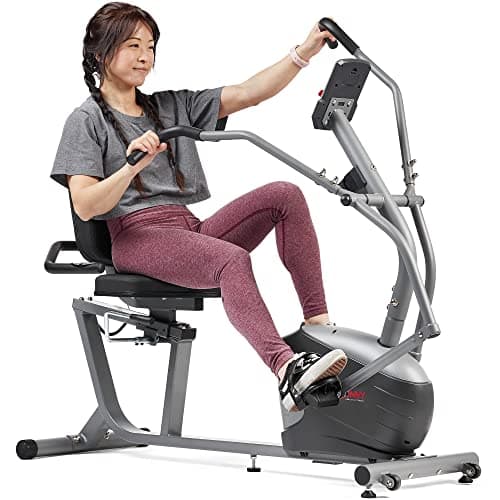
If you transfer independently— to a bed, a car seat, a dining chair — a recumbent exercise bike is genuinely on the table, and it is the best machine of the three for sustained aerobic work because it has proper resistance, a back rest and a seat you can be comfortable in for forty minutes. The thing to check is the geometry, covered in the next section.
If you transfer with assistance, a recumbent is possible but think carefully about the arithmetic. A transfer that needs another person present is a transfer that happens when that person is available, and exercise you can only do when somebody else is free is exercise that happens less. A pedal unit you can use alone, five times a week, will almost certainly produce more activity than a better machine you reach twice.
If you do not transfer, the answer is settled and it is not a compromise. A seated pedal exerciser or an arm bike is the right equipment, full stop. The CDC’s guidance for people with disabilities sets the same 150 minutes a week of aerobic activity as for everybody else and says explicitly that it “can be broken down into smaller amounts, such as about 25 minutes a day every day” — and a unit that is already in front of you is how 25 minutes a day actually happens.
The CDC also says, on activity with chronic conditions and disabilities, that “some physical activity is better than none” and to “be as active as you are able” — and to consult a health care professional or physical activity specialist, a physical therapist for instance, about appropriate types and amounts. If you have a therapist, that is a better source than this page for which of the three answers above is yours.
The two measurements that decide whether a pedal unit fits your chair
This is the practical heart of the page, and it is a tape-measure job rather than a research one. Nobody publishes compatibility with a wheelchair, so you work it out from two numbers.
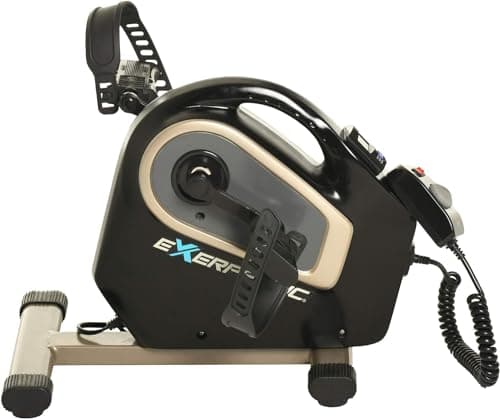
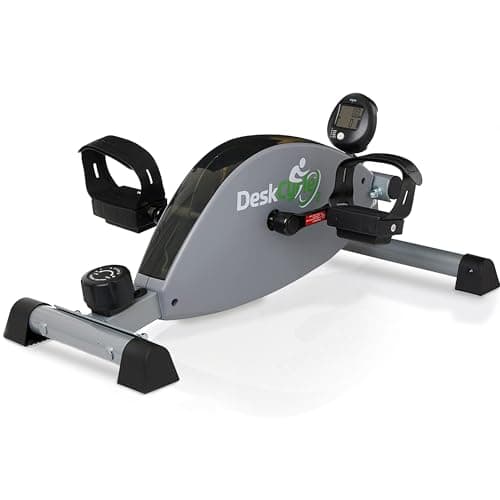
1. Your available floor-to-pedal height.Sit in your chair, with the footplates where they will be during a session, and measure the vertical space in front of you that a unit could occupy without fouling the plates or your feet. Then compare that against the unit’s published overall height. Across the seated units we track, those heights run from a published 5 inches on the LUBBYGIM electric mini bike to 14.5 inches on the Exerpeutic 2000M — a range wide enough that the difference between fitting and not fitting is a specification you can look up. If your footplates swing away or come off, measure both ways; if they are fixed, the low-profile units are your field.
2. Your seat height against the pedal height. This is the one people miss. If the pedals sit much higher than about a third of your seat height, your knees come up rather than traveling forward, which is both uncomfortable and a weaker position to push from. There is no universal figure here because wheelchair seat heights vary with the chair and the cushion, so measure your own from the floor to the top of the cushion and aim for a unit whose pedals sit comfortably below it.
And one thing to check that is not a measurement: your front castors. They swivel, and they need somewhere to be. A unit with a wide, flat base can leave you unable to get the chair close enough to reach the pedals properly. The fix is usually to approach the unit straight on rather than at an angle, and to place it against something solid so it cannot creep away. Our guide on how to use a pedal exerciser covers setup, including the wheel-lock habit that stops the two pieces of equipment pushing each other apart.
What the units actually publish
Four seated units on the two specifications that decide whether they work in front of a wheelchair. Blanks are the manufacturers', not ours.
Machine
Pedal height
Motorized or self-powered
Footprint
LUBBYGIM Electric Mini Exercise Bike, Arm and Leg Pedal Exerciser
5 in overall height, not adjustable — the lowest on this page
Motorized, forward and backward, with a manual-assisted option. The listing calls the self-powered option "Passive mode", which is the reverse of normal usage
15 in × 12 in × 5 in; 9.24 lb
MERACH Under Desk Elliptical MR-E32
7.4 in overall height, not adjustable
Motorized, 60 W, with forward and reverse
15.6 in × 14.9 in × 7.4 in
MOMODA Electric Pedal Exerciser with Leg Support MC51
9.8 in overall height, not adjustable
Motorized, 70 W, forward and reverse. Auto mode turns the pedals for you; Active mode is self-powered against resistance
15 in × 15 in × 9.8 in
Exerpeutic 2000M Motorized Under Desk Exercise Bike
14.5 in overall height, not adjustable
Motorized, with published overload protection that stops the cranks on excessive speed or when the legs cannot rotate freely; auto 15-minute session timer when powered
18.2 in × 21 in × 14.5 in
The useful pattern in that table is that the motorized units tend to be the lower-profile ones, which is convenient, because a motor is also the feature that matters most if starting the pedal stroke yourself is the difficulty. The LUBBYGIM’s published 5 inch height is the lowest we have found anywhere and it is also the cheapest way to get a motor. Its listing has a real problem we will not tidy away, though: it calls the self-powered option “Passive mode”, which is the exact reverse of the clinical meaning of the word, so do not rely on the mode labels to tell you what the machine is doing.
Straps are the other thing to look for and almost nobody publishes them. If your feet do not reliably stay on a pedal, the unit needs something to hold them: the Exerpeutic 2000M publishes adjustable foot straps, and the MOMODA MC51 publishes a removable leg support frame, which is the only unit in our registry stating that the supports detach. Everything else expects your feet to rest there and stay.
If you can transfer: what a recumbent bike does and does not tell you
For readers in the first group, here is the honest state of the information. A recumbent exercise bike is a better aerobic machine than any pedal unit — it has a back rest, numbered resistance that goes high enough to be a workout and low enough to be gentle, and a seat built for a long session. The Arthritis Foundation’s point about cycling — that continuous motion moves a joint through its range and produces the fluid that lubricates it — applies here, and it applies more strongly to a machine you will use for forty minutes than to one you use for ten.
What the category will not tell you is the number you most need: the step-over height. Not one recumbent bike in our registry publishes it, which is a remarkable gap in a category marketed on accessibility. Exactly one publishes a seat height — the Sunny SF-RB420032, at 20.9 to 22.4 inches, which is roughly dining-chair height and is the closest thing to a transfer-relevant figure anybody states. If you are assessing a transfer, that bike is the only one in the aisle giving you something to work with, and our guide to measuring step-over height yourself is the workaround for the rest.
Two practical notes if you go this way. Published inseam range decides whether the seat slides far enough for your legs — the HARISON HR-B51A publishes 26.5 to 38.9 inches, the lowest minimum we have found, which matters for a shorter rider. And a seat that adjusts while you are sitting on it is worth more than one extra resistance level: the same bike’s listing describes a sliding seat you can set one-handed without getting off. Our main recumbent shortlist ranks eleven bikes on these fields, and seated exercises for limited mobility covers what to do with no equipment at all while you decide.
One category we would steer you away from, to be useful rather than exhaustive: an upright exercise bike. The frame geometry puts a crossbar and a console mast exactly where your leg and your transferring arm need to be, the saddle is narrow and firm, and there is nothing behind your back. If a recumbent is marginal for your transfer, an upright is worse in every way that matters here — and a spin bike, which you mount by swinging a leg over a high frame, is worse again. We set out why in recumbent bike versus spin bike.
Making it count once the equipment is in place
Three things we would say to anybody setting this up, none of which cost anything.
Split the minutes.The CDC’s own framing is that 150 minutes a week can be about 25 minutes a day, and short sessions are both easier to tolerate and easier to defend against a bad day. Three eight-minute bouts is a legitimate way to get there.
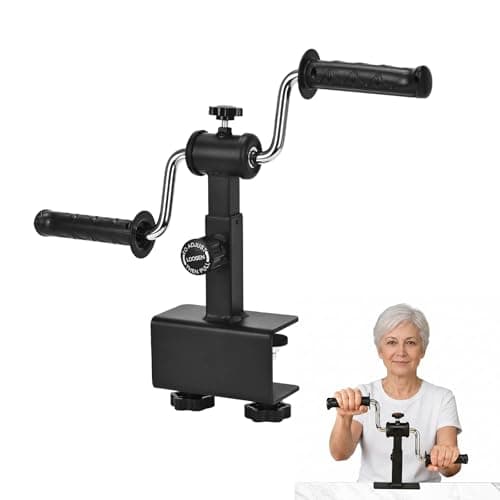
Use your arms too, if you can. Leg pedals and an arm unit do different jobs, and the arm unit is the one that gives you aerobic work you are producing yourself if your legs cannot. Our shortlist of arm exercisers ranks them on what holds the unit still, which turns out to be the specification that decides whether people keep using them.
Be honest with yourself about active versus passive. The National Institute on Aging says almost anyone at any age can do some type of physical activity even with a chronic condition — and the corollary is that it is worth knowing which kind you are doing. A motor turning your legs maintains movement and circulation. You pushing the pedals is exercise. Most motorized units do both, in different modes, and the mode you use should match what you or your therapist are trying to achieve.
General information, not medical advice. Tread & Tone is written by an enthusiast, not a clinician. Nobody here is a doctor, a physical therapist or a trainer, and nothing on this site has been medically reviewed. Talk to your doctor or physical therapist before starting something new, particularly after surgery, a fall, or a change in medication.
Questions people ask
Can a wheelchair user use a recumbent exercise bike?+
Sometimes, and it depends entirely on your transfers rather than on the bike. A recumbent has a step-through frame and a seat with a back, so if you can transfer onto a dining chair with or without help you can probably transfer onto one — the frame is in the way far less than an upright bike's is. What no recumbent in our registry publishes is a step-over height, and only one publishes a seat height at all (20.9 to 22.4 in). If you cannot transfer independently, the bike is not the machine; a pedal unit that works from the chair you are already in is.
What is the best exercise bike to use from a wheelchair?+
Strictly speaking, not a bike — a seated pedal exerciser placed on the floor in front of your chair, or an arm bike clamped to a table. These units cost a fraction of a recumbent bike, need no transfer, and the motorized ones will move your legs through the stroke if starting the motion yourself is the problem. The measurements that decide fit are the unit's overall height against your footplate clearance, and whether your chair's front castors leave room for it. Our shortlist of pedal exercisers for disabled adults ranks nine of them on exactly that.
How do I stop a pedal exerciser sliding away from my wheelchair?+
It is the single most common complaint about these units and there are three fixes. Buy one with a published weighted base or anti-slip pads rather than bare plastic feet. Put it against a wall or a heavy piece of furniture so it has nothing to slide into. And lock your chair's wheels before you start, every time, because the unit and the chair push each other apart — a chair that rolls backward is the usual cause of what looks like the pedals sliding forward. A unit with straps or a leg support also helps, because your feet staying put is half of the unit staying put.
Will my footplates get in the way of a pedal exerciser?+
Very possibly, which is why this is the measurement to take first. Measure the floor-to-pedal-top height you actually have available in front of your chair with the footplates where they will be, then compare it with the unit's published overall height — these run from a published 5 in at the lowest to 14.5 in at the tallest among the units we track. If your footplates swing away or detach, use that; if they do not, the low-profile units are the only ones that will work. A unit much taller than your seat height puts your knees up rather than forward, which is uncomfortable and inefficient.
Is an arm bike better than a leg pedal exerciser for a wheelchair user?+
It depends on which limbs you want to work and what you can do. If your legs have little or no voluntary movement, an arm unit on a table gives you genuine aerobic exercise you perform yourself, which is a different thing from a motor moving your legs for you. If your legs work but are weak, leg pedals do more for circulation and for keeping the joints moving. Plenty of people use both, and the arm units are the cheaper of the two. The thing to look for on an arm unit is whether it clamps to the table, because chasing a sliding unit around a tabletop is why most arm sessions stop.
Does a motorized pedal exerciser count as exercise?+
Partly, and it is worth being clear about the difference. A motor moving your legs through the stroke is passive movement — it keeps joints moving and assists circulation, but you are not producing the work, so it is not aerobic exercise in the sense the physical activity guidelines mean. Most motorized units also have an active mode with resistance, which is exercise. If a clinician has recommended passive movement, follow them. If your goal is the CDC's aerobic minutes, you need a mode where you are the one doing the pedaling.
How much exercise should a wheelchair user aim for?+
The CDC's guidance for adults with disabilities is the same target as for everyone else: at least 150 minutes a week of moderate-intensity aerobic activity, and it explicitly says that this can be broken into smaller amounts such as about 25 minutes a day. It also says that some physical activity is better than none and to be as active as you are able. The CDC's own advice is to consult a health care professional or a physical activity specialist, for example a physical therapist, about what is appropriate given your situation — which is the right way to use a page like this one.
Sources
CDC — Chronic Conditions & Disabilities Activity — "Get at least 150 minutes (for example, 30 minutes 5 days a week) of moderate-intensity aerobic physical activity a week"; "Some physical activity is better than none — be as active as you are able"; and "If you have chronic health conditions or disabilities, consult a health care professional or physical activity specialist about appropriate types and amounts of physical activity" (read October 3, 2026)
CDC — Physical Activity for People with Disability — All adults, with or without disabilities, should get at least 150 minutes of aerobic physical activity a week, and the activity "can be broken down into smaller amounts, such as about 25 minutes a day every day"; consult a healthcare professional or physical activity specialist, for example a physical therapist, about how a disability affects what is safe (read October 3, 2026)
National Institute on Aging — Exercising With Chronic Conditions — "Almost anyone, at any age, can do some type of physical activity, even with a chronic condition"; riding a bike is listed among the moderate-intensity activities that are safe for most people if built up slowly. For arthritis: low-impact activity, and "When done safely, being physically active with arthritis shouldn't make the disease or pain worse." For chronic pain: listen to your body and avoid overexercising on good days. For osteoporosis: weight-bearing exercise, plus muscle-strengthening and balance work (read October 5, 2026)
Every other pedal shortlist assumes you can turn the cranks. These nine are ranked on what happens when you can't — motor, straps, calf supports and a control you can reach.
Top pick: Exerpeutic 2000M Motorized Under Desk Exercise Bike
An arm bike that slides across the table is an arm bike nobody uses twice. Seven ranked on what holds the unit still, whether a motor turns the cranks, and whether one arm can work without the other.
Where to put it, how to stop it sliding, how to set the tension and how long to go for — the small setup details that decide whether a set of pedals becomes a daily habit or a closet ornament.