Tread & Tone

Treadmills and Walking Pads for Seniors

Walking is the activity most people actually want back. The equipment question is narrower than it looks: how high you step up, how slow the belt will go, and whether there is anything to hold.

By Stephen V.Last updated How we choose

How this is funded: we earn a commission if you buy through our links, at no extra cost to you. It never changes what we recommend, and every page here names at least one thing we would not buy. Full disclosure.

Almost nobody arrives here wanting to run. They want to walk, indoors, when the pavement is icy or the hill is too much or it gets dark at four o’clock. That is a much simpler machine than the treadmill industry is set up to sell.

Which means most of the specs on the box are irrelevant to you. Motor horsepower, top speed, incline percentage, program count — none of these decide whether a walking machine works for a 74-year-old. Three things do: how high you have to lift your foot to get on it, how slow the belt will go, and whether there is a rail to hold while you do.

Those are also the three that manufacturers are least consistent about publishing. Across the 6 machines below we looked for 60 measurements and 21are not published by anybody. Exactly one machine here states its floor-to-deck height as a number rather than describing itself as “low profile”.

Every page in this section

Treadmill or walking pad: the only question that matters

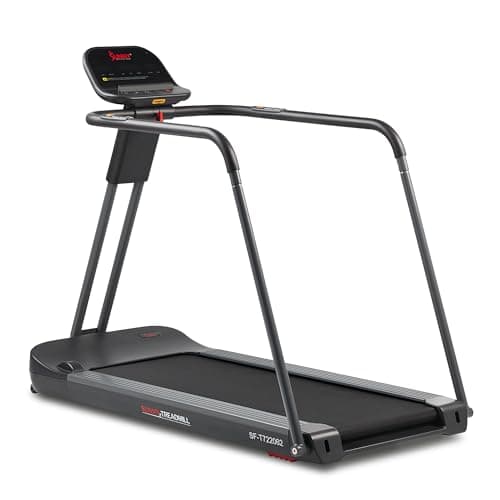
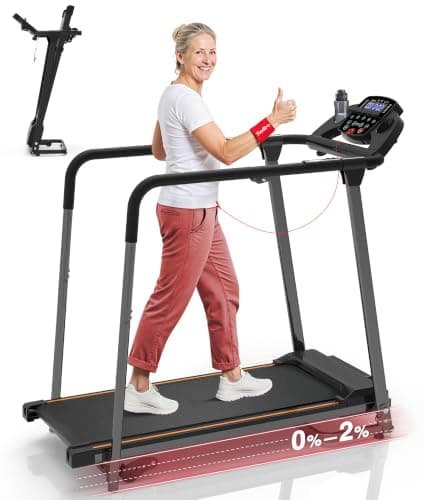
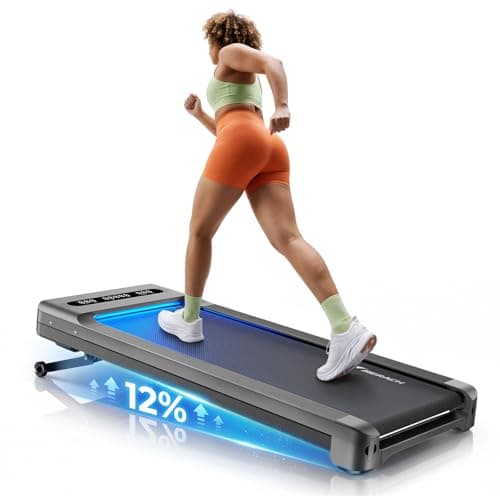
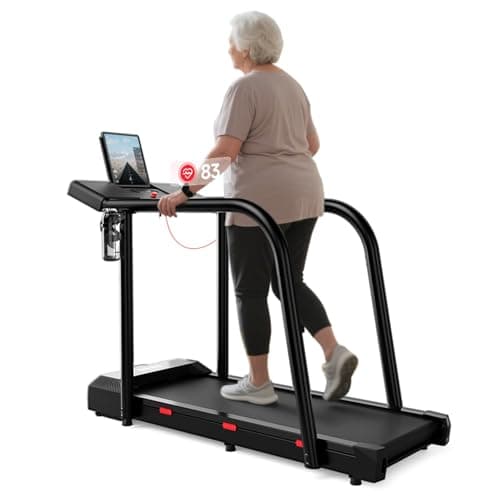
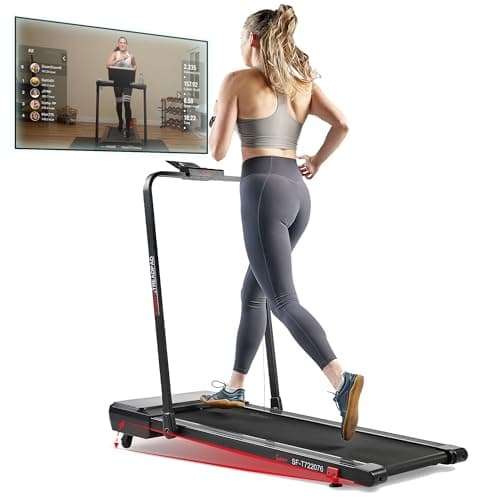
A treadmill has an upright frame with a console and handrails. A walking pad is a flat slab that sits on the floor, usually with nothing to hold. There are hybrids — pads with rails bolted on — and those are where most senior buyers should be looking.

If balance is any part of why you are shopping, buy the machine with rails. Not a single front bar you can reach if you lunge for it: rails that run the length of the deck so your hand is already on one when you need it. The CDC puts falls at more than one in four adults over 65 every year, and a fall on a moving belt is a worse fall than most.

If you are genuinely steady and what you want is something that disappears under the sofa, a flat pad is the better buy. The lowest step-up on this site is a flat pad at about 4.3 inches. But we mark one of those as a “skip” specifically for balance-impaired buyers, because a 4-inch step-up counts for nothing if there is nothing to steady yourself with.

The full comparison is here, with a decision table.

Step-up height: the number to ask about first

Every time you use a treadmill you lift a foot onto the deck. If the deck sits eight inches up, that is a step roughly the height of a stair riser, performed twice per session, often while the belt is stationary and your weight is on one leg. It is a small thing on paper and a real barrier in a hallway.

Sunny Health & Fitness publishes a floor-to-deck height of 4 inches for its extended-handrail treadmill. That is the only machine on this site that states the figure at all, and it is why that one leads the treadmill shortlist despite being the most expensive walking machine here.

For flat pads the step-up is effectively the overall thickness, so it can be read off the published height — about 4.3 inches on one Sunny pad, 5.2 inches on the Yesoul. We mark those as derived in the spec panels, with the reasoning shown, because the manufacturer did not label it that way and we are not going to pretend it did.

Minimum speed matters far more than maximum

A comfortable indoor walking pace for a lot of people past 70 is somewhere between 1.5 and 2.5 mph. A recovery or warm-up pace can be well under 1 mph. A machine whose slowest setting is 1 mph is therefore unusable for the first five minutes of every session, and completely unusable for someone recovering from surgery.

Published minimums on this site: 0.5 mph on the Redliro and both Sunny pads, 0.6 mph on the Yesoul. Two machines publish no minimum at all, including the most expensive one, which publishes only an 8.5 mph maximum — a number that tells a walking buyer precisely nothing.

Top speeds here run from 3.7 mph to 8.5 mph, and for this audience the lower number is arguably the better one. A machine that cannot go fast is a machine nobody in the household will hurt themselves on. How to work out your own pace is here.

Belt size, and the number that rules people out

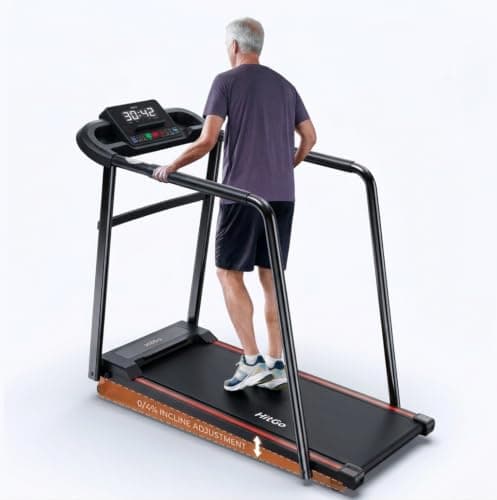
A short belt shortens your stride and puts the back edge closer than you think. Published belt sizes here: 43.3 by 15.5 inches on the HitGo, 41.1 by 16.1 on one Sunny pad, 39 by 14 on the other. Two machines publish a width but not a length, and two publish neither — on a walking pad, which is remarkable.

And then there is the specification most listings bury. Sunny publishes a minimumuser weight of 99 lb for its trekking-pole pad: the belt stops if you weigh less than that. For a frail or very small user — which describes a real portion of this audience — that machine simply will not run. It is published, it is findable, and no roundup we read mentioned it.

Maximum capacities here run from 245 lb to 300 lb, and the two Sunny pads sit at the bottom of that range. One machine publishes no capacity at all despite costing the most.

Where the controls are

This is the detail that separates a machine a nervous walker will use from one they won’t, and almost nobody writes about it.

The Redliro puts its speed buttons on the handrails, so you change pace without letting go. The Yesoul adds a one-tap emergency stop on top of the usual pull-cord safety key. Both Sunny pads ship with a remote so you are not bending to a console at floor level. The HitGo puts its console at eye level specifically so you do not have to look down.

Every one of those is a published, checkable design decision, and every one matters more than the motor.

Whatever you buy, the setup sequence matters too: our treadmill safety checklist covers the nine things to do before the first walk, most of which take under a minute.

General information, not medical advice. Tread & Tone is written by an enthusiast, not a clinician. Nobody here is a doctor, a physical therapist or a trainer, and nothing on this site has been medically reviewed. Talk to your doctor or physical therapist before starting something new, particularly after surgery, a fall, or a change in medication.

Questions people ask

Is walking on a treadmill as good as walking outside?

For the CDC's activity minutes, yes — brisk walking counts as moderate-intensity activity whether the ground moves or you do. What a treadmill removes is uneven ground, curbs, weather and traffic, which is either the whole point or a small loss depending on why you are indoors. What it does not replace is the balance challenge of uneven terrain, so if balance is a concern, add balance work rather than assuming the treadmill covers it.

How far should I be walking each day?

The CDC frames it in minutes rather than distance for adults 65 and over: at least 150 a week of moderate activity, which is about 22 minutes a day. Distance follows from your pace rather than the other way round, and chasing a step count often means chasing someone else's stride length. Start with ten minutes and build.

Do I need a handrail?

If balance is any part of why you are shopping, yes — and rails that run the length of the deck rather than a single bar at the front. If you are steady on your feet and just want indoor walking, a flat pad without rails is fine and steps up in about four inches. We flag one pad on this site as a skip specifically because it has nothing to hold.

Are walking pads quiet enough for an apartment?

Probably, but nobody here will tell you in decibels. Every machine on this page describes itself as quiet or whisper-quiet and not one publishes a figure, so we mark noise as unpublished on all of them. What is published: motor sizes from 1 hp to 2.5 hp, and multi-layer belts with shock absorbers, both of which point the right way without proving anything.

Can a walking pad go under a desk?

That is what most of them are designed for, and two of the pads here are about 4 to 5 inches tall. But be clear about what you are buying: an under-desk pad used at a desk has your hands on a desk rather than a rail, which is a different balance proposition from a treadmill with rails. For a senior buyer we would rather see rails and a chair nearby.

How much assembly is involved?

It varies more than in any other category here. Both Sunny pads are genuinely ready to use out of the box. The HitGo arrives 90% assembled and needs 12 bolts tightened. The full treadmills publish nothing about assembly at all, which for a 62-inch machine is an unhelpful silence.

Sources

Product measurements are cited individually inside each Fit-to-You panel, against the manufacturer page or dated retailer listing they were read from.