The short answer
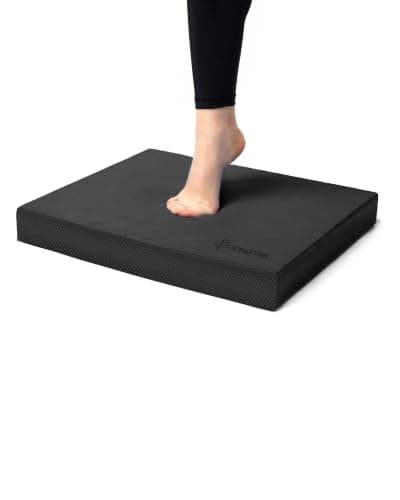
Buy the foam pad if you want the simplest, firmest start and room for two feet. Buy the inflatable cushion if you want to set the difficulty yourself and start almost easy — or if you will actually use it as a chair cushion, which is how most people accumulate daily practice. Both cost about $25, both are safe, and either is a better decision than continuing to think about it.
Published figures from the products on our balance shortlist.| What you care about | Foam balance pad | Inflatable wobble cushion |
|---|
| Height off the floor | 2.25 to 2.4 in, fixed | 2 to 3 in, and lower as you let air out |
|---|
| Difficulty | Set by the manufacturer. What you buy is what you get | Set by you, via the included pump |
|---|
| Standing area | 15.5 × 12.75 in, or 19 × 15.8 in for the wide one | 13.4 to 14 in diameter — a round surface |
|---|
| Room for two feet | Yes on the wide one, tight on the standard | Tight. A round 14 in disc is a narrow stance |
|---|
| Feel | Firm but compresses unevenly under your foot | Softer and springier; more like a ball at full inflation |
|---|
| Doubles as | A kneeling pad for gardening, a standing-desk mat | A chair cushion — which is how it gets daily use |
|---|
| Maintenance | None. Wipe it clean | Loses air slowly; needs occasional topping up |
|---|
| Material | High-density TPE foam, water-resistant | PVC |
|---|
| Price | About $22 to $37 | About $19 to $20 |
|---|
What each one actually does to you
A foam pad compresses unevenly under your foot. Shift your weight and the foam gives more on one side, so the small stabilizing muscles in your ankle and hip make constant micro-corrections. The instability is generated by the surface deforming.
An inflatable cushionis a bag of air. It rocks as well as compressing, which adds a tilting component the foam does not have — and how much depends entirely on how much air is in it. Half-inflated it is barely harder than foam. Fully inflated it is genuinely difficult.
Both are training the same thing: proprioception, the sense of where your joints are in space, which is one of the systems the National Institute on Aging identifies as involved in balance problems in older adults. The NIA lists balance as one of four exercise types older adults need.
The argument for the pad
Predictability, and it matters more for a beginner than adjustability does. A foam pad behaves the same way every time you step onto it. There is no setting to get wrong, nothing to check, and no possibility of finding it much harder than yesterday because someone pumped it up.
Room for two feet.This is the underrated one. A 19 by 15.8 inch pad takes a two-foot stance with margin at the edges, and that margin is the difference between a balance exercise and a stumble off the side. A round 14-inch disc does not, so almost everything you do on a cushion is a narrow or single-foot stance — which is a harder starting point than most people realize.
Nothing to maintain. Foam does not lose air, does not need a pump, and does not develop a slow leak two years in.
The argument for the cushion
It grows with you. Start with it half-inflated and it is gentler than a foam pad. Add air as your balance improves and it becomes harder than one. That means a single $19 purchase covers several weeks of progression, where a foam pad has one difficulty and then you buy the next thing.
It doubles as a chair cushion, and this is a bigger deal than it sounds. The binding constraint on balance training is not equipment, it is remembering to do it. A cushion that lives on your dining chair is in your life every day. A pad in the cupboard is not.
It is the cheapest thing on this site. About $19 with the pump included.
The trade-offs: PVC rather than foam, so it feels springier and less like a floor. It loses air slowly. And one of the two cushions on our shortlist used to claim a 1,000 lb weight limit, which we never treated as a usable figure — its listing has since dropped the number, which rather makes the point that an implausible figure was never one to plan around.
The rule that applies to both
Something solid within arm’s reach, every time. A kitchen counter, a heavy table, a doorframe. Not a dining chair that slides, and not a wall you would have to fall against to reach.
That is not a legal disclaimer, it is the method. Balance training works at the edge of your stability, and working at that edge is only sensible when the recovery is arranged in advance. It is also why where you put it matters as much as which one you buy: put it beside the counter you already stand at, not in the room you visit once a week.
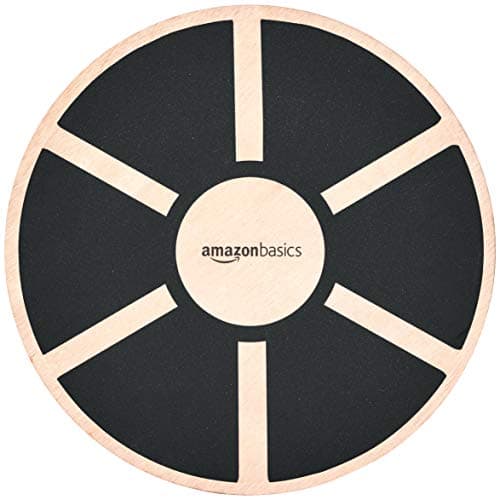
The exercises themselves — six from the National Institute on Aging, in order of difficulty, with a printable version — are on our routine page. And when either of these becomes easy, a rigid board is the next step — though the guide there is blunt about which heights are sensible past 65.
If your balance has changed recently
Buy neither, yet, and see a doctor. The National Institute on Aging lists inner-ear problems, vision changes, blood-pressure drops on standing, nerve damage in the feet and medication side effects among the causes of balance problems in older adults. Several of those are treatable and none of them is addressed by standing on foam.
The CDC also notes that fewer than half of people who fall mention it to their doctor. If you have had one, that conversation is worth more than anything on this page.