The short answer
Buy a treadmill if balance is any part of why you are shopping — you need rails that run the length of the deck, and a flat pad does not have them. Buy a walking pad if you are steady on your feet and the machine has to store under a sofa or arrive without assembly. A third option now exists: pads with rails built in, which is where most senior buyers should look.
The two machine types, on the specifications that differ. Figures are published per machine on the product pages.| What you care about | Walking pad | Treadmill |
|---|
| Step-up height | About 4.3 to 5.2 in (the pad's own thickness) | 4 in on the one machine that publishes it; unstated elsewhere |
|---|
| Handrails | None on a classic pad; some newer models add rails or a folding handlebar | Yes, and the good ones run the deck length |
|---|
| Belt size | 39 to 43 in long, 14 to 16 in wide where published | 18.9 in wide on the one machine publishing it |
|---|
| Speed range | 0.5 to 3.7 mph — a walking machine only | 0.5 to 8.5 mph depending on the machine |
|---|
| Weight capacity | 245 to 265 lb, and one has a 99 lb MINIMUM | 300 lb on the railed models |
|---|
| Assembly | None on two of them; 12 bolts on another | Not published on any full treadmill here |
|---|
| Storage | Under a sofa or flat against a wall | It stays where you put it |
|---|
| Price | $240 to $400 | $300 to $800 |
|---|
Question one: do you need something to hold?
This settles it for most people, and it deserves an honest answer rather than an optimistic one.
A classic walking pad has nothing to hold. It was designed for an office worker at a standing desk with their hands on a keyboard — not for someone whose balance is the reason they stopped walking outdoors. The CDC reports that more than one in four adults 65 and over falls each year, and a stumble on a moving belt with nothing within reach is a worse outcome than most.
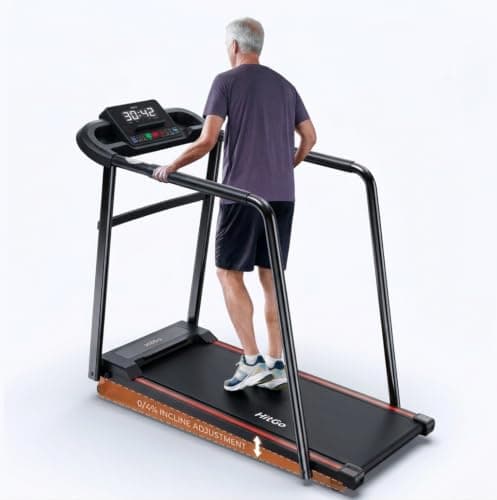
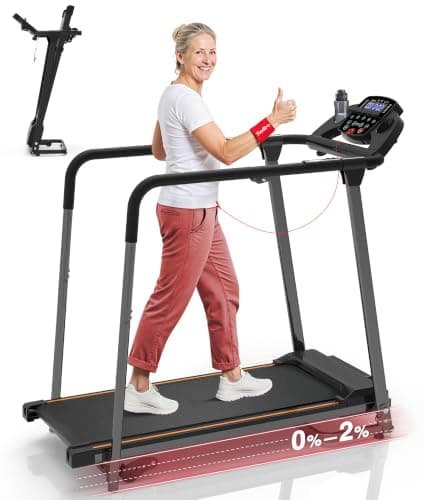
So: if balance is any part of why you are shopping, buy rails.Not a single bar across the front — that is eighteen inches ahead of you and behind your reach at the moment you would need it. Rails that run alongside the deck, so a hand is already resting on one.
The genuinely good news is that this is no longer a straight pad-or-treadmill choice. Three machines on our walking-pad page have rails or a folding handlebar built in, and one of them puts the speed controls on the rails so you never have to let go. That category barely existed a few years ago.
Question two: does it have to disappear?
If the answer is yes — a small apartment, a shared living room, a house where a treadmill would become a family argument — that is a real constraint and the pad wins on it decisively.
A flat pad is 4 to 5 inches thick. It goes under a sofa or against a wall, and two of them on this site need no assembly at all: out of the box, plug in, walk. For anyone who cannot face a box of parts, or has nobody to help, that is worth more than most specifications.
But note the trade-off honestly: rails cost you the storage benefit. The railed pads are 43 to 49 inches tall and do not slide under anything. If you need rails and you need it to disappear, those two requirements are in direct conflict and something has to give.
The step-up height, which is not what you would guess
The usual assumption is that pads are much lower. They are lower, but by less than people think, and one treadmill beats them.
Flat pads on this site work out at about 4.3 and 5.2 inches— derived from their published overall height, since on a flat slab the overall height and the deck height are the same measurement. We mark those as derived, with the arithmetic shown, because the manufacturers did not label them that way.
The Sunny extended-handrail treadmill publishes a 4-inchfloor-to-deck height as a stated accessibility feature, which is lower than both pads. It is also the only full treadmill on this site that publishes the figure at all — the others simply describe themselves as low-profile.
So if step-up height is your deciding constraint, the answer is not “buy a pad”. It is “buy the machine that publishes the number”.
Belt length, and stepping off the back
A short belt shortens your stride and puts the back edge nearer than you expect. On a pad, where there is often no rail to steady you, stepping off the back is the failure mode that matters most.
The HitGo publishes 43.3 by 15.5 inches and makes the point explicitly: about 7 inches longer than a standard pad, as a buffer zone. The Sunny pads publish 41.1 by 16.1 and 39 by 14 inches — that 39 by 14 is the narrowest surface on this site, which for anyone whose gait is not perfectly straight is worth knowing. One pad publishes no belt dimensions at all.
If you are tall, treat this as the deciding specification and not a footnote: our shortlist of walking pads for tall walkers ranks every published belt in the registry. And if the real question is whether a belt is the right category at all, our recumbent bike versus walking pad comparison covers the other way to answer it — a seated machine keeps the minutes and loses the weight-bearing benefit, which is a trade worth making deliberately.
The recommendation
- Balance is a concern: a railed machine, and preferably one with the controls on the rails. Ranked here.
- Steady on your feet, space is tight: a flat pad, used near a table or counter anyway. Ranked here.
- Both matter: a railed pad. It is taller than a flat pad and shorter than a treadmill, and it is the compromise most senior buyers should make.
- Under about 100 lb: check the minimum weight before anything else. One machine here will not run below 99 lb.
And whichever you buy, the CDC also asks for balance work and muscle strengthening alongside the 150 aerobic minutes. Walking on a flat moving belt removes the uneven ground that challenges balance, so add a balance pad rather than assuming the walking covers it.