Somewhere between 1.5 and 2.5 mph for most people, with the first five minutes slower. Which means the minimum speed a machine can do matters more than its maximum — and two machines we cover don't publish it.
Most people past 65 settle somewhere between 1.5 and 2.5 mph, with the first five minutes slower. Find yours with the talk test — fast enough to speak but not sing. Because you will always start slow, a machine’s minimum speed matters far more than its maximum: the pads we cover publish 0.5 or 0.6 mph, and two machines publish no minimum at all.
Find your number rather than using an average
Walking pace is individual. It depends on leg length, joint comfort, fitness and confidence, and the average for a demographic tells you very little about you specifically.
The method takes about three minutes and needs no equipment beyond the machine:
Start at the machine’s minimum, holding the rails with both hands. Walk for a minute. It will feel absurdly slow. That is correct.
Increase by 0.2 mph.Walk another minute. Say a sentence out loud — anything — and notice how easy it is.
Keep going up in 0.2 mph steps until you reach the point where you can speak in full sentences but could not comfortably sing a verse. That is moderate intensity.
Note the number. That is your working pace, and you can now set it directly each session instead of guessing.
For most people that lands between 1.5 and 2.5 mph. If it lands at 1.2, that is genuinely fine — the CDC’s definition of moderate intensity is relative to your own effort, not to a speed. And if it lands at 3.2, also fine.
The talk test, and why it beats a heart-rate number
Talk but not sing. That is the whole thing.
Two reasons it is better than a heart-rate target for this audience. It self-adjusts as your fitness improves, so you do not have to recalculate anything. And it is unaffected by medication — beta blockers in particular make heart-rate targets misleading, and a great many people past 65 are on something that affects heart rate.
It also requires no device, no chest strap and no app, which means you will actually use it.
Always start slower than your working pace
This is the part people skip, and it is why the minimum speed specification matters.
The first two or three minutes of any walk should be well below your working pace. Muscles are cold, joints have not started producing much lubricating fluid yet, and your gait has not settled onto a moving surface. Starting at your working pace is how a good session becomes a sore knee.
Then reverse it at the end: two or three minutes back down at the slow speed rather than stopping abruptly.
Which means, over a twenty-minute session, roughly a quarter of your time is spent at the bottom of the machine’s range. If the bottom of that range is 1 mph, a warm-up is not available to you.
What the machines actually publish
Published speed ranges on the machines we cover:
0.5 to 5 mph— Redliro treadmill. A genuinely walking-shaped range with a slow bottom end.
0.5 to 3.7 mph— both Sunny walking pads. Deliberately capped at walking, which for this audience is a feature.
0.6 to 3.8 mph— Yesoul. Marginally higher minimum.
Up to 8.5 mph, no minimum published— the Sunny extended-handrail treadmill. A running top speed and silence on the number that matters.
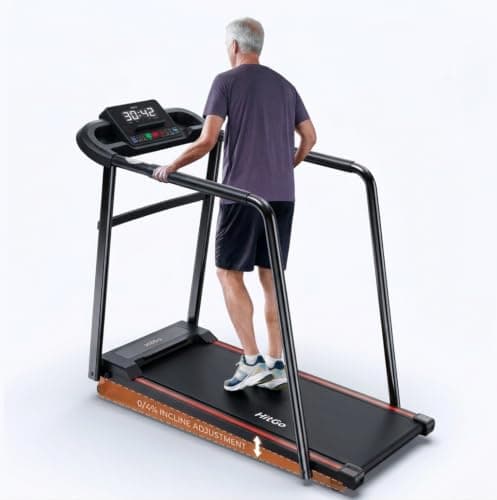
0.6 to 6.2 mph— HitGo. The same slow end as the Yesoul, on a stated 2.5 hp motor, with a running top speed a walking buyer will not use.
Half a mile an hour is slower than most people’s shuffle. It sounds pointless until you need it — for a warm-up, for a first walk after an illness, or on a physical therapist’s advice after surgery. If any of those apply, buy a machine that publishes it rather than one that publishes a top speed you will never use.
On incline
Leave it at zero for several weeks. Incline raises intensity without raising speed, which sounds like exactly what an older walker wants, and there is a catch: it changes your gait and shifts your weight forward onto the balls of your feet. If balance is any part of why you are walking indoors, that is the wrong direction.
The machines here publish modest inclines — 0 to 2% on the Redliro with a true 0% setting, 4% manual on the HitGo. Both are set before you start rather than adjustable mid-walk, which is fine.
Get comfortable at zero, reach the CDC’s weekly minutes at zero, and only then consider adding a percent or two. Duration first, then frequency, then intensity — and incline is intensity.
The three signs to slow down
You cannot speak in full sentences. Above moderate intensity, and not sustainable.
You are gripping the rail rather than resting a hand on it. That is your body telling you the pace is beyond your comfortable balance.
You are watching your feet. Looking down shifts your balance forward and means you have stopped feeling confident in your stride.
Slowing down is not failure. The pace you can repeat tomorrow is worth more than the pace you can survive today, and the whole point of an indoor machine is that it makes the walk happen regularly.
Before your first session, run through the nine-point safety checklist— particularly the three feet of clear floor behind the machine and the safety key clipped to your clothing.
General information, not medical advice. Tread & Tone is written by an enthusiast, not a clinician. Nobody here is a doctor, a physical therapist or a trainer, and nothing on this site has been medically reviewed. Talk to your doctor or physical therapist before starting something new, particularly after surgery, a fall, or a change in medication.
Questions people ask
What speed should a senior walk on a walking pad?+
Most people past 65 are comfortable somewhere between 1.5 and 2.5 mph, with the first five minutes slower than that. But the right number is yours rather than an average — use the talk test: fast enough that you can speak but not sing. Start at the machine's minimum, build up over a couple of minutes, and note the number that produces that breathing.
Is 2 mph a good walking speed for seniors?+
For many people, yes — it is a comfortable steady pace that will usually reach moderate intensity for someone who has not been walking regularly. But it is a starting reference rather than a target. If you can sing comfortably at 2 mph, go a little faster; if you cannot finish a sentence, go slower. Both are normal.
Why does the minimum speed matter more than the maximum?+
Because you will use it every session. The first few minutes of any walk should be slower than your working pace, and a recovery or post-surgical pace can be well under 1 mph. A machine whose slowest setting is 1 mph is therefore unusable for the warm-up and impossible for recovery walking. The 8.5 mph top speed on one machine we cover is capability you will never touch.
How slow do walking pads actually go?+
Published minimums on the machines we cover are 0.5 mph on three of them and 0.6 mph on one — genuinely slow, slower than most people's shuffle, which is exactly what you want available. Two machines publish no minimum at all, including the most expensive walking machine on this site.
Should I use the incline?+
Not at first, and possibly not at all. Incline raises intensity without raising speed, which sounds ideal, but it also changes your gait and shifts your balance forward — the opposite of what you want if balance is why you are indoors. Get comfortable at zero incline for several weeks first. Published inclines on our machines are modest: 0–2% and 4%, both manual.
How do I know if I'm going too fast?+
Three signs: you cannot speak in full sentences, you are gripping the handrail rather than resting a hand on it, or you are watching your feet instead of looking ahead. Any of those means slow down. The point is a sustainable pace you will repeat tomorrow, not the fastest one you can survive today.
Sources
CDC — Older Adult Activity: An Overview — At least 150 minutes a week of moderate-intensity activity, 2 days of muscle strengthening, plus balance activities for adults 65 and over (read July 24, 2026)