Treadmill Safety for Seniors: The Nine-Point Checklist
Run through this once when the machine arrives, and the first three items before every single walk. Most take under a minute. The one people skip is the safety key.
Before the first walk: three feet of clear floor behind the machine, the safety key clipped to your clothing, the emergency stop findable by feel, and handrails you can reach without leaning. Before every walk: safety key on, start at the slowest speed with both hands on the rails, and look ahead rather than down at your feet.
A treadmill is the only machine in this house that moves you against your will. That is not a reason to avoid one — it is a reason to spend five minutes setting it up properly, once, and then thirty seconds before each walk.
The context: the CDC reports that more than one in four adults aged 65 and over falls each year, and that falling once doubles the chance of falling again. A fall onto a moving belt is a worse fall than most, because the belt keeps going.
Once, when the machine arrives
1. Clear three feet behind it
This is the most important item and the one most often ignored, because it is about the room rather than the machine.
If you stumble on a treadmill, you go backwards. Three feet of clear floor is where you land. It must not be a wall, a bookcase, a radiator, a doorway or a piece of furniture. If your only available spot puts the back of the machine against something solid, that is not the spot — and no amount of care compensates for it.
This is also why a treadmill in a tight alcove is a bad idea even when the machine physically fits. The footprint is not the space requirement.
2. Find the emergency stop with your eyes closed
Stand on the stationary belt, close your eyes, and put your hand on the stop button. If you cannot find it, it is in the wrong place for you and you should know that now rather than during an emergency.
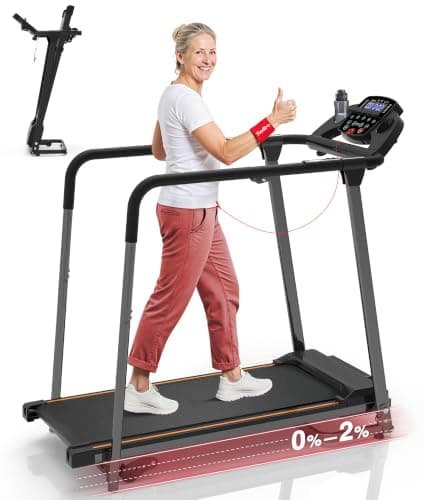
Some machines make this considerably easier than others. One on this site publishes a dedicated one-tap emergency stop in addition to the standard safety key, and another puts speed controls on the handrails so you can slow down without letting go. Those are published design decisions worth paying for.
3. Check the handrails in your actual walking position
Stand on the stationary belt as you would while walking. Let your arms hang naturally. Can you rest a hand on a rail without reaching, leaning, or changing your posture?
If not, the rails are too short or too far forward for you. That is a return rather than something to adapt to — a rail you have to reach for is a rail that is not there at the moment you need it.
4. Learn the slowest speed and where the button is
Set the machine to its minimum and note the number. That is your starting speed for every session forever, and knowing it means you never have to hunt for it.
Every time. Not on the console, not in a drawer, not clipped to the rail — on your clothing, at the waist, so that if you fall or drift backwards it pulls out and the belt stops.
This is the single most-skipped safety step in home treadmill use, and it is skipped because nothing bad has happened yet. It takes four seconds.
6. Start at the slowest speed, both hands on the rails
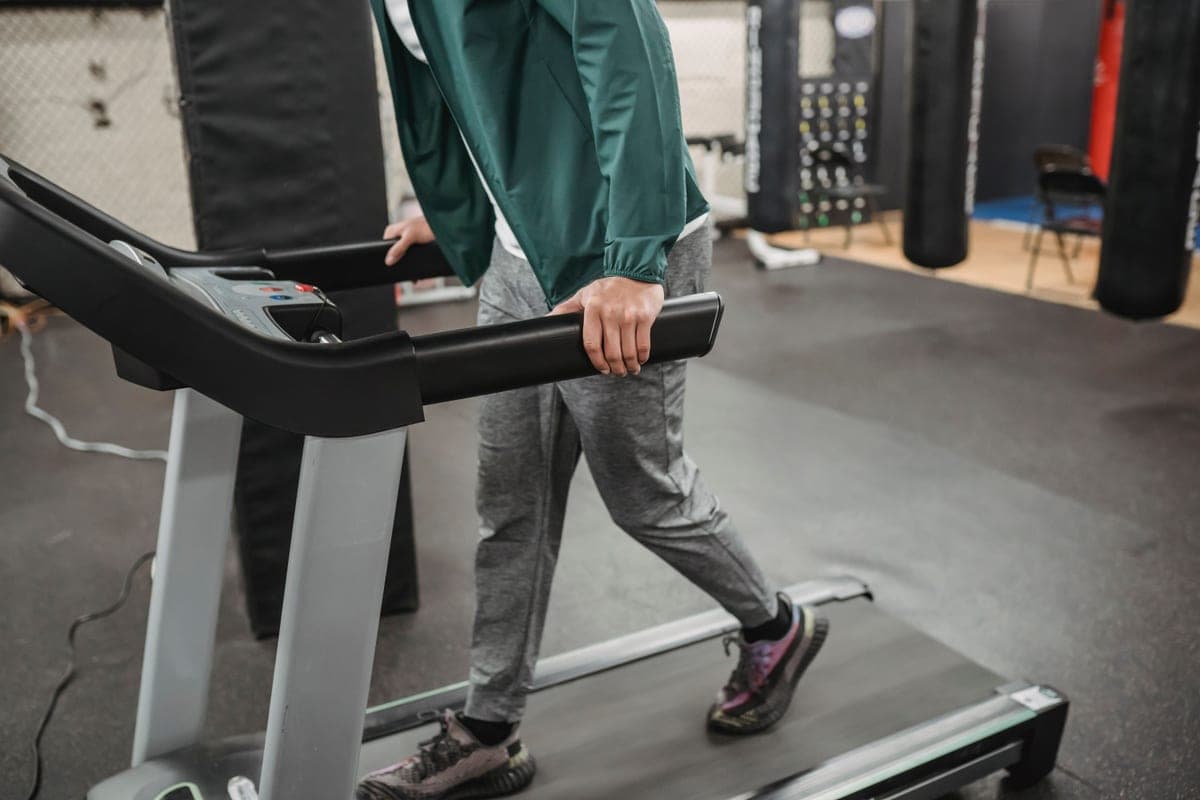
Get on with the belt stopped. Hold both rails. Start it at the minimum. Let your gait settle for thirty seconds or so, then build up to your walking pace.
Never start a belt at your walking speed and step onto it. Never step onto a moving belt at all.
7. Look ahead, not down
Watching your feet is the instinct and it works against you: it tips your head and shifts your balance forward, and it means you are not looking where you are going. Fix your eyes on something at eye level across the room.
This is a real argument for a console positioned at eye level. One machine on this site publishes exactly that, specifically so you do not have to look down to read your pace.
8. Shoes: flat, closed, laced
No socks, no slippers, no backless sandals. Laces tied and tucked in. Trainers are ideal; anything that stays firmly on your foot and grips the belt will do.
9. Tell somebody, or keep a phone within reach
If you live alone, let someone know you are walking, or keep a phone on the console. It costs nothing and it matters exactly once.
If falling when nobody is home is a general worry rather than a treadmill-specific one, fall-detection devicesare a separate category with their own trap — the monthly subscription that turns an $89 watch into roughly $389 in the first year.
Two things to stop and reconsider
If you feel unsteady on the belt even at the slowest speed, stop and speak to a physical therapist before continuing. That is not a setup problem, and a moving surface is the wrong place to be working out whether your balance is adequate. Parallel bars, or supervised walking practice, may be the right step first.
If you get dizzy, breathless beyond exertion, chest pain or pressure, or an irregular heartbeat, stop and contact your doctor. None of that is ordinary exercise discomfort.
The National Institute on Aging recommends talking with your doctor before starting a new exercise program, and that goes double for a machine that moves. Nobody producing this site is a clinician, and this checklist is about equipment setup rather than about whether walking on a belt is right for your body.
General information, not medical advice. Tread & Tone is written by an enthusiast, not a clinician. Nobody here is a doctor, a physical therapist or a trainer, and nothing on this site has been medically reviewed. Talk to your doctor or physical therapist before starting something new, particularly after surgery, a fall, or a change in medication.
Questions people ask
Are treadmills safe for seniors?+
They are, with three things in place: handrails running the length of the deck, the safety key clipped to your clothing every session, and three feet of clear floor behind the machine. Without those, a treadmill is a moving surface and the CDC reports that more than one in four adults over 65 falls each year. With them, it is a controlled way to walk indoors when outdoors is not sensible.
What is the safety key for?+
It is a cord that clips to your clothing at one end and plugs into the console at the other. If you fall, or drift toward the back of the belt, it pulls out and cuts the power immediately. It is the single most-skipped safety step in home treadmill use, and it is the difference between stumbling and being carried backwards off a moving belt.
How much space do I need behind a treadmill?+
At least three feet of clear floor. That space is not for convenience, it is where you end up if you stumble — so it must not be a wall, a bookcase, a doorway or a piece of furniture. This is the reason a treadmill in a tight alcove is a bad idea even when the machine physically fits.
Should I hold the handrails the whole time?+
At the start of every session, yes, and afterwards whenever you feel unsteady. Some people will tell you holding on reduces the workout, which is true and irrelevant here — the goal is walking regularly and safely, not maximizing calorie burn. If balance is why you are indoors, keep a hand on the rail throughout and consider it part of the design.
What shoes should I wear on a treadmill?+
Flat, closed, laced shoes with laces tied and tucked. No socks, no slippers, no loose sandals or backless shoes. Cushioned running shoes are fine but not necessary — what matters is that the shoe stays on your foot and grips the belt.
Can I use a treadmill if I use a cane or walker?+
That is a question for a physical therapist rather than a website, and it depends entirely on why you use it. If you need support to walk, a machine with full-length rails on both sides is the only sensible category, and parallel bars may be a better starting point than a moving belt at all. Do not start a treadmill without talking to someone who can watch you walk.
Sources
CDC — Facts About Falls — More than one in four adults 65 and over falls each year; falling once doubles the chance of falling again (read July 24, 2026)
CDC — Older Adult Activity: An Overview — At least 150 minutes a week of moderate-intensity activity, 2 days of muscle strengthening, plus balance activities for adults 65 and over (read July 24, 2026)
Product measurements are cited individually inside each Fit-to-You panel, against the manufacturer page or dated retailer listing they were read from.
Published minimum speeds range from 0.5 to 0.6 mph. Here is how to find yours, and why buying a machine that can't go slow enough is the common mistake.
A dry belt is the single most common cause of a treadmill that jerks, squeals or trips its motor. What to check, how often, and the mistake that ruins a deck.