Best Treadmill
Best Treadmills for Seniors
Step-up height, minimum speed and handrail length — the three numbers that decide it, and which machines publish them.
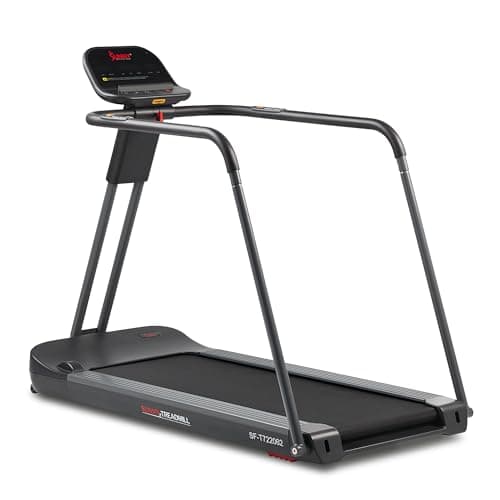
Top pick: Sunny Health & Fitness Treadmill with Extended Safety Handrails, Low Deck
Most home-treadmill trouble — a belt that jerks, squeals, slips or trips the motor — comes down to lubrication, tension and dust. Here’s a simple routine, and the one mistake that wrecks a deck.
How this is funded: we earn a commission if you buy through our links, at no extra cost to you. It never changes what we recommend, and every page here names at least one thing we would not buy. Full disclosure.
The short answer
Most home-treadmill problems trace to a dry belt, wrong tension or dust. Wipe it down often, lubricate on the schedule in your own manual (usually a 100% silicone lubricant), keep the belt centered and not over-tight, and vacuum under the deck — always with the machine unplugged at the wall.
A treadmill belt looks like it just needs to keep turning, so it is easy to assume there is nothing to maintain. There is, and neglecting it is behind most of the faults people blame on a “bad motor” — the jerking, the squeal, the belt that hesitates, the machine that shuts itself off partway through a walk. Almost none of that is the motor giving up. It is friction the motor should never have had to fight.
This is a mechanical guide, not a repair manual for your exact machine. Every treadmill is a little different, and the one document that is always right about yours is the manual that came with it. So the rule underneath everything here is simple: do what your own manual says, and treat the general advice below as the reason those instructions exist rather than a replacement for them.
One thing is true of every machine, on every step in this guide: unplug the treadmill at the wall before you touch anything. A belt that starts moving while your hand is near a roller is exactly the kind of accident maintenance is supposed to prevent. Pull the plug first, every time, even for a quick wipe.
Under the belt is a hard, flat surface called the deck. The belt slides across it thousands of times a walk, and between the two there is meant to be a thin, slippery film that lets the belt glide. That film is what wears away. As it thins, the belt drags on the deck instead of gliding, and drag turns into two things you do not want: heat and load.
The heat cooks the deck surface and the underside of the belt, which is what eventually leaves a deck too worn to rescue. The load lands on the motor, which now has to work harder to turn a belt that is fighting it. That is why a dry belt so often shows up as an electrical-sounding fault — the belt jerks and hesitates, the motor runs hot, and on many machines a safety cutout trips and shuts the treadmill off to protect itself. People read that as the electronics failing. Usually it is friction the whole way down.
Dust makes all of it worse. A treadmill is a fan that pulls carpet fiber, pet hair and grit in under the hood and into the deck, where it grinds against the belt and clogs the motor’s cooling. None of this is dramatic on any single day, which is exactly why it gets ignored until the machine is already laboring.
Belt maintenance sounds like a long list, but it comes down to three: lubrication, tension and tracking, and dust. Get those right and you have handled the large majority of what shortens a home treadmill’s life.
Lubrication restores that slippery film between belt and deck. The near-universal product is a 100% silicone treadmill lubricant, sold as a bottle or a squeeze tube, and on most machines it is applied to the deck under the belt rather than to the top of the belt. Beyond that, stop and read your manual, because the two details that matter most are the two we cannot honestly give you: how much and how often.
We are not going to invent a number here, and you should be wary of any site that does. The right interval depends on your belt’s construction and on how many hours a week it runs, and manufacturers publish their own schedule for exactly that reason. If you have lost the manual, find it on the maker’s website by model number — do not copy an interval from a different treadmill, because a figure that is right for one machine can be wrong for yours. When you do lubricate, unplug the machine, apply the amount the manual specifies, then walk on it slowly for a few minutes to spread the film evenly.
Two separate jobs live at the rear roller, and people mix them up. Tension is how tight the belt is. Tracking is whether it runs down the middle of the deck or wanders to one side. Most machines adjust both with the same hex key, on the two bolts at the back.
A belt that is too loose slips and hesitates under your foot even though the motor is turning normally. A belt that is too tightis the quieter mistake: it does not slip, so it feels fine, but it strains the motor and grinds the roller bearings, and it wears the machine out early. The target is the loosest tension that does not slip — and your manual gives the actual check for your model, sometimes as how far you should be able to lift the belt at the edge. Set it to the manual, not by feel.
For tracking, if the belt has drifted toward one side, you adjust it in smallincrements, one side at a time, checking after each. Unplug, make a small turn of the bolt the manual points you to, plug back in, run the belt briefly at a low speed to see where it settles, then unplug again before the next adjustment. Do not chase it with big turns — a belt that is over-corrected will simply wander to the other side, and you will be there all afternoon.
Every so often, with the machine unplugged, take the motor cover off if your manual says you safely can, and vacuum out the fluff that has collected around the motor and the front roller. Vacuum along both edges of the belt and, on many machines, underneath the deck as well. This is dull and it is the single easiest way to keep a treadmill from cooking itself — a clean machine runs cooler and the lubricant lasts longer. Keep the area around and under the treadmill clean too, because whatever is on the floor is what the machine breathes in.
The best maintenance schedule is the one you do, so keep it light and frequent rather than heavy and forgotten. Roughly:
Notice what is missing: exact days and exact milliliters. Those belong to your machine, not to a web page. The routine above is the shape; your manual fills in the numbers. If you set a phone reminder around the manual’s interval, you will be ahead of almost every home treadmill owner, most of whom lubricate for the first time only after the belt has already started to complain.
A worn deck is often the point where repairing a treadmill stops being worth it. Four avoidable mistakes cause most of them.
The wrong lubricant. Household oil, cooking spray, WD-40 and general-purpose sprays with solvents in them do not do what silicone does, and some actively attack the belt or leave a residue that attracts grit. Use the silicone product your manual names, or the one the manufacturer sells for your model. This is not a place to improvise with what is in the cupboard.
Over-lubricating.More is not better. Too much lubricant pools, throws off the edges, makes the belt slip, and collects dust into a paste. Apply the amount the manual specifies and no more — if the top of the belt feels oily to the touch, you have used too much.
Lubricating a belt that must not be lubricated.Some belts are treated at the factory and are sold as maintenance-free or pre-lubricated, and adding silicone to one of those can ruin it. This is precisely why “check your manual” is not a throwaway line: the first thing it tells you is whether your belt should be lubricated at all.
Working on it while it is plugged in.Every adjustment above — lubricating, tensioning, tracking, vacuuming — happens with the machine unplugged at the wall. The only moment the power goes back on is the brief, hands-off test run to see where the belt sits, and then it comes straight back out. A belt is under a lot of tension and the motor is strong; treat it with the respect you would give any powered machine.
Maintenance fixes friction problems. It does not fix electrical or bearing problems, and trying to lubricate your way out of one of those wastes time and can be dangerous. Some symptoms mean stop rather than adjust.
A burning smell, smoke, or sparks.Turn the machine off, unplug it, and do not use it again until it has been checked. That is not a dry belt — it points at the motor, the wiring or a control board, and it is a safety issue, not a maintenance one.
A cutout that keeps tripping. If the treadmill shuts itself off repeatedly even after you have lubricated it and confirmed the belt is centered and correctly tensioned, stop using it. The machine is protecting itself from something you have not fixed, and forcing it to keep going risks the motor.
Grinding, knocking, or a new noise from under the hood. Squeaks usually mean a dry or mis-tracked belt. Grinding and knocking usually mean a bearing or roller, and those are not a lubricant job. Unplug the machine and get it looked at.
In all of these, the right next call is the manufacturer’s support line or a treadmill technician — not a heavier squeeze of silicone. A machine you keep clean, lubricated on its own schedule, and correctly tensioned will rarely get here. And while you are thinking about the machine, it is worth a look at the treadmill safety checklist too, because a well-maintained belt and a safe setup are the same habit pointed at two different problems. If you want to see how these ideas look on a specific budget machine, our Sunny SF-T722062 review walks through one, and the treadmills-for-seniors shortlist weighs how easy each one is to keep running.
Follow the interval in your own machine's manual, because it varies by belt type and by how much you use it. Manufacturers set a schedule and then adjust it for heavy use, and there is no single number that is true across all machines. If you have lost the manual, look it up on the maker's website by model number rather than copying a figure from a different treadmill.
Almost always a 100% silicone treadmill lubricant, but check your manual first — a few belts are treated at the factory and must not be lubricated at all, and using the wrong product on them causes damage. Never use household oil, cooking spray, WD-40 or a general-purpose silicone spray with added solvents. When in doubt, buy the lubricant the manufacturer names or sells for your model.
The most common cause is friction from a dry belt: as the deck and belt lose their lubrication, the motor has to fight the drag, and the belt catches and lurches instead of running smoothly. A slipping drive belt or a belt that is too loose can do the same. Unplug the machine, check lubrication against your manual first, then tension. If it still hesitates, stop using it and contact the maker.
Unplug the machine first. Most treadmills have two adjustment bolts at the rear roller, one on each side, turned with the hex key that came with the machine. Your manual shows which way to turn and by how much — usually a small amount at a time. Adjust one side in tiny increments, plug in, run it briefly at low speed to see where the belt sits, unplug, and repeat until it stays centered.
Tight enough that it does not slip or hesitate under your foot when the motor is clearly running, and no tighter. An over-tight belt strains the motor and wears the rollers and bearings early. Your manual gives the specific check for your model — some describe how far you should be able to lift the belt at the center edge. Set it to the manual, not by feel, and always with the machine unplugged while you adjust.
A squeak or squeal is usually a dry belt or a tracking problem — the belt rubbing where it should not. Unplug the machine, check lubrication against your manual, then check that the belt is centered and running straight. If the noise is a grinding or a burning smell rather than a squeak, stop: that points at a bearing, roller or motor problem, and that is a job for the maker or a technician, not lubricant.
Best Treadmill
Step-up height, minimum speed and handrail length — the three numbers that decide it, and which machines publish them.
Top pick: Sunny Health & Fitness Treadmill with Extended Safety Handrails, Low Deck
Four inches from floor to deck, published as a number. The only treadmill here that tells you what it costs to step on.
Top pick: Sunny Health & Fitness Treadmill with Extended Safety Handrails, Low Deck
Nine things to set up before the first walk, in order. Most of them take under a minute and one of them is the safety key.
Read the guide