Tread & Tone

The Best Parallel Bars for Home Use

Four sets are live in this category. Exactly one publishes a weight capacity, two publish no measurements whatsoever, and the cheapest of the four is the one that tells you the most — which is the reverse of how this usually goes.

By Stephen V.Last updated How we choose

How this is funded: we earn a commission if you buy through our links, at no extra cost to you. It never changes what we recommend, and every page here names at least one thing we would not buy. Full disclosure.

The set we would buy is the yeezoo 6 ft bars, and the reason is almost uncomfortable: it is the cheapest of the four by a wide margin and it is the only one that publishes a weight capacity. 333 lb, stated in the listing, alongside four rail heights (43.5, 46.0, 48.5 and 51.0 inches), three widths (27.5, 32.0 and 36.5 inches) and six feet of rail on each side. The catch is real and you need to know it before you order: twelve expansion screws fix two base plates into your floor, which in a rental or over a finished floor is often the end of the conversation.

Here is the finding this page exists to report, and it is worse than the usual one on this site. Of the four sets of parallel bars we can buy today, three publish no weight capacity at all. This is equipment whose entire function is to accept a person’s body weight through their arms, bought largely by people who have fallen or are frightened of falling. Two of the four publish no rail height, no width between the rails, no rail length and no footprint either — nothing but the words “adjustable” and “heavy-duty”. And those two are the most expensive products in the category.

Rail height is what decides this purchase, and it is the figure most listings skip. You use parallel bars by pressing down through a near-straight arm, so the rail wants to sit roughly at your wrist when your arm hangs by your side. Too low and you are stooping, which is both useless and a fall risk of its own. Too high and you cannot get your weight over your hands at all. The two sets here that publish a height range barely overlap: the GRIPITHPY covers 31.5 to 43.3 inches and the yeezoo covers 43.5 to 51.0. One of those is for a seated-height transfer or a shorter user; the other is chest-high on the same person. They are not substitutes, and nothing on either listing tells you so.

One thing we will not do on this page, because we are not qualified to: tell you how to anchor anything into your floor. The yeezoo set ships expansion screws and pre-drilled plates and we report that it does, but joist positions, subfloor type and concrete fixings are a question for the published instructions and, if the bars are for rehabilitation, for the physical therapist who prescribed them. Live prices come from the daily refresh; we have not walked a set of these bars ourselves, and what we did instead is written down.

Quick picks

Ranked on the published accessibility measurements and on who each machine actually suits. Select a row to jump to the full write-up. The last column is the number of the nine measurements the manufacturer will not publish — we have not used any of these machines, and here is exactly what we did instead.

#MachineBest forSpecs withheldPrice
1
yeezoo 6 ft Adjustable Parallel Bars

yeezoo 6 ft Adjustable Parallel Bars

Practicing with support on both sides

Publishes the most, costs the least0of 6
$209.99 · Check price on Amazon

Price as of October 25, 2026. #ad How we’re funded

2
GRIPITHPY Adjustable Parallel Bars with Floor Platform

GRIPITHPY Adjustable Parallel Bars with Floor Platform

A low rail, with no drilling

The low rail, no drilling1of 6
$649.99 · Check price on Amazon

Price as of October 25, 2026. #ad How we’re funded

3
OQTUHWM Adjustable Parallel Bars with Non-Slip Base

OQTUHWM Adjustable Parallel Bars with Non-Slip Base

Changing the setting without tools

Adjusts without tools5of 6
$729.99 · Check price on Amazon

Price as of October 25, 2026. #ad How we’re funded

4
Leaceuv Adjustable Parallel Bars with Non-Slip Platform

Leaceuv Adjustable Parallel Bars with Non-Slip Platform

We would skip this one — see below

Skip: dearest, publishes nothing5of 6
$889.74 · Check price on Amazon

Price as of October 25, 2026. #ad How we’re funded

1.Publishes the most, costs the least

yeezoo 6 ft Adjustable Parallel Bars(YEEZOO)
yeezoo 6 ft Adjustable Parallel Bars
$209.99 · Check price on Amazon

Price as of October 25, 2026. #ad How we’re funded

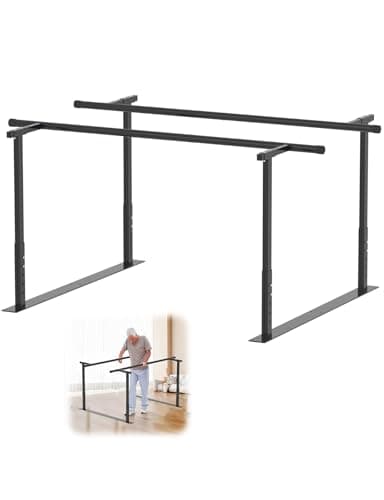
Six feet of rail on both sides, four heights and three widths, so it is the one product here that lets a genuinely unsteady walker practice with something solid in each hand. Two things most listings bury: it bolts into your floor through twelve holes, and the lowest rail setting is 43.5 in, which is chest-high on a shorter user.

What it gets right

  • Publishes a 333 lb capacity — the previous version of this product published none
  • Four heights (43.5, 46.0, 48.5, 51.0 in) and three widths (27.5, 32.0, 36.5 in)
  • 6 ft of rail length, which is enough for several steps rather than one
  • Support on both sides — the only product on this page that offers that
  • Anchoring hardware and tools included, and the design is honest about needing them

What to know first

  • The lowest rail is 43.5 in from the floor. Measure from your floor to your wrist with your arm hanging before you buy — for a shorter user this may simply be too tall
  • Twelve expansion screws fix two base plates into the floor. In a rental, or over a finished floor, that is often a deal-breaker
  • The largest footprint of anything on this page: 6 ft long and up to 36.5 in wide
  • Assembly is required, and at 60 lb it is not a one-person lift into position

Fit-to-You: the nine measurements

yeezoo publishes every measurement on this list. That is unusual enough to be worth saying. How we compile these

Rail height rangeThe difference between a treadmill a nervous walker will use and one they won't.
43.5 in, 46.0 in, 48.5 in and 51.0 in — four fixed positions

Source: Amazon product listing data (Creators API) · read 2026-09-15

Rail width rangeWhether there is room for two feet, or only one.
27.5 in, 32.0 in and 36.5 in — three fixed positions

Source: Amazon product listing data (Creators API) · read 2026-09-15

Rail lengthA short belt means a shortened stride and a real risk of stepping off the back.
6 ft, stated in the listing title and sold as a 6FT length variant

Source: Amazon product listing data (Creators API) · read 2026-09-15

Weight capacitySearched directly, and two of the senior-focused competitors omit it entirely.
333 lb, stated in the listing

Source: Amazon product listing data (Creators API) · read 2026-09-15

InstallationBox weight and how many people it needs. A 130 lb box is a real barrier, not a footnote.
Twelve pre-drilled holes and expansion screws fix two 5 mm base plates to the floor. Industrial-grade steel with reinforced joints, rust-resistant powder coating, tools included. Amazon's unlabeled item-weight field reads 60 lb

Source: Amazon product listing data (Creators API) · read 2026-09-15

FootprintWhether it actually fits the room you have in mind, with clearance to get on and off.
6 ft long, 27.5 to 36.5 in wide and 43.5 to 51.0 in high depending on which settings you use

Source: Amazon product listing data (Creators API) · read 2026-09-15

We have not used this machine. Everything above comes from the manufacturer’s published documentation and the dated retailer listing, with the source given for each figure. Where they don’t publish a number, we say so. We can’t tell you how it feels to ride, how quiet it really is, or how it holds up after two years — and anyone who tells you otherwise without owning one is guessing.
2.The low rail, no drilling

GRIPITHPY Adjustable Parallel Bars with Floor Platform(2066123)

GRIPITHPY Adjustable Parallel Bars with Floor Platform
$649.99 · Check price on Amazon

Price as of October 25, 2026. #ad How we’re funded

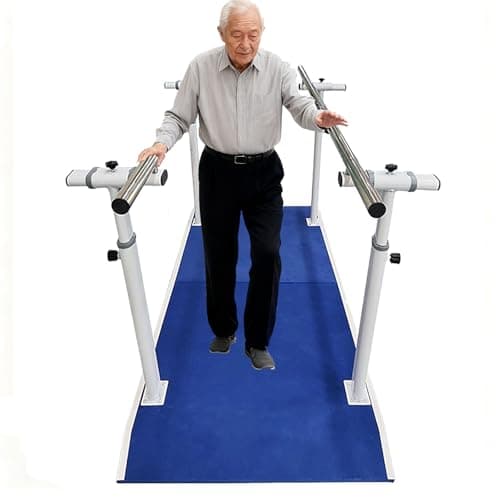
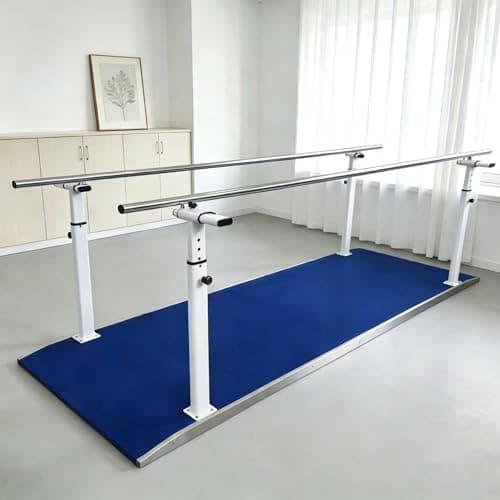
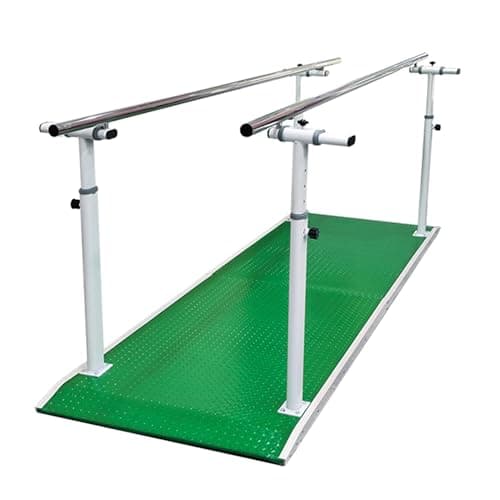
The low-rail option, and the only one here you do not drill into your floor. GRIPITHPY publishes a 31.5 to 43.3 in rail height — the bottom of that range is about 12 inches lower than anything else live in this category — and the bars stand on their own integrated platform, which is what makes them usable in a rental. It will not tell you what it holds, which on a product you lean your whole weight into is the omission that matters most.

What it gets right

  • Publishes a 31.5 to 43.3 in rail height range — the lowest rail live in this category by about 12 in
  • Publishes a 15 to 23.5 in width between the rails, narrow enough to reach both without shrugging
  • Stands on its own integrated textured platform, so nothing is fixed into your floor
  • Publishes a 78.7 in (2 m) rail length and a 79 x 35.4 in footprint
  • Stainless steel handrails, and assembly stated to need no complex tools

What to know first

  • NO published weight capacity at all — on equipment whose entire job is to take your weight
  • The 43.3 in top setting is lower than the yeezoo's LOWEST, so a tall user is out of range
  • The platform that removes the drilling is also something you have to step up onto
  • Roughly three times the price of the yeezoo set, which publishes more

Fit-to-You: the nine measurements

GRIPITHPY does not publish 1 of 6 of these. Where that is the case, this panel says so rather than guessing. How we compile these

Rail height rangeThe difference between a treadmill a nervous walker will use and one they won't.
31.5 in to 43.3 in, published as a continuous adjustment rather than fixed positions

Source: Amazon product listing data (Creators API) · read 2026-10-24

Rail width rangeWhether there is room for two feet, or only one.
15 in to 23.5 in between the rails

Source: Amazon product listing data (Creators API) · read 2026-10-24

Rail lengthA short belt means a shortened stride and a real risk of stepping off the back.
78.7 in (2 m), stated in the listing title and repeated as 79 in in the bullets

Source: Amazon product listing data (Creators API) · read 2026-10-24

Weight capacitySearched directly, and two of the senior-focused competitors omit it entirely.
Not published by the manufacturer
InstallationBox weight and how many people it needs. A 130 lb box is a real barrier, not a footnote.
Stands on an integrated textured leather-and-carpet floor platform — no floor anchoring published or required. Stainless steel handrails on a stated stable base; assembly stated to be simple and to need no complex tools

Source: Amazon product listing data (Creators API) · read 2026-10-24

FootprintWhether it actually fits the room you have in mind, with clearance to get on and off.
79 in long x 35.4 in wide, with the rails set between 31.5 and 43.3 in high

Source: Amazon product listing data (Creators API) · read 2026-10-24

We have not used this machine. Everything above comes from the manufacturer’s published documentation and the dated retailer listing, with the source given for each figure. Where they don’t publish a number, we say so. We can’t tell you how it feels to ride, how quiet it really is, or how it holds up after two years — and anyone who tells you otherwise without owning one is guessing.
3.Adjusts without tools

OQTUHWM Adjustable Parallel Bars with Non-Slip Base(OQTUHWM)

OQTUHWM Adjustable Parallel Bars with Non-Slip Base
$729.99 · Check price on Amazon

Price as of October 25, 2026. #ad How we’re funded

The one mechanical idea here that nobody else publishes is a one-pull telescopic adjustment with tool-free assembly, which for a household that will actually change the setting between two people is worth something real. Everything else is adjectives. It publishes no rail height, no width, no length and no capacity — four blanks on a four-figure question — which is why it sits below two cheaper sets that answer them.

What it gets right

  • Publishes a one-pull telescopic height and width adjustment with tool-free assembly
  • Integrated non-slip foot pads, so nothing is fixed into the floor
  • Heavy-duty steel tube construction, stated

What to know first

  • Publishes NO rail height range, so you cannot tell whether it fits you before it arrives
  • Publishes no width between the rails and no rail length either
  • Claims a high weight capacity without stating a number
  • Dearer than the yeezoo set, which publishes all four of those figures

Fit-to-You: the nine measurements

OQTUHWM does not publish 5 of 6 of these. Where that is the case, this panel says so rather than guessing. How we compile these

Rail height rangeThe difference between a treadmill a nervous walker will use and one they won't.
Not published by the manufacturer
Rail width rangeWhether there is room for two feet, or only one.
Not published by the manufacturer
Rail lengthA short belt means a shortened stride and a real risk of stepping off the back.
Not published by the manufacturer
Weight capacitySearched directly, and two of the senior-focused competitors omit it entirely.
Not published by the manufacturer
InstallationBox weight and how many people it needs. A 130 lb box is a real barrier, not a footnote.
Tool-free assembly stated, with a one-pull telescopic mechanism for height and width. Integrated non-slip foot pads rather than floor anchoring; heavy-duty steel tubes stated

Source: Amazon product listing data (Creators API) · read 2026-10-24

FootprintWhether it actually fits the room you have in mind, with clearance to get on and off.
Not published by the manufacturer

We have not used this machine. Everything above comes from the manufacturer’s published documentation and the dated retailer listing, with the source given for each figure. Where they don’t publish a number, we say so. We can’t tell you how it feels to ride, how quiet it really is, or how it holds up after two years — and anyone who tells you otherwise without owning one is guessing.
4.We would skip this one

Leaceuv Adjustable Parallel Bars with Non-Slip Platform(88656792589)

Leaceuv Adjustable Parallel Bars with Non-Slip Platform
$889.74 · Check price on Amazon

Price as of October 25, 2026. #ad How we’re funded

The most expensive parallel bars live in this category and the least documented. The listing describes a sturdy non-slip platform and heavy-duty steel and then stops — no rail height, no width, no length, no capacity. Those are the only questions this product has to answer.

Why we would skip it

Skip this one, and the reason is the price tag rather than the product. It is the most expensive set live in this category and it publishes not one number: no rail height range, no width between the rails, no rail length, no weight capacity, no footprint. We have no basis on which to tell you it fits you, and at four times the price of a set that publishes all five we are not going to guess on your behalf. If its listing adds the figures, we will re-rank it.

What it gets right

  • Publishes a sturdy non-slip standing platform rather than floor anchoring
  • Heavy-duty steel construction, stated
  • Rails are stated to be adjustable in both height and width

What to know first

  • Publishes NO rail height range — the one figure that decides whether it fits you
  • No published width between the rails, no rail length and no footprint
  • No published weight capacity, on a product you lean your weight into
  • The highest price in the category, paired with the least published detail in it

Fit-to-You: the nine measurements

Leaceuv does not publish 5 of 6 of these. Where that is the case, this panel says so rather than guessing. How we compile these

Rail height rangeThe difference between a treadmill a nervous walker will use and one they won't.
Not published by the manufacturer
Rail width rangeWhether there is room for two feet, or only one.
Not published by the manufacturer
Rail lengthA short belt means a shortened stride and a real risk of stepping off the back.
Not published by the manufacturer
Weight capacitySearched directly, and two of the senior-focused competitors omit it entirely.
Not published by the manufacturer
InstallationBox weight and how many people it needs. A 130 lb box is a real barrier, not a footnote.
Stands on a stated sturdy non-slip platform rather than being anchored to the floor. Heavy-duty steel construction stated; no assembly detail, tools or hardware published

Source: Amazon product listing data (Creators API) · read 2026-10-24

FootprintWhether it actually fits the room you have in mind, with clearance to get on and off.
Not published by the manufacturer

We have not used this machine. Everything above comes from the manufacturer’s published documentation and the dated retailer listing, with the source given for each figure. Where they don’t publish a number, we say so. We can’t tell you how it feels to ride, how quiet it really is, or how it holds up after two years — and anyone who tells you otherwise without owning one is guessing.
What we found looking for these numbers

We went looking for 24 measurements across the 4machines on this page — the nine that decide whether an older adult can get on, reach the controls, read the screen and hear themselves think. 11 of those 24 are not published by anybody. 1 of these machines publishes the full set.

Step-over height is the worst of them. It is the single measurement that decides whether you can get onto a machine at all, and across everything we checked, not one manufacturer states it. That is not an oversight in a category explicitly marketed to seniors, and the count in each panel above is there so you can see who is doing it.

Where a figure exists, we cite it and date it. Where it doesn’t, the panel says Not published by the manufacturer rather than an estimate dressed up as a fact. You can measure step-over height yourself in about a minute — and if a machine is already in your house, that is the fastest way to settle it.

Measure your wrist height before you read anything else

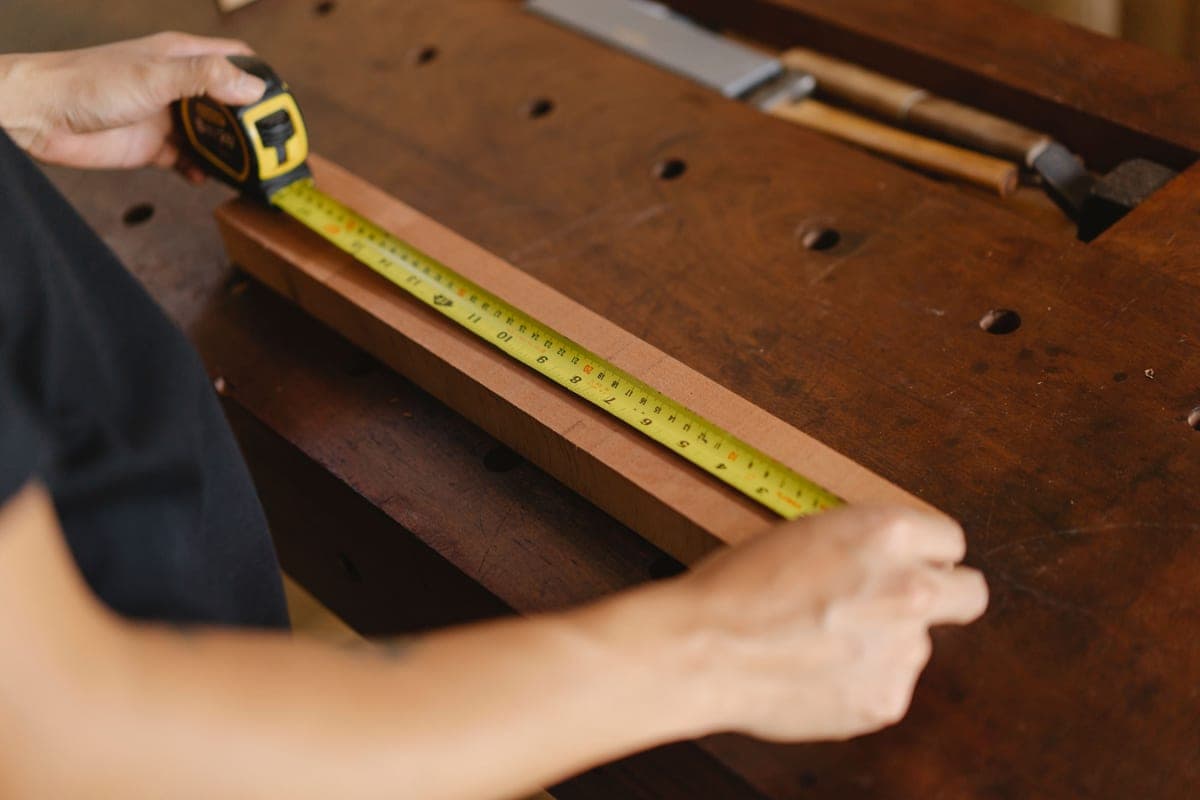
This takes a minute and it eliminates half the category for you, which is why it goes before the picks rather than after them.

Stand as you normally stand, let both arms hang, and have somebody measure from the floor to the crease of your wrist. That number is the rail height you want, give or take an inch or two. It is the height at which you can put weight through a straight arm and actually unload your legs, which is the entire point of the equipment. If you will use the bars mostly to practice standing up, measure with your arms hanging while seated in the chair you will rise from as well, and expect the two numbers to be a long way apart.

Then check it against the only two published ranges in the category. The GRIPITHPY adjusts from 31.5 to 43.3 inches. The yeezoo offers four fixed positions from 43.5 to 51.0. Notice that the yeezoo’s lowest setting is higher than the GRIPITHPY’s highest — there is a 0.2 inch gap between the two products with no overlap at all. For most adults standing, wrist height lands in the upper part of the GRIPITHPY’s range or the lower part of the yeezoo’s, which is exactly where the choice gets made.

Fixed positions versus a continuous adjustment matters more than it sounds.The yeezoo gives you four discrete heights, 2.5 inches apart. If your wrist height falls between two of them you take the nearer one and live with it. The GRIPITHPY publishes a continuous range, so you set it where you want. In a household where two people of different heights will both use the bars, that difference decides it — and so does the OQTUHWM’s one-pull telescopic mechanism, which is the only tool-free adjustment published in the category, even though it will not tell you what range it adjusts through.

Width between the rails is the second measurement.Narrower means both rails are reachable without lifting your elbows out to the side, which matters if your shoulders are stiff. Wider means you can get a walker frame between them, or turn around inside them. The GRIPITHPY publishes 15 to 23.5 inches and the yeezoo 27.5 to 36.5 — again barely overlapping, and again unexplained on either listing.

How it is held down is the safety question, not the steel

Every one of these listings says heavy-duty, sturdy or industrial-grade. None of that is the thing that will go wrong. What decides whether a set of parallel bars is safe in your house is what stops it moving when you put your weight on one rail, and there are three completely different answers in this category.

Anchored into the floor. The yeezoo set has twelve pre-drilled countersunk holes across two 5 mm base plates, and ships expansion screws to fix them down. That is unambiguously the most secure of the three approaches and it is also the one most people cannot use: it means drilling into your floor. In a rental, over tile, or on a floor you are not willing to put twelve holes in, this rules the product out no matter how well it is specified. The listing is at least honest that the hardware is included and intended to be used.

Standing on its own platform.The GRIPITHPY is built on an integrated textured floor platform — the bars and the surface you walk on are one object, so your own weight on the platform is what holds the frame still. No drilling, which makes it the realistic choice for most homes and the only one of the four we would suggest for a rental. The trade is that the platform is itself something you have to step up onto to get between the bars, and the listing does not publish how tall it is.

Standing on rubber feet.The OQTUHWM and the Leaceuv both use non-slip pads or a non-slip base with no anchoring. That is the least secure of the three and neither publishes a weight capacity to go with it, so there is no published basis for judging how much lateral force either frame tolerates. If you are steady enough that the bars are a confidence aid rather than a load-bearing one, that may be fine. If you have fallen, we would not start here — the CDC’s figure that more than one in four adults 65 and over falls each year, and that falling once roughly doubles the chance of falling again, is the reason this distinction gets its own section.

And the honest limit on all four: nobody publishes a lateral load figure. Weight capacity, where it is stated at all, is a vertical number. The force that tips a set of parallel bars over is sideways, and not one of these four listings says anything about it. That is the gap we would most like filled and the one we cannot fill for you. If the bars are part of a rehabilitation program, this is the point at which to let the person running that program choose the equipment.

The four, ranked on what they will tell you

The yeezoo 6 ft bars are the pick.Four published rail heights from 43.5 to 51.0 inches, three published widths from 27.5 to 36.5, six feet of rail — enough for several steps rather than one — and the only published weight capacity in the category at 333 lb. Industrial-grade steel with reinforced joints and rust-resistant powder coating, with anchoring hardware and tools included. Honest cons: 43.5 inches is the lowest rail available, which is chest-high on a shorter user and may simply not fit you; the twelve expansion screws into your floor are a deal-breaker in a rental; it has the largest footprint here at six feet long and up to 36.5 inches wide; and Amazon’s unlabeled item-weight field reads 60 lb, so getting it into position is not a one-person job.

The GRIPITHPY is the one to buy if you cannot drill, or if you need a low rail. A published 31.5 to 43.3 inch continuous height adjustment, the only rail in the category that goes below 43 inches; a published 15 to 23.5 inch width; a 78.7 inch (2 m) rail length; and a 79 by 35.4 inch footprint standing on its own integrated textured platform, so nothing goes into your floor. Stainless steel handrails, assembly stated to need no complex tools. The cons are serious enough that it is second rather than first: it publishes no weight capacity at all, its 43.3 inch ceiling is below the yeezoo’s floor so a taller user is out of range entirely, the platform is a step up, and it costs roughly three times the yeezoo while publishing less.

The OQTUHWM has the only published tool-free adjustment. A one-pull telescopic mechanism for both height and width, tool-free assembly, heavy duty steel tubes and integrated non-slip foot pads. For a household where two people of different heights will share the bars, a setting you can change in seconds without hunting for an allen key is a genuine, practical advantage, and it is the one thing in this category nobody else states. Everything else about it is adjectives: no published rail height range, so you cannot tell whether it fits you until it arrives; no published width, no published rail length, no published footprint; and a claimed high weight capacity with no number attached. It costs more than the yeezoo, which publishes all five.

The Leaceuv is our skip, and it is a skip on price rather than on scorn.It is the most expensive set live in this category and it publishes not one measurement: no rail height, no width, no rail length, no capacity, no footprint. The listing offers a sturdy non-slip platform and heavy-duty steel and stops there. It may well be an excellent set of bars — we have no way to tell you, and neither does the listing, and at four times the price of a set that answers all five questions we are not going to guess on your behalf. If the figures appear, we will re-rank it.

One candidate we rejected before writing, because the rule is availability first.A THOOUM set publishes a 35.4 inch bottom rail — genuinely useful, since it would have been the lowest here — along with five heights, three widths and a 333 lb capacity. It is not on this page because when we checked the live listing it returned no confirmed purchasable offer, only a future availability date with no message attached. We do not feature equipment you cannot actually buy today, so it is recorded here in prose instead. If it comes back in stock it will likely place second.

Whether parallel bars are the right purchase at all

Worth saying plainly, because this is the most expensive thing in our balance category and for a lot of readers it is not the right first buy.

Parallel bars are for gait practice with support on both sides.That is a narrow and real job: relearning to walk after surgery or a stroke, practicing steps when one leg will not yet take full weight, or working on standing up and sitting down with something solid in each hand. The National Institute on Aging points to strength and balance work as what reduces fall risk, and bars let you do that work at an intensity you would not dare attempt unsupported.

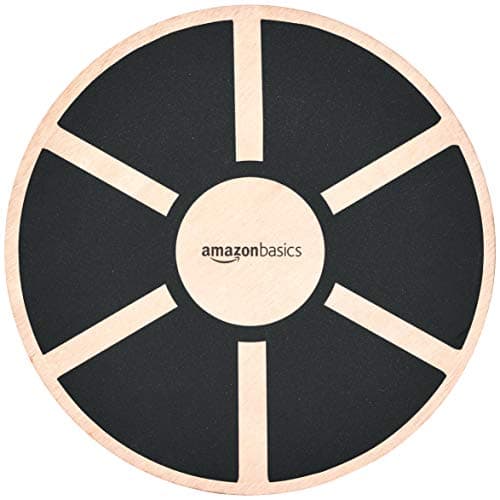
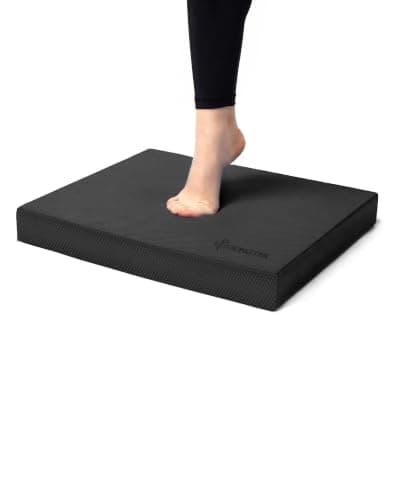
They are not a general balance-training purchase.If what you want is to train your balance, holding onto something with both hands is working against you — the challenge to your balance system is the point, and the bars remove it. For that, the NIA’s named exercises need no equipment at all, and a foam pad costs about $37. Our printable balance routine is free and is where we would start almost everybody.

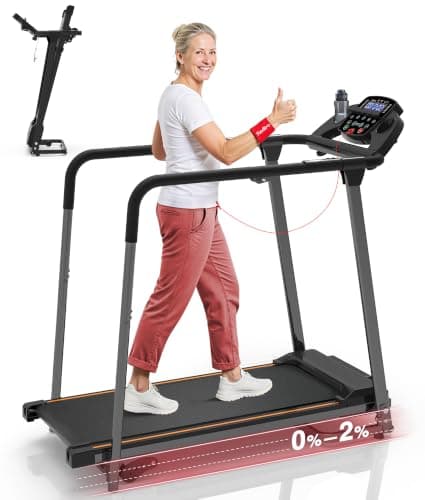
Three cheaper things to consider first.If the goal is safety moving around the house rather than structured practice, fixed grab rails at the specific places you struggle are a fraction of the price and always there — our guide to fall prevention at home works through where they go. If the goal is walking practice, a treadmill with full-length rails gives you support on both sides and a moving belt, and we rank those on where the controls sit in the machines with handrails. And if standing is not reliably available today, seated work is not a consolation prize — it is the correct starting point.

And if what you actually need is strength rather than support— because the reason walking feels precarious is that your legs have got weaker rather than that your balance has changed — bands cost about a twentieth of what these bars do and cover the muscle-strengthening the CDC asks for twice a week. Our shortlist of resistance bands for seniors ranks them on published resistance in pounds, which is a figure only two of five sets will state — the same disclosure problem as this page, at a fiftieth of the price.

If the bars are for rehabilitation, let the therapist choose. This is the one category on the site where we would say that outright. Rail height, rail length and whether the frame needs anchoring are decisions someone watching you walk can make far better than a page can, and the CDC’s own fall-prevention initiative is built around exactly that kind of individual assessment. Use this page to know which figures to demand from a listing, then buy what you are told to buy.

General information, not medical advice. Tread & Tone is written by an enthusiast, not a clinician. Nobody here is a doctor, a physical therapist or a trainer, and nothing on this site has been medically reviewed. Talk to your doctor or physical therapist before starting something new, particularly after surgery, a fall, or a change in medication.

Questions people ask

What height should parallel bars be set to?

Roughly at your wrist when you stand normally with your arms hanging by your sides — that is the height at which you can press down through a near-straight arm and genuinely unload your legs. Measure from your floor to the crease of your wrist before you buy, because the two sets that publish a height range barely overlap: the GRIPITHPY covers 31.5 to 43.3 inches and the yeezoo offers four fixed positions from 43.5 to 51.0. If you will mostly practice standing up from a chair, measure seated too and expect a very different number.

What weight capacity do home parallel bars have?

Only one of the four live sets will tell you. The yeezoo publishes 333 lb; the GRIPITHPY, the OQTUHWM and the Leaceuv publish no capacity figure at all, and the OQTUHWM claims a high capacity without stating a number. We think that is the single worst disclosure gap on this site, because this is equipment designed to take a person's body weight through their arms. Worse, every stated capacity in this category is a vertical figure, and not one listing says anything about the sideways force that would actually tip a frame over.

Do parallel bars have to be bolted to the floor?

It depends on the design, and this is the practical question that decides which one you can own. The yeezoo set is made to be anchored: twelve pre-drilled holes across two 5 mm base plates, with expansion screws included. The GRIPITHPY instead stands on its own integrated floor platform, so your weight on the platform holds the frame and nothing goes into your floor — which makes it the realistic option in a rental. The OQTUHWM and Leaceuv rest on non-slip pads with no anchoring, which is the least secure arrangement of the three.

Are parallel bars good for balance training?

Not really, and it is worth being clear about why. Training your balance means challenging the system that keeps you upright, and holding a solid rail in each hand removes that challenge by design. Bars are for gait practice with support — relearning to walk after surgery or a stroke, practicing steps when a leg will not take full weight, working on sit-to-stand safely. For balance itself, the National Institute on Aging's named exercises need no equipment, and a foam pad costs around $37.

How much space do home parallel bars need?

More than people expect, and two of the four will not tell you. The yeezoo is six feet long and 27.5 to 36.5 inches wide at the rails; the GRIPITHPY publishes a 79 by 35.4 inch footprint including its platform. The OQTUHWM and the Leaceuv publish no footprint at all. Add clearance at both ends, because the whole point is walking in and out of them rather than standing still inside them.

Why are the cheapest parallel bars the best documented?

We genuinely do not know, and we are reporting the pattern rather than explaining it. The yeezoo set is the cheapest of the four by a wide margin and publishes a rail height range, a width range, a rail length, a weight capacity and its anchoring hardware. The two most expensive sets publish none of those. One reasonable guess is that the dearer listings are aimed at clinics buying on a specification sheet elsewhere, but that is a guess and we will not dress it up as a finding.

Can one person assemble parallel bars?

Assembly yes, positioning probably not. All four state that assembly is straightforward, and the OQTUHWM and GRIPITHPY both state it needs no complex tools. The problem is the finished object: Amazon's unlabeled item-weight field for the yeezoo reads 60 lb, and a six-foot steel frame is awkward rather than merely heavy. If the bars are for somebody with limited mobility, plan for a second person on the day it arrives.

Is there a cheaper alternative to parallel bars?

Several, depending on the actual goal. For safety moving around the house, fixed grab rails at the specific spots where you struggle cost a fraction as much and are always in place. For walking practice, a treadmill with full-length rails on both sides gives you the same two-handed support plus a belt. For balance work, a foam pad and a free printable routine will do more than bars will. Parallel bars earn their price for one narrow job: supported gait practice, usually after surgery or a stroke, and usually under someone's supervision.

Sources

Product measurements are cited individually inside each Fit-to-You panel, against the manufacturer page or dated retailer listing they were read from.

Read next