The short answer
Step-over height is the distance from the floor to the highest part of a machine’s frame that your foot has to clear to get on. It decides whether you can use the machine at all. Not one exercise bike manufacturer we checked publishes it — so measure it yourself with a tape measure held vertically from the floor to the top of the frame rail. It takes under a minute.
This page exists because of a specific and slightly absurd situation. The single measurement that determines whether an older adult can physically use an exercise bike is published by nobody, anywhere, at any price.
We checked. Across the 16recumbent bikes on this site — from a $160 Marcy to a $1,349 Teeter — the count of manufacturers publishing a step-over height is zero. That includes brands that market explicitly to seniors, brands that publish assembled dimensions to a tenth of an inch, and brands that describe their step-through frame as an accessibility feature in the same paragraph where they decline to measure it.
Across every product category on this site, 170 accessibility measurements go unpublished. Step-over height is the one that is unpublished every single time.
What it is, precisely
Step-over height is the vertical distance from the floor to the highest point your foot must clear to get into the riding position.
On an upright bikethat is the crossbar — the tube running between the seat post and the handlebar stem. It is usually somewhere between 10 and 16 inches, and crossing it involves lifting one leg over while balancing on the other, which is a single-leg balance task combined with hip abduction. Before you have warmed up.
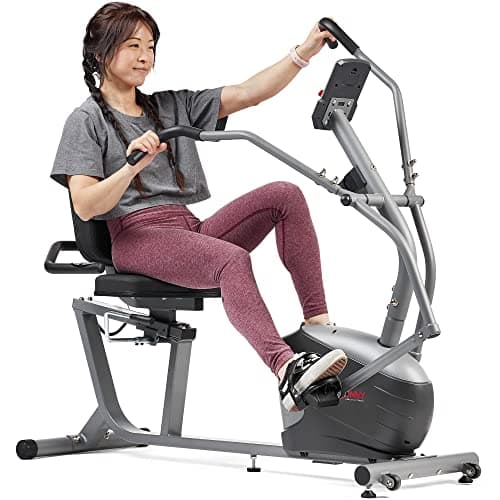
On a recumbent bike the frame is open in the middle by design, so what you step over is a much lower frame rail running along the floor between the seat and the pedals. This is why recumbents are the category people arrive at, and it is a genuine structural advantage rather than a marketing one.
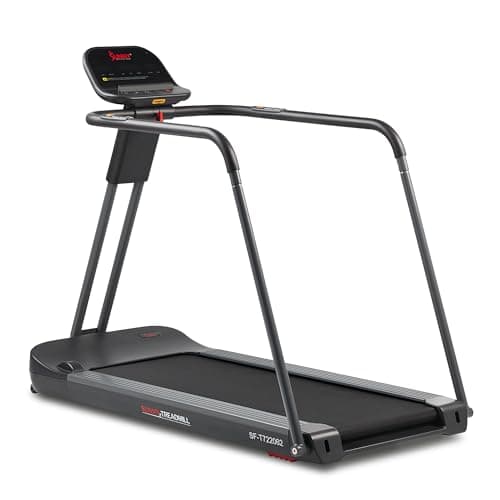
On a treadmill the equivalent measurement is the step-up height: floor to deck. One machine on this site publishes it at 4 inches, and it is the only one that does.
Why it matters more than anything else on the spec sheet
Because it is a gate rather than a preference. Every other specification — resistance levels, flywheel weight, display size, program count — describes how good the experience is once you are on the machine. Step-over height decides whether you get there.
And the failure mode is worse than a simple no. The common outcome is not “I cannot get on this” on day one. It is:
- Day one, you can get on. It takes some effort but it works.
- Week three, on a morning when the hip is stiff, it takes real effort.
- Week six, you skip a session because you cannot face it.
- Month four, there is a very large object in the spare room with a towel on it.
Nobody returns a bike for this, because by the time it becomes the problem the return window has closed and it feels like a personal failing rather than a specification mismatch. Which it isn’t.
How to measure a machine, in about a minute
If the machine is somewhere you can reach it — a shop floor, a gym, a friend’s spare room, a community center — do this. It is the most useful minute you will spend on the purchase.
- Stand where you would get on.Not at the end of the machine — at the side, in the position you would actually approach from.
- Find the highest point your foot must cross. Usually the frame rail between the seat and the pedals. On some machines a footplate or a shroud edge is higher than the rail, so look at the whole path your foot takes rather than assuming.
- Hold a tape measure verticallywith its end on the floor directly below that point, and read off the height at the top of the frame. Keep the tape vertical — angling it inflates the number.
- Write it down. You will not remember three machines later.
Where a machine is coming by post and cannot be measured first, use the published proxies instead: a published seat height (one bike on this site publishes 20.9 to 22.4 inches), a published inseam range, and whether the seat adjusts one-handed. All three bear on getting on and off, and all three are on our shortlist where a manufacturer publishes them.
Now measure yourself, which almost nobody does
A machine measurement is useless without something to compare it against, and “is 12 inches too high?” has no general answer. It depends on your hip mobility, not your age. So establish your own number:
- Stand beside a kitchen counter with one hand on it.
- Stack books or magazines on the floor beside you, starting low.
- Step onto the stack and off again, ten times, alternating legs. If that is comfortable, add to the stack and repeat.
- Stop at the height where ten repetitions stop being easy. Measure the stack. That is your working step height.
Then apply margin. Do not buy a machine whose step-over equals your working step height. Leave two to three inches, because you will be getting on this machine on tired legs, on stiff mornings, and in three years rather than only today. The margin is the whole point of doing the measurement.
If your working step height turns out to be very low, that is genuinely useful information rather than bad news — it points you at a pedal exerciser, which involves no mounting at all because you use your own armchair, and it is worth mentioning to your doctor or a physical therapist.
The four questions to ask a retailer
If you cannot see the machine, ask. A dedicated fitness dealer will usually measure it for you, and the answer you get tells you something either way.
- “What is the step-over height in inches?” If they measure it and tell you, that is a dealer worth buying from.
- “What is the seat height from the floor?” The proxy for standing back up. Ask for the minimum and maximum if the seat adjusts vertically.
- “Can the seat be adjusted with one hand, sitting down?” A two-handed pull-pin that requires bending is a daily annoyance in a shared household.
- “What does the box weigh?”Not the machine — the box. It determines whether it gets past your front door.
Why we keep going on about this
Because it is the clearest example of a gap between what this industry publishes and what its buyers need to know. A manufacturer marketing a “senior-friendly” recumbent bike has the CAD model on a screen in front of them. The number is a two-second query. It is not on the specification sheet because nobody has made it a requirement.
So every product page on this site carries a step-over height row, and it says Not published by the manufacturer, on every single machine. That is not us giving up. It is a count, kept in public, of an industry-wide omission — and the tables on our roundups show you which manufacturers withhold the most.
If you find a manual that publishes one, we would genuinely like to see it. Tell us, and it will be on the site within a week with the source cited.