The short answer
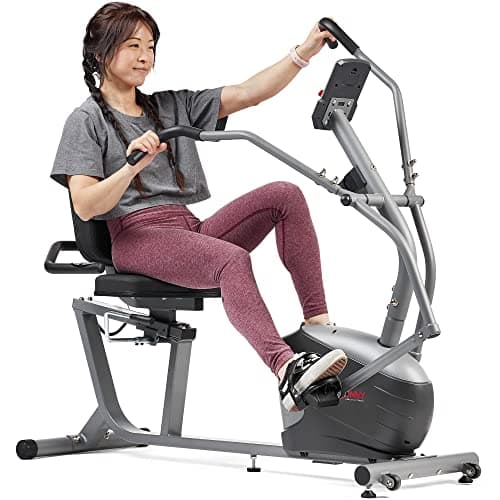
For most buyers over 60, the recumbent bike is the better machine — not because of the pedaling, which is much the same, but because of three things around it. You step through the frame rather than over it, the seat has a back rest so your spine is supported, and no body weight goes through your hands, wrists or shoulders. An upright loads all three. The upright wins on footprint, price and maximum intensity.
Recumbent versus upright, on the things that actually decide it for an older rider.| What you care about | Recumbent bike | Upright bike |
|---|
| Getting on | Step through an open frame, sit down as you would into a chair | Swing a leg over a crossbar, then climb up onto a saddle |
|---|
| Back support | Padded back rest supports the lumbar spine throughout | None. Your core and lower back hold your torso up |
|---|
| Weight through hands and wrists | None. Handles are for stability only | A real proportion of your upper-body weight, continuously |
|---|
| Saddle discomfort | A wide padded seat, weight on your seat bones and thighs | A narrow saddle carrying all your weight on a small area |
|---|
| Footprint | 50 to 66 inches long, plus about 2 feet of mounting clearance | Roughly 40 by 20 inches, no mounting clearance needed |
|---|
| Maximum intensity available | Lower. You cannot stand out of the seat | Higher. Standing recruits more muscle |
|---|
| Typical price for a solid machine | $160 to $900 | Usually less for a comparable build |
|---|
| Best for | Bad knees, hips that don't lift, back pain, wrist arthritis, balance concerns | Small rooms, tight budgets, riders who already cycle outdoors |
|---|
The three differences that matter, in order
1. Getting on and off, which decides everything else
A recumbent frame is open in the middle. You walk into the seat and sit down, the way you would into a dining chair. An upright has a crossbar, and you have to lift a leg over it while standing on the other one — which is a single-leg balance task with a hip abduction, performed before you have warmed up.
If that is difficult, or if it is only sometimes difficult, the decision is already made. A machine you cannot reliably get onto is not a machine, and the sometimes-difficult case is worse than the always-difficult one, because you will buy it and then quietly stop using it.
The annoying part, which we have a whole guide about: not one manufacturer publishes the step-over height of either kind of bike. On an upright it is usually somewhere between 10 and 16 inches. On a recumbent it is much lower, but nobody will state it.
2. What your hands and wrists are doing
This is the difference nobody mentions, and it matters because arthritis rarely confines itself to one joint. On an upright bike a genuine proportion of your upper-body weight goes through your palms into the handlebars, continuously, for the whole session. If you have arthritic wrists, carpal tunnel, a shoulder that objects to bearing weight, or thumb-base arthritis, that is the part of an upright bike that ends the session — not the legs.
On a recumbent your hands rest on side handles for stability and carry nothing. It is a small design consequence with a large practical effect, and it is invisible on a specification sheet.
3. The back rest, and the saddle
The recumbent seat back supports your lumbar spine, so your lower back is not holding your torso up for twenty minutes. And the seat is a wide padded surface rather than a narrow saddle, so your weight is spread across your seat bones and thighs rather than concentrated on a small area.
Saddle discomfort is the single most common reason home exercise bikes stop being used, and it affects older riders more because tissue tolerance changes. A recumbent seat largely removes the problem, which is why published cushion thickness is worth looking at — two bikes on our shortlist state it, at 3.4 inches and 80 mm.
What none of them states is a backrest height or a backrest angle, which is the specification that would actually settle it for a sore back. Our shortlist for back painranks the machines on what each maker does publish — the seat back, the seat rail, and what it takes to get on, off and built.
What the upright genuinely does better
Three things, and they are real rather than consolation.
Footprint. An upright occupies about 40 by 20 inches. A recumbent publishes 50 to 66 inches of length because the pedals are out in front, and then needs roughly two feet of clearance on the mounting side. In a small apartment that difference can be decisive.
Price at a given build quality. Fewer materials and a simpler frame mean an upright at $200 is generally more solidly made than a recumbent at $200.
Maximum intensity. You can stand out of the saddle on an upright, which recruits more muscle and raises the ceiling. For someone training hard that matters. For someone working toward the CDC’s 150 moderate-intensity minutes a week, that ceiling is nowhere near being approached.
What is the same on both
The joint mechanics of pedaling. The Arthritis Foundation notes that cycling’s continuous motion takes a joint through its range, and range of motion is what produces the synovial fluid that lubricates it. That applies equally to both.
And on both, seat position matters more than the machine. Too far from the pedals and you over-extend the knee at the bottom of every revolution. Too close and you close the joint angle up and load the front of the knee. A recumbent with a badly set seat will hurt more than a well-set upright.
Both also skip the two things a bike cannot do. Cycling is seated, so it does nothing for bone loading and nothing for the balance system. The CDC asks for muscle strengthening and balance work alongside the aerobic minutes, so if you buy either kind of bike, add a $37 balance pad to the order.
How to decide in one minute
- Can you comfortably swing a leg over a bar about knee-height, today and on a bad day? If no, buy a recumbent. Stop here.
- Do your wrists, shoulders or lower back object to bearing weight? If yes, buy a recumbent.
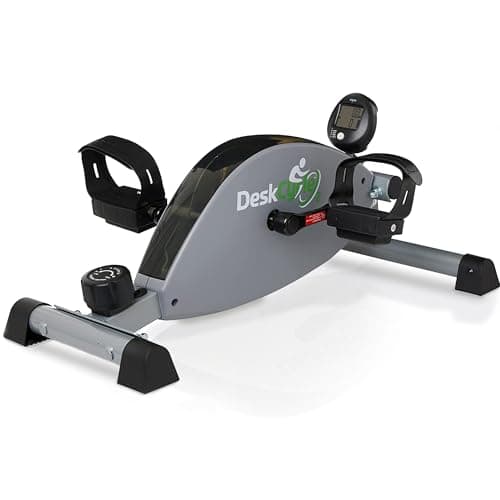
- Is your available floor space under about 5 feet in one direction?If yes, and the first two answers were fine, an upright is the sensible choice — or consider a pedal exerciser, which needs no floor space at all.
- Otherwise, buy a recumbent. Our shortlist is here, ranked on the measurements that decide whether you can get on.
If the machine you are actually weighing up is a spin bike rather than a conventional upright, that is a harder version of this question and it has its own page: recumbent bike versus spin bike goes through the forward-leaning posture, the direct-drive flywheel and the resistance knob you cannot reproduce a setting on.