Recumbent Bike vs Upright Bike
Back support, step-over height, and the wrist and shoulder load nobody mentions. Which one suits which body.
Read the guideThese two machines are sold side by side and they are built for opposite bodies. One asks your hands, wrists, neck and lower back to hold a forward-leaning position for the whole session; the other asks nothing of them at all.
How this is funded: we earn a commission if you buy through our links, at no extra cost to you. It never changes what we recommend, and every page here names at least one thing we would not buy. Full disclosure.
The short answer
Buy the recumbent bikeunless you specifically want to ride out of the saddle. A spin bike holds you in a forward lean for the whole session, resting your weight on your hands, wrists and a deliberately narrow saddle with nothing behind your back — that posture is the machine, not a setting you can turn off. Buy the spin bike only if your wrists, neck, shoulders and lower back are all fine and you want high-intensity standing work a recumbent genuinely cannot do.
We get this question in a slightly different form from the upright-bike one, and the difference is worth naming up front. An upright exercise bike is a milderversion of a recumbent’s alternative: you sit up, the bars are near seat height, and the posture is roughly what you would use on a shopping bike. A spin bike is a different proposition altogether — it is built to imitate a road racing bike, with the saddle level with or above the handlebars, a heavy flywheel, and an assumption baked into the geometry that you will spend part of the session standing on the pedals. If you have already read our recumbent versus upright comparison, read this one as the harder version of the same question.
We do not have a spin bike in our product registry, because this site covers low-impact equipment for people past 60 and an indoor cycling bike is not that. So everything below about the recumbent side is grounded in specifications we have checked and cited per machine, and everything about the spin side is a description of how that category is built rather than a published figure we are citing from a particular model. Where we say “most spin bikes” we mean exactly that, and the honest instruction is to check the listing of whatever specific bike you are considering. We would rather tell you where the floor of our evidence is than quietly let a comparison table imply we have measured both sides.
Forget the flywheel for a moment. The question that settles this for almost every buyer on this site is which parts of your body are holding you up for the next half hour.
On a spin bike, four things are working besides your legs.Your hands and wrists carry a share of your upper-body weight on the bars, held in extension. Your shoulders and upper back stabilize that lean. Your lower back holds a flexed position with nothing behind it. And your neck is extended so you can look forward rather than at the floor. None of that is a flaw in the design — it is the correct position for the sport the machine imitates. It is also, in order, four of the most common places a 65-year old already hurts.
On a recumbent bike, none of them are.You are in a seat with a back rest, your hands rest on stationary side handles that exist mostly to help you get on and off — Schwinn describes the 290’s handlebars in exactly those terms — and your spine is supported along its length. The legs do the work and nothing else is recruited to hold the position. That is the whole argument, and it does not get more sophisticated than that.
Then there is the saddle, which deserves its own sentence.A spin bike saddle is narrow and firm on purpose: a wide, soft saddle chafes when you are pedaling hard and shifting position, and it gets in the way when you stand. The recumbent’s seat is a chair. If you have ever abandoned an exercise bike because of soreness rather than effort, that sentence is the reason, and it is not something you fix with a gel cover.
One nuance in the spin bike’s favor, because it is real. For a rider with hip osteoarthritis, NIAMS notes that the pain is often felt in the groin, inner thigh or buttocks and that range of hip motion reduces over time — and some people find a more open, forward-leaning hip angle easier than a deeply seated one. That is individual enough that the only sensible advice is to raise it with whoever manages the joint, and it is one of the few arguments for the forward position that is not about fitness.
| What you care about | Recumbent bike | Spin bike |
|---|---|---|
| Posture | Seated and reclined against a back rest; spine supported throughout | Forward lean held by your hands, shoulders and lower back for the whole session |
| Where your weight rests | A padded seat and a back rest | A narrow firm saddle, plus your hands and wrists on the bars |
| Getting on | Step-through frame; one bike publishes a 20.9 to 22.4 in seat height, about dining-chair height | Swing a leg over a high frame between the saddle and the bars |
| Standing climbs | Impossible by geometry | Core to how the format is taught, and the main reason to choose one |
| Resistance you can reproduce | Numbered levels: 8 to 25 across our registry, and one machine publishes pounds (0 to 105 lb across 20 levels) | Usually a friction or magnetic knob with no numbered scale, so yesterday's setting is a guess |
| Can you stop pedaling? | Yes. Stop and the pedals stop | Often not freely — most are direct-drive, so the flywheel keeps the cranks turning. Check the specific model |
| Balance demand | None. You are sitting in a chair | Real, especially out of the saddle |
| Upper body | Some models have moving arm handles that work with or without the legs | Loaded statically to hold the position, not exercised |
| Floor space | 52.5 to 66.4 in long across the bikes we track, and it does not fold | Smaller footprint, taller profile |
| Subscription pressure | Low. Most bikes we track work fully with no account | High. The format is sold as instructor-led classes in an app |
Spin bike marketing is built on flywheel weight, and there is a real mechanism behind it: a heavy flywheel carries momentum through the dead spots in your pedal stroke, which makes the motion feel smooth and road-like. That genuinely matters if you are riding hard and standing up.
At the intensities most readers of this site will use, it matters far less than resistance granularity.What decides whether you can do a useful twenty minutes is whether the machine can be set to a load you can sustain — and then nudged up by a known amount next month. That is a question about the bottomof the resistance range and the size of the step between settings, not about the top. Our registry runs from 8 levels on the cheapest bikes to 25 on the Schwinn 290, and the Teeter FreeStep publishes its resistance in pounds — 0 to 105 lb across 20 levels — which is the only machine here you can actually quantify your progress on.
A typical spin bike gives you a stepless knob instead. Infinitely adjustable sounds better than 25 levels until you try to repeat Tuesday’s session on Friday and find that “about a quarter turn” is not a measurement. If progressive overload is your plan, numbered levels beat a smooth knob, and we go through this at length in how to choose a recumbent bike.
The one specification on the spin side we would check before buying anything, if you are considering one: whether the flywheel is direct-drive. On most indoor cycling bikes it is, which means the cranks keep turning with the wheel — you slow it with a brake lever rather than by stopping your feet. For a rider whose balance or reaction time is not what it was, that is a genuine consideration, and the CDC’s figure that more than one in four adults 65 and over falls each year is the reason we raise it rather than assume it is fine. A recumbent has no equivalent failure mode: your feet stop, the bike stops.
| Machine | Seat height from floor | Inseam range | Weight capacity |
|---|---|---|---|
| Sunny Health & Fitness Smart Recumbent Bike with Dual-Motion Arm Exercisers | 20.9 in minimum, 22.4 in maximum | 29.9 in to 38.6 in | 265 lb |
| Schwinn Fitness 290 Recumbent Bike | Not published by the manufacturer | Not published by the manufacturer | 330 lb |
| HARISON Recumbent Exercise Bike, 450 lb capacity | Not published by the manufacturer | 26.5 in to 38.9 in (stated rider height 4 ft 8 in to 6 ft 4 in) | 450 lb |
Two observations about that table. The first is how little gets published: one bike in our whole registry states a seat height, and not a single machine in this category publishes a step-over height— the one measurement that would answer the getting-on question outright. We wrote a guide to measuring it yourself precisely because the industry will not. The second is that inseam range, where it is published, is the specification that decides fit for a short or a tall rider far more reliably than the height ranges in the marketing copy do.
Those are the fields a recumbent buyer should be comparing. Notice that none of them have a spin bike equivalent, because a spin bike is not fitted that way — you set saddle height, saddle fore-aft and handlebar drop, and the fit question is about reach rather than about whether you can get aboard at all.
We would rather send you to the right machine than win the argument, so here is the honest case for the other side.
Buy the spin bike if standing climbs are the point.If you have ridden a road bike for years, your wrists and lower back are untroubled, and what you actually want is to reproduce a climb in your living room, a recumbent will bore you within a fortnight and no feature list changes that. The format’s structure — an instructor, a cadence, a group — is also a real adherence advantage for people who like it, and adherence is most of the result.
Buy the spin bike if the room is tiny and height is not a problem. A spin bike occupies a smaller floor footprint than a recumbent, which runs 52.5 to 66.4 inches long across the bikes we track and does not fold. It just occupies that space vertically instead.
And do not buy the spin bike if getting aboard is the question. You mount one by swinging a leg over a high frame between the saddle and the handlebars, which is a harder movement than stepping through a recumbent and a much harder one than transferring into a seat. If that is where your decision actually sits, our guide to exercise bikes for wheelchair users works through the transfer question properly and names the equipment that skips it entirely.
And buy the recumbent if any of the following is true, which is why most readers here end up with one: your wrists, neck, shoulders or lower back object to being held in one position; you have had a fall, or you do not trust your balance; you want the resistance set genuinely light on a bad day; you want to be able to stop pedaling without thinking about it; or you simply want to do forty minutes while watching something, which is an unglamorous reason that produces more exercise than most ambitious ones. The Arthritis Foundation’s point about cycling — that continuous motion moves a joint through its range and produces the fluid that lubricates it — applies to both machines equally. You may as well collect that benefit from the one with a back rest.
If you want spin-style effort on a recumbent, the method is intervals rather than hardware: raise the resistance a known number of levels for a minute, drop back for two, repeat. Judge the effort with the CDC’s talk test rather than the console’s calorie estimate, which is a generic formula on every machine we track. Our recumbent workout plan has a structure you can follow, and getting the seat position right matters more to how the session feels than anything you can buy.
General information, not medical advice. Tread & Tone is written by an enthusiast, not a clinician. Nobody here is a doctor, a physical therapist or a trainer, and nothing on this site has been medically reviewed. Talk to your doctor or physical therapist before starting something new, particularly after surgery, a fall, or a change in medication.
For most buyers past 60, the recumbent bike, and not because of the pedaling. A spin bike is built around a forward-leaning posture: your weight sits on your hands and wrists, your lower back is unsupported, your neck is extended to look ahead, and the saddle is narrow and firm because it is designed to be ridden out of rather than sat on. A recumbent bike removes every one of those loads by putting you in a seat with a back rest. The exception is a rider with no wrist, neck, shoulder or lower-back issues who genuinely wants high-intensity interval work, including standing climbs — a recumbent cannot deliver that, and a spin bike can.
No, and that is one of the real differences between the two machines rather than a shortcoming. Standing climbs are a core part of how indoor cycling classes are structured, and the geometry of a recumbent bike makes them impossible — you are seated, reclined, with the pedals in front of you. If the sessions you want to do involve getting out of the saddle, a recumbent is the wrong machine and no amount of resistance will substitute. If getting out of the saddle sounds like a way to hurt yourself, that impossibility is a feature.
Both are low-impact, so neither punishes a knee the way walking or running does, and the Arthritis Foundation's point about cycling applies to both: continuous motion moves the joint through its range and produces the fluid that lubricates it. The difference is in how the load arrives. On a spin bike you push against a heavy flywheel from a forward position, often against high resistance and sometimes standing, which puts real force through the knee at the top of the stroke. On a recumbent you push horizontally from a supported seat and the resistance can be set genuinely light. For a knee that objects, the recumbent is the easier machine to get right.
A spin bike makes high-intensity work easier to reach, and high intensity is a time-efficient way to accumulate effort — so if you can ride one comfortably, it has an edge per minute. But weight loss is decided by total minutes over months, not by the peak of any one session, and the machine you will sit on for forty-five minutes five days a week beats the machine that gives you a brilliant twenty minutes you then avoid for a week. For most readers of this site that is the recumbent, which is why our weight-loss shortlist ranks seat comfort and seat travel rather than flywheel weight.
An upright exercise bike is a conventional bicycle position with a console in front of you: you sit up, the handlebars are roughly at seat height or above, and the resistance is usually a numbered magnetic scale. A spin bike is built to mimic a road bike — the saddle sits level with or above the handlebars, the flywheel is heavy, the pedals are usually directly driven by it, and the whole machine assumes you will spend part of the session standing. An upright is the middle option between a spin bike and a recumbent, and we compare it against the recumbent on its own page.
The machine does not, but the format largely does: indoor cycling is sold as classes, and most of the well-known spin bikes are built around a paid app with an instructor on a screen. A basic spin bike with a friction knob and no console needs nothing. The same question comes up on the recumbent side and the answer is better — most of the bikes we track run perfectly well with no account at all, and we have a shortlist specifically for buyers who refuse a monthly bill.
Three, in rough order of how well they work. Buy a recumbent with fine resistance granularity and do intervals seated — a bike with 25 numbered levels lets you jump a known amount and come back down, which is the part that matters. Or buy a recumbent cross-trainer with moving arm handles, which brings your upper body into the session without loading your wrists. Or use the CDC's talk test to raise your effort on whatever you own, rather than buying a machine to do it for you. None of these reproduce a standing climb, and we are not going to pretend otherwise.
Product measurements are cited individually inside each Fit-to-You panel, against the manufacturer page or dated retailer listing they were read from.
Back support, step-over height, and the wrist and shoulder load nobody mentions. Which one suits which body.
Read the guideBest for Seniors
Eleven bikes ranked on the measurements that decide whether you can get on — with the count of specs each manufacturer refuses to publish.
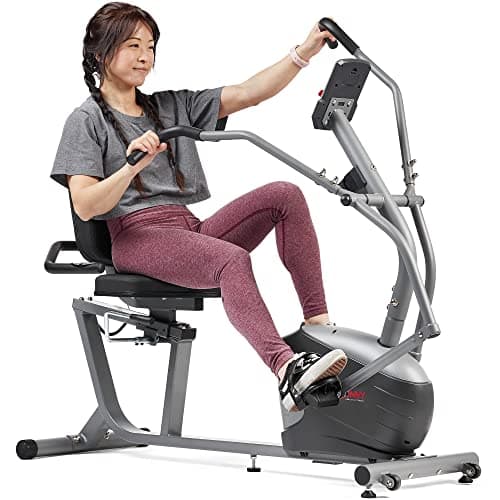
Top pick: Sunny Health & Fitness Smart Recumbent Bike with Dual-Motion Arm Exercisers
The handful of measurements that actually decide whether a seated bike fits your body and your room — seat range, capacity, resistance control and step-through — and the specs you are paying for that do not matter.
Read the guideBest for Back Pain
The seat back is the reason people buy this category, and exactly one manufacturer publishes anything about it. Ranked on what each maker documents about back support, seat distance and getting on.
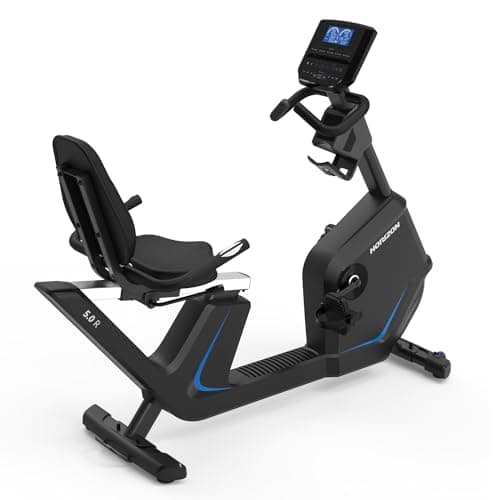
Top pick: Horizon Fitness 5.0 R Recumbent Bike
The seat distance decides whether the bike helps your knees or hurts them, more than the machine does. How to set it in two minutes, and the leg angle to aim for.
Read the guideBest Premium Bike
The seated motion is the same at every price, so the only honest question is what the extra money buys — finer resistance, a bigger screen, dimensions you can measure — and the four things it buys nobody at any price.
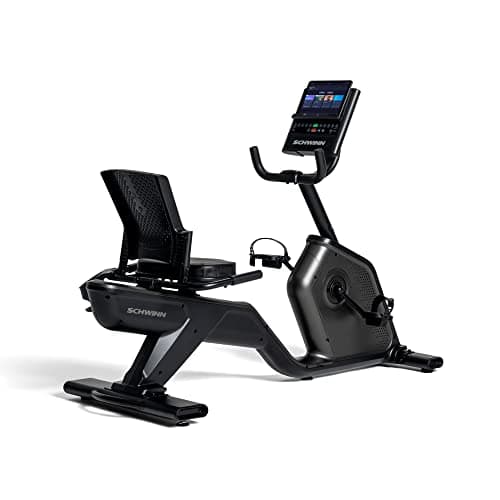
Top pick: Schwinn Fitness 290 Recumbent Bike
Price as of October 21, 2026. #ad How we’re funded