Tread & Tone

The Best Balance Boards for Seniors

A rigid board that tilts is a genuine progression from foam, not a variation. Height off the floor is what separates a sensible one from a bad idea.

By Stephen V.Last updated How we choose

How this is funded: we earn a commission if you buy through our links, at no extra cost to you. It never changes what we recommend, and every page here names at least one thing we would not buy. Full disclosure.

“Balance board” covers three quite different objects, and the shopping confusion between them is most of why people buy the wrong one.

A rigid wobble board is wood or plastic on a fixed dome. It tilts, predictably, in whichever direction you lean. An inflatable discis a cushion of air — softer, adjustable, and much closer to a foam pad in difficulty. A spring-mounted board sits on actual springs and oscillates under you, which is a different and much harder proposition.

For an older adult the ordering is straightforward and it is mostly about height. Foam pad, then inflatable disc, then rigid board, then — if ever — springs. We include the spring board here marked as a skip, because it is exactly the product that looks most impressive in a listing and is most likely to put someone on the floor.

One thing worth noticing before you read on: only one product on this page publishes a weight capacity. On rigid platforms you stand on, that is a strange gap.

Quick picks

Ranked on the published accessibility measurements and on who each machine actually suits. Select a row to jump to the full write-up. The last column is the number of the nine measurements the manufacturer will not publish — we have not used any of these machines, and here is exactly what we did instead.

#MachineBest forSpecs withheldPrice
1
Amazon Basics Wood Wobble Balance Trainer Board

Amazon Basics Wood Wobble Balance Trainer Board

Progressing past a foam pad

Best rigid board0of 6
2
ProSource Core Balance Disc Trainer, 14 in

ProSource Core Balance Disc Trainer, 14 in

Adjustable difficulty

Adjustable difficulty1of 6
3
Trideer Wobble Cushion Balance Disc

Trideer Wobble Cushion Balance Disc

The lowest price

Lowest price1of 6
$18.80 · Check price on Amazon

$20.8910% off

Price as of July 24, 2026. #ad How we’re funded

4
ELDGREON Balance Board with Spring System

ELDGREON Balance Board with Spring System

We would skip this one — see below

Too high to start on1of 6
1.Best rigid board

Amazon Basics Wood Wobble Balance Trainer Board(IR97339-BK)
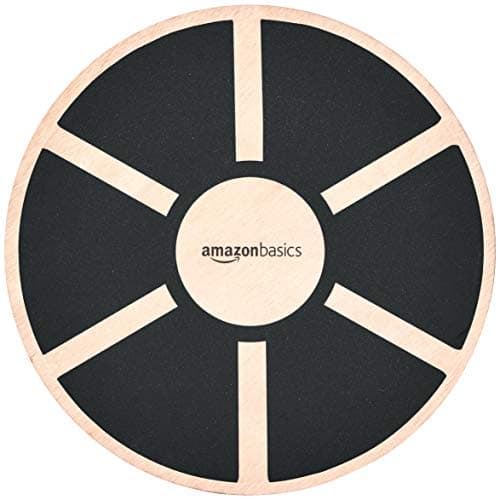
A rigid wooden board that tilts on a fixed dome — a real step up in difficulty from any foam pad, and the only balance product here that publishes a weight capacity (265 lb). Its own listing warns it must not be used on a smooth or wet floor, which rules out a lot of kitchens.

What it gets right

  • Publishes a weight capacity — 265 lb — which no pad or cushion here does
  • Solid wood top with a non-slip surface, published at 15.75 in square
  • Rigid platform gives a clear, predictable tilt rather than a squishy one
  • One-year limited warranty

What to know first

  • 3.15 in tall and tilting — a significant step up in difficulty. This is not a first purchase for someone with a fall history
  • The listing explicitly warns against use on wet or smooth surfaces
  • 265 lb capacity is the lowest published figure on the site
  • No published tilt angle, which is what actually sets the difficulty

Fit-to-You: the nine measurements

Amazon Basics publishes every measurement on this list. That is unusual enough to be worth saying. How we compile these

ThicknessPad height sets the difficulty. Too tall is not 'more effective', it is a fall.
3.15 in

Source: Amazon product listing data (Creators API) · read 2026-07-24

Standing surfaceWhether there is room for two feet, or only one.
15.75 in × 15.75 in

Source: Amazon product listing data (Creators API) · read 2026-07-24

Weight capacitySearched directly, and two of the senior-focused competitors omit it entirely.
265 lb

Source: Amazon product listing data (Creators API) · read 2026-07-24

FirmnessA pad that bottoms out gives no training effect; one that is too soft is unstable.
Rigid solid wood on a fixed dome; tilt angle not published

Source: Amazon product listing data (Creators API) · read 2026-07-24

Non-slip baseWhether you need something solid to hold while you use it — and most people do.
Non-slip surface, but the listing warns it must not be used on a wet or smooth floor

Source: Amazon product listing data (Creators API) · read 2026-07-24

Needs support nearbyWhether you need something solid to hold while you use it — and most people do.
Yes, and for this one it is not optional. Use it inside a doorway or at a rail

Source: Amazon product listing data (Creators API) · read 2026-07-24

We have not used this machine. Everything above comes from the manufacturer’s published documentation and the dated retailer listing, with the source given for each figure. Where they don’t publish a number, we say so. We can’t tell you how it feels to ride, how quiet it really is, or how it holds up after two years — and anyone who tells you otherwise without owning one is guessing.
2.Adjustable difficulty

ProSource Core Balance Disc Trainer, 14 in(ps-2142-bd-gray)

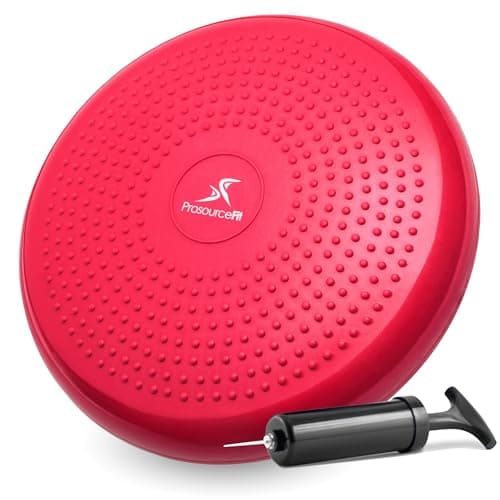
An inflatable disc whose difficulty you set yourself: let air out and it is nearly a firm pad, pump it up and it is genuinely unstable. That adjustability is the reason to choose a cushion over a foam pad — you can start easy and progress without buying twice.

What it gets right

  • You control the challenge by inflation level, so it grows with you
  • Published 14 in diameter, 3 in height, 2.2 lb — all three numbers stated
  • Hand pump included, so no separate purchase
  • Works as a seat cushion too, which is how most people get regular use out of one

What to know first

  • PVC, not foam, so it will feel like a beach ball at high inflation
  • No published weight capacity
  • A round 14 in disc is a one-foot or narrow two-foot stance, not a wide one
  • Inflatables lose air slowly and need topping up

Fit-to-You: the nine measurements

ProSource does not publish 1 of 6 of these. Where that is the case, this panel says so rather than guessing. How we compile these

ThicknessPad height sets the difficulty. Too tall is not 'more effective', it is a fall.
3 in at full inflation, and lower as you let air out

Source: Amazon product listing data (Creators API) · read 2026-07-24

Standing surfaceWhether there is room for two feet, or only one.
14 in diameter

Source: Amazon product listing data (Creators API) · read 2026-07-24

Weight capacitySearched directly, and two of the senior-focused competitors omit it entirely.
Not published by the manufacturer
FirmnessA pad that bottoms out gives no training effect; one that is too soft is unstable.
Set by the user via the included hand pump; no firmness scale published

Source: Amazon product listing data (Creators API) · read 2026-07-24

Non-slip baseWhether you need something solid to hold while you use it — and most people do.
Dual-textured PVC — raised massaging bumps one side, smoother bumps the other

Source: Amazon product listing data (Creators API) · read 2026-07-24

Needs support nearbyWhether you need something solid to hold while you use it — and most people do.
Yes, and more so than a foam pad at high inflation

Source: Amazon product listing data (Creators API) · read 2026-07-24

We have not used this machine. Everything above comes from the manufacturer’s published documentation and the dated retailer listing, with the source given for each figure. Where they don’t publish a number, we say so. We can’t tell you how it feels to ride, how quiet it really is, or how it holds up after two years — and anyone who tells you otherwise without owning one is guessing.
3.Lowest price

Trideer Wobble Cushion Balance Disc

Trideer Wobble Cushion Balance Disc
$18.80 · Check price on Amazon

$20.8910% off

Price as of July 24, 2026. #ad How we’re funded

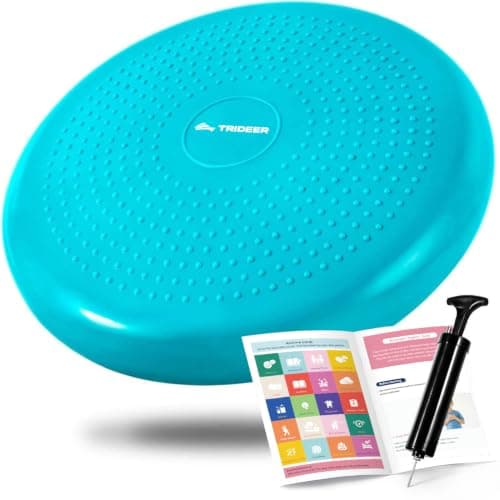
A 13.4 inch inflatable disc at the cheapest price on this page, with the pump included. Its listing also claims a 1,000 lb weight limit, which we are not going to repeat as a meaningful figure.

What it gets right

  • The cheapest balance product on the site, with a pump included
  • 13.4 in (34 cm) diameter published in both units
  • Inflation-adjustable, so difficulty can start very low
  • Doubles as a chair cushion, which is how it earns its keep

What to know first

  • The listing states a 1,000 lb weight limit. We do not believe that is a useful number and we are not treating it as a specification
  • 2 in tall, the thinnest here, so the top of its difficulty range is limited
  • Marketed mostly at classroom seating rather than balance training
  • No published firmness scale

Fit-to-You: the nine measurements

Trideer does not publish 1 of 6 of these. Where that is the case, this panel says so rather than guessing. How we compile these

ThicknessPad height sets the difficulty. Too tall is not 'more effective', it is a fall.
2 in

Source: Amazon product listing data (Creators API) · read 2026-07-24

Standing surfaceWhether there is room for two feet, or only one.
13.4 in (34 cm) diameter

Source: Amazon product listing data (Creators API) · read 2026-07-24

Weight capacitySearched directly, and two of the senior-focused competitors omit it entirely.
The listing states 1,000 lb. We are reporting that it is stated, not endorsing it as a figure you should rely on

Source: Amazon product listing data (Creators API) · read 2026-07-24

FirmnessA pad that bottoms out gives no training effect; one that is too soft is unstable.
Not published by the manufacturer
Non-slip baseWhether you need something solid to hold while you use it — and most people do.
Non-slip surface

Source: Amazon product listing data (Creators API) · read 2026-07-24

Needs support nearbyWhether you need something solid to hold while you use it — and most people do.
Yes

Source: Amazon product listing data (Creators API) · read 2026-07-24

We have not used this machine. Everything above comes from the manufacturer’s published documentation and the dated retailer listing, with the source given for each figure. Where they don’t publish a number, we say so. We can’t tell you how it feels to ride, how quiet it really is, or how it holds up after two years — and anyone who tells you otherwise without owning one is guessing.
4.We would skip this one

ELDGREON Balance Board with Spring System

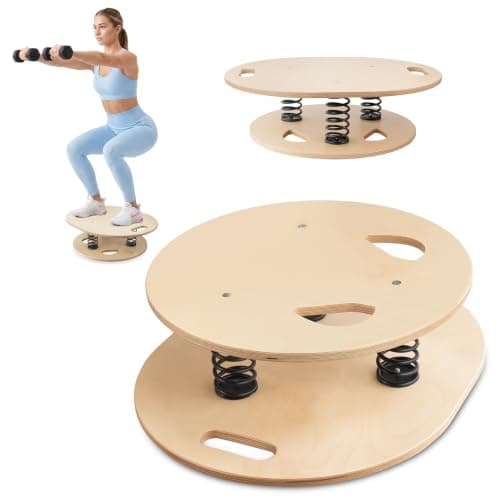
A birch board on springs with a published 350 lb capacity — the highest here. It also sits 6 inches off the floor and moves unpredictably, which makes it a progression tool for the already-steady, not a starting point.

Why we would skip it

Skip this one for a senior beginner. It is well made — birch multiplex, a published 350 lb capacity, 6.39 lb — but it stands 6 inches off the floor on springs that oscillate under you. Six inches is roughly a stair riser, and a spring-loaded platform is deliberately unpredictable. That combination is the opposite of what someone with a fall history needs. If you are already steady and want progression, it is a reasonable buy; if balance is the reason you are shopping, start on a 2 inch foam pad instead.

What it gets right

  • Publishes a 350 lb weight capacity — the highest of any balance product here
  • Birch multiplex construction with a published 6.39 lb board weight
  • Spring oscillation trains reaction rather than static hold
  • Published dimensions 18.8 in × 14.9 in × 6 in

What to know first

  • 6 in tall — about a stair riser. A fall off this is a fall from height
  • Springs make the platform move unpredictably, which is the point and also the risk
  • No published spring rate, so the difficulty cannot be compared to anything
  • Wrong first purchase for the audience this site is written for

Fit-to-You: the nine measurements

ELDGREON does not publish 1 of 6 of these. Where that is the case, this panel says so rather than guessing. How we compile these

ThicknessPad height sets the difficulty. Too tall is not 'more effective', it is a fall.
6 in

Source: Amazon product listing data (Creators API) · read 2026-07-24

Standing surfaceWhether there is room for two feet, or only one.
18.8 in × 14.9 in

Source: Amazon product listing data (Creators API) · read 2026-07-24

Weight capacitySearched directly, and two of the senior-focused competitors omit it entirely.
350 lb

Source: Amazon product listing data (Creators API) · read 2026-07-24

FirmnessA pad that bottoms out gives no training effect; one that is too soft is unstable.
Spring-mounted rigid birch platform; spring rate not published

Source: Amazon product listing data (Creators API) · read 2026-07-24

Non-slip baseWhether you need something solid to hold while you use it — and most people do.
Not published by the manufacturer
Needs support nearbyWhether you need something solid to hold while you use it — and most people do.
Yes, absolutely — and at 6 in off the floor, a rail rather than a countertop

Source: Amazon product listing data (Creators API) · read 2026-07-24

We have not used this machine. Everything above comes from the manufacturer’s published documentation and the dated retailer listing, with the source given for each figure. Where they don’t publish a number, we say so. We can’t tell you how it feels to ride, how quiet it really is, or how it holds up after two years — and anyone who tells you otherwise without owning one is guessing.
What we found looking for these numbers

We went looking for 24 measurements across the 4machines on this page — the nine that decide whether an older adult can get on, reach the controls, read the screen and hear themselves think. 3 of those 24 are not published by anybody. 1 of these machines publishes the full set.

Step-over height is the worst of them. It is the single measurement that decides whether you can get onto a machine at all, and across everything we checked, not one manufacturer states it. That is not an oversight in a category explicitly marketed to seniors, and the count in each panel above is there so you can see who is doing it.

Where a figure exists, we cite it and date it. Where it doesn’t, the panel says Not published by the manufacturer rather than an estimate dressed up as a fact. You can measure step-over height yourself in about a minute — and if a machine is already in your house, that is the fastest way to settle it.

The specification that decides it, and the one nobody publishes

Height off the flooris what you can compare, and everyone publishes it: 2 inches on the Trideer, 3 inches on the ProSource disc, 3.15 inches on the Amazon Basics board, 6 inches on the spring board. That range is not incremental — the top of it is roughly a stair riser.

Tilt angleis what actually sets the difficulty on a rigid board, and not one manufacturer publishes it. A board that tilts 10 degrees and a board that tilts 20 degrees are radically different exercises and both are sold as “wobble boards”. It is the balance-equipment equivalent of the step-over height problem, and it is why the height figure has to do the work.

On an inflatable disc, difficulty is set by you— less air is easier, more air is harder. That adjustability is a genuine advantage for a beginner, and it is the main argument for buying a disc rather than a rigid board first.

Why the Amazon Basics board leads

Not because it is sophisticated — it is a piece of wood on a dome for about $19. It leads because of three published facts.

It publishes a 265 lb weight capacity, which no other balance product on this site does. It publishes a 15.75-inch square surface, which is enough for a two-foot stance. And at 3.15 inches it is a real progression from foam without being high enough that a step off it is a fall.

It also publishes a warning we take seriously and repeat here: its own listing says it must not be used on a wet or smooth surface. That rules out tiled and laminate kitchens — which is awkward, because the kitchen counter is the thing most people hold onto. On carpet or a rug over a hard floor it is fine.

What it does not publish is the tilt angle, so how hard it actually is remains something you find out by standing on it.

Why we would skip the spring board

The spring-mounted board is the best-made object on this page. Birch multiplex, a published 350 lb capacity — the highest of any balance product on this site — a published 6.39 lb board weight, and a spring system that trains reaction rather than static hold. For a physically confident user wanting progression it is a reasonable buy.

For a senior beginner it is the wrong product, for two reasons that compound.

It is 6 inches off the floor. That is roughly a stair riser. A misstep is a fall from height rather than a step down.

Springs move unpredictably.A rigid board on a dome tilts the way you lean, so your correction matches your intention. A spring platform oscillates — it keeps moving after you have corrected, and it can move in a direction you did not initiate. That unpredictability is precisely the training effect it is sold for, and precisely the wrong thing for someone with a fall history.

Height plus unpredictability is the combination to avoid. If you want progression past a rigid board, the honest answer is a physical therapist rather than a taller product.

How to use a board without hurting yourself

Four rules, in order of importance:

  1. Stand in a doorway, or at a counter, with a hand on something solid. For a rigid board this is not optional the first several times. A doorframe gives you support on both sides, which is why it is the best place in most houses.
  2. Check the floor.Rigid boards on smooth or damp surfaces slide — the Amazon Basics listing warns about exactly this. Carpet, or a rug, or a mat.
  3. Bare feet or flat shoes. Not socks on a hard floor, and not cushioned trainers, which mask the feedback from your feet that the whole exercise depends on.
  4. Thirty seconds, then rest. Balance work fatigues the small stabilizing muscles quickly, and a fatigued ankle is how a session ends badly. Six short goes beat one long one.

The exercises themselves — taken from the National Institute on Aging, in order of difficulty — are on our printable routine page. And the straight answer on whether these are safe past 65 is here.

General information, not medical advice. Tread & Tone is written by an enthusiast, not a clinician. Nobody here is a doctor, a physical therapist or a trainer, and nothing on this site has been medically reviewed. Talk to your doctor or physical therapist before starting something new, particularly after surgery, a fall, or a change in medication.

Questions people ask

Are balance boards safe for seniors?

A 3-inch rigid board used in a doorway or at a counter is reasonable for someone already steady on a foam pad. A 6-inch spring-mounted board is not, for a beginner — that is a fall from roughly a stair riser's height on a platform that moves unpredictably. Height and predictability are the two variables that matter, and both are in your control at the point of purchase.

Should I start on a board or a foam pad?

A pad, essentially always. It is 2 to 2.4 inches instead of 3-plus, it compresses rather than tilts, and a misstep off it is a step rather than a fall. Move to a rigid board when standing on the pad with your hands off and your eyes closed has become genuinely boring — which for most people is several weeks of practice away.

What is the difference between a wobble board and a wobble cushion?

A board is rigid and tilts on a fixed dome, so it moves the way you lean and the difficulty is set by the manufacturer. A cushion is inflatable and compresses, so you set the difficulty yourself by how much air you put in. The cushion is the gentler and more adjustable option; the board is the firmer, more definite progression.

How long should I stand on a balance board?

Thirty seconds at a time, several times, rather than one long attempt. Balance work fatigues the small stabilizing muscles in the ankle and hip quickly, and a fatigued ankle is how sessions end badly. Six short goes with rests between them gives you more quality practice than three minutes of deteriorating wobble.

Can I use a balance board on a hard floor?

Check the product. The Amazon Basics board's own listing explicitly warns against wet or smooth surfaces, which rules out tile and laminate. Use it on carpet, or put a rubber mat or rug underneath. This is a real constraint because the hard-floor kitchen is often where the counter you want to hold is.

Does a heavier person need a different board?

Check the published capacity, and note how few publish one. The Amazon Basics board publishes 265 lb — the lowest published capacity anywhere on this site — and the spring board publishes 350 lb. The two inflatable discs publish nothing meaningful; one claims 1,000 lb, which we report as stated and do not treat as a usable figure. If you are near 265 lb, that is worth checking before buying the board we rank first.

Sources

Product measurements are cited individually inside each Fit-to-You panel, against the manufacturer page or dated retailer listing they were read from.

Read next