Balance Exercises for Seniors: A Printable Routine
Six exercises from the National Institute on Aging, ordered from easiest to hardest, taking about eight minutes. Print the card below and keep it where you already stand.
Six exercises, about eight minutes, all done beside a kitchen counter with something solid to hold. Four need no equipment at all; two use a foam pad. They are ordered easiest to hardest — do them in order and do not move on until the current one is genuinely boring. Print the card below and keep it where you already stand.
Print this and keep it by the counter
Balance routine — about 8 minutes
Hold a counter, a heavy table or a doorframe for every exercise. Do them in order. Stop if anything hurts. Talk to your doctor or physical therapist before starting, especially after a fall.
1. Stand up from a chair without using your hands— 5 repetitions
Sit toward the front of a firm chair, feet flat and hip-width apart. Lean forward slightly, then stand — arms crossed over your chest if you can. Sit down slowly, taking three seconds. Use the chair arms whenever you need to.
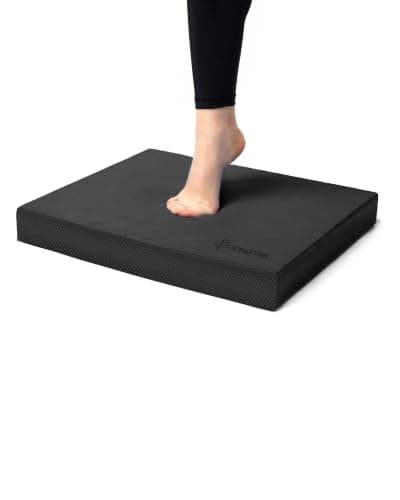
2. Two-foot stand on the pad— 30 seconds, 3 times
Stand on a foam balance pad with both feet, hip-width apart, one hand on the counter. When 30 seconds is easy, use fingertips only. Then hands off, counter still within reach. Then, only then, eyes closed.
3. Heel-to-toe walk— 10 steps, 3 times
Walk in a straight line placing the heel of one foot directly in front of the toes of the other, so they almost touch. Keep your eyes on a fixed point ahead, not on your feet. Trail one hand along the counter.
4. Balance walk— 20 steps, 2 times
Walk in a straight line, raising the back leg and pausing for one second with it off the floor before stepping. Arms out to the sides at shoulder height. Along the counter to begin with.
5. Stand on one foot— 10 seconds each side, 3 times
Hold the counter, lift one foot so the ankle clears the floor, and hold. Build to fingertips, then to hands hovering. Swap sides. The CDC names standing on one foot as an example of a balance activity.
6. One foot on the pad— 10 seconds each side, 2 times
The hardest item here and the last one to attempt. Stand on the foam pad on one foot, with a hand on the counter throughout — not fingertips, a hand. Stop the moment your standing ankle starts to fatigue.
Exercises drawn from National Institute on Aging guidance. treadandtone.com — not medical advice.
Press Ctrl+P (or Cmd+P on a Mac) to print just this card. There is nothing to sign up for.
Where these come from
The National Institute on Aging lists balance as one of four exercise types older adults need, alongside endurance, strength and flexibility, and it names specific exercises: standing on one foot, the heel-to-toe walk, the balance walk, standing up from a seated position, and tai chi as a “moving meditation”.
The CDC’s guidance for adults 65 and over asks for activities to improve balance alongside 150 weekly minutes of moderate activity and two days of muscle strengthening, and gives standing on one foot as its example.
The routine above uses those exercises. The orderingby difficulty, and the decision to add a foam pad to two of them, is our editorial judgment rather than something either authority specifies — and we would rather say so than imply the NIA published a six-step program.
Why it matters
The CDC reports that more than one in four adults 65 and over falls each year, that falling once doubles the chance of falling again, and that fewer than half of people who fall mention it to a doctor. The National Institute on Aging notes that improved physical function reduces both the risk of falling and the likelihood of serious injury if you do.
Eight minutes and a $25 pad is an unusually good ratio of effort to benefit. It compares favorably with every machine on this site.
The three rules
1. Something solid within arm’s reach, always.A counter, a heavy table, a doorframe. Not a dining chair that slides, and not a wall you would have to fall against to reach. This is not a caution bolted onto the routine — it is what makes working at the edge of your balance a sensible thing to do.
2. Short and frequent beats long and occasional. Balance work fatigues the small stabilizing muscles in the ankle and hip quickly, and a fatigued ankle is how a session ends badly. Eight minutes twice a day beats half an hour on Sunday, and it is far more likely to keep happening.
3. Progress by reducing support, not by increasing height. The route from easy to hard is: two hands, one hand, fingertips, hands hovering, eyes closed. It is not a taller pad or a wobblier board. Height is the risk multiplier, which is why we recommend against the 6-inch spring board on our board page.
Where to put the pad
Beside whichever kitchen counter you already stand at, and leave it there. This sounds trivial and it is the single biggest determinant of whether the routine happens.
A pad in the spare room requires a decision every time. A pad by the kettle gets stood on while the kettle boils, which is how anybody accumulates practice without scheduling anything. Every pad on this site weighs under 7 lb and one weighs 12 ounces, so there is no reason it cannot live where you are.
When to see someone instead
Nobody producing this site is a physical therapist, and this routine is general information rather than a program designed for you. See a doctor or physical therapist first if any of these applies:
You have had a fall in the past year.
You feel dizzy or lightheaded when you stand up.
Your balance has changed noticeably or suddenly.
You have numbness or tingling in your feet.
You have a diagnosed inner-ear, neurological or vision condition.
Your medication has changed recently.
The National Institute on Aging lists inner-ear problems, vision changes, blood-pressure drops on standing, nerve damage in the feet and medication side effects among the causes of balance problems in older adults. Several of those are treatable, and none of them is addressed by standing on foam. A physical therapist can also give you a routine matched to what your balance system is actually struggling with, which a printable card cannot.
If a counter-based routine is not the format that sticks for you, there is one alternative with real published support behind it for the same outcome. NCCIH reports evidence supporting a beneficial effect of yoga on balance in community-dwelling older adults — while also noting that yoga injuries treated in emergency departments are more common past 65 than in younger adults. Our chair yoga guide covers both halves of that, and which poses to leave alone.
General information, not medical advice. Tread & Tone is written by an enthusiast, not a clinician. Nobody here is a doctor, a physical therapist or a trainer, and nothing on this site has been medically reviewed. Talk to your doctor or physical therapist before starting something new, particularly after surgery, a fall, or a change in medication.
Questions people ask
What are the best balance exercises for seniors?+
The National Institute on Aging names several directly: standing on one foot, the heel-to-toe walk, the balance walk, standing up from a seated position, and tai chi as a modality. The routine on this page uses those, ordered from easiest to hardest, with a foam pad added for the two that benefit from an unstable surface. All of them are done beside a counter.
How often should I do balance exercises?+
The CDC's guidance for adults 65 and over includes balance activities as part of the weekly routine but does not set a session count. In practice short and frequent wins: this routine takes about eight minutes and doing it twice a day beside the counter accumulates far more practice than one planned weekly session. Little and often is how balance improves.
Do I need equipment for balance exercises?+
No. Four of the six exercises here need nothing but a counter to hold. A foam pad at about $25 to $37 adds an unstable surface for two of them, which increases the challenge without increasing the height — and height is the risk multiplier. Start with the four free ones; buy the pad if they become easy.
How long before balance improves?+
We are not going to give you a number, because we have no basis for one and anybody who does is guessing. What the National Institute on Aging does say is that improved physical function reduces both the risk of falling and the likelihood of serious injury from a fall. The honest measure of progress is the exercises themselves: when 30 seconds becomes easy, or you can drop from a hand to fingertips, that is the improvement.
Is it safe to do these alone?+
Beside a counter, with the progression respected, yes — that is what the counter is for. If you have had a fall, feel dizzy when you stand, or have a diagnosed balance condition, ask your doctor or a physical therapist before starting, and consider having somebody in the room the first few times. The CDC notes that fewer than half of people who fall mention it to their doctor.
Can I print this routine?+
Yes — that is what the card below is for. Print this page and everything except the routine card is dropped, so you get a clean single sheet to keep by the counter or on the fridge. No sign-up, no email address, no download.
CDC — Facts About Falls — More than one in four adults 65 and over falls each year; falling once doubles the chance of falling again (read July 24, 2026)
CDC — Older Adult Activity: An Overview — At least 150 minutes a week of moderate-intensity activity, 2 days of muscle strengthening, plus balance activities for adults 65 and over (read July 24, 2026)
Product measurements are cited individually inside each Fit-to-You panel, against the manufacturer page or dated retailer listing they were read from.