Chair Exercises for Seniors
Which chair to use — and it matters more than the exercises — followed by a routine that takes twelve minutes.
Read the guideStart with the seated half and treat the standing half as balance training, because that is what it is. The published evidence is strongest on balance — and so is the published injury risk.
How this is funded: we earn a commission if you buy through our links, at no extra cost to you. It never changes what we recommend, and every page here names at least one thing we would not buy. Full disclosure.
The short answer
Chair yoga is yoga with the chair doing the job the floor usually does: seated poses done sitting, standing poses done holding the chair back. Start with the seated half — the risk there is close to zero and the stiffness benefit arrives quickly. Treat the standing half as balance training, because that is exactly what it is, and it is also the half the injury statistics are about. The NCCIH notes evidence supporting a beneficial effect of yoga on balance in older adults living in the community, and in the same breath notes that yoga injuries treated in emergency departments are more common past 65 than in younger adults. Both facts point at the same advice: keep hold of the chair longer than you think you need to.
There are thousands of chair yoga videos and very few pages that tell you what the published evidence actually says, which parts of a class to be careful with, and how it differs from the chair exercises you may already be doing. That is what this page is for.
A chair yoga class has two distinct halves, and conflating them is how people get into trouble.
The seated half. Spinal twists, side bends, forward folds, shoulder and neck work, seated cat-cow, ankle and wrist circles, and breath work. You are sitting throughout. The risk here is genuinely low, the range-of-motion benefit is the fastest to appear, and this is where somebody new should spend the first few weeks.
The standing half.Poses done beside the chair with one or both hands on the back of it — a supported warrior, a chair-assisted tree, calf raises, standing side bends. This is more effective and it is also, plainly, balance work performed near a support. Which is excellent — balance work is the highest-value exercise on this site — as long as you treat it with the care balance work deserves.
And what it is not: a strength program or a cardio session. It will not get your heart rate into a training zone and it will not build much muscle. The National Institute on Aging’s four types of exercise are endurance, strength, balance and flexibility; chair yoga covers the last two well and the first two barely. Treat it as two of four rather than as the whole thing.
We are going to quote the NCCIH twice, because both halves matter and most pages on this topic only use the first one.
On the benefit: “Several newer studies have provided additional evidence supporting a beneficial effect of yoga on balance in community-dwelling older adults.” That is a measured statement rather than a headline, and it points at the outcome that matters most here. Set it against the CDC’s figure that more than one in four adults 65 and over falls each year, and a practice that improves balance is not a wellness nicety.
On the risk: “Older adults may need to be particularly cautious when practicing yoga. The rate of yoga-related injuries treated in emergency departments is higher in people age 65 and older than in younger adults.” NCCIH also says that older adults and people with health conditions “should talk with their health care providers and the yoga instructor about their individual needs”, and adds a line worth repeating: “Don’t use yoga to postpone seeing a health care provider about a medical problem.”
Nobody here is a clinician and nothing on this site has been medically reviewed. What that statistic changes, practically, is three things:
Week one and two: seated only. Ten minutes, seated poses, every day or most days. Breath first, then gentle spinal movement, then shoulders and neck. You are establishing a habit and learning what your range is today, which is the information the rest depends on.
Week three: add the chair-supported standing poses, two hands on the chair. Both hands, every time, for at least a fortnight. The point is not to need the chair less — it is to be doing balance work safely enough to keep doing it.
Later: one hand, then fingertips. This is the progression, and it is the same one our balance exercise guide uses for standing drills: reduce the support rather than increase the difficulty of the movement. If you ever need to grab, you have progressed too fast; go back a stage and stay there longer.
The chair itself decides a lot of this. Four legs on the floor, no wheels, no swivel, no arms if you can manage it. Our chair exercises page is built around exactly that choice, because the wrong chair makes the identical routine both harder and less safe.
| Machine | Standing surface | Thickness | Needs support nearby | Weight capacity |
|---|---|---|---|---|
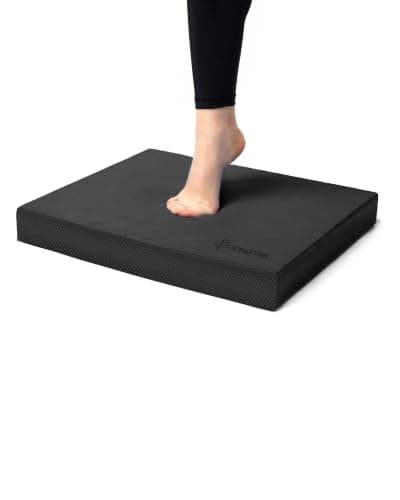
| StrongTek Extra Wide TPE Balance Pad | 19 in × 15.8 in | 2.4 in | Yes — use it within reach of a wall, counter or sturdy chair. Every balance product on this page needs that | Not published by the manufacturer |
| Trideer Wobble Cushion Balance Disc | 13.4 in (34 cm) diameter | 2 in | Yes | Not published by the manufacturer |
Neither publishes a weight capacity, which is worth saying out loud about products people stand on. Both publish their dimensions precisely, and the dimension that matters for the pad is the one in the first row: a standing surface with room for two feet side by side plus margin is the difference between a balance exercise and a stumble off an edge.
Three questions that sort the good from the generic, all of which can be asked in a short phone call or read off a class description:
Does the instructor ask about conditions before the first class?This is the single best signal, and it is exactly what NCCIH’s advice implies — talk with the yoga instructor about your individual needs. An instructor who does not ask cannot adapt.
Are standing poses offered rather than assumed? A good chair yoga class has a seated version of everything. A class where the standing section is the main event and the chair is a prop is a regular class with chairs in the room.
Is it described as chair yoga rather than gentle yoga?“Gentle” usually still means getting down to a mat, which is the exact barrier chair yoga exists to remove. If getting down to and up from the floor is the problem, ask directly.
And if you are practising from a video at home, the honest advice is to use it as a sequence to copy rather than a teacher to follow. Pause it. Skip things. Come out early.
Related reading: our printable balance routine is four exercises on one page you can keep beside the chair, and warming up and cooling down covers where a short seated sequence fits around the rest of a week’s activity.
General information, not medical advice. Tread & Tone is written by an enthusiast, not a clinician. Nobody here is a doctor, a physical therapist or a trainer, and nothing on this site has been medically reviewed. Talk to your doctor or physical therapist before starting something new, particularly after surgery, a fall, or a change in medication.
Yoga adapted so the chair takes the place of the floor: seated poses done sitting, and standing poses done holding the chair back instead of balancing unaided. It is not a watered-down class — the breath work and the held positions are the same, and removing the getting-down-to-and-up-from-the-floor problem is what makes the rest accessible. NCCIH describes yoga as 'an ancient and complex practice, rooted in Indian philosophy', of which the physical postures are one part.
Safer than mat yoga for most people past 70, and not risk-free. NCCIH is direct about the age pattern: 'Older adults may need to be particularly cautious when practicing yoga. The rate of yoga-related injuries treated in emergency departments is higher in people age 65 and older than in younger adults.' Its standing advice is to talk with both your health care provider and the yoga instructor about your individual needs. The practical reading is that the seated half is very low risk and the standing-at-the-chair half deserves the same care as any balance work.
On balance, there is real published support: NCCIH notes that 'several newer studies have provided additional evidence supporting a beneficial effect of yoga on balance in community-dwelling older adults'. Given that the CDC reports more than one in four adults 65 and over falls each year, balance is not a small outcome. On flexibility and on the feeling of being less stiff, most people notice something within a fortnight. What chair yoga does not do much of is build strength or endurance, so it supplements rather than replaces the rest.
Chair exercises are repetitions: a count of arm raises, a set of seated marches, done to build strength or get the heart rate up. Chair yoga is positions held with attention on the breath, done to improve range, balance and how your body feels. Both are worth doing and they are not substitutes. If you want one sentence: chair exercises change what you can do, chair yoga changes how comfortably you can do it.
A stable dining chair with four legs on the floor, no wheels, no swivel, and ideally no arms so your hips and arms are not boxed in. A chair that rolls or rotates turns a held position into an unplanned movement, and an armchair prevents half the seated poses outright. Our page on chair exercises goes into the chair itself in detail, because it decides more than the routine does.
No. A chair and enough floor space to put your arms out is the whole requirement, which is the main reason this is the most-started form of exercise on this site. Two optional things earn their keep: a light resistance band if you want to add gentle load to seated shoulder and arm work, and a foam pad for the standing-at-the-chair balance poses once those feel easy — the pad reintroduces the instability a floor removes.
Product measurements are cited individually inside each Fit-to-You panel, against the manufacturer page or dated retailer listing they were read from.
Which chair to use — and it matters more than the exercises — followed by a routine that takes twelve minutes.
Read the guideSix exercises from the National Institute on Aging, in order of difficulty, with a printable one-page version to keep by the counter.
Read the guideEight movements you can do from a dining chair, and where equipment genuinely adds something rather than just costing money.
Read the guideFive minutes at each end that make the middle safer and more comfortable, a gentle routine for stiff joints, and why the machine itself is the easiest warm-up there is.
Read the guideA room-by-room list drawn from CDC and NIA guidance, ordered by how much difference each change makes relative to its cost.
Read the guideBest Balance Gear
Pads, cushions, boards and rails ranked by how safely you can start — including the one we tell you not to start on.
Top pick: StrongTek Extra Wide TPE Balance Pad
Price as of October 11, 2026. #ad How we’re funded