Chair Exercises for Seniors
Which chair to use — and it matters more than the exercises — followed by a routine that takes twelve minutes.
Read the guideEight movements from a dining chair, taking about twelve minutes. Then the honest part: where equipment genuinely adds something, and where it is just a purchase.
The short answer
Eight movements from a firm dining chair, working upward from the ankles, taking about twelve minutes: ankle pumps, heel and toe raises, knee extensions, seated marching, shoulder rolls, arm raises, trunk rotation, and sit-to-stand. No equipment needed. Do them most days rather than occasionally, and stop at movement four if twelve minutes is too much.
Before anything else. Use a firm dining chair: flat seat, no wheels, ideally with arms, at a height where your feet rest flat on the floor with your knees at roughly a right angle.
Not an armchair — a soft, deep seat changes every movement below and makes sit-to-stand much harder than it needs to be. Never an office chair with castors, which will move at the worst possible moment.
If your feet do not reach the floor comfortably, put a book under them. If the chair is too low to stand up from easily, add a firm cushion. Both are free and both change the whole routine.
The order is deliberate: it works from the ankles upward, so that by the time you reach sit-to-stand everything below it has already moved. If you stop partway, you will still have done something coherent.
About twelve minutes at a comfortable pace. Breathe throughout — the commonest error in seated work is holding your breath during the effort.
Slower is better than more. Ten controlled knee extensions with a two-second hold do more than twenty rushed ones, and the slow lowering phase is where most of the useful work happens. That applies especially to sit-to-stand: the three-second sit is the important half.
It is last on the list and first in importance. It is the movement you perform most often in a day without thinking about it, and it is the one whose loss changes a life most — getting out of a chair, off a toilet, out of a car, out of bed.
The National Institute on Aging includes standing up from a seated position among its balance exercises, which is worth noting: it is simultaneously strength work and balance work, which very few movements are.
Use the chair arms as much as you need. Five with arms is better than none without. Over weeks, the progression is to use them less — two hands, then one, then a light touch — rather than to do more repetitions.
This is a site that sells equipment, so it is worth being precise about what a purchase does and does not add here.
It does not add strength work. Everything above already does that with your own body weight, and adding load is better done with a $12 resistance band or a pair of light hand weights than with a machine.
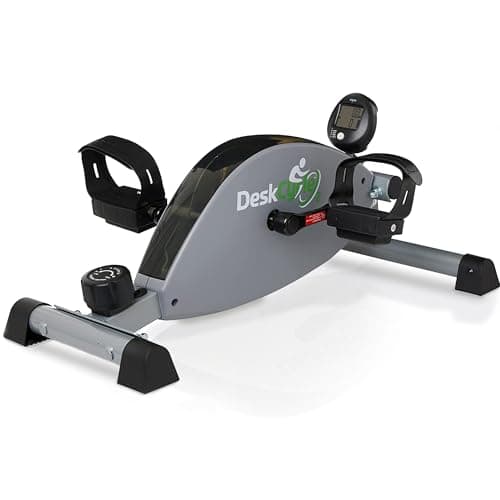
What it does add is continuous aerobic work. The routine above is repetitions: you count, you stop, you count again. A pedal exerciserunder the same chair lets you move continuously for fifteen or twenty minutes, which is a genuinely different stimulus and the one the CDC’s 150 minutes is describing. It costs about $50 to $170.
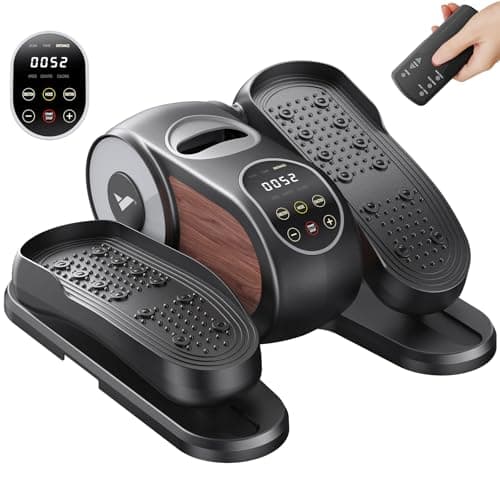
And if starting the pedal motion is itself the barrier, a motorized seated elliptical will move your legs through the stride for you. Be clear about what that is: passive movement, which keeps joints moving and helps circulation, but does not build strength because there is no load to adapt to. It is a bridge to being able to pedal yourself, not a destination. Our shortlist of exercise pedals for disabled adults ranks the motorized units on the things that decide it — the straps and calf supports that hold a limb in place, and what each machine does when a leg stops rotating.
If the chair in question is a wheelchair, the fit question is different again: the unit has to clear your footplates and sit low enough relative to your seat cushion. Exercise bikes for wheelchair users works through both measurements, and explains why a recumbent exercise bike is usually the wrong machine despite being what the search results hand you.
The National Institute on Aging lists improved physical function and mobility among the benefits of regular activity for older adults, and notes that better physical function reduces the risk of falls and the likelihood of serious injury from one.
What we are not going to do is put a timescale on that for you. We have no basis for one, and anybody offering “results in three weeks” is guessing. The honest measure of progress is the routine itself: when the knee extensions stop being a challenge, when you need one chair arm instead of two, when twelve minutes stops feeling like twelve minutes.
Stop and speak to your doctorif you get chest pain or pressure, unusual breathlessness, dizziness, or sharp rather than achy pain anywhere. And if your mobility is limited by a diagnosed condition, a physical therapist can give you a routine matched to it — which this page cannot, because nobody producing it is qualified to assess you.
For a shorter, gentler version built around which chair to use, our chair exercise guide covers the same ground in twelve minutes with fewer movements.
One constraint worth separating out, because it changes which machine is usable rather than which exercise is: reduced sensation in the feet. A foot you cannot feel will not report that it is sliding off a pedal, which makes pedal retention a buying specification rather than a comfort feature. Our shortlist for neuropathy ranks every machine on whether the maker publishes straps, counterbalanced pedals, or a lock that holds the pedals still while you load them — four of sixteen do.
General information, not medical advice. Tread & Tone is written by an enthusiast, not a clinician. Nobody here is a doctor, a physical therapist or a trainer, and nothing on this site has been medically reviewed. Talk to your doctor or physical therapist before starting something new, particularly after surgery, a fall, or a change in medication.
A surprising amount, from a chair. The routine on this page works ankles, knees, hips, shoulders and trunk in about twelve minutes, and it needs no equipment. The CDC's guidance for adults 65 and over is written in terms of moderate-intensity activity rather than particular movements, and its own materials note that anything that gets you moving and breathing harder counts.
If they reach moderate intensity, yes — the CDC's target is about intensity rather than about which movement you perform. Whether a seated routine reaches it depends on how vigorously you do it. Gentle range-of-motion work probably does not; twelve minutes of continuous seated marching and arm work at a pace that leaves you breathing harder probably does.
A firm dining chair with a flat seat and no wheels, ideally with arms, at a height where your feet rest flat with knees at roughly a right angle. Not an armchair, and never an office chair with castors. The chair matters more than the exercises — a soft chair changes every movement and a rolling one is a hazard.
Most days, and short beats long. Twelve minutes daily is more useful than forty minutes twice a week, both because the movements are about maintaining range of motion and because a short routine is one you keep doing. If twelve minutes is too much, do the first four movements — they are ordered so that stopping partway still leaves you with a coherent routine.
No. Everything on this page needs a chair. Where equipment genuinely adds something is continuous aerobic work — a pedal exerciser under the chair lets you keep moving for twenty minutes rather than counting repetitions, which is a different kind of exercise. Light hand weights or a resistance band add load once the bodyweight versions become easy.
It maintains range of motion and it works muscle, which is worth a great deal. Whether it is enough for your situation is a question for a physical therapist rather than a website — and if mobility is limited by a diagnosed condition, a therapist can give you a routine matched to it, which a general page cannot. Nobody producing this site is qualified to assess you.
Product measurements are cited individually inside each Fit-to-You panel, against the manufacturer page or dated retailer listing they were read from.
Which chair to use — and it matters more than the exercises — followed by a routine that takes twelve minutes.
Read the guideBest Pedal Exerciser
Pedal height is the spec that decides whether your knees hit the desk, and exactly one manufacturer publishes it as a range.
Top pick: DeskCycle DeskCycle 2 Under Desk Bike
Price as of October 22, 2026. #ad How we’re funded
Best Seated Elliptical
Motorized or self-powered is not a feature comparison, it is two different products. Which one your legs actually need.
Top pick: MERACH Under Desk Elliptical MR-E32
Price as of October 22, 2026. #ad How we’re funded
Hip precautions change which machines are sensible and which are off-limits at first. What that means for bikes, treadmills and seated cardio, and why your care team decides.
Read the guide