The short answer
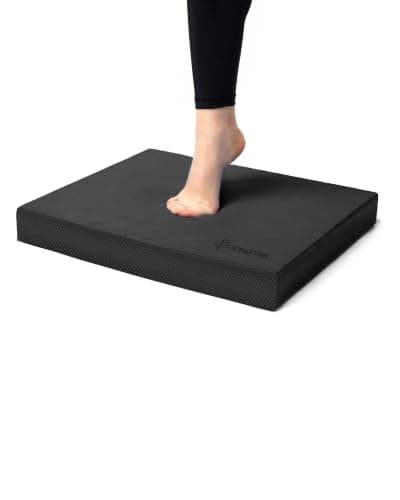
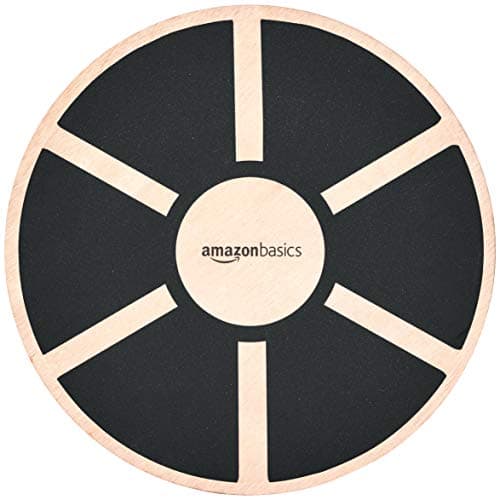
Start with the foam pad. It sits almost flat on the floor, gives a little under your foot, and never tips you — so it trains balance without adding a fall risk. A rigid balance boardactively tilts and sits higher up; it is a genuine next step once you are steady on the pad, not a starting point. Decide by your fall history, how steady you are today, and what you can hold onto — and use either one within arm’s reach of a counter or rail.
Two balance tools, side by side on what actually separates them for an older beginner.| What you care about | Balance pad (foam) | Balance board (rigid, tilts) |
|---|
| How it challenges you | The foam compresses unevenly — the ground gives, but stays put | The platform physically tilts under your weight |
|---|
| Height off the floor | Low — a couple of inches of foam, close to standing on the floor | Higher — the platform holds you up on its base, roller, or dome |
|---|
| How forgiving of a wobble | Very — a stumble puts your foot back on the floor | Less — an edge can drop faster than an older ankle reacts |
|---|
| Who should start here | Almost every older beginner | People already steady on a pad, moving up on purpose |
|---|
| What to hold | A counter or rail within reach — wise, not always essential | A counter or rail within reach — essential, especially early |
|---|
| Price | Inexpensive — usually the cheaper of the two | A little more, and it varies widely by type |
|---|
The one difference that decides everything: the floor moves, or it doesn’t
Both tools do the same job in principle. They make standing slightly harder than it is on a solid floor, which forces the small muscles around your ankles, knees, and hips to keep making the tiny corrections that keep you upright. That is balance training, and it is one of the four kinds of exercise the National Institute on Aging names as worth doing as you age, alongside endurance, strength, and flexibility. So far, so equal.
The difference is in how each one makes standing harder. A foam pad stays exactly where you put it. What changes is the surface: the foam sinks a little under the heavier parts of your foot, so the ground feels soft and slightly uneven, and your ankles have to keep hunting for level. It never moves you anywhere. If you wobble, your foot comes back down onto foam, and the foam is sitting on the floor.
A balance board does the opposite. It is a rigid platform on a curved rocker, a roller, or a rounded dome, and the instant your weight shifts, the platform tilts to follow it. The board moves you, and it can drop an edge quicker than a stiff older ankle can answer. It also holds you higher off the floor than a pad does, so there is more distance to fall through if the correction comes late. None of that makes a board bad. It makes it a bigger, faster, less predictable challenge — which is exactly why it belongs later.
Why nearly everyone should begin with the pad
The case for starting on the pad is not that the board is dangerous in some absolute sense. It is that the pad lets you build the exact control the board will later demand, on a surface that forgives your mistakes while you are still making them.
This matters more with age than most equipment marketing lets on. The CDC reports that more than one in four adults aged 65 and over falls each year, and that falling once roughly doubles the chance of falling again. When you buy a balance tool, you are stepping into that statistic on purpose — deliberately making yourself unsteady in order to get steadier. That is a good trade only if the tool fails gently. A pad fails gently: the worst it usually does is drop your foot back to the floor. A board can fail all at once.
So the pad is where the ankle and hip muscles learn the job. Weeks of small, safe corrections on foam build the reactions that a board will eventually test at a higher speed and a greater height. Try to buy those reactions by starting on the board, and you are asking untrained muscles to catch a moving platform — which is how a piece of balance equipment quietly becomes the cause of the fall it was meant to prevent. Our guide to the best balance equipment puts the pad first for exactly this reason.
When a board is a sensible next step — not a fall risk
A rigid board is not a mistake. It is a progression, and there is a point where moving up to one is the right call rather than a reckless one. You are ready to think about it when a few things are true at once.
- You are genuinely steady on the pad. Not white-knuckling the counter, but able to stand on the foam, shift your weight, and hold it comfortably. If the pad still feels like work, the board is not next yet.
- Your recent history is on your side. No recent fall, no new dizziness, no fresh unsteadiness. Balance problems can be a signal worth raising with a doctor, and the National Institute on Aging treats a change in balance as a reason to check in rather than to push harder on your own.
- You have something solid to hold.A board should be used in a doorway, beside a kitchen counter, or next to a fixed rail — somewhere a fingertip can find support the instant the platform tilts too far.
- Ideally, someone has watched you. If you have a physical therapist, or you can get one session, having them see you step onto a board is worth more than any article. They can watch the actual joint move, which we cannot.
Even then, boards are not one thing. A gently rocking board that tilts on a single axis is a world away from a wobble board on a dome that can tip in any direction. If you do move up, start with the tamest board you can find and treat it the way you treated the pad on day one: low, slow, and holding on. Our shortlist of balance boards for seniors leans hard toward the forgiving, single-axis end for this reason, and our guide to whether wobble boards are safe for seniors walks through the specific board types in more detail.
How to actually decide
Strip away the product names and it comes down to three honest questions about you, not about the gear.
Have you fallen recently, or do you feel unsteady on a normal floor?If yes, this is a pad decision, full stop — and a conversation with your doctor before you start either one. Both tools assume you can already stand safely on solid ground before you make the ground harder.
How steady are you today, honestly?A beginner, or anyone getting back into movement, starts on the pad. Someone who is already active and comfortable, and who wants to push balance further, is the candidate for a board — after the pad, not instead of it.
What can you hold onto where you’ll use it?Whichever you choose, set it up within arm’s reach of something solid and immovable. That single habit — always inside reach of a counter or rail — is what lets you push the difficulty safely on either tool, and it is the one rule that does not change no matter which side of this comparison you land on.
For most readers of this page, the answer is the same and it is not a compromise: buy the pad, get steady on it over a few unhurried weeks, and only then decide whether a board is a step you actually want. If you would like the full picture of what belongs in a home balance kit — and what to do with it — our balance exercises for seniors guide picks up where this one leaves off.