Recumbent Bike vs Walking
One is weight-bearing and builds bone; the other is not and never will be. Which answers your reason for exercising — and why for most people the honest answer is both.
Read the guideThese two machines are bought by the same person for opposite reasons. One is weight-bearing and trains your balance; the other removes balance from the equation entirely — and that is not a tie-breaker, it is the decision.
How this is funded: we earn a commission if you buy through our links, at no extra cost to you. It never changes what we recommend, and every page here names at least one thing we would not buy. Full disclosure.
The short answer
Buy the recumbent bike if a joint or your balance is the reason you are shopping: you are seated, supported, and there is nothing to fall off, which is why it is the machine most people over 60 will actually use daily. Buy the walking pad if bone density or keeping an existing walking habit going is the reason: walking is weight-bearing and cycling is not, and no amount of pedalling changes that. If you want the one-line version of the specification that decides it, the bike wins on getting on and off, and the pad wins on what the exercise does for your skeleton.
These two machines keep appearing on the same shortlist, usually because somebody has been told to “get more active” and is looking at what fits in the spare room. They are not close substitutes. They sit at opposite ends of a single trade: how much of your own body weight the exercise asks you to support. A recumbent bike takes essentially all of it off you. A walking pad asks for all of it, on one leg at a time. Everything else — footprint, price, noise, what the console does — follows from that one difference.
Walking builds bone. Cycling does not.This is the part of the comparison that is not a matter of preference. NIAMS’s guidance on exercise for bone health explains that bone is living tissue that responds to exercise by becoming stronger, and that weight-bearing exercises “produce a force on bones that makes them work harder” — with brisk walking, climbing stairs and dancing given as the examples. Sitting on a padded seat while your legs turn a crank produces no such force. If low bone density is in your notes, that single paragraph reorders this whole comparison, and NIAMS also says anyone with low bone density or osteoporosis should talk to a health care provider before starting an exercise program.
And a bike cannot be fallen off. This is the mirror-image argument, and it is just as decisive in the other direction. The CDC reports that more than one in four adults 65 and over falls each year, and that falling once roughly doubles the chance of falling again. A walking pad is a moving surface you stand on, and most of them have nothing whatsoever to hold. If your balance is the reason you are exercising rather than an incidental detail, the seated machine is not the cautious choice — it is the correct one.
Everything else about these machines is a matter of degree. That first pair of paragraphs is a matter of kind, which is why we have put it before the table.
| What you care about | Recumbent bike | Walking pad |
|---|---|---|
| Weight-bearing (bone) | No. You are seated and supported throughout | Yes. This is the one thing it does that the bike cannot |
| Balance demand | None. Nothing to fall off | Real. Six of the nine machines we track have nothing to hold |
| Getting on | Sit down. One bike publishes a 20.9 to 22.4 in seat height — dining-chair height | Step up onto a moving deck; two machines publish the step-up, at about 4.1 to 4.3 in |
| Joint load | Minimal. Continuous motion with no impact | Your body weight on each step, cushioned to a degree nobody quantifies |
| Floor space | Permanent. 50 to 66 in long, and it does not fold | 4 to 6.5 in high, stores upright or under furniture |
| Weight to move | 63.8 to 123 lb assembled across the bikes we track | 41.5 to 67.7 lb published, most with transport wheels |
| Assembly | Usually required; makers claim 70 to 90 percent pre-assembled | Most flat pads arrive ready to use; the railed Sunny Pacer needs assembling |
| Upper body | Available on some — one bike's handlebars move with or without the pedals | Nothing. It is a walking machine |
| Trains your gait | No. A pedal stroke is not a step | Yes, and that transfers to walking outdoors |
If you have settled which machine you want, the specifications that matter are different enough that it is worth saying them separately.
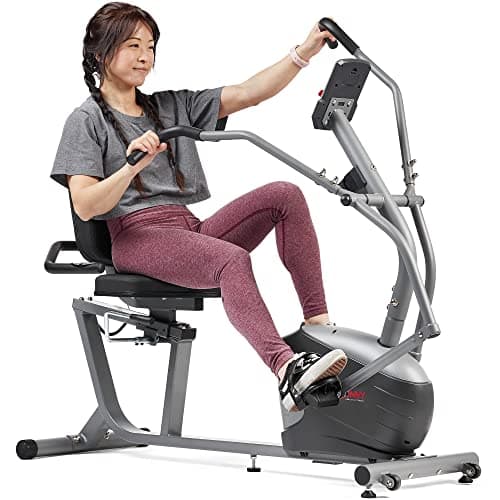
On a recumbent bike, chase the numbers that decide whether you can get on. Seat height is the one that matters most and almost nobody publishes it — one bike in our registry does. Next is whether the seat slides continuously or clicks into fixed notches, because seat distance is the setting most owners get wrong, and then the published weight capacity, which is the easiest spec in the category to state and therefore the most telling when it is missing. Step-over height, the number that would answer the entry question outright, is published by nobody at all — our guide to measuring it yourself exists because of that gap.
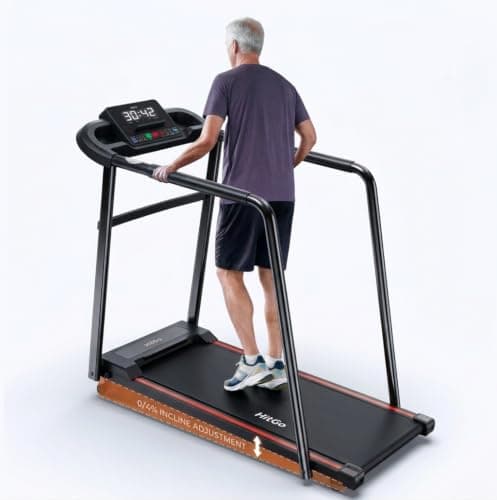
On a walking pad, chase belt length and whether there is a rail.Six of the nine walking machines we track publish a belt length, and those six span nearly ten inches — from 36 to 45.7 inches — which is the difference between walking normally and shuffling to stay off the back roller. Then look for something to hold: three machines publish rails or a handlebar, and six publish nothing because there is nothing there. Minimum speed matters more than top speed, since a walking machine that will not go below 1 mph is no use for a cautious first week. We go through the whole list in how to choose a walking pad, and rank the long-belt machines in the best walking pads for tall walkers.
| Machine | Weight capacity | Footprint | Assembly and box weight |
|---|---|---|---|
| Sunny Health & Fitness Smart Recumbent Bike with Dual-Motion Arm Exercisers | 265 lb | 63.8 in long × 26.4 in wide × 49.6 in high | 91.3 lb shipping weight, in a 56.3 × 9.8 × 23.6 in box; 77.4 lb assembled |
| HARISON Recumbent Exercise Bike, 450 lb capacity | 450 lb | 54.6 in long × 25.7 in wide × 46.2 in high | Not published by the manufacturer |
| Sunny Health & Fitness Pacer 2-in-1 Auto Incline Treadpad Treadmill | 265 lb maximum, and a 99 lb MINIMUM user weight — Sunny publishes both ends | 58.2 in long × 26.4 in wide × 47.4 in high in use; 63.9 × 26.4 × 7.7 in with the handlebar folded down. Product weight 79.4 lb | Assembly required; Sunny describes an easy-to-assemble frame setup and publishes a 93.7 lb ship weight in a 64.2 × 27.2 × 7.1 in carton |
| HitGo Walking Pad with Handrails | 250 lb | The listing's dimension fields give 40.6 in × 19 in × 4.1 in, which cannot describe the assembled machine — the belt alone is published at 43.3 in long. Reported as published; no assembled footprint is stated that we can cite | Stated 90% pre-assembled, 12 bolts to tighten; 59.5 lb machine weight |
Two things in that table are worth saying out loud. The walking machines are the lighter objects, which is counter-intuitive until you remember that a bike has to be heavy enough to sit still while you push against it. And the bikes publish higher capacities — up to 450 lb against the pads’ 245 to 350 lb — which is the usual pattern, because a frame holding a seated rider is a simpler engineering problem than a motor and belt taking a heel strike.
For a lot of readers the right answer is both, and that is less extravagant than it sounds — a walking pad and a budget recumbent bike together often cost less than one premium machine. They cover each other exactly: the bike gives you joint-friendly minutes on a day when a knee or a hip is complaining, and the pad gives you the weight-bearing work and the gait practice the bike cannot. The CDC’s recommendation for adults 65 and over is at least 150 minutes a week of moderate-intensity activity plus two days of muscle-strengthening and separate balance work — and nothing in that sentence is satisfied by one machine.
If it has to be one, use this order. Have you fallen, or do you avoid things because of your balance?Buy the bike, and do your balance work separately on the floor — our printable balance routine needs no equipment at all. Have you been told your bone density is low? Buy the walking pad, with a rail, and read our page on walking pads and osteoporosis first. Is a specific joint the reason? Buy the bike. Is it that you already walk and winter is coming? Buy the pad; you are replacing a habit, not starting one, and the machine that resembles what you already do is the one you will use.
One last note on the third option people forget. If neither machine quite fits — because the room is tiny, the budget is small, or standing is genuinely not available — a seated pedal unit under a chair does a smaller version of the bike’s job for a fraction of the money and none of the floor space. We compare that against a pad in under-desk bike versus walking pad.
General information, not medical advice. Tread & Tone is written by an enthusiast, not a clinician. Nobody here is a doctor, a physical therapist or a trainer, and nothing on this site has been medically reviewed. Talk to your doctor or physical therapist before starting something new, particularly after surgery, a fall, or a change in medication.
Whichever one matches the reason you are shopping. If your concern is a joint that objects to impact, or you have had a fall and do not trust your balance on a moving belt, the recumbent bike is the safer and more usable machine — you are seated, supported, and there is nothing to fall off. If your concern is bone density, or keeping the walking you already do going through winter, the walking pad is the one that does a job the bike cannot do at all: NIAMS is clear that weight-bearing exercise is what makes bone work harder, and sitting down is not weight-bearing.
We will not give you a number for either, and nor should anyone else without knowing your weight and your effort. Both machines estimate calories from a generic formula — not one publishes watts, which is the only figure that would make a real estimate possible. The useful answer is that the machine you will use for more minutes will do more for you, and the CDC's talk test is how you judge whether a given session counts as moderate intensity: able to talk, not able to sing.
For the activity minutes, largely yes — the CDC counts brisk walking as moderate-intensity activity whether the floor moves or you do. What a belt cannot replicate is uneven ground, turning, and the small balance corrections that outdoor walking demands of you, and those are part of why walking is protective. Treat a pad as the machine that keeps the habit alive on a dark February afternoon rather than as a complete substitute, and keep some of your walking outdoors if you safely can.
Usually the bike first, with the walking pad as something to add later. A recumbent bike unloads the joint almost completely while still moving it through its range, which is the mechanism the Arthritis Foundation describes — continuous motion produces the fluid that lubricates a joint. A belt, even a cushioned one, still asks the knee to accept your body weight on every step. Our guide on walking pads and knee arthritis goes through the specifications that make a belt tolerable if you want both, and either way this is worth raising with whoever manages your knees.
The walking pad, and by a wide margin. The flat pads we track are around 4 to 6.5 inches high and store upright or slide under furniture, where a recumbent bike occupies a 50 to 66 inch footprint permanently — it is not a machine you put away. If floor space is the binding constraint, that comparison is one-sided. If what you need is a machine you can be sitting on inside ten seconds, the bike's permanence is actually the point.
The recumbent bike, clearly. The CDC's figure is that more than one in four adults 65 and over falls each year, and that falling once roughly doubles the chance of falling again — so a moving belt is a genuine consideration rather than a theoretical one. A bike removes balance from the exercise entirely. If you want to walk anyway, buy a machine with something to hold: only three of the nine walking machines we track publish rails or a handlebar at all.
If the budget and the room allow it, that is the honest answer for a lot of people, and it is cheaper than it sounds because the two machines sit at different price points. They cover each other's gaps: the bike gives you the joint-friendly minutes on a bad day, and the pad gives you the weight-bearing work that keeps bone and balance in the picture. If you can only have one, buy the one that solves your binding constraint today — you can add the other later.
Product measurements are cited individually inside each Fit-to-You panel, against the manufacturer page or dated retailer listing they were read from.
One is weight-bearing and builds bone; the other is not and never will be. Which answers your reason for exercising — and why for most people the honest answer is both.
Read the guideBest Walking Pad
Flat pads step up in inches rather than a foot — but most have nothing to hold. The ones that solve both, and one that doesn't.
Top pick: HitGo Walking Pad with Handrails
Price as of October 22, 2026. #ad How we’re funded
Best for Seniors
Eleven bikes ranked on the measurements that decide whether you can get on — with the count of specs each manufacturer refuses to publish.
Top pick: Sunny Health & Fitness Smart Recumbent Bike with Dual-Motion Arm Exercisers
A walking pad is not a small treadmill. Four numbers decide it — belt length, what there is to hold, the slowest speed and the weight you have to move — and most listings publish two of them.
Read the guideBoth promise movement while you get on with your day. One asks nothing of your balance and the other asks for all of it — and that, not the price, is the decision.
Read the guideYes on the bone question — walking is weight-bearing and a bike is not. The problem is the other risk: most walking pads have nothing at all to hold onto.
Read the guide