Four numbers decide this purchase, and the listings publish about half of them. Here is the order to check them in, what the honest answers look like, and where the whole category goes quiet.
How this is funded: we earn a commission if you buy through our links, at no extra cost to you. It never changes what we recommend, and every page here names at least one thing we would not buy. Full disclosure.
The short answer
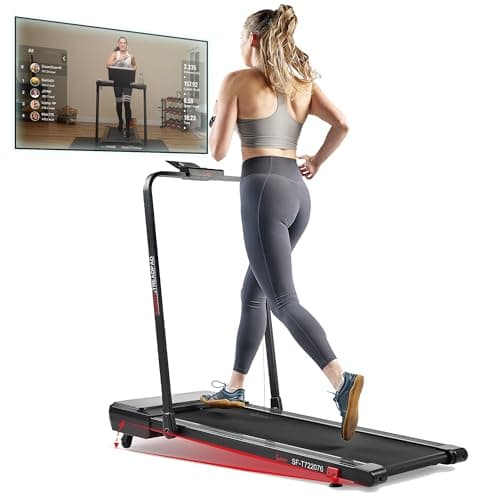
Check four published numbers, in this order: belt length(36 to 45.7 inches across the machines we track — a short belt shortens your stride), whether there is anything to hold (six of nine have nothing), the minimum speed rather than the top speed, and the machine’s own weight if you will be moving it. If you want the one-machine answer: the Sunny Pacer Treadpad publishes the longest belt here and has a handlebar that folds, which makes it the pad that fits the widest range of buyers.
A walking pad looks like a simplified treadmill, and that framing causes most of the bad purchases in this category. It is actually a different machine with a different design brief: it has to disappear under something when you are done, and every other specification has been traded against that. Once you know which trades were made, the shopping takes about ten minutes.
We should say what this guide is not. It is not a list of features to want — app connectivity, step counts, incline programs. Those are easy to compare because every listing shouts about them. This is a list of the four things that decide whether the machine suits your body and your room, which is the part the listings go quiet about.
1. Belt length, which is the one almost nobody checks
This is the first number, and it is the one most likely to be missing.Of the nine walking machines in our registry, six publish a belt length and three do not. The six that do span from 36 inches to 45.7 inches — nearly ten inches of difference in a category where every machine looks much the same in a photograph.
What a short belt does is change your gait. You shorten your stride and quicken your cadence to stay forward of the back roller, which keeps your attention on your feet rather than on the walk, and makes a brisk pace harder to hold. Since the CDC counts brisk walking as moderate-intensity activity, a deck you are negotiating works against the reason you bought it.
How to check it against yourself: walk down a hallway at the pace you would actually use indoors and have somebody mark where the same heel lands on two consecutive steps. That is your stride at that pace, and you want the belt to give you that plus clear margin at both ends. If you are tall, this is the specification that should decide the purchase, and we rank the long-belt machines in the best walking pads for tall walkers.
2. Whether there is anything to hold
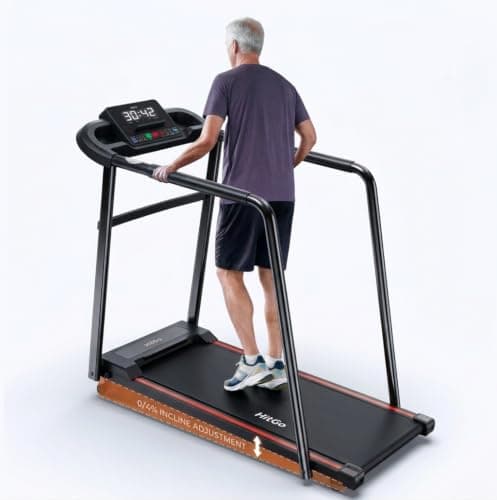
This is a yes-or-no question and it cuts the market in half. Six of the nine machines we track publish no handrail, handlebar or upright of any kind — in several listings the specification reads, in effect, “none; there is nothing to hold”. Three publish something: full-length rails on both sides, a handlebar that folds down, or a single stability bar.
A related number that almost nobody publishes: the step-up height.Two machines state it, at about 4.1 to 4.3 inches, and the rest leave it blank. It is a small step either way — this is the one accessibility advantage a flat pad has over a treadmill — but if you want to know before it arrives, measure the pad’s overall height in the dimensions field and treat that as the upper bound.
3. The minimum speed, not the top speed
Every listing in this category leads with its top speed. It is the least useful number on the page. These machines run to between 3.7 and 6.2 mph where published, and a walking program does not need the upper half of that range — one full-size treadmill in our registry publishes an 8.5 mph top speed, which is a running machine’s figure on a machine sold for walking.
What you want to know is how slow it will go.The slowest published minimums here are 0.5 and 0.6 mph, which is genuinely slow — slower than most people’s unhurried indoor pace, and exactly right for a first week, a warm-up, or a day when you want movement without effort. Four of the nine machines publish both ends of their speed range. Two publish nothing at all about speed, which on a machine whose only job is to move a belt is a strange thing to leave out.
Our guide on walking pad speed for seniors goes through what each setting is actually for. The short version: start at the bottom, add minutes before you add speed, and use the talk test rather than the display to judge whether a session counts as moderate.
4. The weight you have to move, and the capacity you must not exceed
These are two different numbers and people mix them up.
The machine’s own weightdecides whether “it folds away” is true for you. Six of the nine publish it, from 41.5 lb to 67.7 lb, almost all with transport wheels. Forty pounds on wheels is a daily chore most people will keep doing; nearly seventy is one most people will do twice and then leave the machine where it stands. Be honest with yourself about this before you buy a heavier machine on the strength of its other specifications.
The weight capacityis a ceiling to stay well under rather than a target, because a deck worked near its limit flexes and an unsteady-feeling machine is one you stop using. Two listings in the category are instructive. MERACH publishes both a 400 lb peak and a 330 lb sustained figure, and the sustained one is the number that matters because it is the one you stand on for twenty minutes — it is the only machine here that separates the two. The Kalwol, by contrast, publishes 400 lb in its title and 350 lb in its specification bullet and reconciles neither. If capacity is why you are buying, buy from a listing that states it once. Our high-capacity shortlist goes through every published figure.
What the makers publish
Four walking pads on the specifications this guide ranks. Blanks are the manufacturer's, not ours.
Machine
Belt size
Handrails
Weight capacity
Minimum speed
Sunny Health & Fitness Pacer 2-in-1 Auto Incline Treadpad Treadmill
45.7 in long × 16 in wide, which Sunny labels the running surface
A folding handlebar rather than rails on both sides. Folded down it is an under-desk pad capped at 3.7 mph; unfolded and fully extended it allows up to 6 mph
265 lb maximum, and a 99 lb MINIMUM user weight — Sunny publishes both ends
0.5 mph to 3.7 mph with the handlebar folded, 0.5 to 6 mph with it extended; 2.0 hp peak DC motor
WELLFIT Walking Pad with Incline and Handlebar
36 in long × 16 in wide, published as a multi-layer non-slip belt
One stability handlebar, published as a 2-in-1 design giving support while walking. Length in inches not published, and there are no side rails
350 lb
Not published by the manufacturer
MERACH UltraWalk W60 Walking Pad
41.3 in long × 16.5 in wide; stated as 33 percent more stride space
None. There is nothing to hold
400 lb peak and 330 lb sustained — the only machine on this site publishing both figures
Not published by the manufacturer
KALWOL Walking Pad with 14 Percent Auto Incline
40 in long × 16 in wide, published as a 7-layer belt with 10 shock-absorption points
None. There is nothing to hold
Published twice and differently: 400 lb in the listing title, 350 lb in the specification bullet. The listing does not reconcile them
0.6 mph to 6.2 mph on a stated 3.5 HP brushless motor
Read down the handrail column and you have the shape of the whole category: two of these four publish “nothing to hold”, and the two that do publish something describe a single bar rather than rails on both sides. Read down the belt column and you get the other finding — a 9.7 inch spread between the longest and the shortest, on four machines that photograph identically.
The three things not to pay extra for
Incline, mostly. Several machines here publish an auto incline up to 12 or 14 percent, changed from a remote. It is a genuine feature and it does make a given speed harder, but it is also the thing that pushes the price up most. If your reason for buying is activity minutes rather than training intensity, speed and time will get you there, and a manual incline you set once is no worse than a motorised one you will leave alone.
Decibel claims.Four listings in our registry publish a noise figure — 40, 45 and 54 dB appear — and not one publishes a test method. A seller’s average with no method behind it is not a measurement, and we report these as the claims they are. If noise genuinely matters because of a downstairs neighbour, the thing to ask about is the motor rating and the belt construction rather than the number.
App ecosystems. Most of these machines pair with something, and on the machines we track nothing in the published specifications puts the belt or the speed behind a fee. It is a log, not a key. Enjoy it if you want it, but do not let it outrank a belt length.
One last piece of advice that costs nothing: the National Institute on Aging recommends talking to your doctor before starting something new, which is worth doing before the machine arrives rather than after. And if what you actually want is to keep walking outdoors through the year with the pad as a backstop, our couch-to-walking plan is the page to read next.
General information, not medical advice. Tread & Tone is written by an enthusiast, not a clinician. Nobody here is a doctor, a physical therapist or a trainer, and nothing on this site has been medically reviewed. Talk to your doctor or physical therapist before starting something new, particularly after surgery, a fall, or a change in medication.
Questions people ask
What should I look for in a walking pad?+
Four published numbers, in this order: belt length (because a short belt shortens your stride), whether there is anything to hold onto, the minimum speed rather than the top speed, and the machine's own weight if you will be moving it. Capacity matters too, but read it as a ceiling to stay well under. Of the nine walking machines we track, six publish a belt length, three publish a rail or handlebar, four publish a minimum speed, and six publish their own weight — so you will usually be buying with at least one blank.
Is a walking pad worth it for a senior?+
It can be, if the thing you want is to keep walking when the weather or the light makes going outside unappealing. The CDC counts brisk walking as moderate-intensity activity and recommends at least 150 minutes a week for adults 65 and over, and a pad makes those minutes available at any hour. The honest caution is that most pads have nothing to hold onto, so if your balance is a concern rather than an afterthought, buy one of the few with a rail or buy a railed treadmill instead.
What minimum speed should a walking pad have?+
Low enough that your first week is comfortable — in practice 0.5 to 0.6 mph, which is slower than most people's shuffling pace. That matters more than the top speed, which on these machines runs to 3.7 to 6.2 mph and is far more than a walking program needs. Four of the nine machines we track publish a figure at both ends; the rest publish a top speed or nothing. Our guide on walking pad speed for seniors goes through what each setting actually feels like in practice.
Do I need a walking pad with a handrail?+
If you have fallen, feel unsteady, or want something to hold while you get on and off, yes — and it narrows the field sharply. Three of the nine machines we track publish a rail or handlebar: the HitGo H2 has full-length rails on both sides, the Sunny Pacer has a handlebar that folds down, and the WELLFIT T3810 has a single stability handlebar. The other six publish 'none — there is nothing to hold', which is the listing's own wording more often than you would expect.
How much weight capacity do I need?+
Comfortably more than you weigh, and read any published figure as a ceiling rather than a target — a deck worked near its limit flexes, and a machine that feels unsteady is one you stop using. Two listings in this category are worth knowing about: MERACH publishes both a 400 lb peak and a 330 lb sustained figure, which is the honest way to do it, and the Kalwol publishes 400 lb in its title and 350 lb in its specifications without reconciling them. Our high-capacity shortlist goes through every published number.
Can I put a walking pad on carpet?+
Manufacturers of the machines we track do not publish guidance on carpet, so we are not going to invent any. What we can say is what the specifications imply: a pad on a thick carpet sits less stably and the belt has less clearance underneath, and the ones that publish a low deck height — about 4.1 to 4.3 inches on the two Sunny machines — have the least room to spare. If the floor is carpeted, check the seller's own answer before buying rather than taking ours.
Walking pad or treadmill?+
A pad if space is the binding constraint and your balance is fine; a treadmill if you want rails, a longer deck and a real incline. The honest summary is that a pad is sold on footprint and the belt length is the first thing shortened to achieve it — no pad we track publishes a belt longer than 45.7 inches. Our walking pad versus treadmill comparison lays out the rest, including what folding actually means on each.
CDC — Older Adult Activity: An Overview — At least 150 minutes a week of moderate-intensity activity, 2 days of muscle strengthening, plus balance activities for adults 65 and over (read July 24, 2026)
CDC — Facts About Falls — More than one in four adults 65 and over falls each year; falling once doubles the chance of falling again (read July 24, 2026)
A short belt shortens your stride and puts the back edge closer than you think. Six of the nine walking machines here publish a belt length, and they span nearly ten inches.
Top pick: Sunny Health & Fitness Pacer 2-in-1 Auto Incline Treadpad Treadmill
Published minimum speeds range from 0.5 to 0.6 mph. Here is how to find yours, and why buying a machine that can't go slow enough is the common mistake.
One maker publishes a sustained capacity as well as a peak. One publishes two different capacities in the same listing. Six walking machines ranked on the number heavier walkers are actually buying.
The four measurements that decide it — step-up height, minimum speed, handrail length and deck size — and the features you're paying for that don't matter.