Best Treadmill
Best Treadmills for Seniors
Step-up height, minimum speed and handrail length — the three numbers that decide it, and which machines publish them.
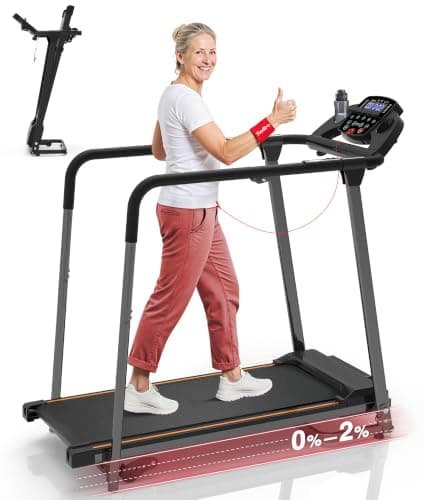
Top pick: Sunny Health & Fitness Treadmill with Extended Safety Handrails, Low Deck
Four measurements decide whether a treadmill suits an older walker — step-up height, how slow it will go, the handrails, and the belt size. Here's how to weigh them, and the features you can safely ignore.
How this is funded: we earn a commission if you buy through our links, at no extra cost to you. It never changes what we recommend, and every page here names at least one thing we would not buy. Full disclosure.
The short answer
Four things decide it — how high you step up onto the deck, how slow the belt will go, how long the handrails run alongside you, and whether the belt is big enough for your stride. Almost everything else, including programs, big screens and high top speeds, is a feature you are paying for and will not use.
Treadmill listings are written to sell horsepower, program counts and top speeds, none of which an older walker needs. The four things that actually decide whether a machine suits you are harder to find on the spec sheet, and two of them you can only judge with the machine in front of you. This guide is about those four, in the order that matters, and about the long list of features you can cross out with a clear conscience.
Every treadmill sits its belt some distance off the floor, because the motor, the rollers and the cushioning all live under the deck. That distance is the first thing to check, because it is the move you make most often and the one you make when you are least steady — getting on, and getting off again at the end when your legs are tired.
We are not going to give you a number, because a “safe” step-up depends entirely on the person and inventing a figure would be dishonest. The useful test is your own: measure a step you already climb comfortably at home — a porch step, a stair — and compare it to how high the deck sits. If getting onto the belt asks more of your hip and knee than that familiar step does, the machine is working against you before you have taken a stride. Lower is better. A near-level entry is best of all. Our guide to step-over height walks through how to measure this on any machine and why the published figure, when a maker bothers to publish one, is worth more than any marketing claim.
This is also the measurement that quietly rules out a lot of otherwise fine treadmills. A tall deck is usually the sign of a machine built for runners, where a bit of a climb is nothing. For a walker who is buying a treadmill precisely because outdoor curbs and steps have become a worry, that climb is the whole problem in miniature.
Shoppers look at the top speed. For an older walker the top speed is irrelevant — you will never reach it — and the number that matters is the one at the bottom. The belt has to move slowly enough that you can step on, find your balance, and settle into your own pace before you decide whether to go faster. If the slowest setting is quicker than your natural amble, the machine sets the pace and you chase it, which is exactly the situation a treadmill is supposed to remove.
Most people badly underestimate how slow their comfortable indoor pace is, especially in the first weeks or when returning to activity after a break. A machine that will crawl gives you room to start below what feels reasonable and build up; a machine with a brisk minimum gives you nowhere to stand. Our guide to a sensible walking-pad speed for seniors explains how to find your own pace and why starting slower than seems worthwhile is the fastest route to walking regularly.
A related point that costs nothing to check: how the speed changes. A machine that jumps in big steps can drop you from “too slow” to “too fast” with one press, while finer increments let you sit exactly where you want. You are looking for a slow floor and small steps up from it, not a high ceiling.
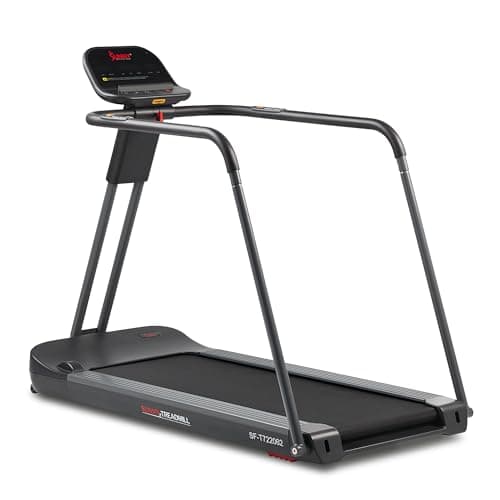
Nearly every treadmill has something to hold. What varies, and what matters, is where. A single bar across the front is there for a runner to grab for a moment; it does nothing for a walker who wants steady support, because to hold it you have to reach forward and tip your balance the wrong way. The rails that count run alongside the deck, level with where your hands naturally fall as you walk, so you can rest a hand on one without leaning, reaching or changing your posture.
This is not a small preference. The CDC reports that more than one in four adults aged 65 and over falls each year, and that falling once doubles the chance of falling again. A rail you can reach at the moment you feel unsteady is a genuine safety feature; a rail you would have to lunge for is decoration. If balance is any part of why you are choosing to walk indoors, treat side rails that run the length of the belt as a requirement rather than an upgrade.
Frustratingly, hardly any manufacturer publishes a handrail length, so this is one you often have to judge in person or from photographs. Our shortlist of treadmills with proper handrailsis built around exactly this — rails that run alongside you, and the machines that put speed controls on the rails so you never have to let go to slow down.
The belt has to be long enough that a full, relaxed stride lands comfortably on it, with room to spare front and back. Short belts force you to shorten your steps to stay on, which changes how you walk and puts you closer to the ends than you want to be. Width matters too: a narrow belt leaves no margin for the small side-to-side drift that everyone has, and that margin is what stops a wandering foot from finding the frame.
The trade-off is that a longer, wider deck means a larger machine in the room, and space is a real constraint for a lot of people. That is a fair thing to balance — but balance it knowingly. If the choice is between a machine that fits the corner and a machine that fits your stride, the stride should usually win, because a cramped belt is something you feel on every single walk. We do not quote deck dimensions here because they belong on each machine’s own page against the listing they came from; the thing to carry away is that bigger is safer, and you are trading floor space for margin.
Once you have weighed those four, most of the rest of the spec sheet can be crossed out. Here is what to stop paying attention to, and why.
Spend your budget on the frame’s stability, the rails and the belt, and let the console be as simple as it likes. A mid-priced machine chosen for the right four reasons will serve you better than a costly one chosen for its screen. We keep exact prices off this page because they change week to week; check the live listing, and judge the price against the four measurements, not the feature count.
Choosing the right machine is half the job; the other half is putting it in the right place and using it sensibly. Two things do most of the work. First, leave clear floor behind the belt — that space is where you go if you stumble, so it must not be a wall, furniture or a doorway. Second, clip the safety key to your clothing every single session, so that if you fall or drift back, the belt stops. Our treadmill safety checklist runs through the full setup, most of it under a minute, before your first walk.
It is worth remembering why any of this is worth doing. The CDC’s guidance for adults 65 and over is at least 150 minutes a week of moderate-intensity activity, plus muscle strengthening and some balance work — and brisk walking counts as moderate-intensity activity. A treadmill that suits you is simply a way to hit that target indoors on the days the weather, the pavement or the light make going out unwise. The right machine is the one that gets you walking often, not the one with the longest feature list.
None of this is medical advice, and nobody here is a clinician. If you are unsteady on your feet, recovering from surgery or a fall, or unsure whether walking on a moving belt is right for your body, talk to your doctor or physical therapist before you buy — a machine that watches nothing about you is no substitute for someone who can watch you move.
General information, not medical advice. Tread & Tone is written by an enthusiast, not a clinician. Nobody here is a doctor, a physical therapist or a trainer, and nothing on this site has been medically reviewed. Talk to your doctor or physical therapist before starting something new, particularly after surgery, a fall, or a change in medication.
Four things, in this order: a low step-up onto the deck, a minimum speed slow enough for a natural walking pace, handrails that run alongside where you stand rather than only across the front, and a belt long enough for a full stride with margin to spare. Almost everything else on the spec sheet — programs, screens, high top speeds — is a feature you are paying for and will not use.
There is no single number, and we are not going to invent one. The honest test is to measure the step you already climb comfortably at home and compare it to the height of the treadmill deck off the floor. A deck you have to lift a leg onto is a deck you may catch a foot on when tired. Lower is better, a level floor entry is best, and if the machine lists a step-up figure, that is the one number worth checking.
Slow enough that you can step on, find your balance, and settle into your own pace before you decide to speed up — never so fast that the belt sets the pace for you. Your natural indoor walking speed is usually slower than you think, so the minimum speed matters far more than the maximum. A machine whose slowest setting is faster than your comfortable amble is the wrong machine, whatever else it does well.
If balance is any part of why you are walking indoors, yes — and the useful rails are the ones that run alongside the deck where your hands actually fall, not a single bar across the front you would have to reach forward to hold. The CDC reports that more than one in four adults over 65 falls each year, so a rail you can rest a hand on without leaning is a genuine safety feature, not a nicety.
No. Incline is pleasant and it raises the effort without raising the speed, which can be useful later, but it is not one of the four things that decide whether a machine is safe and usable for an older walker. Plenty of good choices have a fixed flat deck. Buy for the step-up, the minimum speed, the rails and the belt first; treat a motorized incline as a bonus, not a requirement.
Enough to get a stable frame, honest handrails and a belt that does not feel cramped — and no more. The features that push a treadmill into the premium bracket, mostly big screens and steep top speeds, are exactly the ones an older walker never uses. A mid-range machine bought for the right four reasons will serve better than a costly one bought for its console. We keep prices off this page because they move; check the live listing.
Product measurements are cited individually inside each Fit-to-You panel, against the manufacturer page or dated retailer listing they were read from.
Best Treadmill
Step-up height, minimum speed and handrail length — the three numbers that decide it, and which machines publish them.
Top pick: Sunny Health & Fitness Treadmill with Extended Safety Handrails, Low Deck
Best Handrails
A front bar is not a handrail. Which machines put rails alongside the whole deck, and which put the controls on them.
Top pick: Redliro Treadmill for Seniors with Long Handrails
The footprint is only half the answer — the clearance around the deck and the doorway the box has to come through decide the rest. How to measure your room before you buy.
Read the guideNine things to set up before the first walk, in order. Most of them take under a minute and one of them is the safety key.
Read the guideA manual belt you push along yourself against a motor that sets the pace. Which is safer for an unsteady walker, and why the answer is not the one most people expect.
Read the guide