Best Treadmill
Best Treadmills for Seniors
Step-up height, minimum speed and handrail length — the three numbers that decide it, and which machines publish them.
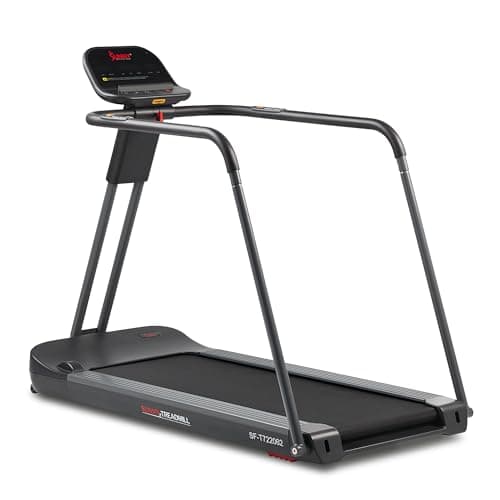
Top pick: Sunny Health & Fitness Treadmill with Extended Safety Handrails, Low Deck
The footprint is only half the answer — the clearance around the deck and the doorway the box has to come through decide the rest. How to measure your room before you buy.
The short answer
Plan for more than the treadmill’s own footprint. Measure the machine’s length and width, then add a clear zone behind the belt and room on the side you step onto. Check ceiling height for incline, and confirm the box fits through your doorway and hallways before you buy.
People almost always ask about treadmill space the wrong way round. They find a machine they like, read its length and width, pace out that rectangle on the floor, and decide it fits. The footprint is a real number and worth having, but it is only the start of the answer. A treadmill you can walk on safely needs clear room around it, enough height above it, and — the part that trips up the most people — a delivery path wide enough to actually get the box into the room. Getting moving at home is a genuinely good goal; the CDC recommends at least 150 minutes a week of moderate-intensity activity for adults 65 and over, and a treadmill in the spare room makes hitting that far more likely when the weather or the pavement outside is against you. But the machine only helps if it fits the room properly, so this guide walks through every measurement that matters before you buy.
Begin with the machine’s own dimensions, because everything else builds on them. Every treadmill lists a length and a width, and a full-size walking treadmill takes up a meaningful patch of floor — longer than most people picture, because the belt has to be long enough for a full stride and the frame and motor housing add to both ends. Write those two numbers down and mark that rectangle on your floor with tape or a couple of boxes. Standing in it gives you a far better sense of the reality than reading the figures ever will.
Here is the important part, though: that taped rectangle is the minimum the machine occupies, not the amount of room you should plan for. Nobody uses a treadmill jammed into a footprint-sized hole with walls on every side. You have to get onto it, walk on it, and get off it safely, and all of that happens in the space around the deck rather than on the deck itself. So treat the footprint as the first measurement of several. If the bare footprint only just fits your room with nothing to spare, the honest conclusion is that the room is too small for that machine — not that it barely fits. Choosing the right size machine for the room is its own decision, and our guide on how to choose a treadmill for seniors walks through matching the deck to both the walker and the space.
The single most overlooked measurement is the clear space behind the belt. When you walk on a treadmill, the belt is carrying you gently toward the back of the machine the whole time, and if you lose your footing or your attention wanders you may need to step or stumble backward. If a wall, a bookshelf, or a piece of furniture is right there, that is where you land. So leave a clear zone behind the belt — a couple of feet of open floor is a sensible, common-sense amount — so there is somewhere safe to go if you stumble. This is the same patch of floor you use to step down and dismount at the end of a walk, so it earns its keep twice over.
Then think about the sides. You step onto and off of a treadmill from the side, usually with the belt stopped, and for an older walker that is a moment worth making easy rather than awkward. Keep the side you mount from clear of furniture so you can step on and off without twisting past anything, and ideally keep that side within reach of a wall or a sturdy fixture you could steady a hand on. Clearance around the machine is really a safety question as much as a comfort one, and it deserves the same care as choosing the machine itself — our guide to treadmill safety for seniors goes deeper on mounting, dismounting, and using the machine confidently. When you plan the layout, plan the clear zones first and fit the deck around them, not the other way round.
Ceiling height rarely gets a thought until it becomes a problem, and it becomes a problem more often than you would expect — in basements, in converted lofts, and in rooms with sloped or beamed ceilings. The thing to remember is that a treadmill deck sits a few inches off the floor to begin with, so you are already standing higher than your normal height the moment you step on. A taller walker in a room with a low ceiling can end up closer to it than feels comfortable, and feeling boxed in is not the frame of mind you want while exercising.
Incline makes this sharper. Most treadmills can raise the front of the deck to simulate walking uphill, and when they do, they lift you higher still. The way to check is simple arithmetic: take the walker’s height, add the deck height, and add a bit more for incline if the machine will be used that way, then make sure there is still comfortable clearance to the lowest point of the ceiling. Do this measurement standing where the treadmill will actually go, because a beam, a light fixture, or a sloping section of ceiling might sit lower over the exact spot you had in mind. It is a two-minute check that saves a real disappointment later.
This is the measurement that catches the most people out, and it has nothing to do with the room itself. Treadmills ship large and heavy, and the shipping carton is bigger and bulkier than the assembled machine — often a long, flat, awkward box that two people struggle to carry. A treadmill that would fit your spare room beautifully is no use at all if the box cannot physically reach that room, so trace the entire delivery path before you order and measure the tightest points along it.
Start at the front door and follow the route the box will travel: exterior doors, interior doorways, the width of hallways, and — critically — any turns. A long box can fit through a wide doorway and still be impossible to pivot around a tight corner between a hall and a room. Then account for stairs, which are the hardest part of all: a heavy, unwieldy carton going up or down a staircase is a genuine two-person job, and a narrow stairwell with a turn in it may simply not allow it. Measure the narrowest doorway, note every corner the box must round, and be honest about the stairs. If any point on that path is tighter than the box, you need a smaller machine, a different room, or delivery help — and it is far better to know that before you buy than on the day the pallet arrives at your curb.
If floor space is genuinely tight, the good news is that not every machine has to sit out at full size all day. This is where folding treadmills and walking pads change the maths, and the key idea is that they have two different footprints: the one they occupy while you use them, and the much smaller one they occupy while stored. When you measure a small room, measure for both.
A folding treadmill lifts its deck up toward vertical and locks it there, so between walks it parks against a wall and takes up a fraction of the floor it needs when it is down and running. A flat walking pad goes further still: it has no upright console to fold, stores in a matter of inches, and can slide under a bed or a sofa or stand on its end in a cupboard, then come out onto the floor when it is time to walk. For a small apartment or a shared room, that difference between the standing footprint and the stored footprint is often what makes a treadmill possible at all. Our roundup of the best walking pads for seniorsis worth a look if this is your situation, because it focuses on exactly the low, stowable machines that suit a room with no space to spare. Just remember that when you walk on any folding or stowable machine, you still need the full standing footprint plus the clear zones around it — folding solves storage, not the space you need while actually walking. If a seated machine would suit you better, the same measuring problem applies to bikes and our shortlist of recumbent bikes for small spaces ranks them on published footprint, from 50 inches long upward.
Once you know it fits, placement is the last piece, and a few small choices make the machine nicer to live with. Put it within reach of a wall outlet and plug it straight into the wall where you can, rather than running it off a long, flimsy extension lead across the floor — that trailing cord is a trip hazard and not what a heavy machine should draw its power through. Set it on a hard, level floor so it sits solidly and does not rock, and put a mat underneath it: on a hard floor a mat helps stop the machine creeping and catches dust, and on any floor a little cushioning underneath softens vibration and noise.
Noise is worth thinking about before you settle on a spot, particularly upstairs or in an apartment where someone lives below. A treadmill on a bare hard floor transmits more thump and hum than one on a mat over a solid base, and the difference matters a great deal to the neighbors underneath. If you are in a flat, choosing a quieter machine and placing it thoughtfully is the whole game — our guide to a quiet treadmill for apartments covers which machines stay quiet and how to set them up so your walking does not travel through the floor. Give yourself clear, unobstructed access from the side you step onto, keep the area well lit, and make sure nothing you might trip on lives in the clear zone behind the belt.
Bring all of it together into one short measuring session before you buy. Take a tape measure, a pad, and a few minutes, and work through these in order:
The short version is to measure the room, not just the machine. The footprint tells you where the deck sits; the clear zones tell you whether you can walk on it safely; the ceiling tells you whether incline is on the table; and the doorway tells you whether the thing can even get into the house. Spend the ten minutes with a tape measure before you order and you will avoid the two most common disappointments — a machine that fits the room but not the walker, and a box that fits the room but not the stairs. When your numbers are in hand, our guide to the best treadmills for seniors will help you pick one that fits both the space and the person using it.
General information, not medical advice. Tread & Tone is written by an enthusiast, not a clinician. Nobody here is a doctor, a physical therapist or a trainer, and nothing on this site has been medically reviewed. Talk to your doctor or physical therapist before starting something new, particularly after surgery, a fall, or a change in medication.
More than the machine’s own footprint, which is the number to watch out for. A full-size treadmill takes up a fair patch of floor on its own, and then you want clear room behind the belt so you can step back safely if you stumble, plus space on the side you step onto and off of. The honest answer is to measure the machine, then add clear zones around it — the footprint alone is the minimum, not the amount of room to plan for.
Leave a clear zone behind the belt — a couple of feet of open floor is a sensible, common-sense amount — so that if you lose your footing there is somewhere to step back to rather than a wall or a piece of furniture right behind you. That same clear space is where you dismount at the end of a walk. It is one of the most overlooked measurements and one of the most worth keeping, especially for an older walker.
That is the question to answer before you order, not after the box arrives. Treadmills ship large and heavy, and the carton is bigger than the assembled machine. Measure the narrowest doorway on the route, then think about hallway turns and any staircase the box has to travel. A machine that fits the room perfectly is no use if it cannot reach the room, so plan the delivery path first.
You need enough headroom that a walker does not feel boxed in, and the thing people forget is that the deck lifts you a few inches off the floor to begin with, and using incline raises the front of the deck further. Add your height to the deck height, then to any incline rise, and make sure there is comfortable clearance to the ceiling — low basements and rooms with sloped ceilings are where this catches people out.
Often yes, if you choose the machine for the space rather than the other way around. A flat walking pad stores in a matter of inches and can slide under a bed or sofa, and a folding treadmill lifts its deck up to shrink its parked footprint. Just remember the standing footprint and the stored footprint are two different numbers, and in an apartment you also want to think about noise for the people below you.
A mat is a sensible idea on most floors. On a hard, level floor it helps keep the machine from shifting and catches dust, and on any floor it adds a little cushioning underneath that can take the edge off noise and vibration. Place the treadmill on a level surface within reach of an outlet, avoid running it off a flimsy extension lead, and give yourself room to get on and off from the side.
Product measurements are cited individually inside each Fit-to-You panel, against the manufacturer page or dated retailer listing they were read from.
Best Treadmill
Step-up height, minimum speed and handrail length — the three numbers that decide it, and which machines publish them.
Top pick: Sunny Health & Fitness Treadmill with Extended Safety Handrails, Low Deck
Nobody publishes a decibel figure, so 'quiet' has to be reasoned from the mechanism. What actually makes a treadmill quiet through a shared wall or floor.
Read the guideThe four measurements that decide it — step-up height, minimum speed, handrail length and deck size — and the features you're paying for that don't matter.
Read the guide