Best Treadmill
Best Treadmills for Seniors
Step-up height, minimum speed and handrail length — the three numbers that decide it, and which machines publish them.
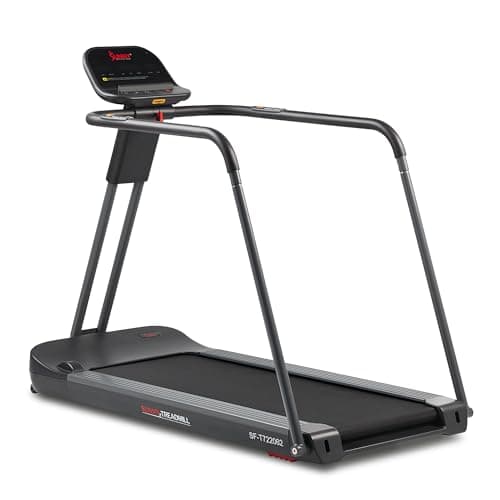
Top pick: Sunny Health & Fitness Treadmill with Extended Safety Handrails, Low Deck
A manual belt you push along yourself, against a motor that sets the pace for you. For an unsteady older walker the two behave very differently in the one moment that matters — when you stop.
How this is funded: we earn a commission if you buy through our links, at no extra cost to you. It never changes what we recommend, and every page here names at least one thing we would not buy. Full disclosure.
The short answer
For an unsteady older walker, a motorizedtreadmill run at a slow, steady pace with handrails is usually the safer and more usable choice: an even, machine-set pace is easier to keep an even gait to and easier to hold a rail against. Its one risk — the belt keeps moving if you stumble — is what the safety key is for. Choose a manual belt only if you are a steadier walker who wants the belt to stop the instant you do.
| What you care about | Manual treadmill | Motorized treadmill |
|---|---|---|
| Who controls the pace | You do — the belt only moves as fast as your feet push it | The motor does — you set a speed and it holds it steady |
| If you stop or stumble | The belt stops the instant you do | The belt keeps moving; the safety key is what stops it |
| Effort to start each step | High — every step drives the belt, asking more of legs and balance | Low — the belt is already moving, so you match an even pace |
| Noise | No motor, so mostly just the belt and your footfall | A motor runs the whole time you walk |
| Cost and space | Often simpler, and needs no power outlet | More machine, and it has to be plugged in |
| Best for | A steadier walker who wants the belt to stop when they do | An unsteady walker who wants a slow, even pace and rails to hold |
A treadmill is either powered by a motor or powered by you. On a motorized treadmill a motor turns the belt at a speed you dial in, and it holds that pace whether you push or not. On a manual treadmill — a flat belt on rollers, or the curved-deck kind — there is no motor at all. Your feet are the engine. The belt moves only while you drive it, at whatever speed your stride sets, and it stops the moment your feet do.
Every other difference between the two flows from that single fact. It decides how much effort each step costs, how the machine behaves when something goes wrong, how much noise it makes, and which kind of walker each one actually suits. So it is worth taking the two things that matter most to an older buyer — what happens when you stop, and how hard each step is — one at a time.
This is where the two machines genuinely diverge, and it cuts both ways. On a manual belt, a stumble is self-correcting in one respect: the belt is only moving because your feet are moving, so if you falter, the belt slows and stops with you. There is nothing left running to carry your feet out from under you.
A motorized belt does the opposite. If you stumble, the belt keeps traveling at the speed you set, because the motor does not know you are in trouble. That is precisely why every motorized treadmill ships with a pull-cord safety key that clips to your clothing and cuts the power if you drift back — it is the machine’s answer to its own main hazard, and it only works if you actually clip it on. This is not a small point. The CDC reports that more than one in four adults aged 65 and over falls each year, and that falling once roughly doubles the chance of falling again, so the stopping behavior of a moving floor is not a footnote — it is close to the whole decision.
Read narrowly, that looks like a straight win for the manual belt. It is not, and the reason is the second difference.
On a manual treadmill every stride has to drive the belt forward. Starting the belt from a standstill takes a firm shove, and keeping it moving asks your legs to do continuous work that a motor would otherwise do. That extra effort is the whole appeal for a fit, steady walker — it is a harder workout for less machine. But for an unsteady older walker it changes the walk in an unwelcome way: the pace tends to surge and stall as you push and ease off, the gait becomes uneven, and an uneven gait is harder to hold a handrail against and harder to keep your balance through.
A motorized belt removes that variable. The pace is set and steady, so your body can settle into an even rhythm and your hands can stay quietly on the rails rather than bracing against the next push. For someone whose priority is a repeatable, low-drama walk — the kind you can do a little of most days — that evenness is worth a great deal. Brisk walking is one of the activities the CDC counts as moderate-intensity movement, and the weekly minutes can be split into short sessions rather than done all at once, which points toward the machine you will step onto willingly and often. For most people the target is the CDC’s at least 150 minutes a week of moderate activity for adults 65 and over, and the treadmill that gets used is the one that actually reaches it.
Put the two differences together and the picture resolves. The manual belt’s safety advantage — it stops when you do — is real, but it is bought with a harder, more uneven walk that demands more of the very balance and leg strength an unsteady walker is short of. The motorized belt’s hazard — it keeps moving if you stumble — is real too, but it is a known hazard with a known, simple countermeasure you clip to your shirt, and in exchange you get the steady pace that makes the walk safer to hold a rail against in the first place.
For the typical buyer of this site — an older walker rebuilding confidence, protecting a joint, or coming back from an injury — a motorized treadmill run at a slow, steady speed with full-length handrails is the more usable and generally the safer machine. The mechanism is not medical, it is mechanical: an even, machine-set pace is easier to keep an even gait to, and a steady gait is easier to support with your hands than a surging one. Our shortlist of treadmills for seniors ranks the motorized machines on exactly the features that matter here — a low floor speed, rails that run the length of the deck, and controls you can reach without letting go — and the low-profile walking pads apply the same logic to a smaller footprint.
A manual treadmill is not the wrong answer for everyone. It is the right answer for a steadier walker who specifically wants the belt to stop the instant they do, and who values the harder workout and the absence of a motor. If you are surefooted, if you want no motor noise in an apartment, and if the reassurance of a belt that can only move under your own power outweighs the surging pace, the manual belt earns its place. It is simpler, it needs no outlet, and its one safety behavior — instant stopping — is genuinely valuable.
The line is drawn by how steady you are on your feet, not by which machine is “better.” A confident walker can spend the manual belt’s extra effort and bank its instant stop. An unsteady one is usually better served by an even, motor-held pace and a safety key. And if the walker is coming back from a fall, surgery, or a recent change in balance or medication, neither machine is the first decision — a doctor or physical therapist is, because they can watch the gait and tell you what pace and what support it should be working with before any belt is switched on. Whichever you choose, read our treadmill safety guide for seniors first and clip the safety key on every single time.
General information, not medical advice. Tread & Tone is written by an enthusiast, not a clinician. Nobody here is a doctor, a physical therapist or a trainer, and nothing on this site has been medically reviewed. Talk to your doctor or physical therapist before starting something new, particularly after surgery, a fall, or a change in medication.
On a manual treadmill there is no motor — your feet drive the belt, so it moves only as fast and as long as you push it, and it stops the instant you do. On a motorized treadmill a motor turns the belt at a speed you set, and it keeps that pace steady until you change it. The whole difference comes down to who is powering the belt, and that decides how each machine behaves when you stop.
Usually the motorized machine, for one specific reason: a slow, motor-held pace is easier to keep an even gait to and easier to hold a handrail on than a belt you have to keep shoving with every step. The trade-off is that a motorized belt keeps moving if you stumble, which is exactly why the safety key exists — clip it on every time. A manual belt stops when you do, which suits a steadier walker. Talk to your doctor or physical therapist about which fits you.
It asks more of you. Every step has to drive the belt, so starting each stride takes a firm push, and that demands more from the legs and from your balance than matching a belt that is already moving. For a fit, steady walker that extra effort is part of the appeal. For someone rebuilding confidence or protecting a joint, the steady, even pace of a motorized belt is generally the easier and more repeatable walk.
Yes — that is their main safety advantage. With no motor, the belt only moves while your feet drive it, so the moment you stop walking the belt stops too. There is nothing to keep it running. On a motorized treadmill the belt carries on at the set speed until you slow it or the safety key cuts the power, which is the reason the pull-cord key matters so much on a motorized machine.
Generally, because there is no motor running the whole time — the noise is mostly the belt and your footfall. That can matter in an apartment or a shared home. A motorized treadmill runs its motor continuously, which adds a baseline hum. Neither of these is a decibel figure we can quote for you, and quietness is only one factor; for most unsteady walkers the steadier pace of a motorized belt outweighs the noise difference.
For most unsteady older walkers, a motorized treadmill run at a slow, steady pace with full-length handrails is the more usable and generally safer choice, because an even machine-set pace is easier to hold a rail against and easier to keep an even gait to. Choose a manual belt only if the walker is steady and specifically wants the belt to stop the instant they do. Either way, keep the safety key clipped on and check with their doctor or physical therapist first.
Product measurements are cited individually inside each Fit-to-You panel, against the manufacturer page or dated retailer listing they were read from.
Best Treadmill
Step-up height, minimum speed and handrail length — the three numbers that decide it, and which machines publish them.
Top pick: Sunny Health & Fitness Treadmill with Extended Safety Handrails, Low Deck
Best Walking Pad
Flat pads step up in inches rather than a foot — but most have nothing to hold. The ones that solve both, and one that doesn't.
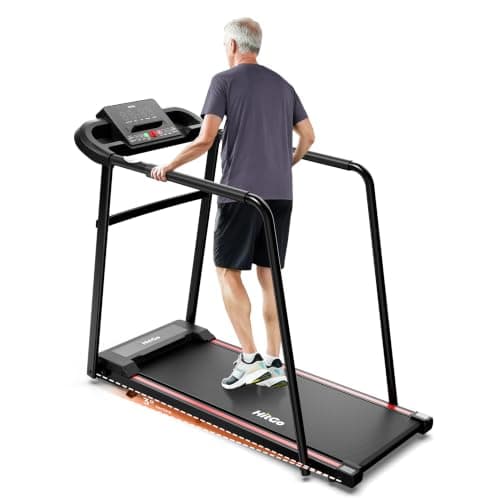
Top pick: HitGo Walking Pad with Handrails
Price as of September 23, 2026. #ad How we’re funded
Nine things to set up before the first walk, in order. Most of them take under a minute and one of them is the safety key.
Read the guide