Is a Recumbent Bike Good for Osteoporosis?
No, not for your bones — and we are not going to pretend otherwise. What a recumbent bike does do for someone with osteoporosis, and what has to sit alongside it.
Read the guideOn the bone question, yes — and it is the one thing a walking machine does that a seated bike cannot do at all. The catch is that most walking pads give you nothing to hold, which is exactly the wrong trade when a fall is the thing you are protecting against.
How this is funded: we earn a commission if you buy through our links, at no extra cost to you. It never changes what we recommend, and every page here names at least one thing we would not buy. Full disclosure.
The short answer
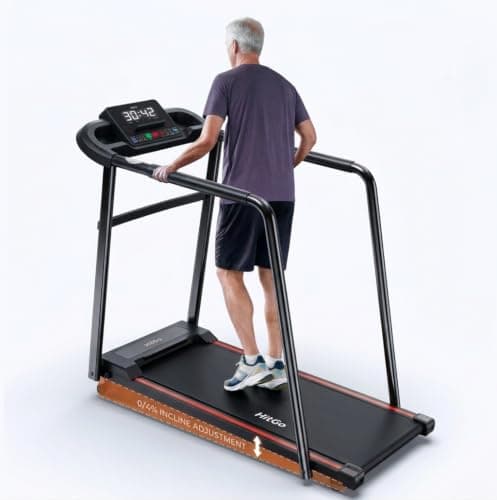
Yes, on the bone question— walking is weight-bearing and cycling is not, and NIAMS is explicit that weight-bearing exercise is what makes bone work harder. But buy one with a rail.Six of the nine walking machines we track publish nothing to hold onto, and when the thing you are protecting against is a fracture, a moving belt with no handle is the wrong trade. The three railed options are the HitGo H2, the Sunny Pacer Treadpad and the WELLFIT T3810. Talk to your provider before starting — NIAMS says so too.
This question has two halves that pull in opposite directions, and almost every page that answers it only handles one. The first half is about bone: does this exercise do anything for bone density? The second is about fracture: does this exercise put me at risk of the event that makes bone density matter? A walking pad scores well on the first and, in most of the models sold, badly on the second. Getting the purchase right means refusing to average those two into a single verdict.
NIAMS’s guidance on exercise for bone health is unusually clear for public-health writing. Bone is living tissue that responds to exercise by becoming stronger, and weight-bearing exercises “produce a force on bones that makes them work harder” — with brisk walking, climbing stairs and dancing given as examples.
Read that sentence next to a recumbent bike and the problem is obvious. On a bike you are seated, your weight is on the seat, and your legs are turning a crank against magnetic resistance. There is no force on the skeleton of the kind NIAMS is describing. That is precisely why a bike is so kind to joints — and precisely why it does nothing for this. We say the same thing from the other direction in our page on recumbent bikes and osteoporosis, and it is the single clearest line in our recumbent bike versus walking pad comparison.
On a belt, you support your own body weight on every step, exactly as you would on a pavement.The loading mechanism is the same. That makes a walking machine a genuinely different item on your list from a bike, not a more expensive version of one. And NIAMS’s own caveat comes with it: anyone with low bone density or osteoporosis should talk to a health care provider before starting an exercise program.
Here is the uncomfortable arithmetic. The CDC reports that more than one in four adults 65 and over falls each year, and that falling once roughly doubles the chance of falling again. If you have been told your bone density is low, a fall is not an abstraction — it is the event the diagnosis is about.
And the walking-pad category is built around removing the thing you would grab. Six of the nine walking machines in our registry publish no rail, handlebar or upright of any kind. That is not an accident or an oversight; it is the whole design premise, because a flat pad is what slides under a sofa. For an office worker who wants steps while taking calls, that trade is fine. For this reader it is backwards.
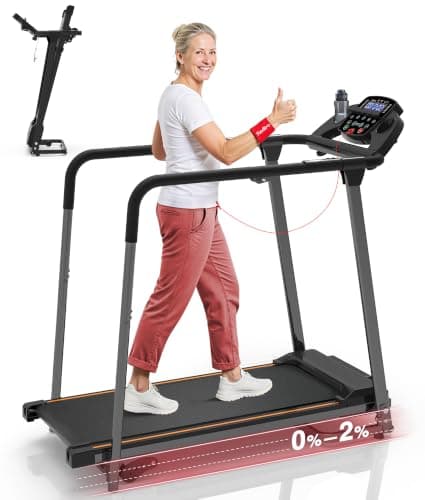
Three machines publish something to hold, and those are the ones this page recommends. The HitGo H2 publishes full-length carbon steel rails on both sides. The Sunny Pacer publishes a handlebar that folds — up, it is a railed walking machine; down, it is an under-desk pad capped at 3.7 mph, with the 6 mph mode requiring the bar unfolded and fully extended. The WELLFIT T3810 publishes a single stability handlebar, which steadies you without surrounding you, and is honest enough in its own listing to be described that way.
If none of the three fits, the honest recommendation is to step up a category to a full-size treadmill with proper rails, which is what our handrail shortlist is for. It is more money and considerably more floor space, and for this particular buyer it is usually the right call.
| Machine | Handrails | Step-up height | Weight capacity | Belt size |
|---|---|---|---|---|
| HitGo Walking Pad with Handrails | Full-length carbon steel rails on both sides, stated as heavy-duty carbon steel giving 360-degree support. Length in inches not published | Not published by the manufacturer | 250 lb | 43.3 in long × 15.5 in wide; stated to suit users up to 6 ft 2 in |
| Sunny Health & Fitness Pacer 2-in-1 Auto Incline Treadpad Treadmill | A folding handlebar rather than rails on both sides. Folded down it is an under-desk pad capped at 3.7 mph; unfolded and fully extended it allows up to 6 mph | 4.1 in flat, rising to 5.7 in at full incline — Sunny publishes this as “deck to floor height”, which almost no maker does | 265 lb maximum, and a 99 lb MINIMUM user weight — Sunny publishes both ends | 45.7 in long × 16 in wide, which Sunny labels the running surface |
| WELLFIT Walking Pad with Incline and Handlebar | One stability handlebar, published as a 2-in-1 design giving support while walking. Length in inches not published, and there are no side rails | Not published by the manufacturer | 350 lb | 36 in long × 16 in wide, published as a multi-layer non-slip belt |
Two notes on that table. Not one of the three publishes a rail height or a rail length in inches, so there is no way to know from a listing whether a rail sits where your hand naturally falls — this is the single biggest documentation gap in the category, and it is why we have not built a page ranking machines on rail height: the data does not exist. And the step-up column shows what the pads do have over a treadmill — where it is published at all, it is about 4.1 inches, which is a much smaller climb than a full-size deck.
Walking is one line on the list, and it is worth knowing what the other lines are so the machine does not end up carrying more weight than it should.
Balance work, done separately and on the floor. The CDC’s recommendation for adults 65 and over includes balance activities as their own item, not as something walking covers. A belt actively removes balance demand, since you are going in a straight line with no turns and, if you bought wisely, a rail. Our printable balance routine needs no equipment, and the balance equipment shortlist is the cheapest aisle on this site.
Strength work, twice a week.Muscle pulls on bone, and the same CDC recommendation names two days of muscle strengthening. Light dumbbells or bands at home are enough to start — see our light dumbbell exercises and band routine.
And the house itself. The National Institute on Aging’s guidance on falls and fractures covers the environment as well as the exercise, and a pad is a new object on your floor with a power cable attached — worth thinking about where it lives, and whether it is in the path you walk at night. Our fall-prevention guide goes room by room.
Finally, the order of operations. Talk to your provider first, because NIAMS says to and because the answer may change what you buy — advice about impact, bending and twisting varies with your history, particularly if you have had a vertebral fracture. Then buy the machine with the rail. Then start at the slowest speed the belt will hold, which on the machines above is published as low as 0.5 to 0.6 mph on some models, and add minutes before anything else.
General information, not medical advice. Tread & Tone is written by an enthusiast, not a clinician. Nobody here is a doctor, a physical therapist or a trainer, and nothing on this site has been medically reviewed. Talk to your doctor or physical therapist before starting something new, particularly after surgery, a fall, or a change in medication.
Walking is weight-bearing, and NIAMS explains that bone is living tissue that responds to exercise by becoming stronger, with weight-bearing exercises producing 'a force on bones that makes them work harder' — brisk walking is one of its named examples. So yes, in the sense that matters here, and it is why walking beats cycling on this particular question. NIAMS also says anyone with low bone density or osteoporosis should talk to a health care provider before starting an exercise program, and that is the right order to do this in.
On the weight-bearing mechanism, a belt gives you the same thing: you are supporting your own body weight on each step either way. What an indoor belt does not give you is uneven ground, turning, and the small balance corrections outdoor walking demands — which matter for the other half of the osteoporosis problem, which is not breaking a bone. Treat a pad as the machine that keeps the walking habit alive through winter rather than as a complete replacement.
If you are shopping because of low bone density, lean toward something with rails — which in practice usually means a treadmill or one of the three railed walking machines we track. The reason is blunt: the CDC reports that more than one in four adults 65 and over falls each year and that falling once roughly doubles the chance of falling again, and a fracture is the outcome you are trying to avoid. A machine with nothing to hold is the wrong trade for this buyer, however good its other specifications are.
Not useless, but it does not do the bone job. Seated cycling is not weight-bearing, so it does not produce the force on bone that NIAMS describes — it is excellent for joints, cardiovascular minutes and leg strength, and those all matter. The honest framing is that a bike and a bone-loading activity are two different items on the list rather than alternatives. We go through that in detail on our page about recumbent bikes and osteoporosis.
Ordinary walking is not the mechanism people with osteoporosis need to worry about; falls are. That said, specific advice about impact, bending and twisting depends on your bone density, your history and whether you have had a vertebral fracture, which is exactly why NIAMS directs you to a provider before starting a program. Ask specifically about what to avoid as well as what to do, and bring the machine's specifications to the conversation if you are unsure.
Three of the nine we track publish any kind of support. The HitGo H2 publishes full-length carbon steel rails on both sides, the Sunny Pacer publishes a handlebar that folds down — up for a railed walk, down to slide under a desk — and the WELLFIT T3810 publishes a single stability handlebar. The other six publish nothing, and in several listings the specification reads, in effect, 'none; there is nothing to hold'.
The general target for adults 65 and over is at least 150 minutes a week of moderate-intensity activity plus two days of muscle strengthening and separate balance work, and brisk walking counts toward the first of those. For bone specifically, the useful framing is regularity rather than volume — bone responds to being loaded often. What progression is appropriate for your bone density is a question for your provider rather than for a product page.
Product measurements are cited individually inside each Fit-to-You panel, against the manufacturer page or dated retailer listing they were read from.
No, not for your bones — and we are not going to pretend otherwise. What a recumbent bike does do for someone with osteoporosis, and what has to sit alongside it.
Read the guideBest Handrails
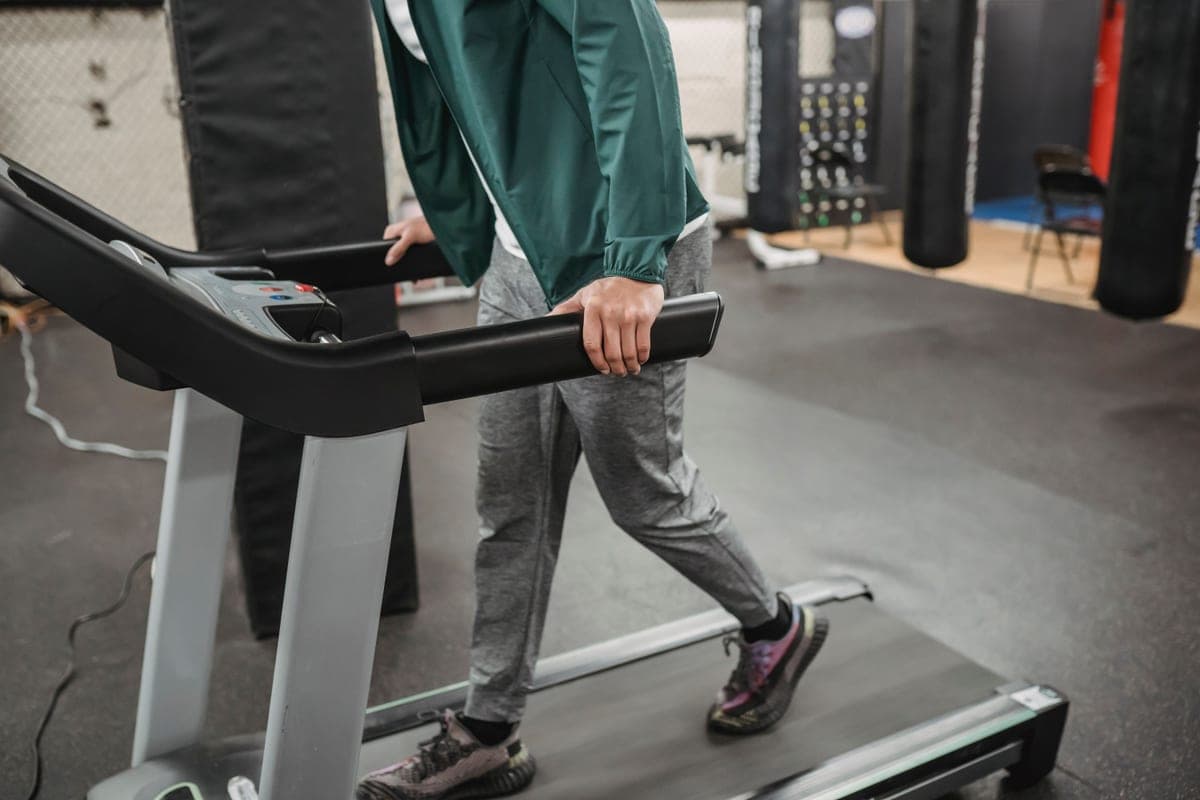
A front bar is not a handrail. Which machines put rails alongside the whole deck, and which put the controls on them.
Top pick: Redliro Treadmill for Seniors with Long Handrails
Price as of October 22, 2026. #ad How we’re funded
A walking pad is not a small treadmill. Four numbers decide it — belt length, what there is to hold, the slowest speed and the weight you have to move — and most listings publish two of them.
Read the guideBest Balance Gear
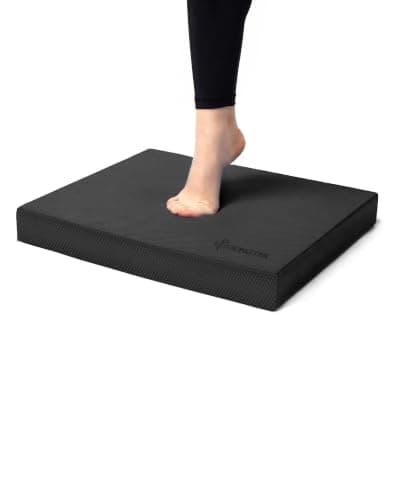
Pads, cushions, boards and rails ranked by how safely you can start — including the one we tell you not to start on.
Top pick: StrongTek Extra Wide TPE Balance Pad
Price as of October 22, 2026. #ad How we’re funded
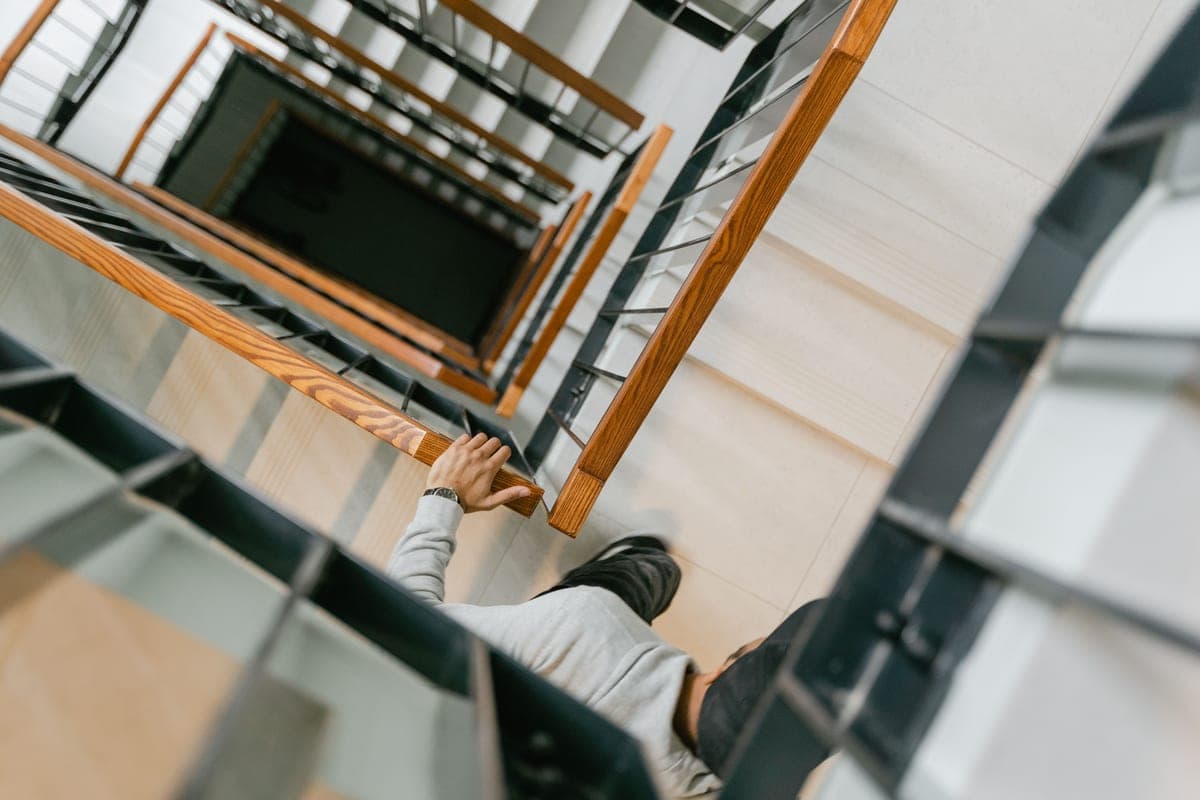
A room-by-room list drawn from CDC and NIA guidance, ordered by how much difference each change makes relative to its cost.
Read the guideBest Walking Pad
Flat pads step up in inches rather than a foot — but most have nothing to hold. The ones that solve both, and one that doesn't.
Top pick: HitGo Walking Pad with Handrails
Price as of October 22, 2026. #ad How we’re funded