Light Dumbbell Exercises for Seniors
A gentle seated-and-standing routine with a pair of light weights that covers the CDC's two-days-a-week strength guideline — and how to pick a starting weight you will not regret.
Read the guideBands are the cheapest way to cover the strength half of the guidelines, and you can do the whole routine from a chair. Here's a simple seated set, how to progress, and where a band stops being enough.
How this is funded: we earn a commission if you buy through our links, at no extra cost to you. It never changes what we recommend, and every page here names at least one thing we would not buy. Full disclosure.
The short answer
Resistance bands are the cheapest, gentlest way to meet the strength half of the activity guidelines. A seated chair routine can work the major muscle groups with low injury risk, which suits older beginners. Start with a light band, progress slowly, and see a doctor or physical therapist if a joint is painful or has recently changed.
Most conversations about exercise for older adults are really about walking, and walking is a good place to start. But walking is endurance work, and endurance is only one of the things a body past 60 needs. The National Institute on Aging groups exercise into four types — endurance, strength, balance and flexibility — and treats them as separate needs rather than as one thing you get from a single activity. You can walk every day and still be doing nothing at all for the second one.
Strength is the type that lets you carry a bag of shopping, get up out of a low chair without pushing off the arms, and catch yourself when a foot slips. It is also the type most people quietly lose without noticing, because the everyday tasks that used to keep it topped up ask a little less of you each year. Losing it is not inevitable, and it is not one-way. Muscle responds to being asked to work at any age.
This is why the CDC’s guidance for adults 65 and over does not stop at 150 minutes a week of moderate activity. It also asks for muscle-strengthening activity on at least two days a week, working the major muscle groups, plus some balance work. That two-days figure is easy to skip because it needs a different tool than a pair of walking shoes. A set of bands is the cheapest way to own that tool.
There are gentler and harsher ways to load a muscle, and a resistance band sits at the gentle end for four practical reasons.
They are cheap.A set of bands is the least expensive thing in the whole world of home fitness — a small fraction of the cost of a single dumbbell set, and a rounding error next to a machine. If you try them and decide strength work is not for you, you have lost very little. That low stakes matters when you are not yet sure this is a habit.
They scale. The resistance in a band comes from stretching it, so the load builds gradually through the movement rather than sitting on the joint as a fixed dead weight from the first inch. Bands also come in graded strengths, usually color-coded from light to heavy, so you can start almost impossibly easy and step up one band at a time. Very few beginners are well served by the jump from one dumbbell to the next; a band lets you find a load that fits.
They are portable and forgiving. A band weighs almost nothing, folds into a drawer, and cannot be dropped on your foot. If your grip fails mid-rep the resistance simply eases off, where a dumbbell would keep falling. That single difference removes the most common way older beginners hurt themselves with free weights. It travels, too, which makes it the one piece of strength kit that survives a visit to family or a week away.
You can do it sitting down. Almost every band exercise has a seated version, which takes balance out of the equation entirely. For anyone unsteady on their feet, that means you can work on strength first and worry about standing balance separately, rather than needing both at once. Our chair exercise guide covers the wider seated routine that a band slots into.
Here is a simple set you can do from a sturdy dining chair — one without wheels, pushed back from anything you might knock. It works the major muscle groups the CDC guidance asks you to cover: back, chest, shoulders, arms and legs. Do it as a circuit, resting as needed.
Three rules apply to every movement below. Move slowly and under control— roughly two seconds out, two seconds back, with no jerking and no letting the band snap you back. Breathe out on the effort and in on the return; do not hold your breath. And stop the movement short of pain— a working muscle should feel like effort, never like a sharp catch in a joint.
Seated row.Loop the band around the soles of both feet and hold an end in each hand, arms out in front. Sitting tall, draw your elbows back past your ribs as though starting a lawnmower, squeezing the shoulder blades together, then return slowly. This works the upper back — the muscles that hold your posture up.
Chest press. Pass the band behind your upper back, under the arms, and hold an end in each hand at chest height. Press both hands forward until the arms are almost straight, then bring them back with control. Keep the shoulders down away from the ears throughout.
Band pull-apart. Hold the band out in front of you at shoulder height with both hands, palms down, hands about shoulder-width apart. Pull your hands outward to stretch the band across your chest, squeezing the shoulder blades, then return slowly. This one is small and unglamorous and does more for round-shouldered posture than almost anything else here.
Seated leg extension. Loop the band around one ankle and anchor the other end under the opposite foot, or around a chair leg. Straighten the working leg out in front until it is almost level, hold for a moment, then lower slowly. Swap legs. This works the front of the thigh, the muscle that stands you up out of a chair.
Biceps curl. Stand or sit on the middle of the band with both feet, hold an end in each hand with palms facing forward, and curl the hands up toward the shoulders, keeping the elbows tucked in at your sides. Lower under control. Do not let the elbows drift forward or the band do the work on the way down.
Seated leg abduction.Tie the band into a loop, place it around both legs just above the knees, and press the knees apart against the band, then return slowly. This works the outer hip — a set of muscles that quietly matter a great deal for steadiness when you walk. If you only have time for one lower-body move on a busy day, this is a strong candidate.
The mistake almost everyone makes is starting too hard, being sore for three days, and quietly never going back. The fix is to start easier than feels worthwhile and let the volume build. The Arthritis Foundation’s guidance on how much exercise is enough is about building activity gradually rather than hitting a target on day one, and it applies just as well to strength as to cardio.
A workable path looks like this. In the first couple of weeks, do one set of eight to ten controlled reps of each movement, twice a week, with a rest day in between. Once that feels genuinely easy — meaning the last rep of the set is no harder than the first — add a second set before you touch the band strength. Building the number of sets and reps is how you add volume without adding risk.
Only move up a band when the last reps of your top set are easy.That is the single rule that keeps this safe. If you are grinding out the final rep with your form falling apart, the band is already too heavy, not not-heavy-enough. When you do step up, expect to drop back down in reps for a week while the new resistance settles, exactly as you would starting over on a slightly harder setting. Progress in one direction at a time: more reps, then more sets, then a heavier band — never two of those at once.
A band is the right first tool for most older beginners, but it is worth being straight about where it stops.
It loses precision as you get stronger. The gentle, gradual load that makes a band forgiving is the same thing that makes it vague. You cannot know exactly how much you pulled today versus last week, and past a certain point the band you would need becomes so stiff it is awkward and unpleasant to use. If strength training genuinely takes hold and you want to keep progressing, weights or a machine give you a load you can measure and repeat. That is the point of the equipment overview— it is where a band-graduate goes next.
Form matters more than resistance.A band used with sloppy technique — shoulders hunched, back rounded, joints snapping to full lock — can create the very aches it was meant to avoid. If you are not sure a movement is right, doing it slowly in front of a mirror, or having someone watch you once, is worth more than any amount of extra resistance. Fewer clean reps beat more messy ones every time.
Pain and surgery are a doctor’s conversation, not a band’s. The National Institute on Aging is clear that you should talk with your doctor before starting a new kind of activity, particularly if you have a health condition. If a joint is painful, swollen, recently injured, or post-surgical, a band is not a treatment and we are not qualified to say otherwise. See a physical therapist, who can tell you which movements and ranges are safe for your body — something no routine written for everyone can do. If standing or balance is the harder problem, our guide to seated exercises for limited mobility stays entirely in the chair.
General information, not medical advice. Tread & Tone is written by an enthusiast, not a clinician. Nobody here is a doctor, a physical therapist or a trainer, and nothing on this site has been medically reviewed. Talk to your doctor or physical therapist before starting something new, particularly after surgery, a fall, or a change in medication.
For most people, yes. A band is the cheapest and gentlest way to load a muscle, it scales to almost any starting strength, and it lets you work sitting down in a chair. The resistance comes on gradually through the stretch rather than as a fixed dead weight, which is forgiving on stiff joints. The main thing it does not do is replace a doctor's judgment if a joint is painful or recently changed.
The CDC's guidance for adults 65 and over asks for muscle-strengthening activity on at least two days a week, working the major muscle groups, alongside 150 minutes a week of moderate activity and some balance work. Two short band sessions, with a rest day between them so the muscle can recover, is enough to meet the strength half of that. More is fine once you are used to it, but two is the floor that counts.
Lighter than you think. The right band is one where you can complete the whole set with clean form and still have a rep or two left in you, not one that leaves you straining on the last pull. Most band sets are color-coded from light to heavy; start at or near the lightest and expect to spend a few weeks there. It is far easier to move up a band later than to recover from a strain in week one.
Yes. Muscle responds to being challenged at any age, and a band challenges it the same way a weight does, by making it work against resistance. What changes with age is the pace, not the possibility: recovery takes a little longer, so progress is measured in months rather than weeks. Consistency matters more than the tool. Two honest sessions a week for a season will do more than a heavy month that ends in a sore shoulder.
In some ways. A band cannot be dropped on your foot, it weighs almost nothing to store, and its resistance eases off the moment you relax rather than staying constant, so a slip is less punishing. A dumbbell, on the other hand, gives you an exact and repeatable load. Neither is safe if the form is wrong. The band's real safety advantage for older beginners is that it removes the two failure modes of free weights: the drop and the fixed jump between weights.
Gripping a thin band is often the part that hurts first, before the muscle you are trying to work ever feels it. Bands with padded loop handles, or a soft cuff that goes around the wrist or ankle instead of being gripped, take the hand out of the equation. If a joint is painful, swollen, or recently changed, that is a conversation for your doctor or a physical therapist before you start, not something to push through. Nobody here is a clinician.
Product measurements are cited individually inside each Fit-to-You panel, against the manufacturer page or dated retailer listing they were read from.
A gentle seated-and-standing routine with a pair of light weights that covers the CDC's two-days-a-week strength guideline — and how to pick a starting weight you will not regret.
Read the guideWhich chair to use — and it matters more than the exercises — followed by a routine that takes twelve minutes.
Read the guideEight movements you can do from a dining chair, and where equipment genuinely adds something rather than just costing money.
Read the guideBest Overall
One pick from each of the four categories, with the published accessibility numbers side by side — and a plain answer to what to buy first.
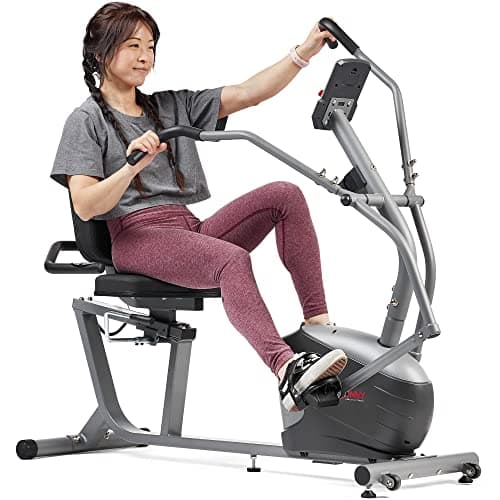
Top pick: Sunny Health & Fitness Smart Recumbent Bike with Dual-Motion Arm Exercisers