Recumbent Bike vs Treadmill
One is weight-bearing and one isn't, and that single difference decides it for most people. Here's how to tell which side you're on.
Read the guideOne is weight-bearing and builds bone; the other is not and never will be. Which answers your reason for exercising — and why for most people past 60 the honest answer is both.
How this is funded: we earn a commission if you buy through our links, at no extra cost to you. It never changes what we recommend, and every page here names at least one thing we would not buy. Full disclosure.
The short answer
Walking does more: it is weight-bearing, so it loads bone, and it trains the standing balance that keeps you upright. A recumbent bike does one thing walking cannot — it lets you choose the load, so the session still happens on a day your knees or your balance say no. If you can only do one, walk. If walking is unreliable, ride. Most people over 60 should do some of each.
This comparison gets answered badly almost everywhere, usually by someone totting up calories per hour. Calories are the least interesting difference between these two activities and the least reliably measured. The real difference is structural, it is not close, and it runs in both directions.
Cycling is not weight-bearing. Your body weight sits in the seat, which is exactly why it is kind to a sore knee — and exactly why it does nothing for your bones.
This is not a nuance, and we are not going to bury it. NIAMS describes bone as living tissue that responds to exercise by becoming stronger, and names weight-bearing exercise — activity that “produce[s] a force on bones that makes them work harder” — as the kind that does it, listing brisk walking, climbing stairs and dancing. A recumbent bike produces no such force at any resistance level. You cannot turn a knob and make pedaling weight-bearing.
So if bone density is part of why you are exercising — and after 60, for a lot of people, it is — the bike is not the answer on its own. We have a whole page on that specific question, and the answer there is a plain no with an explanation of what the bike is still good for.
Walking also trains something a seated machine never touches: standing balance. The CDC’s guidance for adults 65 and over lists balance activities alongside the aerobic minutes and the strengthening days, because they are a separate thing you have to do on purpose. Twenty minutes of pedaling is not balance work, however hard you pedal.
Walking has no dial. Your knee takes your body weight on every step, and the only adjustments available are distance, pace and gradient. For a joint that will not tolerate that load today, there is no setting low enough.
A bike has a dial, and that changes what is possible. The Arthritis Foundation makes the point that cycling’s continuous motion takes the joint through its range, which is the part that helps an arthritic knee rather than aggravating it. You can set the resistance light enough that the movement happens and the load does not.
Three more things a bike does that walking does not:
| What you care about | Recumbent bike | Walking |
|---|---|---|
| Weight-bearing (bone) | No. Your weight is in the seat. Nothing loads the skeleton. | Yes. NIAMS names brisk walking as a weight-bearing exercise. |
| Load on a sore knee | You choose it. Resistance is a setting, and it goes low. | Your body weight, every step. No adjustment available. |
| Balance required | None. Seated throughout, back supported. | All of it, and it trains it — which is the point and the risk. |
| Trains the movement daily life needs | No. Pedaling does not rehearse getting up a kerb. | Yes. It is the movement independence is made of. |
| Available in bad weather or bad light | Always. | Outdoors, no. Indoors on a treadmill or pad, yes. |
| Equipment needed | A machine, 50–66 in of floor, and a route to get it in. | Shoes. Or a treadmill if outdoors is not realistic. |
| Upper body involved | Only on machines with moving handles, and most couple them to the pedals. | Arms swing, which is not strength work either. |
| Counts toward 150 weekly minutes | Yes, at moderate effort. | Yes, at a brisk pace. |
Two specifications decide whether a recumbent bike gets used: whether you can get onto it, and whether the seat reaches your leg length. Neither is the one the marketing leads with.
| Machine | Weight capacity | Inseam range | Footprint |
|---|---|---|---|
| HARISON Recumbent Exercise Bike, 450 lb capacity | 450 lb | 26.5 in to 38.9 in (stated rider height 4 ft 8 in to 6 ft 4 in) | 54.6 in long × 25.7 in wide × 46.2 in high |
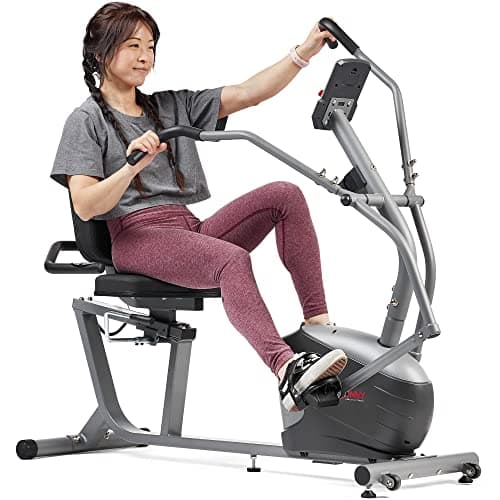
| Sunny Health & Fitness 16-Level Smart Magnetic Recumbent Bike with Workout Bands | 300 lb | 27.2 in to 35.8 in | 51.8 in long × 25.6 in wide × 46.1 in high |
Note what is absent from both: a step-over height. Not one manufacturer on this site publishes it, in a category sold to older adults, which is why measuring it yourself takes about a minute and is worth doing before you order.
If outdoor walking is not realistic — and for plenty of people it genuinely is not — the indoor version has to keep the weight-bearing benefit without introducing a fall. That comes down to the step-up and the handrails.
| Machine | Step-up height | Handrails | Minimum speed |
|---|---|---|---|
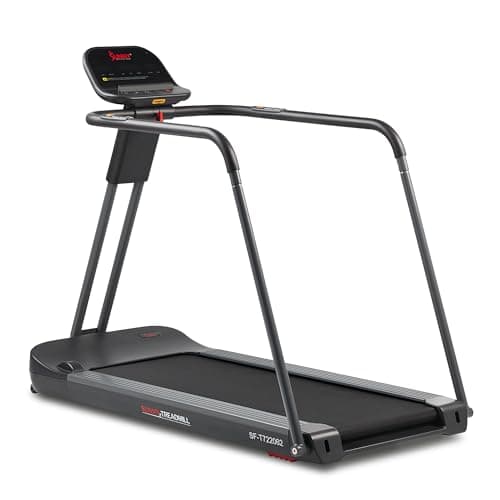
| Sunny Health & Fitness Treadmill with Extended Safety Handrails, Low Deck | 4 in floor-to-deck | Extended safety handrails running alongside the deck, plus a safety clip for emergency stops. Length in inches not published | Top speed published as 8.5 mph; the minimum speed is not published |
| HitGo Walking Pad with Handrails | Not published by the manufacturer | Full-length carbon steel rails on both sides, stated as heavy-duty carbon steel giving 360-degree support. Length in inches not published | 0.6 mph to 6.2 mph, on a stated 2.5 hp motor |
The Sunny figure — 4 inches floor to deck — is the lowest published step-up anywhere on this site, and it is published as a number rather than described as “low”. That is rare enough to be the reason it leads our treadmill shortlist.
Do both, if you can, and stop treating it as a choice. They cover different ground: the walking gives you bone loading and balance practice, the bike gives you volume on days when walking is a bad idea. Between them they cover the aerobic minutes, and a pair of light dumbbells twice a week covers the strengthening days the CDC asks for.
If it genuinely has to be one: walk, unless walking is unreliable. “Unreliable” is a short list, and it is worth being honest about which items apply to you — balance you do not trust, a joint that will not take your weight, no safe route within reach, or a week where the weather decides whether you exercise. Any one of those is a good reason to buy the bike, and none of them is a reason to feel you have taken the easy option.
People ask for the comparison and then do nothing, because two activities sounds like twice the commitment. It is not, and it is worth seeing the arithmetic written out.
The CDC asks for 150 minutes of moderate aerobic activity, two days of muscle strengthening, and some balance work. Spread across seven days that is roughly 20 minutes a day of something aerobic, two short sessions with weights, and a few minutes of standing on one leg while the kettle boils. Nothing in that list takes an hour.
A version that covers all of it: walk for 20 to 30 minutes on four days, because that is the weight-bearing half and the balance practice comes free with it. Ride for 20 minutes on two of the other days, which is where the aerobic volume comes from without asking anything more of the joints. Do something with light dumbbells twice a week, on any days you like. One day off, deliberately.
The point of the bike in that week is not that it is better than the walking. It is that it makes the walking survivable — it keeps the legs conditioned, it absorbs the days the weather or a joint cancels the walk, and it means a bad fortnight does not turn into a stopped habit. That is a real contribution, and it is the one most people buying a recumbent bike are actually getting.
If you are starting from very little, the couch-to-walking plan is a gentler on-ramp than anything above, and how often seniors should exercise covers the frequency question properly.
Recumbent bike versus treadmill is the right page if you have decided to buy a machine and are choosing between the two. How far should seniors walk puts a realistic number on the walking side, and the couch-to-walking plan is the one to start from if it has been a while.
General information, not medical advice. Tread & Tone is written by an enthusiast, not a clinician. Nobody here is a doctor, a physical therapist or a trainer, and nothing on this site has been medically reviewed. Talk to your doctor or physical therapist before starting something new, particularly after surgery, a fall, or a change in medication.
For cardiovascular fitness and for the weekly activity minutes, it can be — both count as moderate activity if the effort reaches moderate. For your bones, no, and not partially: cycling is not weight-bearing, so it does not load the skeleton. NIAMS is explicit that weight-bearing exercises are the ones that 'produce a force on bones that makes them work harder', and gives walking and stair climbing as examples. A bike does not do that at any resistance setting.
The bike, usually, and for a specific reason: you control the load. On a bike the resistance is a setting you choose, and your body weight is in the seat rather than on the joint. Walking loads the knee with your full weight on every step and there is no dial. The Arthritis Foundation points out that cycling's continuous motion moves the joint through its range, which is the part that helps. On a bad knee day the bike is usually the session that still happens.
Three things. It is weight-bearing, so it loads bone. It trains standing balance, which is a separate kind of exercise entirely and the one most closely tied to falls. And it rehearses the exact movement that independence depends on — getting to the shop, up the stairs, across the car park. No seated machine trains any of those, regardless of how hard you work on it.
Yes, if the effort is at least moderate. The CDC's target for adults 65 and over is 150 minutes a week of moderate-intensity activity plus two days of muscle strengthening and some balance work, and it does not specify a machine. The test for 'moderate' is the talk test: you can hold a conversation but not sing. Gentle pedaling while reading does not clear that bar, which is the usual reason seated cardio disappoints people.
Walk, if you can do it safely — it covers more of the target, including bone and balance, and it needs no equipment. Ride, if walking is unreliable: if balance is a worry, if a joint will not take your weight, if the weather or the neighborhood makes outdoor walking a fortnightly event rather than a daily one. The best exercise is the one that is still happening in six months, and a bike in the spare room is available on days that walking is not.
For bone and cardio, close enough — you are still carrying your own weight. The differences are balance and surface. A treadmill moves the ground under you, which demands more of your balance than a pavement does, and it gives you handrails, which demand less. It also removes kerbs, cambers, weather and traffic. Our recumbent-versus-treadmill comparison covers that trade in full.
Product measurements are cited individually inside each Fit-to-You panel, against the manufacturer page or dated retailer listing they were read from.
One is weight-bearing and one isn't, and that single difference decides it for most people. Here's how to tell which side you're on.
Read the guideNo, not for your bones — and we are not going to pretend otherwise. What a recumbent bike does do for someone with osteoporosis, and what has to sit alongside it.
Read the guideBest for Seniors
Eleven bikes ranked on the measurements that decide whether you can get on — with the count of specs each manufacturer refuses to publish.
Top pick: Sunny Health & Fitness Smart Recumbent Bike with Dual-Motion Arm Exercisers
Best Treadmill
Step-up height, minimum speed and handrail length — the three numbers that decide it, and which machines publish them.
Top pick: Sunny Health & Fitness Treadmill with Extended Safety Handrails, Low Deck
Price as of October 5, 2026. #ad How we’re funded
Minutes beat steps, and the CDC's guidance is written in minutes for a reason. What the target is and how to build to it.
Read the guideA gentle eight-week build from a few minutes a day to the CDC's weekly target, written for a body that hasn't done this in a while.
Read the guide