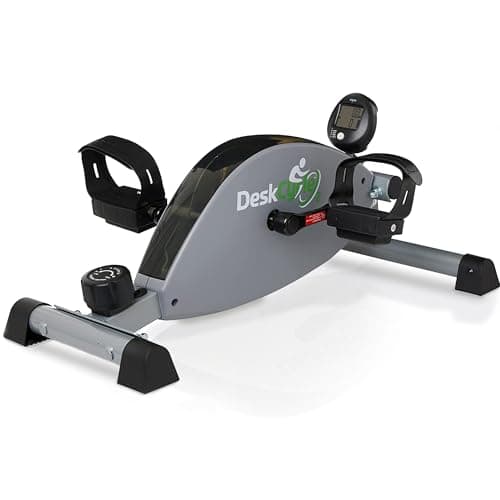
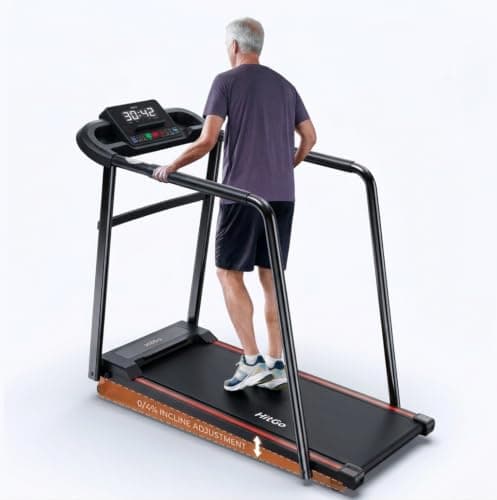
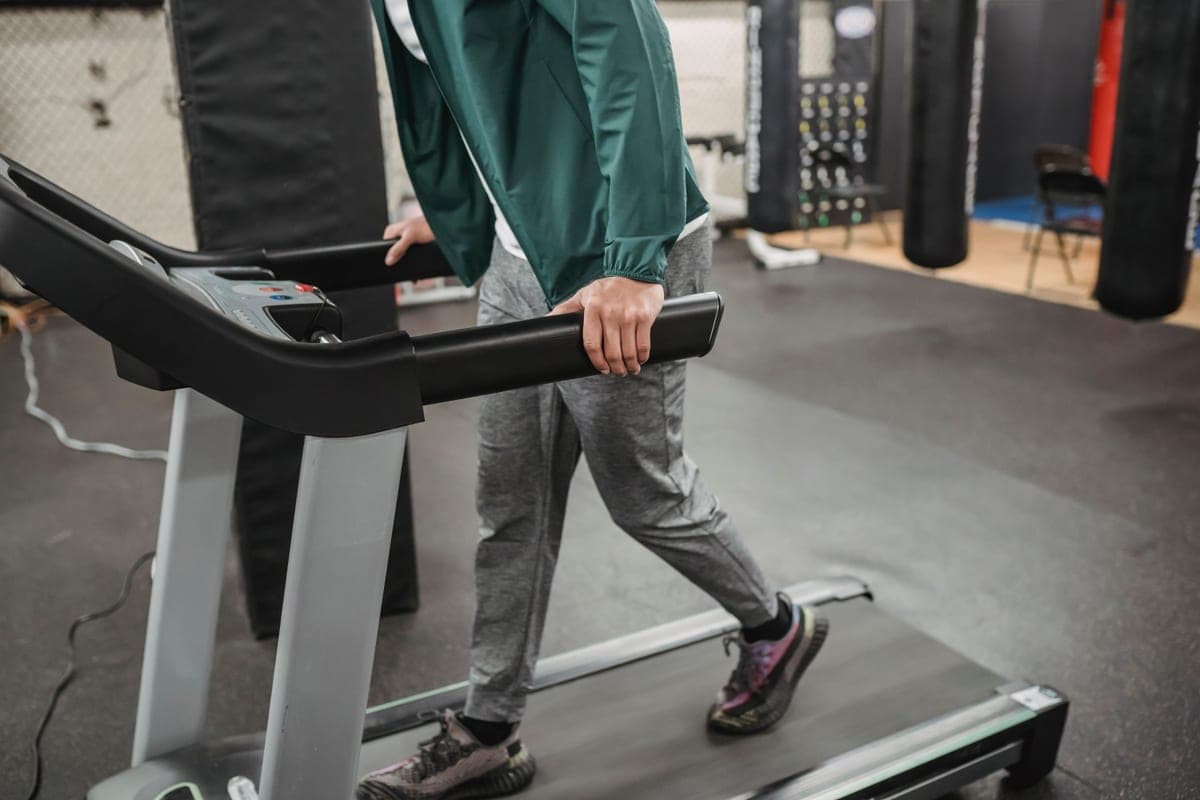
Both promise movement while you get on with your day. One asks nothing of your balance and the other asks for all of it — and that, not the price or the step count, is the decision.
How this is funded: we earn a commission if you buy through our links, at no extra cost to you. It never changes what we recommend, and every page here names at least one thing we would not buy. Full disclosure.
The short answer
Buy the under-desk bike if balance is a concern, if you live above someone, or if the movement has to happen while you are sitting anyway. Buy the walking pad if you are steady on your feet and want weight-bearing exercise that counts toward the weekly activity target faster. The bike is the safer purchase; the pad is the more effective one.
These two products are sold to the same person with almost the same promise — movement that fits around an ordinary day, in a space you already have — and they are not remotely the same thing. One of them you use sitting in the chair you are already in. The other one moves the floor under your feet.
That is the whole comparison, and everything below is detail. But the detail decides which one ends up in a cupboard, so it is worth twenty minutes before you spend the money.
The one question that settles it
Do you trust your balance, on a bad day, without thinking about it?
If the answer is an immediate yes, read on with an open mind — the walking pad may well be your machine. If you hesitated, stop here and buy the seated option. More than one in four adults 65 and over falls each year according to the CDC, and falling once roughly doubles the chance of falling again. A machine that introduces a new way to stumble, twice a day, in your own house, is not a good trade for a slightly better calorie figure.
That is not an argument against walking. Walking is the activity most people actually want back, and there is a whole section of this site about doing it safely indoors. It is an argument against walking on a machine with nothing to hold, which is what most walking pads are. One of the pads below has full-length rails on both sides; that is the version of this product we would put in a house where balance is the concern.
What each one actually does for you
The honest trade, published specs only. No calorie figures, because nobody measures them.
What you care about
Under-desk bike or elliptical
Walking pad
Balance required
None. You are seated in your own chair throughout.
All of it. The belt moves whether you are ready or not.
Weight-bearing
No. Your weight is in the chair, so it does nothing for bone.
Yes. You carry yourself, which is what loads the skeleton.
Step-up height
Not applicable — nothing to step onto.
Published at 4.3 in and 5.2 in on the two pads we track.
Published resistance
The DeskCycle 2 publishes 8 settings up to 39 lb. The Cubii JR1 publishes none at all.
Speed rather than resistance: 0.5–3.7 mph and 0.6–6.2 mph published.
Noise through a floor
Magnetic resistance puts nothing into the structure. No decibel figures published.
Footfall and vibration travel down. No decibel figures published.
Footprint when stored
15–23 in across, light enough to lift aside.
Pad length plus somewhere to slide it. Published 4.3–5.2 in high.
Can you read or watch while using it?
Yes, easily, which is both the appeal and the risk — effort drifts to nothing.
Not safely at the start. Looking down while walking is how people trip.
Who it suits
Anyone who cannot stand safely for 20 minutes, or lives above a neighbor.
A steady walker who wants weekly activity minutes that build faster.
The specification each category hides
Both of these aisles have one number that decides the purchase and that most makers will not print.
For a seated unit it is pedal height.Your knees have to clear the underside of your desk through the whole rotation, and if they do not, the unit is unusable — not uncomfortable, unusable. Exactly one unit we track publishes it as an adjustable range with a stated desk clearance.
Seated units: the published figures that decide whether it fits under your desk.
Machine
Pedal height
Resistance range
Footprint
DeskCycle DeskCycle 2 Under Desk Bike
Adjustable 9 in to 10 in; stated to fit desks as low as 27 in
8 magnetic settings, up to 39 lb
Not published by the manufacturer
Cubii JR1 Under Desk Elliptical
10 in overall height, not adjustable
Not published by the manufacturer
23.15 in × 17.56 in × 10 in
For a walking pad it is the step-up and the rails. Height is published by both pads below, and it is low on each. What is not published anywhere is a decibel figure, and that is the question most apartment buyers actually have.
Walking pads: what each maker publishes about getting on and holding on.
Machine
Step-up height
Handrails
Minimum speed
Sunny Health & Fitness Wi-Fi Treadpad Walking Treadmill
About 4.3 in
None. There is nothing to hold
0.5 mph to 3.7 mph, 1 hp motor
HitGo Walking Pad with Handrails
Not published by the manufacturer
Full-length carbon steel rails on both sides, stated as heavy-duty carbon steel giving 360-degree support. Length in inches not published
The under-desk bike fails by being too easy. The appeal is that you can read, work or watch television while pedaling. The consequence is that the resistance drifts to the bottom and stays there, and after a month you are moving your legs rather than exercising. The fix is mechanical, not motivational: buy the unit that publishes resistance in pounds so you can set a number and see it, rather than one with eight unlabeled levels.
The walking pad fails by being in the way.It is 4 or 5 inches tall and four feet long, which sounds like nothing until it has to live somewhere between sessions. The pads that get used are the ones with a home — against a particular wall, under a particular bed — decided before the box arrives. Measure the space and the route to it first.
And one failure they share: both are easy to start too hard. The CDC’s intensity guidance is a talk test — moderate effort means you can hold a conversation but not sing. It costs nothing, needs no watch, and works identically on both machines.
So which should you buy?
Our answer, plainly. If you are over 70 and shopping because standing or walking outdoors has become unreliable, buy the seated unit. The best exercise plan is the one that is still happening in six months, and a machine that cannot cause a fall survives bad days, bad weather and bad knees.
If you are steady on your feet and the motivation is weekly activity minutes, buy the pad — and buy the one with rails. The CDC’s target for adults 65 and over is 150 minutes a week of moderate activity plus two days of strengthening, and walking accumulates those minutes faster than seated pedaling does.
If the honest answer is “some days each”, the seated unit is the cheaper of the two and the one that works on the worse days. Start there.
The third option this comparison leaves out
Both of these products are bought on the same promise — small, cheap, fits around the day — and for one reader neither of them is the right answer. It is worth saying so before you spend.
If what you actually want is a proper twenty-minute cardio session rather than movement layered onto something else, a recumbent bike does that job better than either machine here. You get a back rest, a seat you sit down onto rather than a chair you happen to be in, a resistance range that goes meaningfully high, and pedals positioned for pedalling rather than for clearing a desk. The cost is floor space: the bikes we track publish footprints from 50 inches long upward, against 15 to 23 inches for a seated unit.
The honest test is what you intend to do while using it. If the answer is “work, read or watch television”, buy the under-desk unit — it is designed for exactly that and it costs a fraction as much. If the answer is “exercise, and nothing else”, the pedal unit will disappoint you within a month and the bike will not. Our recumbent bike shortlist ranks every machine we track on the measurements that decide whether you can get onto one, and the pedals-versus-bike comparison sets the two side by side if you want it in a table.
One more case worth naming: if turning the cranks unaided is itself the difficulty, neither product on this page is right, and the motorized pedal units are the aisle to look in instead.
General information, not medical advice. Tread & Tone is written by an enthusiast, not a clinician. Nobody here is a doctor, a physical therapist or a trainer, and nothing on this site has been medically reviewed. Talk to your doctor or physical therapist before starting something new, particularly after surgery, a fall, or a change in medication.
Questions people ask
Which is better for a senior, an under-desk bike or a walking pad?+
For most people over 70, the under-desk bike — not because it is better exercise, but because it asks nothing of your balance. You are sitting in a chair you already trust, and a stumble is not a possible outcome of the session. A walking pad does more for you per minute and is weight-bearing, which pedaling never is, but it moves the floor under your feet. If balance is already the reason you are shopping for home equipment, that settles it.
Does an under-desk bike count as exercise?+
It can, if the resistance is set high enough that you are working. The CDC's own test is whether you can talk but not sing — if you can pedal while holding a normal conversation effortlessly, you are moving rather than exercising, which is still better than sitting still. Where under-desk pedaling falls down is that most people leave the resistance at the bottom and read instead. The machine that publishes resistance in pounds, rather than as numbered levels, is the one that lets you check.
What desk height do I need for an under-desk bike?+
The number to check is pedal height, and almost nobody publishes it alongside a desk clearance. The DeskCycle 2 publishes an adjustable 9 to 10 inch height and states it clears desks as low as 27 inches, which is the only pair of figures of its kind we have found. Measure from your floor to the underside of your desk, then subtract the pedal height plus a couple of inches for your knees — if the result is negative, the unit will not fit and no review can change that.
Will a walking pad annoy the neighbors below?+
Possibly, and no manufacturer will help you find out. Not one walking pad we track publishes a decibel figure. The noise that travels through a floor is footfall and vibration rather than motor hum, so the variables are your weight, your speed and what the pad sits on — none of which appears on a spec sheet. An under-desk bike with magnetic resistance puts nothing through the floor at all, which is the honest answer if an apartment below is the constraint.
Can I use a walking pad without a desk?+
Yes, and most people do. 'Walking pad' is a storage description rather than a use case — the pads we track publish overall heights between 4.3 and 5.2 inches, so they slide out of the way. What matters more is whether there is anything to hold: one of the pads we list has full-length rails on both sides, and one has nothing at all, and that is a bigger difference than any other spec between them.
Which one burns more calories?+
Walking, by a wide margin at the same duration, because you are carrying your own weight. But we are not going to give you a number — calorie figures for either machine depend on your weight, speed, resistance and gait, and every published estimate we have seen is generated rather than measured. Judge effort with the talk test instead, which works identically on both machines and needs nothing but your own voice.
Sources
CDC — Older Adult Activity: An Overview — At least 150 minutes a week of moderate-intensity activity, 2 days of muscle strengthening, plus balance activities for adults 65 and over (read July 24, 2026)
CDC — How to Measure Physical Activity Intensity — Moderate-intensity activity is 64–76% of your estimated maximum heart rate, and vigorous is 77–93%; intensity can also be judged with the talk test (read July 24, 2026)
CDC — Facts About Falls — More than one in four adults 65 and over falls each year; falling once doubles the chance of falling again (read July 24, 2026)
Published minimum speeds range from 0.5 to 0.6 mph. Here is how to find yours, and why buying a machine that can't go slow enough is the common mistake.
Not what low-impact cardio is — how to actually do it indoors: the room you have, the floor you have, the people below, exercising alone safely, and how to tell the effort is counting.