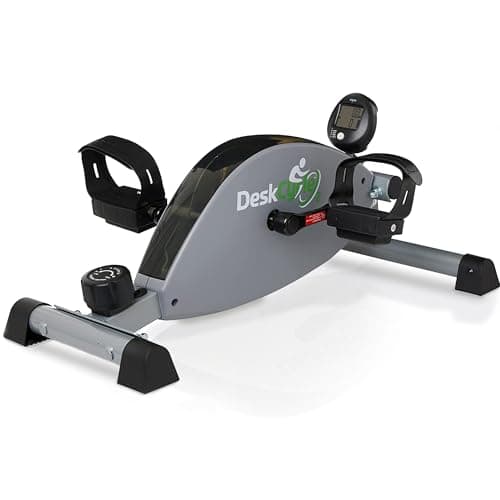
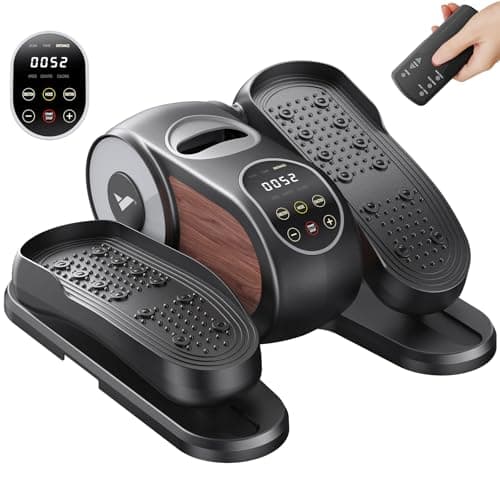
The short answer
Decide the motor question first. If you can turn pedals yourself, buy a self-powered unit — it gives you actual exercise rather than passive movement. Then, within self-powered, pick an elliptical if the knee is your constraint (shallower knee angle) and a pedal unit if clearance, price or arm use matters (lower, cheaper, works on a table).
Published figures from the products on our two seated-cardio shortlists.| What you care about | Pedal exerciser | Under-desk elliptical |
|---|
| Foot path | A circle, like a bike pedal | A flatter, longer oval |
|---|
| Knee angle at the top of the stroke | Deeper flexion | Shallower — the main mechanical argument |
|---|
| Motorized versions | Rare. Nearly all are self-powered | Common. One on our list has a 60 W motor |
|---|
| Published height range | 9–10 in adjustable, up to 18 in fixed | 7.4 in to 10 in, none adjustable |
|---|
| Resistance published as a figure | Yes on two — 8 settings up to 39 lb | No. Neither publishes a range |
|---|
| Works for arms on a table | Yes, on three of them | Generally no |
|---|
| Anti-slip feet published | Yes on two of them | Not published |
|---|
| Price | $50 to $170 | $65 to $170 |
|---|
| Best for | Tight clearance, tight budget, arm work, hard floors | A sensitive knee, or needing the motion assisted |
|---|
The distinction that actually decides it
Not the stroke shape. Whether a motor does the work.
The listings blur this badly. Both kinds of machine sit in the same Amazon aisle at similar prices under similar names, and one of them will move your legs while you sit still.
Self-powered. You turn the pedals against magnetic resistance. The work is yours, which is what makes it exercise. Every pedal exerciser on our shortlist is this, and so is the Cubii elliptical.
Motorized. A motor drives the pedals through the stride whether you push or not, forwards or in reverse, across preset programs. The MERACH publishes a 60 W motor and twelve automatic programs.
Motorized units are genuinely valuable in specific situations: very low leg strength, the early weeks after surgery when a therapist has asked for movement without load, or a long stretch of inactivity where the first problem is simply getting a joint moving. Passive movement keeps joints moving and helps circulation.
What it does not do is build strength. Muscle adapts to load; if a motor supplies the movement, there is no load to adapt to. So it is a bridge to self-powered use rather than a destination — and a listing claiming a motorized unit “strengthens your legs” while you sit still is describing two things that cannot both be fully true.
The stroke shape, and how much it matters
On a pedal exerciser your foot travels a circle, so the knee flexes through a deeper arc at the top of each revolution. On an elliptical the foot travels a flatter, longer oval, so the knee stays in a shallower range throughout.
For a knee that objects to being bent past a certain point, that is a real advantage, and it is the honest reason to pay more for an elliptical.
But keep it in proportion. On these small seated units the difference in stroke geometry is modest — both have short travel compared with a full machine — and how gently you can set the resistance probably matters more for a sensitive knee than the shape of the path. Which is awkward for the ellipticals, because neither publishes a resistance range at all, while two pedal units publish theirs in pounds and one offers stepless resistance.
The Arthritis Foundation’s point about cycling — that continuous motion moves the joint through its range, producing the fluid that lubricates it — applies to both types equally.
Clearance, where pedal units win on published data
This is the specification most likely to cause a return, and it does not split by type.
Published heights: 7.4 inches on the motorized MERACH elliptical, 9 to 10 inches adjustable on the DeskCycle 2 pedal unit, 10 inches on the Cubii, 11.7 inches on the Sunny pedal unit. The Vive publishes two contradictory figures in the same listing — 12.5 inches in its bullets, 7.7 inches in its dimensions table — which we report as published because we cannot resolve it.
Only DeskCycle publishes its height as a range andstates the desk height it clears — 27 inches. That is the most useful pair of numbers in this whole aisle and it belongs to a pedal unit.
Measure before you buy: floor to the underside of the desk, or floor to the front edge of the armchair seat, and leave room for the knee to travel above the pedal at its highest point.
Three things only pedal units do
- Arms. Put the unit on a table and pedal with your hands. Three publish this as a stated use, and it is genuinely useful for shoulder range of motion. Elliptical geometry does not translate.
- Stay put on hard floors.Two publish four anti-slip rubber pads, which is the fix for the commonest complaint in this category — the unit walking away across laminate while you pedal. No elliptical here publishes it.
- Fold. The Drive Medical unit folds for storage. None of the ellipticals does.
How to choose, in order
- Can you turn pedals yourself? If no, buy the motorized elliptical and treat it as passive movement rather than exercise. If yes, continue.
- Measure your clearance. This eliminates more options than anything else, and it eliminates the 18-inch unit from any desk.
- Is a knee the reason you are shopping?If yes, the elliptical’s shallower stroke is worth having — but so is stepless resistance on a pedal unit, and you may not get both.
- Do you want arm work, hard-floor stability, or the lowest price? All three point at a pedal unit.
And if the answer to all of this is that you actually want more exercise than either provides, a recumbent bikeis the next step up — a supported back, a comfortable longer session, and considerably more work done.