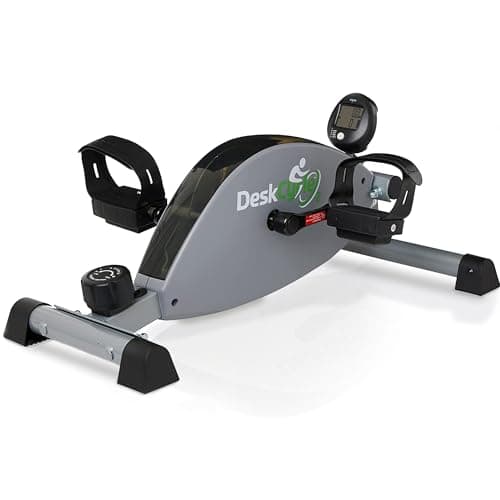
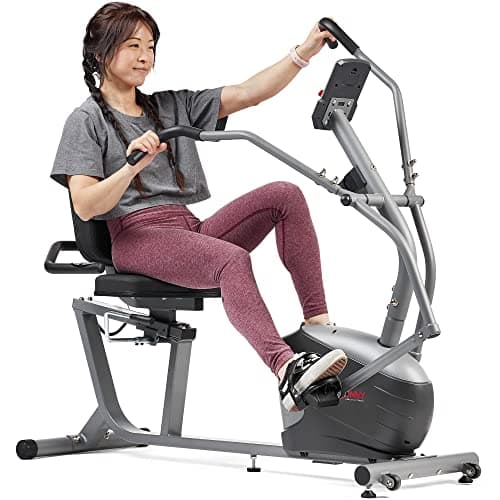
The short answer
A recumbent bike is the better workout — a supported seat, a back rest, more resistance, a session you can sustain. A pedal exerciser is the better starter: it costs a fraction as much, needs no floor space, requires no mounting, and hides under the chair you already own. Buy the pedal unit if budget, space, or getting onto a bike is the barrier. Buy the bike if you want a real, sustained workout and have the room.
The small machine against the full one, on what actually separates them.| What you care about | Pedal exerciser | Recumbent bike |
|---|
| Price | About the cost of a nice dinner | Several times more |
|---|
| Floor space | None — lives under a chair | A permanent 4-to-5-foot footprint |
|---|
| Getting on | Nothing to mount — use your own chair | Step through a frame and sit down |
|---|
| Back support | Whatever your chair offers | A built-in back rest |
|---|
| Resistance and workout | Light — best for breaking up sitting | Real range — a sustained session |
|---|
| Works the arms too | Yes, on a tabletop | Only with moving-arm models |
|---|
| Best when | Budget, space or mounting is the barrier | You want a proper, comfortable workout |
|---|
They aren’t really the same purchase
It is tempting to treat this as a cheap version against an expensive version of one thing. It isn’t. A recumbent bike is a machine you go to and get onto. A pedal exerciseris a set of pedals that comes to the chair you are already sitting in. That difference — whether there is a machine to mount at all — is the thing to decide on, and it matters more than price.
The Arthritis Foundation supports the seated pedaling motion for arthritic joints on either device — the continuous, low-impact movement is the same in kind. What changes is how much of it you can comfortably do, and whether you can get to it.
Where the pedal exerciser is genuinely the right buy
Three situations, and in each the small machine is not a compromise but the correct answer.
Budget or space is the barrier.If the reason you have bought nothing is that a bike costs too much or won’t fit the room, the pedal unit removes that reason for a fraction of the cost and no permanent footprint. Something used daily beats a better machine used never.
Getting onto a bike is the barrier. This is the strongest case. There is no mounting: you sit in your own supported armchair and the pedals are already there. For someone for whom stepping onto and off a machine is itself the problem, that is the whole point rather than a limitation.
You want to move your arms too.Put the unit on a table and it becomes a shoulder-mobility tool — something a recumbent bike cannot do. Set the resistance lower; arms tire faster than legs. Our guide to what a pedal unit can and can’t do walks through the honest limits.
Where the recumbent bike earns its price
The bike wins whenever the goal is a real, sustained workout. It gives you a proper seat and a back rest, so a longer session is comfortable rather than a strain on your own chair. It offers a genuine resistance range, so you can make the work harder as you get fitter. And its weight means it stays put on any floor.
That matters against the target. The CDC asks adults 65 and over for at least 150 minutes a week of moderate-intensity activity, and a bike reaches moderate intensity far more readily than gentle pedaling under a desk does. If a real workout is what you are after, the recumbent bike shortlist is the right aisle, and the Arthritis Foundation’s guidance on building volume is worth reading alongside it.
A sensible path, not just a pick
For a lot of people the honest advice is not one or the other but a sequence. Start with the pedal exerciser: it is cheap, it removes every barrier, and it tells you within a fortnight whether you will use a seated cardio habit at all. If you find yourself wanting more resistance and a comfortable seat for longer sessions, step up to a recumbent bike— you will buy it knowing you use it, rather than hoping you will. And if even light pedaling is too much for a knee, a motorized seated elliptical that moves your legs for you is the gentler starting point.