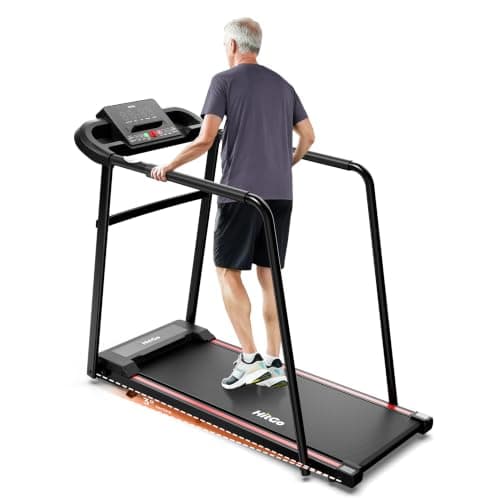
Best Walking Pad
Best Walking Pads for Seniors
Flat pads step up in inches rather than a foot — but most have nothing to hold. The ones that solve both, and one that doesn't.
Top pick: HitGo Walking Pad with Handrails
A one-tap emergency stop on top of the usual safety key, a remote so speed changes need no reach forward, and a top speed capped where a walking machine should stop. From the published specifications: who this suits.
How this is funded: we earn a commission if you buy through our links, at no extra cost to you. It never changes what we recommend, and every page here names at least one thing we would not buy. Full disclosure.

A dedicated emergency stop button
A one-tap emergency stop on top of the usual safety key, plus a remote so speed changes don't need a reach forward. The top speed of 3.8 mph is a deliberate limit rather than a shortcoming — this is a walking machine and nothing else.
Yesoul does not publish 5 of the 10 measurements we look for. The panel below names which.
Price as of August 4, 2026. #ad How we’re funded
Almost every walking machine ships with a pull-cord safety key: a clip that attaches to your clothing and cuts the power if you drift back and the cord pulls out. It works, but it is a passive device — it only helps if you have already fallen far enough back to yank the clip. The Yesoul walking treadmill adds something most machines at this price do not: a deliberate, active way to stop.
It publishes a one-tap emergency stop button in addition to the pull-cord safety key, plus a remote control for the speed. That is two design decisions aimed squarely at the moment a walk goes wrong, and a third — a top speed of 3.8 mph — that says plainly this is a walking machine and nothing else. Yesoul also publishes a 300 lb capacity, with six shock absorbers under a six-layer belt.
We have not walked on this machine and we own none of the equipment we write about, so this is not about how the deck feels or how quiet it really is. Everything below is reasoned from the specification Yesoul and the retailer listing publish. That specification has a genuine strength — the way it lets you stop — and one real hole that a careful buyer should know about before ordering.
Yesoul does not publish 5 of 10 of these. Where that is the case, this panel says so rather than guessing. How we compile these
Source: Amazon product listing data (Creators API) · read 2026-07-24
We have not used this machine. Everything above comes from the manufacturer’s published documentation and the dated retailer listing, with the source given for each figure. Where they don’t publish a number, we say so. We can’t tell you how it feels to ride, how quiet it really is, or how it holds up after two years — and anyone who tells you otherwise without owning one is guessing.
This is the reason to look at the Yesoul. It publishes a one-tap emergency stop button sitting alongside the usual pull-cord safety key. On most machines the safety key is the only stop mechanism beyond slowing the belt to zero — and the key is passive. It does its job only once you have already slid back far enough to pull the clip out, which on a slow walking belt is further back than people expect.
A dedicated stop button is an active alternative. If you feel unsteady, if a phone rings, if a pet wanders in, you press one thing and the belt stops — no reaching for the right console key, no waiting to drift back into the cord. For a walker who is nervous about the machine getting away from them, having a single, obvious “stop now” control is the kind of feature that decides whether the treadmill gets used at all or quietly becomes a clothes rail.
Keep the safety key clipped on anyway. The two are complementary: the button is the one you reach for on purpose, and the key is the one that saves you when you cannot. Yesoul publishing both, rather than treating the pull-cord as sufficient on its own, is the right instinct.
The second published feature is a remote control for speed and mode, paired with an extended handrail. That combination matters more than it first appears. On a bare walking pad the controls are usually at floor level or on the front lip, which means bending or reaching forward to change pace — the exact motion you least want to make while a belt is moving under you and your balance is the thing you are trying to protect.
A remote takes that reach away. You can hold the rail with one hand, thumb the remote with the other, and change speed without shifting your weight toward the front of the deck. It is the same problem the rail-mounted buttons on some treadmills solve, answered a different way — and for someone whose main worry is losing their footing during an adjustment, either solution beats a console you have to lean in for.
Yesoul publishes an extended handrail rather than a stubby front bar, though it does not publish the rail length in inches, so how far back along the deck the support runs is something to confirm at home: stand on the stationary belt in your normal position, let a hand fall, and see whether it lands on the rail without reaching.
Yesoul publishes a speed range of 0.6 mph to 3.8 mph. The 3.8 mph ceiling is not a weakness — it is a decision. A great many machines sold to walkers can run to 8 mph or more, which is a running speed nobody in this audience needs and a fair amount of motor, noise and cost spent on a capability that will never be used. Capping the top at 3.8 mph keeps the whole machine honest about what it is for.
A walking pace is exactly the range that does the work. Brisk walking is one of the activities the CDC counts as moderate-intensity movement, and the weekly minutes can be split into short sessions rather than done in one go — which suits a machine you step onto for ten minutes at a time. The common target is the CDC’s at least 150 minutes a week of moderate activity for adults 65 and over, and a walking-only machine reaches that as well as any oversized treadmill does, because whether a session is moderate depends on your effort, not the number the belt can hit.
The one caveat on the range sits at the bottom, not the top. The published floor is 0.6 mph, which is slightly higher than the 0.5 mph a couple of other machines on this site publish. For most walkers 0.6 mph is still comfortably slow — slower than a normal stroll — but if your steady pace is genuinely at the very low end, that extra tenth of a mile an hour is worth noticing against a machine that starts at 0.5.
No published belt dimensions at all.This is the real hole. On a walking machine the belt length and width are the numbers you most want, because a short belt shortens your stride and puts the back edge closer than you think, and the width sets how much margin you have either side of your foot. Yesoul publishes neither. It publishes an overall footprint, but the walking surface inside it is left unstated — so the single most useful specification for judging fit is missing, and there is no way to check it short of asking the retailer directly.
No manufacturer model number. Yesoul does not publish a model number for this machine, which sounds like a footnote and is not. A model number is how you confirm that a review, a manual, a replacement part or a spec sheet actually refers to the machine in front of you. Without one, everything you look up afterward is matched by description rather than by a definite identifier, and that makes every later question harder to answer with confidence.
No published step-up height.How high you lift your foot to get onto the deck, every time, is not published for this model — the same gap almost every machine in this category leaves. And there is no published decibel figure and no published assembly weight, so “quiet” stays a description rather than a measurement, and how much of a job the setup is has to be taken on trust. The safety design is the reason to buy this machine; the missing belt dimensions are the reason to ask a question or two before you do.
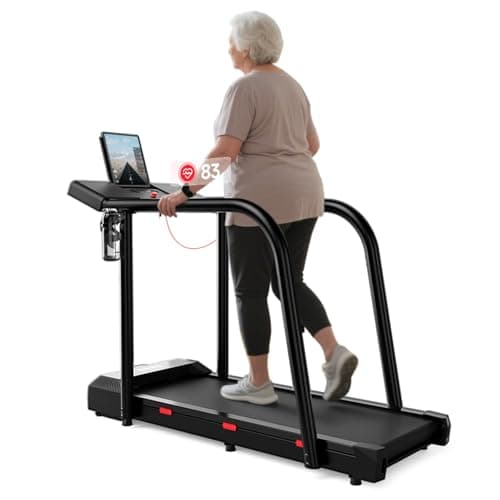
A walker who wants a clear way to stop. The one-tap emergency stop button on top of the pull-cord safety key is the standout, and it answers the fear that a treadmill will get away from you.
Anyone who dislikes reaching forward to change pace. The remote lets you adjust speed with a hand on the rail, no leaning toward the front of the deck.
Someone who only ever intends to walk. The 3.8 mph ceiling means you are not paying for a running motor you will never use, and the range that is there is the range that does the work.
A buyer who wants a stated capacity. The published 300 lb limit, with six shock absorbers under a six-layer belt, is a real number to check against your own weight rather than a guess.
Anyone whose deciding number is belt size. Yesoul publishes no belt length or width at all, so there is nothing to check. If stride length or margin either side of your foot is your constraint, choose a machine that states its belt, or ask before ordering.
Anyone who needs the very slowest floor speed. The published minimum is 0.6 mph, a touch above the 0.5 mph machines here. For most people that is still slow, but at the very low end it is worth weighing.
Anyone who wants to verify everything by model number. There is no published model number, so later lookups for parts, manuals or spec sheets are matched by description rather than a definite identifier.
Anyone whose constraint is step-up height. It is not published for this model, so there is no figure to check against.
Price as of August 4, 2026. #ad How we’re funded
General information, not medical advice. Tread & Tone is written by an enthusiast, not a clinician. Nobody here is a doctor, a physical therapist or a trainer, and nothing on this site has been medically reviewed. Talk to your doctor or physical therapist before starting something new, particularly after surgery, a fall, or a change in medication.
Two ways. Yesoul publishes a dedicated one-tap emergency stop button in addition to the usual pull-cord safety key. The button is the active control you press on purpose the moment you feel unsteady; the safety key is the passive backstop that cuts power if you drift back and the clip pulls out. Keep the key clipped to your clothing every time and use the button whenever you want to stop deliberately.
Yes — it publishes a remote control for speed and mode, paired with an extended handrail. That lets you change pace with a hand still on the rail instead of bending or reaching forward to a console, which is the motion you least want to make while the belt is moving. It is one of the two reasons this machine suits a walker whose main worry is losing their footing during an adjustment.
Its published range is 0.6 mph to 3.8 mph. The 3.8 mph ceiling is deliberate: this is a walking machine, not a running one, so you are not paying for a large motor you will never use. The 0.6 mph floor is comfortably slow for most walkers — slower than a normal stroll — though it is a tenth of a mile an hour above the 0.5 mph a couple of other machines on this site publish.
Yesoul does not publish the belt dimensions — neither length nor width. That is the machine's real gap, because on a walking pad the belt length sets your stride and how close the back edge is, and the width sets your margin either side of your foot. The listing gives an overall footprint but not the surface you walk on, so if belt size is your deciding factor, ask the retailer directly before ordering.
The published weight capacity is 300 lb, and Yesoul states six shock absorbers under a six-layer belt. The capacity is a hard limit rather than a guideline, so check it against your own weight rather than assuming headroom. It is one of the specifications Yesoul does publish plainly, which counts for something on a machine that leaves the belt dimensions and model number unstated.
It sits between the two: a low-profile walking machine with an extended handrail and a top speed capped at 3.8 mph, so it walks like a pad but adds the support and the stop controls of a treadmill. It suits someone who wants something to hold and a clear way to stop, rather than a bare pad that slides under a sofa. Whichever label you use, it is built for walking, not running.
Product measurements are cited individually inside each Fit-to-You panel, against the manufacturer page or dated retailer listing they were read from.
Best Walking Pad
Flat pads step up in inches rather than a foot — but most have nothing to hold. The ones that solve both, and one that doesn't.
Top pick: HitGo Walking Pad with Handrails
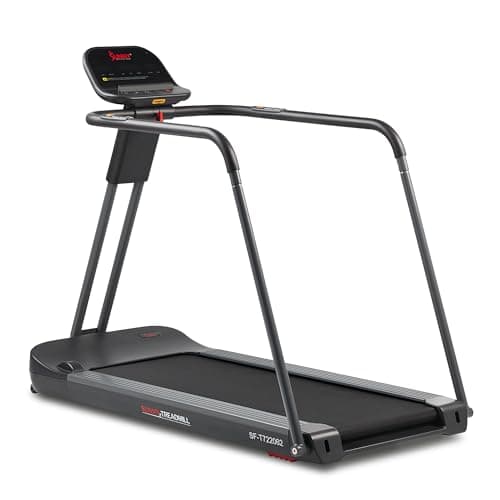
Best Treadmill
Step-up height, minimum speed and handrail length — the three numbers that decide it, and which machines publish them.
Top pick: Sunny Health & Fitness Treadmill with Extended Safety Handrails, Low Deck
Price as of August 4, 2026. #ad How we’re funded
Published minimum speeds range from 0.5 to 0.6 mph. Here is how to find yours, and why buying a machine that can't go slow enough is the common mistake.
Read the guide