Best Treadmill
Best Treadmills for Seniors
Step-up height, minimum speed and handrail length — the three numbers that decide it, and which machines publish them.
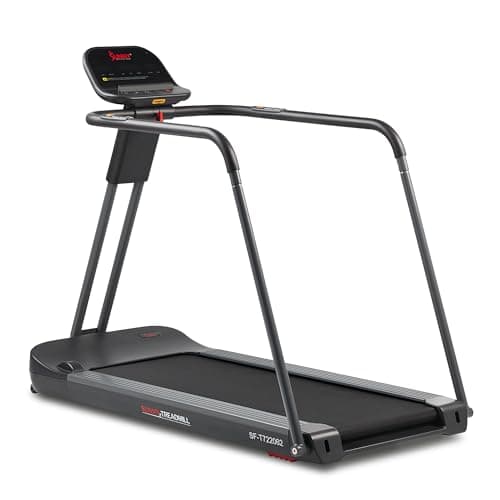
Top pick: Sunny Health & Fitness Treadmill with Extended Safety Handrails, Low Deck
For an arthritic joint the two machines pull in opposite directions: the pad is easier to get onto and put away, the cushioned deck is easier on the joint with every step you take. Which matters more depends on your joint and your room.
How this is funded: we earn a commission if you buy through our links, at no extra cost to you. It never changes what we recommend, and every page here names at least one thing we would not buy. Full disclosure.
The short answer
For an arthritic joint, a cushioned treadmill deck is gentler at every step, because it absorbs more of the impact your knee, hip or ankle would otherwise take. A walking pad is flatter, lower to step onto, and folds away — but its thin, hard deck transmits more of each footstrike into the joint. Choose the cushioned treadmill if the joint is the main problem and you have room; choose the pad if getting on and storing it are the bigger obstacles.
| What you care about | Walking pad | Cushioned treadmill |
|---|---|---|
| Impact reaching the joint | Higher — thin, hard deck | Lower — the deck absorbs more per step |
| Step-up height | Very low — inches off the floor | Higher — a real step onto the deck |
| Something to hold | Usually nothing | Handrails along the deck |
| Belt length / stride room | Short — watch the stride | Longer — room for a full stride |
| Storage | Folds flat or slides away | A large, permanent object |
| Noise | Quiet at walking speed | Louder — a bigger motor and deck |
| Best when | Getting on and storing it are the problem | The joint is the main problem |
Walking is one of the low-impact activities the Arthritis Foundation recommends for arthritic joints, and the CDC counts brisk walking as moderate-intensity activity. So the goal is not in doubt. The question is how to do that walking while asking the least of a sore joint, and that is where the deck comes in.
Every step you take sends a small shock up through the ankle, knee and hip. A cushioned deck flexes and absorbs part of that shock before it reaches the joint; a thin, hard walking-pad surface passes more of it straight through. Over a ten-minute walk that is hundreds of footstrikes, and the difference between a deck that gives a little and one that does not is felt cumulatively rather than on any single step. For a joint that is already inflamed, keeping the per-step impact down is the single most useful thing the equipment can do. Our guide to treadmill cushioning explains how to tell a real system from the word on a box.
Cushioning is not treatment, and it is worth being plain about that. It reduces an aggravating factor; it does not fix a joint. Nobody here is a clinician, and anything painful is a reason to talk to your doctor before you shop, not after.
The pad is not the lesser machine — it is the better machine for two real problems.
Getting on. A walking pad sits only inches off the floor, so the foot lift to step aboard is small. If raising your foot onto a raised deck is itself part of what hurts, that low profile is a genuine advantage, and it is the one thing the cushioned treadmill cannot match.
Storage and noise. A pad folds flat or slides under a bed and runs quietly at walking speed. If the machine has to vanish between uses, or a shared wall makes noise a constraint, that requirement can outweigh the deck argument entirely. Our walking-pad shortlist ranks the ones that solve the usual weaknesses, and our quiet-machine guide covers the noise question specifically.
There is a safety point that often decides this for an arthritic user whose balance is also affected. Most walking pads have no handrail, while a cushioned treadmill has rails running alongside the deck. The CDC reports that more than one in four adults 65 and over falls each year, and arthritis and unsteady balance frequently travel together. If a rail to hold is part of what would make you feel safe walking, the treadmill’s handrails can matter more than the pad’s low step-up. We rank machines on exactly that in our handrail roundup.
Put the two problems side by side. If the joint pain is the main eventand you have the floor space, the cushioned treadmill’s softer deck, handrails and longer belt make it the more joint-friendly walk — see our treadmill shortlist. If getting onto the machine, storing it, or keeping it quietis the bigger obstacle, the walking pad’s low profile wins, and you manage the impact by keeping the pace gentle.
And if walking on any deck aggravates the joint no matter how soft, that is your body telling you to take the weight off it. A recumbent bikeremoves weight-bearing entirely, which is the more conservative route when a joint simply will not tolerate impact — and the right first step there is your doctor or physical therapist, not a purchase.
General information, not medical advice. Tread & Tone is written by an enthusiast, not a clinician. Nobody here is a doctor, a physical therapist or a trainer, and nothing on this site has been medically reviewed. Talk to your doctor or physical therapist before starting something new, particularly after surgery, a fall, or a change in medication.
It depends on which problem is bigger for you. A cushioned treadmill deck absorbs more of the shock at each footstrike, which is gentler on an arthritic knee, hip or ankle over a whole walk. A walking pad is flatter and easier to step onto and store, but its thin, hard deck transmits more of each step into the joint. If the joint is the main concern and you have the space, the cushioned deck usually wins; if getting on and storing it are the bigger obstacles, the pad does.
It changes how much impact reaches the joint at each step, and over thousands of steps that adds up. It is not a treatment and it will not fix arthritis — the Arthritis Foundation's point is that low-impact movement helps joints, and a softer deck simply keeps the impact lower. Think of cushioning as reducing an aggravating factor, not as therapy. If a joint is painful, that is a conversation for your doctor before you shop.
Walking slowly does reduce impact, and it helps. But speed and deck hardness are separate things: even at a gentle pace, a thin hard pad transmits more of each footstrike than a cushioned deck does at the same speed. Slowing down and cushioning the deck both help, and they stack — the cushioned treadmill simply gives you the second one built in.
The pad is lower to step onto, which is a genuine advantage, especially if lifting your foot is itself part of the problem. But most walking pads have nothing to hold, while a cushioned treadmill has handrails. For an arthritic user whose balance is also affected, a handrail can matter more than a low step-up. Weigh both, not just the one.
The walking pad, clearly. It folds flat or slides under furniture and tends to run quietly at walking speeds, which is why it suits an apartment or a shared room. A cushioned treadmill is a large, permanent object. If the machine has to disappear between uses, that requirement can override the joint argument on its own.
The Arthritis Foundation lists walking among the low-impact activities that help arthritic joints, and the CDC counts brisk walking as moderate-intensity activity. But 'right' depends on your specific joints and stage, and a cycling or water option removes weight-bearing entirely if walking aggravates things. If you are unsure, ask your doctor or physical therapist which loads your joints can handle.
Product measurements are cited individually inside each Fit-to-You panel, against the manufacturer page or dated retailer listing they were read from.
Best Treadmill
Step-up height, minimum speed and handrail length — the three numbers that decide it, and which machines publish them.
Top pick: Sunny Health & Fitness Treadmill with Extended Safety Handrails, Low Deck
Best Walking Pad
Flat pads step up in inches rather than a foot — but most have nothing to hold. The ones that solve both, and one that doesn't.
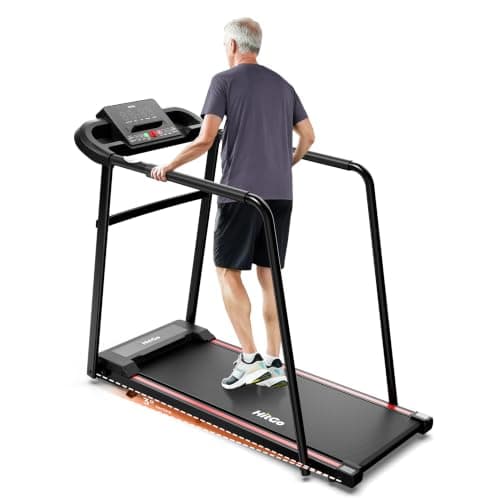
Top pick: HitGo Walking Pad with Handrails
Price as of September 23, 2026. #ad How we’re funded
What a 'cushioned deck' really is, why it matters more past 60 than at any other age, and how to tell a genuine system from a marketing word.
Read the guide