Best Treadmill
Best Treadmills for Seniors
Step-up height, minimum speed and handrail length — the three numbers that decide it, and which machines publish them.
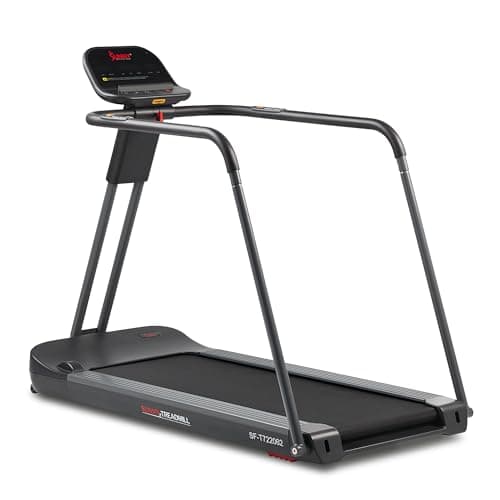
Top pick: Sunny Health & Fitness Treadmill with Extended Safety Handrails, Low Deck
A 'cushioned deck' can mean a real shock-absorbing system or almost nothing. Here's what cushioning actually does for an older walker's joints, and how to tell the two apart before you buy.
How this is funded: we earn a commission if you buy through our links, at no extra cost to you. It never changes what we recommend, and every page here names at least one thing we would not buy. Full disclosure.
The short answer
Cushioning is a deck built to flex and absorb part of each footstrike before it reaches your joints. It matters more past 60 because it lowers the impact on knees, hips and ankles over thousands of steps. But “cushioned” on a box is often just a word — and a deck that is too soft is its own problem.
“Cushioned deck” is one of the most common phrases on a treadmill box and one of the least defined. On one machine it means a real, engineered shock-absorbing system. On the next it means a slightly less rigid board than the cheapest option, described with the same two words. This guide is about telling those apart, because for an older walker the difference is the difference between a machine that spares your joints and one that only claims to.
When your foot lands, a force travels up through the ankle, knee and hip. On a hard floor, all of it comes back at you, because concrete does not move. A treadmill deck sits between your foot and the frame, and cushioning is simply how much of that force the deck soaks up before it reaches you.
Mechanically there are two common approaches. The most widespread is a set of elastomers— rubber blocks fitted between the deck and the frame, so the board flexes down a fraction on each step and springs back. The other is a suspension deck, where the whole platform is mounted to give a controlled amount, sometimes more at the front where you land and firmer at the back where you push off. Either way, the point is the same: the machine absorbs part of the footstrike so your joints absorb less.
This is why deck depth matters. A thicker deck has room to flex; a very thin one, sitting almost on the floor, does not. It is also why cushioning is a genuine feature to design and pay for, rather than something every machine has by default. A rigid board under a belt is cheaper to build, and plenty of machines ship exactly that and still print the word “cushioned” somewhere on the carton.
Walking is one of the best things an older adult can do, and cushioning is about making it sustainable rather than making it magic. The Arthritis Foundation explains that movement helps osteoarthritic joints rather than aggravating them — the joint needs to be used — and that the low-impact forms of activity are the ones to reach for. It lists walking among the low-impact options that suit arthritic joints, alongside cycling and water exercise.
Cushioning sits inside that idea. It does not change what walking does for you; it lowers the impact each step delivers. Over a ten-minute walk that is a few hundred footstrikes, and over a month of most days it is tens of thousands. A knee or hip that tolerates one hard step fine can still object to the accumulation, and the whole argument for a cushioned deck is about the accumulation, not any single step.
None of this makes cushioning a treatment. It reduces impact; it does not repair a joint or numb one. If a knee, hip or ankle is already painful, the honest answer is that lower impact may help you keep walking, but the person to decide whether you should be walking at all is your doctor or physical therapist. Nobody at Tread & Tone is a clinician, and a cushioned deck is a spec, not a course of care.
Here is the frustrating part, and we would rather say it plainly than pretend the market is tidier than it is: on cushioning, most manufacturers publish almost nothing. It is a recurring finding across the machines on this site. You will see “cushioned deck” or “shock absorption” on the listing, and then no explanation of what produces it, how much give it provides, or where on the belt.
So the test is not whether the word appears — it nearly always does — but whether a mechanism is described. A maker that has actually built a cushioning system tends to say how it works: elastomer blocks, a named suspension deck, cushioning that is softer where you land and firmer where you push off. A maker that has only added the word gives you the word and nothing behind it. When there is no mechanism described, treat “cushioned” as marketing until the machine proves otherwise under your own feet.
The most reliable check is still the oldest one: walk on it. If you can try a machine, walk at your normal pace and notice whether the deck gives a little and evenly, or whether it feels like a plank, or whether it feels like a trampoline. Numbers on a box cannot tell you that, and on cushioning there are usually no numbers anyway.
It is tempting to assume more cushioning is always better. It is not, and this is where an older walker’s needs part company with a runner’s. A deck that is too soft feels spongy and unsettled underfoot, a little like walking on a mattress, and that softness moves under you in ways a firm surface does not.
For someone whose balance is not what it was, that matters. The CDC reports that more than one in four adults aged 65 and over falls each year, and that falling once doubles the chance of falling again. A walking surface that subtly shifts under each step is working against your stability, and no amount of joint-sparing softness is worth an unsteady footing. On a moving belt, feeling secure underfoot is not a luxury.
The target, then, is not the softest deck you can find. It is a firm, even give — enough to take the edge off each footstrike, not so much that the ground feels uncertain. If a machine feels bouncy or you can feel yourself correcting for the surface, that is too much cushioning for walking, whatever it does for someone jogging on it. And if steadiness is the real concern, handrails you can reach do more for you than any cushioning system, which is a different feature to shop for.
Put cushioning in its place. It is one thing to weigh, and for most older walkers it ranks below handrails, a slow enough minimum speed, and a stop control you can find without looking. A cushioned deck on a machine you cannot safely get on and off is the wrong priority.
With that said, when you do compare cushioning, look for a described mechanism rather than the bare word, favor a deck with the depth to flex over a wafer-thin one, and aim for firm, even give rather than maximum softness. Because so little is published, the walk-on-it test carries more weight here than on almost any other feature.
The volume target is worth keeping in view while you shop, because cushioning only earns its keep if you actually walk. The CDC’s guidance for adults 65 and over is at least 150 minutes a week of moderate-intensity activity, plus muscle strengthening and balance work. That is built from short, regular walks, and a deck that is comfortable enough to use most days matters more than a deck that is impressive on paper and used twice.
Two of our shortlists carry this further. Our best treadmills for seniors ranks machines on what actually helps an older walker, cushioning included, and our walking pad versus cushioned treadmill comparison covers why a thin pad has little room for a real cushioning system in the first place. And if a specific joint is the reason you are here, knee pain on the treadmill looks at causes that cushioning alone will not fix.
General information, not medical advice. Tread & Tone is written by an enthusiast, not a clinician. Nobody here is a doctor, a physical therapist or a trainer, and nothing on this site has been medically reviewed. Talk to your doctor or physical therapist before starting something new, particularly after surgery, a fall, or a change in medication.
It is the way the walking surface is built to flex and give a little under each footstrike instead of staying rigid. A cushioned deck usually sits on the frame through rubber blocks, called elastomers, or a suspension system, so part of the impact is absorbed by the machine before it reaches your feet, ankles, knees and hips. Done well it is a real mechanism; on many machines the word describes almost nothing.
It can lower the impact that reaches the joint, which is different from treating what hurts. The Arthritis Foundation explains that low-impact movement helps arthritic joints rather than aggravating them, and cushioning keeps the impact of each step lower than a hard floor would. But cushioning is not a cure, and if a joint is painful the person to ask is your doctor or physical therapist, not a website.
No. A deck that is too soft feels spongy and unstable underfoot, a bit like walking on a mattress, and for an older walker that unsteadiness is a real cost rather than a comfort. The CDC notes that more than one in four adults over 65 falls each year, so a surface that subtly unsettles your balance is working against you. The aim is a firm, even give, not the softest possible deck.
Look for a described mechanism rather than a single word. A real system names how it works — elastomer blocks, a suspension deck, cushioning that varies along the belt — and ideally lets you feel a firm, even give when you walk on it. Most makers publish very little, which is a recurring frustration on this site, so 'cushioned deck' on a box with no explanation should be treated as marketing until proven otherwise.
A walking pad is thinner, so its deck usually sits close to a hard floor with little room to flex, which means less genuine cushioning. A full treadmill has the depth to build a real shock-absorbing deck, and it can carry handrails, which matter more than cushioning if balance is a concern. Which is right depends on your space, your balance and your joints; our walking-pad-versus-cushioned-treadmill guide walks through the trade-off.
Often yes, compared with concrete or paving. A well-built cushioned deck absorbs part of each step, where a sidewalk gives back nothing, so many people find the machine easier on the joints than a hard pavement. Grass or a track can be gentler still, and outdoor walking has its own benefits, so this is a reason to consider a treadmill for hard-surface days, not a reason to stop walking outside.
Product measurements are cited individually inside each Fit-to-You panel, against the manufacturer page or dated retailer listing they were read from.
Best Treadmill
Step-up height, minimum speed and handrail length — the three numbers that decide it, and which machines publish them.
Top pick: Sunny Health & Fitness Treadmill with Extended Safety Handrails, Low Deck
A flat pad is easier to step onto and store; a cushioned deck is gentler on the joint at every step. For an arthritic knee, that trade-off is the whole question.
Read the guideMost treadmill knee pain traces to three things you can change without buying anything — speed, stride and the deck under you. When it's the machine, and when it's the doctor.
Read the guide