Best Treadmill
Best Treadmills for Seniors
Step-up height, minimum speed and handrail length — the three numbers that decide it, and which machines publish them.
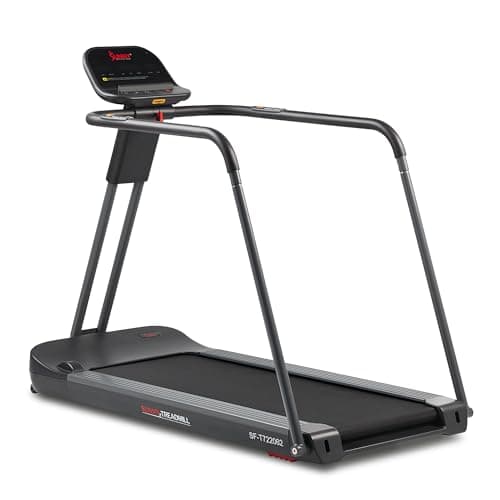
Top pick: Sunny Health & Fitness Treadmill with Extended Safety Handrails, Low Deck
A treadmill trains the thing you actually do all day — walking — and gives you a rail to hold. An elliptical removes the impact but stands you on moving pedals. The right choice is the one your joints and your balance can both live with.
How this is funded: we earn a commission if you buy through our links, at no extra cost to you. It never changes what we recommend, and every page here names at least one thing we would not buy. Full disclosure.
The short answer
A treadmill trains walking — the most functional movement you own — and gives you handrails to hold, at the cost of impact on each step. An elliptical removes the impact with a gliding stride, but stands you on raised, moving pedals and asks your balance to keep up. Choose the treadmill if keeping your walking ability matters and you can walk safely. Choose the elliptical if impact is the problem and your balance is solid — and consider a seated machine if it’s both.
| What you care about | Treadmill | Elliptical |
|---|---|---|
| Impact on the joints | Real — each step lands your weight | None — the foot never leaves the pedal |
| Balance demand | Moderate — walking a moving belt | High — standing on moving pedals |
| Something to hold | Handrails along the deck | Moving handles, not fixed rails |
| Getting on | Step up onto the deck (a few inches) | Step up onto raised pedals, then balance |
| Functional carry-over | High — walking is a daily-life skill | Lower — the stride isn't a daily movement |
| Fall risk | Real — a moving belt underfoot | Real — nothing beneath you if you slip |
| Best suited to | Keeping or rebuilding walking, safely | Sparing the joints with solid balance |
Walking is the movement you do all day, and it is the one whose loss changes a life the most. A treadmill trains it directly, and the CDC names brisk walking as moderate-intensity activity in its own right. If your goal is to keep walking, or to get back to it, no other machine rehearses the real skill the way a treadmill does.
It also gives you something to hold. Rails running the length of the deck are the difference between a machine a nervous walker will use and one they won’t, and they are the reason a treadmill can be the safer choice for someone whose balance is uncertain — provided it is set up properly. Our handrail shortlist and the pre-walk safety checklist cover exactly that.
The cost is impact. Every step carries your body weight down onto the deck, and for an inflamed joint that is the drawback. A cushioned deck softens it, but it does not remove it.
The elliptical’s advantage is clean and real: your foot never strikes anything, so there is no impact to reach the joint. For someone whose knees or hips object to footstrike specifically, that is a genuine solution, and it keeps you standing and weight-bearing, which the seated machines do not.
The catch is balance. You are standing on two pedals raised off the floor, and they move under you for the whole session. The CDC’s figure — more than one in four adults 65 and over falls each year — is the reason this is not a small caveat. A standing elliptical suits a senior with good balance who wants to spare the joints; it is a poor fit for anyone whose balance is part of why they are shopping. We lay out where that line falls in our guide to ellipticals for seniors.
People compare these on impact and forget access. A treadmill deck sits a few inches off the floor — the one machine on this site that publishes the figure states four inches — and you step onto it twice a session. An elliptical asks you to step up onto raised pedals and then stay standing on them. For an unsteady user, stepping onto something that is about to move is the harder task, and the machines mostly won’t publish the number either way.
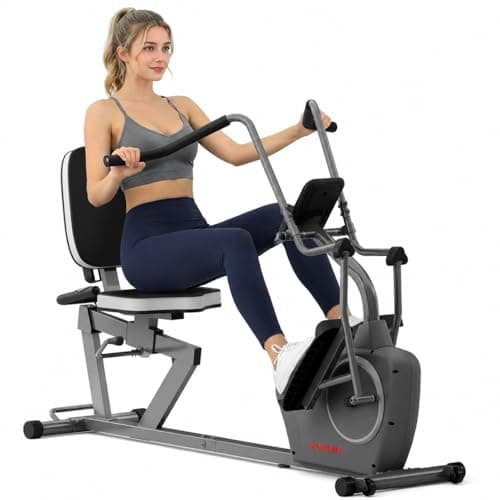
If your reason for shopping is joints or balance rather than a wish to keep walking, the honest recommendation is neither of these standing machines. A recumbent bike or a recumbent cross-trainer removes impact and balance demand at the same time — you sit down, and neither problem is on the table. The elliptical only makes sense when impact is the single thing you need to avoid and your balance is genuinely solid.
So: treadmill to keep walking, elliptical to spare the joints while standing, and a seated machine when it’s both. Whichever you land on, the CDC also asks for balance work that none of these cardio machines provide, so add a balance pad to any of them.
General information, not medical advice. Tread & Tone is written by an enthusiast, not a clinician. Nobody here is a doctor, a physical therapist or a trainer, and nothing on this site has been medically reviewed. Talk to your doctor or physical therapist before starting something new, particularly after surgery, a fall, or a change in medication.
They do different jobs. A treadmill trains walking — the most functional movement there is — and has handrails to hold, but each step carries impact. An elliptical removes the impact with a gliding stride, but it stands you on raised, moving pedals and demands balance. If keeping your walking ability matters and you can walk safely, choose the treadmill. If impact is the problem and your balance is solid, choose the elliptical.
The elliptical, on impact alone — your foot never leaves the pedal, so there is no footstrike. A treadmill's every step carries your body weight down onto the deck, though a cushioned deck softens that. But 'easier on the knees' is not the only question: the elliptical asks your balance to work continuously, and for many older users that trade is not worth it. A seated machine sidesteps both problems.
It depends on your balance. A treadmill has a moving belt and handrails; an elliptical has no belt but stands you on moving pedals with nothing beneath you if you slip. The CDC reports more than one in four adults 65 and over falls each year. If your balance is uncertain, the treadmill's handrails and the option to go slowly usually make it the more controllable machine — and either way, a seated cross-trainer removes the balance question entirely.
Both are weight-bearing in the sense that you stand and carry your own weight, so both load the skeleton more than sitting does. Walking's repeated footstrike is often described as the stronger bone-loading stimulus, but if bone health is a specific concern, that is a question for your doctor, whose answer depends on your own bone density and fracture risk — not something to settle from a website.
Not necessarily. The Arthritis Foundation lists walking among helpful low-impact activities, and a cushioned deck plus a gentle pace keeps the impact down. But if any footstrike aggravates the joint, the elliptical's no-impact stride — or better, a seated machine that removes weight-bearing — is the more conservative route. Match the machine to what your joints actually tolerate, and ask a professional if you're unsure.
Ask which you're more worried about: losing your walking ability, or your joints and balance. If it's walking, the treadmill trains exactly that and gives you a rail. If it's your joints or balance, a seated recumbent bike or cross-trainer beats both standing machines — it removes impact and balance demand at once. The elliptical is the narrower pick: right when impact is the only problem and balance is not.
Product measurements are cited individually inside each Fit-to-You panel, against the manufacturer page or dated retailer listing they were read from.
Best Treadmill
Step-up height, minimum speed and handrail length — the three numbers that decide it, and which machines publish them.
Top pick: Sunny Health & Fitness Treadmill with Extended Safety Handrails, Low Deck
The gliding stride is genuinely gentle on the joints — but the high step-up and the balance it demands are the reasons a seated cross-trainer often wins.
Read the guideBest Cross-Trainer
Seated ellipticals that swap the circular pedal stroke for a stepping stride — ranked on which makers publish a weight capacity and which hide it.
Top pick: VANSWE Recumbent Elliptical Cross Trainer