The elliptical's no-impact stride is real and valuable — but standing on raised, moving pedals is a balance task, and that's the catch nobody mentions. Here's when it fits, and the seated version that often fits better.
How this is funded: we earn a commission if you buy through our links, at no extra cost to you. It never changes what we recommend, and every page here names at least one thing we would not buy. Full disclosure.
The short answer
Yes, for the right person — the gliding stride is genuinely no-impact and gentle on the joints. The catch is that a standard elliptical stands you on raised, moving pedals and demands continuous balance. So if your balance is anything but solid, a seated recumbent cross-trainer gives you the same stride without the risk.
The elliptical has a real, specific advantage for older joints, and it also has a real, specific drawback that the marketing never mentions. Both are true at once, and which one decides the question depends less on the machine than on one thing about you: how steady you are on your feet. This page keeps the two apart so you can weigh them honestly.
The real benefit: your foot never lands
On a treadmill, or a pavement, every step ends in a small collision — your foot strikes the ground and a shock travels up through the ankle, the knee and the hip. Do that a few thousand times and a sore joint knows about it. The elliptical’s whole design is built to remove that collision.
Your feet sit on two pedals that never leave a smooth, closed loop. You are not stepping; you are gliding, and because the foot never lifts off and lands again, there is no footstrike and no impact to absorb. This is the honest, mechanical reason ellipticals get called “low-impact”: not a vague gentleness, but the specific absence of the moment your weight slams down onto a joint.
That matters because the answer to a stiff, arthritic joint is rarely to stop moving it. The Arthritis Foundation explains that movement helps osteoarthritis rather than aggravating it — the joint needs to be taken through its range, not rested into stiffness. The trick is finding motion that does not also pound the joint, and low-impact cardio is exactly that category. The Foundation’s own list of ways to work out with arthritis centers on cycling, walking and water exercise; the elliptical belongs to the same family by the same logic — it keeps the legs moving through a full, continuous stride without the footstrike.
So the benefit is genuine, and if we stopped here the elliptical would look like an easy recommendation. We are not going to stop here, because the next part is the reason we usually don’t.
The catch: you are balancing the whole time
Here is the sentence the product pages leave out. A standard elliptical asks you to stand on two pedals that are moving in opposite directions, several inches off the ground, for the entire workout. That is not a footnote. For an older body, that is a continuous balance task laid on top of the exercise.
Think about what your body is actually doing. Nothing is fixed underneath you — both platforms are gliding, one forward while the other goes back, and your job is to stay upright and centered over a surface that never stops shifting. The handles help, but leaning on them changes your posture and defeats part of the point. On a good day with good balance, none of this registers. On a tired day, an off day, or with any unsteadiness at all, it is the whole experience.
This is not a small-stakes worry. The CDC reports that more than one in four adults aged 65 and over falls each year, and that falling once doubles the chance of falling again. A machine whose basic operating position is “balance on a moving surface” deserves to be judged against that number, not around it.
There is a second, quieter problem: the step-up. Those pedals sit well above the floor, and getting on means lifting a foot high, transferring your weight onto a pedal that wants to move, and then bringing the other foot up to join it. That mount and dismount is often the least stable moment of the whole session — you are balancing on one raised, unfixed platform before you have even started. For anyone with hip or knee limitation, or a history of feeling wobbly, it is a genuine hurdle rather than a detail.
Who a standing elliptical actually suits
None of this makes the elliptical a bad machine. It makes it a machine for a particular person, and it is worth being honest about who that is.
A standing elliptical suits you if your balance is genuinely solid — you move around your home and outdoors without holding on, you do not have episodes of dizziness, and stepping up onto a raised platform is a non-event. If that describes you, the elliptical offers something the seated machines cannot: a standing, weight-bearing, full-body workout. Being on your feet and carrying your own weight has value, the moving handles bring your arms into it, and the whole thing burns more and works more of you than sitting down does.
The line to be clear about is that the elliptical asks you to already havethe balance, rather than being a way to build it safely. It is a reward for steadiness, not a tool for unsteadiness. If you are confident on your feet and want a low-impact machine that keeps you upright and works your whole body, it is a fine choice. If any part of the previous section made you picture yourself gripping the handles hard, read on — there is a version of this that keeps everything good about the stride and removes the part that worried you.
The seated alternative that keeps the stride
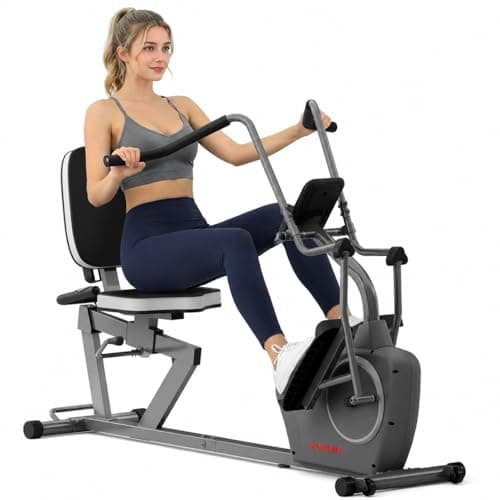
The elliptical’s appeal is the gliding motion. Its drawback is that you have to stand up on a moving platform to get it. Those two things are not actually welded together, and the machine that separates them is the recumbent cross-trainer.
A recumbent cross-trainer takes the supported chair of a recumbent bike and gives it an elliptical-style striding path instead of a tight pedal circle, usually with moving handles so your arms are still in the workout. You sit back into a seat with a backrest, your feet follow the long gliding stride, and your arms push and pull — but there is no standing, no step-up onto a raised platform, and no balancing. Your weight is carried by the chair the entire time. The one part of the standing elliptical that puts an older body at risk is simply gone, and the part that helps the joints is entirely kept.
That trade is why, for a lot of the people this site is written for, the seated version is the better answer even though it is less famous. You get the no-footstrike stride, the full-body movement and the moving handles, without ever having to trust your balance on a shifting surface. If you want the reasoning laid out head to head, our recumbent versus elliptical comparison puts the two machines side by side on exactly this point.
There is also a smaller version of the same idea. An under-desk elliptical gives you the gliding stride from the armchair you already own, with no frame and no floor space surrendered — less machine than a seated cross-trainer, and far less house. Our shortlist of the ellipticals that suit seniors ranks both kinds together, from the small units up to the seated cross-trainers, on what each maker actually publishes.
Deciding against a treadmill or a bike
The elliptical does not exist in isolation, and the honest way to place it is against the two machines most people are also considering.
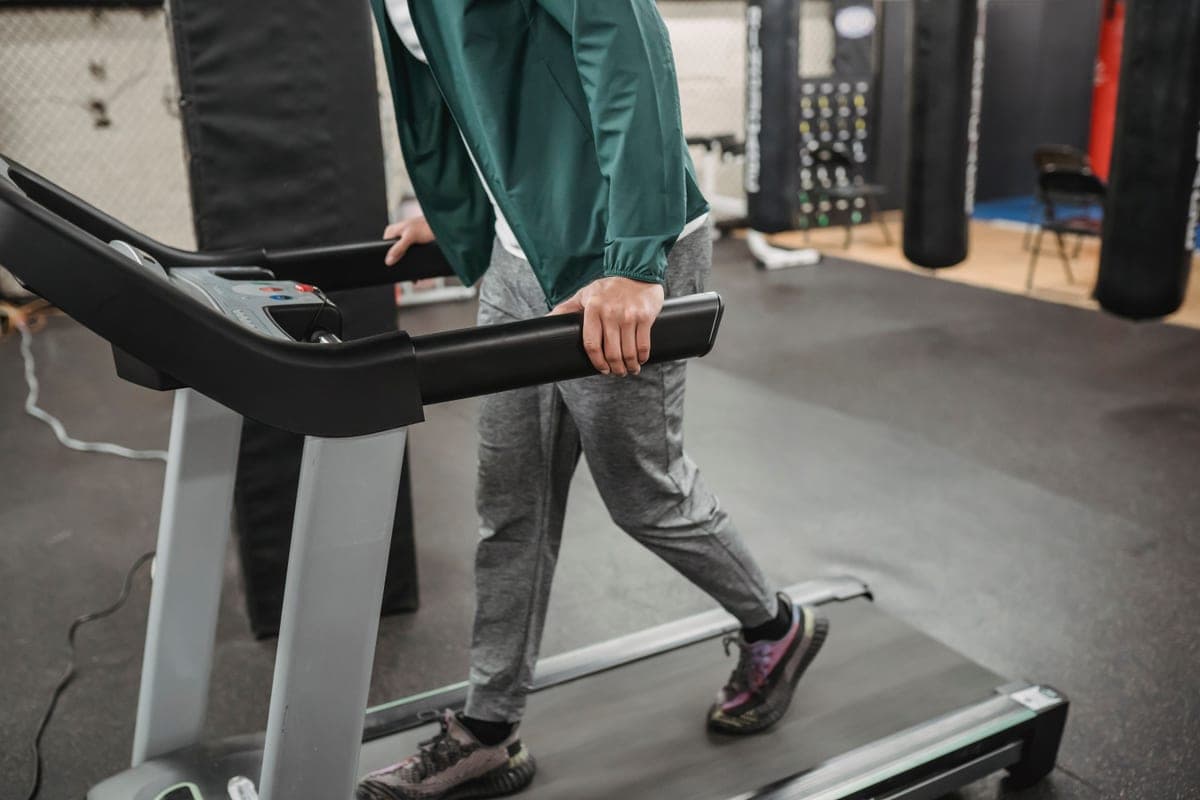
Versus a treadmill.The elliptical wins on the joints, because it removes footstrike entirely and a treadmill does not. But a treadmill trains the actual mechanics of walking — the thing you do every day — and staying good at walking is its own kind of safety. Neither is inherently steadier to stand on; both are raised, moving surfaces. Our treadmill-versus-elliptical guide works through which trade-off suits which person rather than crowning a winner.
Versus a recumbent bike.A recumbent bike is the most supported, lowest-risk of the group — seated, no step-up, no balancing — but it is a leg-driven, seated-only motion. An elliptical, standing or seated, brings in the arms and a longer stride. If your first priority is the safest possible way to get moving, the bike is hard to beat; if you specifically want the gliding, whole-body feel, the cross-trainer gives you that without giving up the seat.
One point applies whichever way you go. The CDC’s guidance for adults 65 and over asks for at least 150 minutes a week of moderate activity, two days of muscle strengthening, and — crucially — balance work as its own category. No cardio machine, elliptical included, ticks that balance box for you. Deliberate balance training is a separate thing you do on the side, and it matters more than which cardio machine you pick.
Finally, the line we draw on every page here. If you have fallen recently, if your balance has changed, or if you are unsteady enough that standing on a moving platform sounds risky, that is a conversation for your doctor or physical therapist before it is a purchase. Nobody at Tread & Tone is a clinician. We can tell you how these machines are built and which one removes which risk; we cannot tell you whether your body is ready to stand on a moving surface — and we are not going to pretend a spec sheet can answer that for you.
General information, not medical advice. Tread & Tone is written by an enthusiast, not a clinician. Nobody here is a doctor, a physical therapist or a trainer, and nothing on this site has been medically reviewed. Talk to your doctor or physical therapist before starting something new, particularly after surgery, a fall, or a change in medication.
Questions people ask
Are ellipticals good for seniors?+
For the right person, yes. The gliding stride never lets your foot strike the ground, so there is no impact traveling up through the ankle, knee and hip — which is exactly what a sore joint wants. The catch is that a standard elliptical stands you on raised, moving pedals and asks you to balance the whole time. If your balance is solid it is a fine machine; if it is not, the same stride is available sitting down.
Is an elliptical safe if I have balance problems?+
This is a question for your doctor or physical therapist, not a website, and it depends entirely on why your balance is unsteady. A standing elliptical is a continuous balance task on a moving surface, which is the opposite of what most people with balance problems need. A seated recumbent cross-trainer gives you the same low-impact leg motion with your weight fully supported and both feet reachable from a chair. If you have fallen recently, talk to someone who can watch you move before buying anything.
Elliptical or treadmill for seniors?+
The elliptical removes footstrike entirely, so it is gentler on the joints than a treadmill; the treadmill trains the actual mechanics of walking, which matters more for staying steady on your feet day to day. Neither is safer to stand on than the other — both are raised, moving surfaces. Our treadmill-versus-elliptical comparison walks through which trade-off suits which person.
Elliptical or recumbent bike for seniors?+
A recumbent bike is the safer starting point for most older adults because you are seated the entire time, with no step-up and no balancing. An elliptical adds a standing, weight-bearing, full-body element that some people specifically want. If you like the idea of the elliptical stride but not the standing, a recumbent cross-trainer sits between the two — the glide, done from a chair.
What is a recumbent cross-trainer?+
It is a seated machine that combines a recumbent bike's supported chair with an elliptical-style striding motion, usually with moving handles so your arms work too. You sit back, your feet follow a gliding path rather than a tight pedal circle, and there is no standing, no step-up onto a platform and no balancing. It is the answer for people who want the elliptical's motion without its main drawback.
Is an elliptical good for arthritic knees?+
The no-impact stride is friendly to arthritic knees, and the Arthritis Foundation notes that movement helps osteoarthritis rather than aggravating it. Two cautions: the gliding arc is a fixed path your knee has to follow, and some arthritic knees object to the arc itself rather than to the load; and standing to use it may be the harder part. If the motion suits your knee but the standing does not, a seated cross-trainer keeps the stride and removes the standing.
CDC — Older Adult Activity: An Overview — At least 150 minutes a week of moderate-intensity activity, 2 days of muscle strengthening, plus balance activities for adults 65 and over (read July 24, 2026)
CDC — Facts About Falls — More than one in four adults 65 and over falls each year; falling once doubles the chance of falling again (read July 24, 2026)
Product measurements are cited individually inside each Fit-to-You panel, against the manufacturer page or dated retailer listing they were read from.
Three kinds of elliptical share one aisle, and only two of them suit an older body. The machines that give you the gliding stride without asking you to balance on it.
Top pick: VANSWE Recumbent Elliptical Cross Trainer
Weight-bearing walking against a gliding, no-impact stride. Which keeps you walking, which spares the joints, and why the step-up height decides more than the price.
One keeps both feet planted and supported; the other lifts and swings them through a stride. Which suits stiff knees, and which suits balance you don't fully trust.