The short answer
Both are low-impact, so both spare your knees and hips the pounding of walking. The deciding difference is balance and access: a recumbent bike seats you and asks nothing of your balance, while a standard elliptical stands you on pedals set well off the floor and keeps them moving under you. If your balance is solid and you want a standing stride, the elliptical is fine. If it isn’t, the bike wins — and a recumbent cross-trainer gives you the elliptical motion while seated.
The two machines on the things that actually differ for an older buyer.| What you care about | Recumbent bike | Upright elliptical |
|---|
| Impact on the joints | None. Seated and smooth | None. The foot never leaves the pedal |
|---|
| Balance demand | None. You are seated and supported | Continuous. You stand on moving pedals |
|---|
| Getting on | Step through a frame and sit down | Step up onto pedals set well off the floor |
|---|
| Weight-bearing | No. The seat carries you | Yes. You carry your own weight, standing |
|---|
| Upper body | Little, unless it has moving arms | Yes. Moving handles are standard |
|---|
| Usable after a fall or with poor balance | Usually yes | Often not — ask a professional first |
|---|
| Footprint | 50 to 66 in long, plus mounting clearance | Long and tall — needs headroom as well as floor |
|---|
| Best suited to | Joint, balance or getting-on concerns | Good balance, wanting a standing stride |
|---|
The one difference that decides it: do you have to balance?
People compare these two on impact, and on impact they are nearly identical — neither one pounds your joints, because on both machines your foot stays in contact rather than striking the ground. That shared quality is real and it is why both show up on lists of low-impact exercise. But it is not the difference that matters for an older buyer.
The difference that matters is that a standard elliptical is a standing balance task. You step up onto two pedals raised some inches off the floor, and then you balance on them while they glide forwards and backwards underneath you. If your balance is good, that is unremarkable. If it is not — and the CDC reports that more than one in four adults 65 and over falls each year — then it is the entire objection to the machine, and no other feature makes up for it.
A recumbent bike removes the task completely. You sit down into a supported seat, and your balance system does nothing for the rest of the session. For anyone whose reason for shopping is a joint, a recent injury, or balance they don’t fully trust, that is not a minor convenience — it is the whole point.
Getting on: a bigger gap than the brochures admit
The other place these diverge is access. A recumbent asks you to step through a low frame and sit — nobody publishes the step-through height, but it is lower than an upright bike’s crossbar and it ends with you seated. An elliptical asks you to step up onto raised pedals and then stay standing. For a nervous or unsteady user, stepping up onto something that is about to move is a meaningfully harder ask than lowering yourself onto a seat.
This is why “low-impact” and “senior-friendly” are not synonyms. An elliptical is genuinely low-impact and can still be the wrong machine for a particular person, because the impact was never the problem — the standing and the step-up were.
Where the elliptical genuinely wins
None of this makes the elliptical a bad machine. For the right person it does two things the bike does not.
It is weight-bearing.Standing and moving your own body weight loads the skeleton in a way sitting does not, and weight-bearing activity is the kind associated with bone loading. If that is a specific goal for you, it is a real point in the elliptical’s favor — and a specific thing to raise with your doctor, because the right answer depends on your own bone health.
It is a fuller-body, more vigorous option at a given sense of effort. The CDC counts sustained effort like this as moderate-intensity activity, and a standing stride reaches that threshold more readily than gentle seated pedaling. If your balance is good and you want to work harder, that is a legitimate reason to choose it.
The option most people miss: a seated cross-trainer
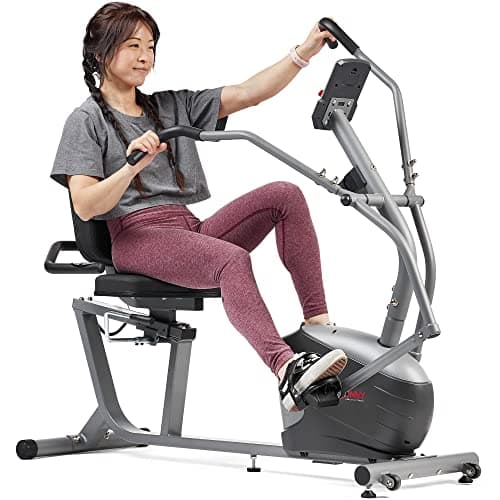
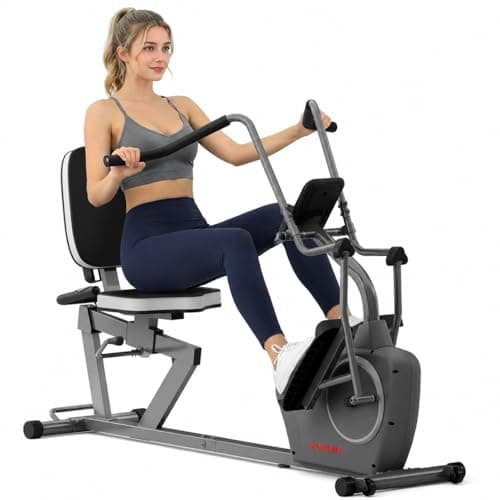
If what appeals about an elliptical is the long gliding stride — and for stiff knees it genuinely can be more comfortable than a bike’s tight circle — but what puts you off is the standing and the balance, there is a machine that gives you the first without the second. A recumbent cross-trainer seats you with your back supported, exactly like a bike, and moves your feet through an elliptical or stepping path. You get the stride, you keep the seat, and your balance is never asked to do anything.
For a large share of the people who start out weighing a bike against an elliptical, that third machine is the actual answer — it resolves the trade-off instead of forcing it. We walk through where the line falls in our guide to whether ellipticals suit seniors.
How to choose, in one paragraph
If your balance is solid and you want a standing, weight-bearing workout, buy the elliptical. If a joint, an injury, a recent fall, or unsteady balance is why you are shopping, buy the recumbent bike— it is safer, easier to get onto, and usable on a day when something hurts. And if you want the elliptical stride but not the standing, the seated cross-trainer is the machine that was built for exactly that compromise. Whichever you choose, add a balance pad: it is the cheapest thing on this site and it addresses the one requirement none of these cardio machines meet.