Tread & Tone

The Best Recumbent Bikes for Stroke Recovery at Home

Our pick is the HARISON HR-B51A, because it is the only bike here whose seat is published as one-hand adjustable — and with a weak side, a two-handed pull-pin is the difference between equipment you use and equipment somebody has to set up for you.

By Stephen V.Last updated How we choose

How this is funded: we earn a commission if you buy through our links, at no extra cost to you. It never changes what we recommend, and every page here names at least one thing we would not buy. Full disclosure.

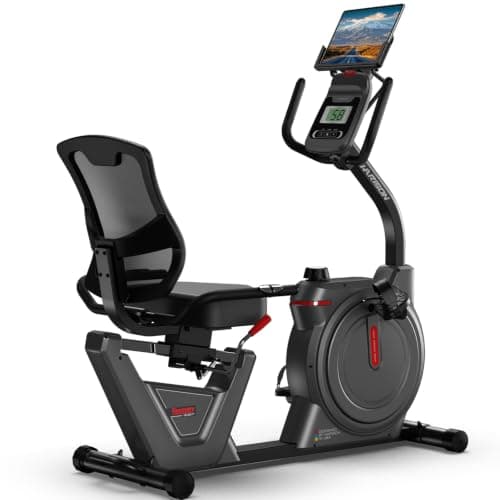
The pick is the HARISON HR-B51A, and the reason is a sentence on its listing nobody else writes: a one-hand sliding seat rail you adjust without bending down or pulling a pin. After a stroke that has left one side weaker, that is not a convenience feature. It is the difference between a machine the person sets up themselves and a machine that needs somebody else in the room first. It also holds 450 lb and publishes the lowest inseam minimum we have found anywhere — 26.5 in — so a shorter rider can reach the pedals. It is for somebody who can pedal unaided and wants the fewest two-handed tasks between them and a session.

Before the list, the thing that has to be said once and plainly. Recovery after a stroke is clinician-led work. The CDC describes rehabilitation as starting in the hospital, often within a day or two, and says that “physical therapy uses exercises to help you relearn movement and coordination skills you may have lost because of the stroke.” Nothing on this page replaces that. Home equipment is what fills the days between appointments, and what carries on after the appointments stop. Which machine to buy, and whether to buy one at all, is a question for the physical therapist who knows the case.

What we can do is tell you which specifications change for this buyer, because they are not the usual ones. Weight capacity and footprint still matter. But four others move to the front: can the seat be set with one hand, does anything hold the foot on the pedal, do the arm handles move independently of the legs, and what happens if one leg stops pushing partway through. Each of the picks below leads on one of those, and the one that leads on all the published safety behavior is not a bike at all.

One count worth carrying with you: of the six machines here, exactly two publish anything that holds the feet onto the pedals, and exactly one publishes what the machine does when a leg cannot rotate. The silence from the rest is the finding, and it is why the last entry is one we tell you to skip.

Quick picks

Ranked on the published accessibility measurements and on who each machine actually suits. Select a row to jump to the full write-up. The last column is the number of the nine measurements the manufacturer will not publish — we have not used any of these machines, and here is exactly what we did instead.

#MachineBest forSpecs withheldPrice
1
HARISON Recumbent Exercise Bike, 450 lb capacity

HARISON Recumbent Exercise Bike, 450 lb capacity

One-handed seat adjustment

One-handed seat rail6of 10
2
Sunny Health & Fitness Smart Recumbent Bike with Dual-Motion Arm Exercisers

Sunny Health & Fitness Smart Recumbent Bike with Dual-Motion Arm Exercisers

Sitting down onto, not lowering into

Arms that work alone4of 10
$358.99 · Check price on Amazon

$499.9928% off

Price as of October 5, 2026. #ad How we’re funded

3
Sunny Health & Fitness 16-Level Smart Magnetic Recumbent Bike with Workout Bands

Sunny Health & Fitness 16-Level Smart Magnetic Recumbent Bike with Workout Bands

Shorter riders and tight rooms

Straps on the pedals5of 10
$295.54 · Check price on Amazon

$369.9920% off

Price as of October 5, 2026. #ad How we’re funded

4
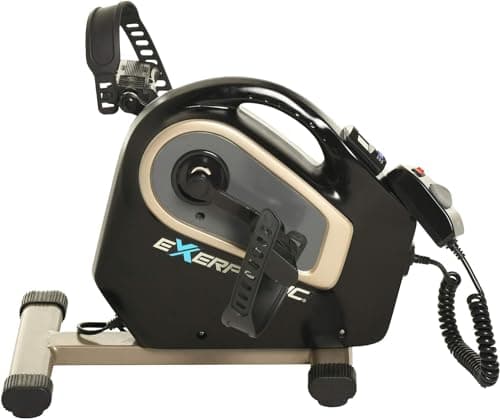
Exerpeutic 2000M Motorized Under Desk Exercise Bike

Exerpeutic 2000M Motorized Under Desk Exercise Bike

When the legs may not rotate freely

When one leg cannot push2of 7
5
Teeter FreeStep Recumbent Cross Trainer

Teeter FreeStep Recumbent Cross Trainer

Knees that dislike a circular pedal stroke

Pedals held still to transfer5of 10
$1,299.99 · Check price on Amazon

$1,499.0013% off

Price as of October 5, 2026. #ad How we’re funded

6
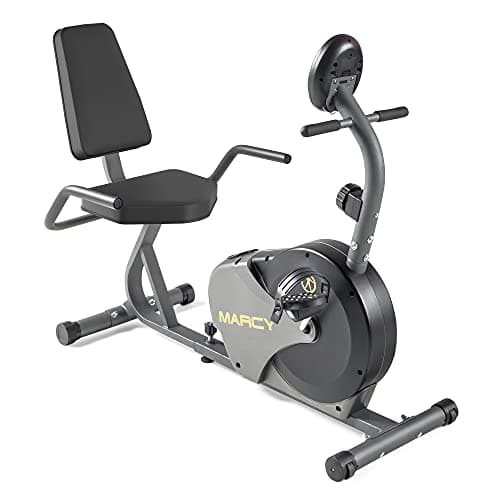
Marcy Magnetic Recumbent Bike NS-716R

Marcy Magnetic Recumbent Bike NS-716R

We would skip this one — see below

Publishes nothing8of 10
1.One-handed seat rail

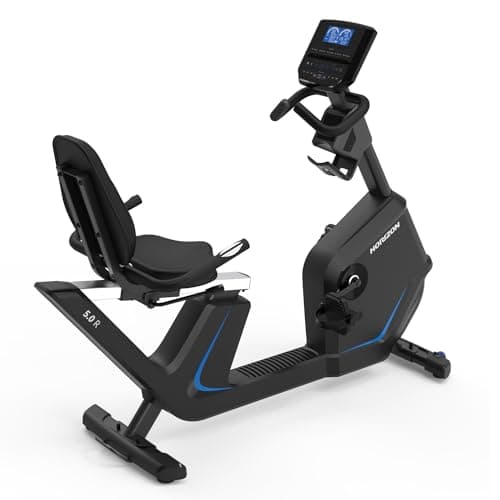
HARISON Recumbent Exercise Bike, 450 lb capacity(Ben-HR-B51A)
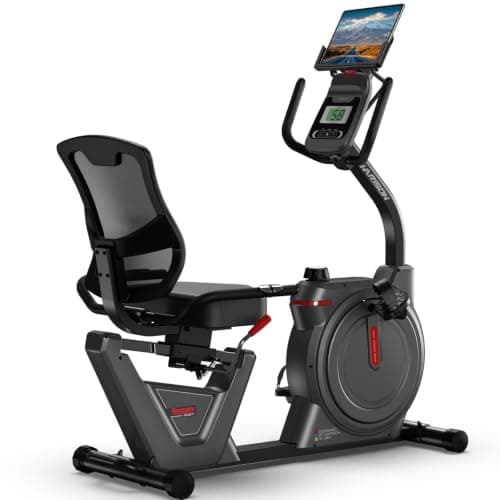
The only bike here with a genuinely one-handed seat adjustment — you slide the seat with one hand from the seated position instead of bending down to a pull-pin — on a 450 lb frame with the lowest published inseam minimum we have found. For a shared household or a weak grip, that combination is hard to beat.

What it gets right

  • One-hand sliding seat rail, published — no bending down and no two-handed pull-pin
  • 450 lb capacity, joint-highest in this shortlist
  • Front transport wheels and a lifting handle are published, so moving it has been thought about
  • Published inseam 26.5–38.9 in reaches the shortest riders of any bike we list

What to know first

  • Its listing used to claim under 15 dB; the current one gives no decibel figure at all, so noise is unpublished like everyone else's
  • Step-over height and seat height are both unpublished
  • Assembly weight and box weight are not published anywhere we could find

Fit-to-You: the nine measurements

HARISON does not publish 6 of 10 of these. Where that is the case, this panel says so rather than guessing. How we compile these

Step-over heightThe single number that decides whether you can get on at all. Almost nobody publishes it.
Not published by the manufacturer
Seat height from floorDecides whether you sit down onto the seat or lower yourself into it, and whether you can stand back up unaided.
Not published by the manufacturer
Weight capacitySearched directly, and two of the senior-focused competitors omit it entirely.
450 lb

Source: Amazon product listing data (Creators API) · read 2026-07-24

Inseam rangeWhether the seat travels far enough for your leg length without over-extending the knee.
26.5 in to 38.9 in (stated rider height 4 ft 8 in to 6 ft 4 in)

Source: Amazon product listing data (Creators API) · read 2026-07-24

Pedal spacing (Q-factor)How far apart the pedals sit. A narrow pedal spacing reduces the sideways load on arthritic knees.
Not published by the manufacturer
Display character heightCharacter height and contrast. Presbyopia is close to universal past 60.
Not published by the manufacturer
Controls and reachCan it be operated one-handed, by feel, while seated? This is where low-strength and low-vision buyers get stranded.
One-hand sliding seat rail, adjustable without bending or pulling; 16-level resistance on a knob

Source: Amazon product listing data (Creators API) · read 2026-07-24

Assembly and box weightBox weight and how many people it needs. A 130 lb box is a real barrier, not a footnote.
Not published by the manufacturer
Noise (dB)Apartments, shared walls, and a sleeping partner in the next room.
Not published by the manufacturer
FootprintWhether it actually fits the room you have in mind, with clearance to get on and off.
54.6 in long × 25.7 in wide × 46.2 in high

Source: Amazon product listing data (Creators API) · read 2026-07-24

We have not used this machine. Everything above comes from the manufacturer’s published documentation and the dated retailer listing, with the source given for each figure. Where they don’t publish a number, we say so. We can’t tell you how it feels to ride, how quiet it really is, or how it holds up after two years — and anyone who tells you otherwise without owning one is guessing.
2.Arms that work alone

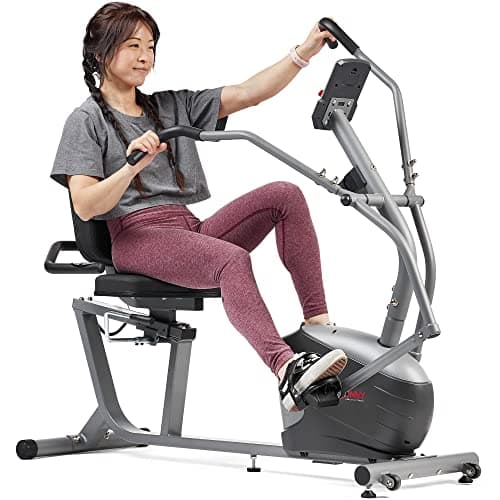
Sunny Health & Fitness Smart Recumbent Bike with Dual-Motion Arm Exercisers(SF-RB420032)

Sunny Health & Fitness Smart Recumbent Bike with Dual-Motion Arm Exercisers
$358.99 · Check price on Amazon

$499.9928% off

Price as of October 5, 2026. #ad How we’re funded

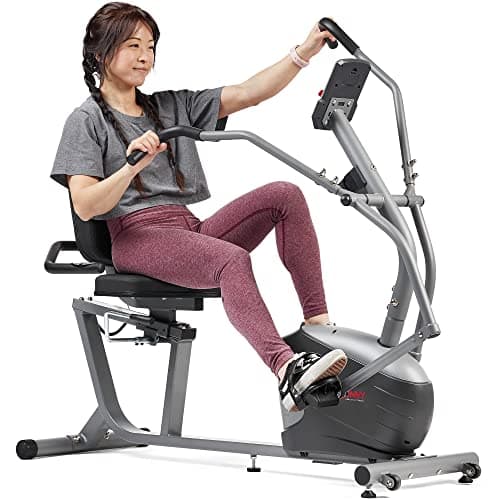
The only bike in this shortlist whose maker publishes an actual seat height — 20.9 to 22.4 inches, which is about dining-chair height, so you sit down onto it rather than lowering yourself into it. That one published number is why it leads.

What it gets right

  • Sunny publishes a real seat height range (20.9–22.4 in) — nobody else in this shortlist does
  • Published inseam range of 29.9–38.6 in is the widest seat travel here
  • Moving handlebars work with or independently of the pedals, so an arm-only session is possible on a bad-knee day
  • Pulse sensors sit on the stationary handlebars, within reach from the seated position

What to know first

  • 265 lb weight capacity is the lowest of any bike here — a hard stop for a lot of buyers
  • 8 resistance levels, against 16 on several cheaper machines
  • Step-over height still isn't published, so the getting-on question is only half answered

Fit-to-You: the nine measurements

Sunny Health & Fitness does not publish 4 of 10 of these. Where that is the case, this panel says so rather than guessing. How we compile these

Step-over heightThe single number that decides whether you can get on at all. Almost nobody publishes it.
Not published by the manufacturer
Seat height from floorDecides whether you sit down onto the seat or lower yourself into it, and whether you can stand back up unaided.
20.9 in minimum, 22.4 in maximum

Source: Sunny Health & Fitness product page, SF-RB420032 · read 2026-07-24

Weight capacitySearched directly, and two of the senior-focused competitors omit it entirely.
265 lb

Source: Sunny Health & Fitness product page, SF-RB420032 · read 2026-07-24

Inseam rangeWhether the seat travels far enough for your leg length without over-extending the knee.
29.9 in to 38.6 in

Source: Sunny Health & Fitness product page, SF-RB420032 · read 2026-07-24

Pedal spacing (Q-factor)How far apart the pedals sit. A narrow pedal spacing reduces the sideways load on arthritic knees.
Not published by the manufacturer
Display character heightCharacter height and contrast. Presbyopia is close to universal past 60.
Not published by the manufacturer
Controls and reachCan it be operated one-handed, by feel, while seated? This is where low-strength and low-vision buyers get stranded.
Pulse sensors on the stationary handlebars; seat adjusts forward and back; no one-handed operation claim made

Source: Amazon product listing data (Creators API) · read 2026-07-24

Assembly and box weightBox weight and how many people it needs. A 130 lb box is a real barrier, not a footnote.
91.3 lb shipping weight, in a 56.3 × 9.8 × 23.6 in box; 77.4 lb assembled

Source: Sunny Health & Fitness product page, SF-RB420032 · read 2026-07-24

Noise (dB)Apartments, shared walls, and a sleeping partner in the next room.
Not published by the manufacturer
FootprintWhether it actually fits the room you have in mind, with clearance to get on and off.
63.8 in long × 26.4 in wide × 49.6 in high

Source: Sunny Health & Fitness product page, SF-RB420032 · read 2026-07-24

We have not used this machine. Everything above comes from the manufacturer’s published documentation and the dated retailer listing, with the source given for each figure. Where they don’t publish a number, we say so. We can’t tell you how it feels to ride, how quiet it really is, or how it holds up after two years — and anyone who tells you otherwise without owning one is guessing.
3.Straps on the pedals

Sunny Health & Fitness 16-Level Smart Magnetic Recumbent Bike with Workout Bands(SF-RB424006)

Sunny Health & Fitness 16-Level Smart Magnetic Recumbent Bike with Workout Bands
$295.54 · Check price on Amazon

$369.9920% off

Price as of October 5, 2026. #ad How we’re funded

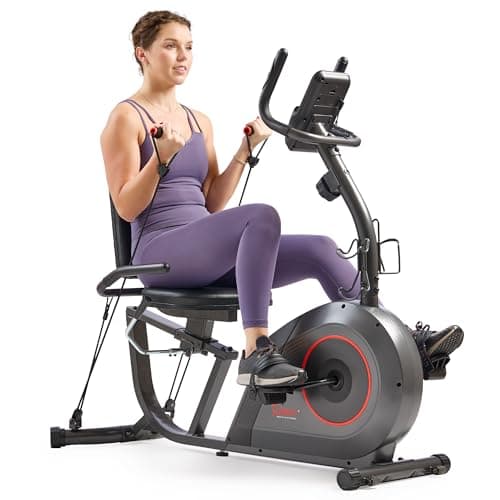
A flip-away side lever clears the way when you get on, and at 63.8 lb assembled it is the lightest full-size bike here — which matters if it has to move between rooms. A published inseam minimum of 27.2 in, second only to the HARISON, suits a shorter rider.

What it gets right

  • Flip-able side handle gets out of the way for entry and exit, published
  • Published inseam minimum of 27.2 in — the second lowest of any bike we list, behind the HARISON
  • 63.8 lb assembled: the lightest full-size bike on this page, so relocating it is realistic
  • 16 resistance levels on a belt drive, plus two 20 lb bands for seated upper-body work

What to know first

  • 300 lb capacity, below the 400–450 lb machines here
  • Sunny publishes a 'step height' range for this model without defining what it measures, so we are not going to tell you what it means
  • Resistance bands need a pulley setup that some buyers will simply never use

Fit-to-You: the nine measurements

Sunny Health & Fitness does not publish 5 of 10 of these. Where that is the case, this panel says so rather than guessing. How we compile these

Step-over heightThe single number that decides whether you can get on at all. Almost nobody publishes it.
Not published by the manufacturer
Seat height from floorDecides whether you sit down onto the seat or lower yourself into it, and whether you can stand back up unaided.
Not published by the manufacturer
Weight capacitySearched directly, and two of the senior-focused competitors omit it entirely.
300 lb

Source: Sunny Health & Fitness product page, SF-RB424006 · read 2026-07-24

Inseam rangeWhether the seat travels far enough for your leg length without over-extending the knee.
27.2 in to 35.8 in

Source: Sunny Health & Fitness product page, SF-RB424006 · read 2026-07-24

Pedal spacing (Q-factor)How far apart the pedals sit. A narrow pedal spacing reduces the sideways load on arthritic knees.
Not published by the manufacturer
Display character heightCharacter height and contrast. Presbyopia is close to universal past 60.
Not published by the manufacturer
Controls and reachCan it be operated one-handed, by feel, while seated? This is where low-strength and low-vision buyers get stranded.
Flip-able side handle for getting on and off; self-leveling pedals with adjustable straps

Source: Sunny Health & Fitness product page, SF-RB424006 · read 2026-07-24

Assembly and box weightBox weight and how many people it needs. A 130 lb box is a real barrier, not a footnote.
76 lb shipping weight; 63.8 lb assembled

Source: Sunny Health & Fitness product page, SF-RB424006 · read 2026-07-24

Noise (dB)Apartments, shared walls, and a sleeping partner in the next room.
Not published by the manufacturer
FootprintWhether it actually fits the room you have in mind, with clearance to get on and off.
51.8 in long × 25.6 in wide × 46.1 in high

Source: Sunny Health & Fitness product page, SF-RB424006 · read 2026-07-24

We have not used this machine. Everything above comes from the manufacturer’s published documentation and the dated retailer listing, with the source given for each figure. Where they don’t publish a number, we say so. We can’t tell you how it feels to ride, how quiet it really is, or how it holds up after two years — and anyone who tells you otherwise without owning one is guessing.
4.When one leg cannot push

Exerpeutic 2000M Motorized Under Desk Exercise Bike(4107)

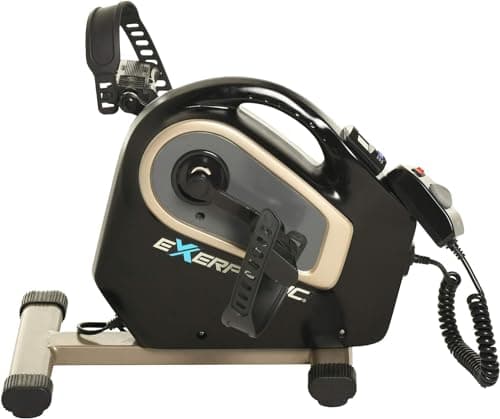
The only unit here whose listing describes what happens when the legs stop cooperating: an overload protection that halts the cranks if the pedals cannot rotate freely. That is the specific failure a motorized pedal unit can cause and almost nobody addresses it in writing. Add adjustable foot straps and a named manufacturer behind the brand, and it is the one we would put a relative on.

What it gets right

  • Published overload protection that stops the cranks on excessive speed or when the legs cannot rotate freely — the one safety behavior that matters most on a motorized unit
  • Adjustable straps on large foldable pedals, published, so the feet are held rather than balanced
  • Speed controller on a published 6 ft cord, so settings change without bending down
  • A named manufacturer (Paradigm Health and Wellness) and a published 1-year limited warranty, which most of this category does not have
  • Published floor mat and a built-in carry handle

What to know first

  • The controller is corded, not wireless — 6 ft of cable across the floor near someone unsteady on their feet
  • Published 15-minute automatic session timer when the motor is running, so a longer powered session means restarting it
  • No published user weight capacity
  • At 14.5 in tall it is the second-tallest unit here, which rules out most desks
  • No decibel figure, and no calf or leg supports

Fit-to-You: the nine measurements

Exerpeutic does not publish 2 of 7 of these. Where that is the case, this panel says so rather than guessing. How we compile these

Pedal heightThe clearance under your desk or chair. Get this wrong and the pedals hit your knees.
14.5 in overall height, not adjustable

Source: Amazon product listing data (Creators API) · read 2026-10-03

Resistance rangeHow gently it can be set. The lowest setting matters far more than the highest.
No numbered resistance levels. The listing states the bike "offers more resistance when the motor is off" and that speed is set on the hand-held controller

Source: Amazon product listing data (Creators API) · read 2026-10-03

Weight capacitySearched directly, and two of the senior-focused competitors omit it entirely.
Not published by the manufacturer
Motorized or self-poweredWhether the machine moves your legs or you move it. For very low leg strength that is the whole decision.
Motorized, with published overload protection that stops the cranks on excessive speed or when the legs cannot rotate freely; auto 15-minute session timer when powered

Source: Amazon product listing data (Creators API) · read 2026-10-03

Display and controlsCharacter height and contrast. Presbyopia is close to universal past 60.
Multi-function LCD showing distance, time, calories and total repetitions; hand-held speed controller on a 6 ft cord

Source: Amazon product listing data (Creators API) · read 2026-10-03

FootprintWhether it actually fits the room you have in mind, with clearance to get on and off.
18.2 in × 21 in × 14.5 in

Source: Amazon product listing data (Creators API) · read 2026-10-03

Noise (dB)Apartments, shared walls, and a sleeping partner in the next room.
Not published by the manufacturer

We have not used this machine. Everything above comes from the manufacturer’s published documentation and the dated retailer listing, with the source given for each figure. Where they don’t publish a number, we say so. We can’t tell you how it feels to ride, how quiet it really is, or how it holds up after two years — and anyone who tells you otherwise without owning one is guessing.
5.Pedals held still to transfer

Teeter FreeStep Recumbent Cross Trainer(SE2701)

Teeter FreeStep Recumbent Cross Trainer
$1,299.99 · Check price on Amazon

$1,499.0013% off

Price as of October 5, 2026. #ad How we’re funded

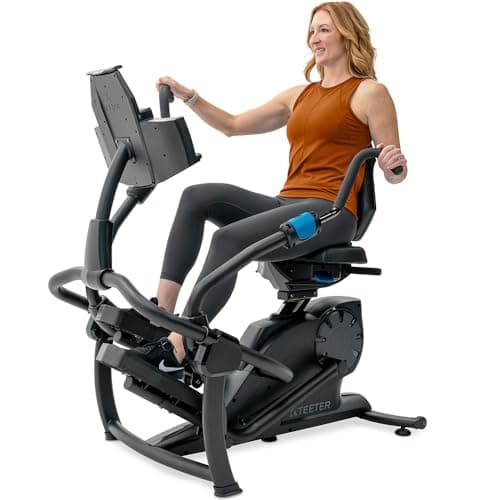
Not a bike. The pedals travel in a straight line rather than a circle, which removes the knee-flexion arc that makes a circular pedal stroke uncomfortable for some arthritic knees — and Teeter publishes an electronic step lock specifically for getting on and off. Also the most expensive machine on the site.

What it gets right

  • Linear stepping motion rather than a circular pedal stroke — a genuinely different joint path, not a marketing distinction
  • Electronic Step Lock holds the pedals still while you get on and off, published as an accessibility feature
  • Publishes resistance in pounds (0–105 lb across 20 levels), not just level numbers
  • 9 in color LCD, the largest display anywhere on this site; published rider range 4 ft 11 in to 6 ft 6 in

What to know first

  • The most expensive machine here by a wide margin
  • 32.7 in wide and 59 in long — the largest footprint of any seated machine on this page
  • Step-over height, seat height and box weight still unpublished
  • The physical-therapy licensing claim is about the stride patent, not evidence that it will help your specific condition

Fit-to-You: the nine measurements

Teeter does not publish 5 of 10 of these. Where that is the case, this panel says so rather than guessing. How we compile these

Step-over heightThe single number that decides whether you can get on at all. Almost nobody publishes it.
Not published by the manufacturer
Seat height from floorDecides whether you sit down onto the seat or lower yourself into it, and whether you can stand back up unaided.
Not published by the manufacturer
Weight capacitySearched directly, and two of the senior-focused competitors omit it entirely.
350 lb; rated for users 4 ft 11 in to 6 ft 6 in

Source: Amazon product listing data (Creators API) · read 2026-07-24

Inseam rangeWhether the seat travels far enough for your leg length without over-extending the knee.
Not given as an inseam; stated rider height range 4 ft 11 in to 6 ft 6 in

Source: Amazon product listing data (Creators API) · read 2026-07-24

Pedal spacing (Q-factor)How far apart the pedals sit. A narrow pedal spacing reduces the sideways load on arthritic knees.
Not published by the manufacturer
Display character heightCharacter height and contrast. Presbyopia is close to universal past 60.
9 in color LCD; character height not published

Source: Amazon product listing data (Creators API) · read 2026-07-24

Controls and reachCan it be operated one-handed, by feel, while seated? This is where low-strength and low-vision buyers get stranded.
Electronic Step Lock for entry and exit; console quick-keys for 20 resistance levels (0–105 lb); height-adjustable media rack

Source: Amazon product listing data (Creators API) · read 2026-07-24

Assembly and box weightBox weight and how many people it needs. A 130 lb box is a real barrier, not a footnote.
Not published by the manufacturer
Noise (dB)Apartments, shared walls, and a sleeping partner in the next room.
Not published by the manufacturer
FootprintWhether it actually fits the room you have in mind, with clearance to get on and off.
59 in long × 32.7 in wide × 54.8 in high

Source: Amazon product listing data (Creators API) · read 2026-07-24

We have not used this machine. Everything above comes from the manufacturer’s published documentation and the dated retailer listing, with the source given for each figure. Where they don’t publish a number, we say so. We can’t tell you how it feels to ride, how quiet it really is, or how it holds up after two years — and anyone who tells you otherwise without owning one is guessing.
6.We would skip this one

Marcy Magnetic Recumbent Bike NS-716R(NS 716R)

The listing describes a fully adjustable seat and an 8-level tension knob, and then stops. No published weight capacity, no seat height, no inseam range, and two contradictory sets of dimensions. We would spend the same money elsewhere.

Why we would skip it

We would skip this one. Not because it is a bad machine — we have no idea, and neither does anyone else who hasn't ridden it — but because Marcy publishes almost nothing about it. No weight capacity, no seat height, no inseam range, no step-over height, and the Amazon listing's two dimension fields contradict each other. For the same money the VANSWE RB661 publishes a capacity and a seat range. When a manufacturer won't tell you what a machine will hold, that is your answer.

What it gets right

  • Foam-covered handlebars and transport wheels are both published
  • LCD tracks speed, distance, time and calories

What to know first

  • No published weight capacity anywhere we could find — the single most-searched spec in this category
  • The Amazon listing's dimension field says 56 × 25 × 39 in while its own title says 11 × 22 × 31 in
  • Marcy's site has no live product page for this model that we could reach
  • Eight of the nine accessibility measurements are unpublished

Fit-to-You: the nine measurements

Marcy does not publish 8 of 10 of these. Where that is the case, this panel says so rather than guessing. How we compile these

Step-over heightThe single number that decides whether you can get on at all. Almost nobody publishes it.
Not published by the manufacturer
Seat height from floorDecides whether you sit down onto the seat or lower yourself into it, and whether you can stand back up unaided.
Not published by the manufacturer
Weight capacitySearched directly, and two of the senior-focused competitors omit it entirely.
Not published by the manufacturer
Inseam rangeWhether the seat travels far enough for your leg length without over-extending the knee.
Not published by the manufacturer
Pedal spacing (Q-factor)How far apart the pedals sit. A narrow pedal spacing reduces the sideways load on arthritic knees.
Not published by the manufacturer
Display character heightCharacter height and contrast. Presbyopia is close to universal past 60.
Not published by the manufacturer
Controls and reachCan it be operated one-handed, by feel, while seated? This is where low-strength and low-vision buyers get stranded.
8-preset tension knob; fully adjustable seat; foam-covered handlebars

Source: Amazon product listing data (Creators API) · read 2026-07-24

Assembly and box weightBox weight and how many people it needs. A 130 lb box is a real barrier, not a footnote.
Not published by the manufacturer
Noise (dB)Apartments, shared walls, and a sleeping partner in the next room.
Not published by the manufacturer
FootprintWhether it actually fits the room you have in mind, with clearance to get on and off.
Listing data says 56 in × 25 in × 39 in; the same listing's title says 11 × 22 × 31 in. Both are reported because we cannot tell which is right

Source: Amazon product listing data (Creators API) · read 2026-07-24

We have not used this machine. Everything above comes from the manufacturer’s published documentation and the dated retailer listing, with the source given for each figure. Where they don’t publish a number, we say so. We can’t tell you how it feels to ride, how quiet it really is, or how it holds up after two years — and anyone who tells you otherwise without owning one is guessing.
What we found looking for these numbers

We went looking for 57 measurements across the 6machines on this page — the nine that decide whether an older adult can get on, reach the controls, read the screen and hear themselves think. 30 of those 57 are not published by anybody. Not one manufacturer here publishes the full set.

Step-over height is the worst of them. It is the single measurement that decides whether you can get onto a machine at all, and across everything we checked, not one manufacturer states it. That is not an oversight in a category explicitly marketed to seniors, and the count in each panel above is there so you can see who is doing it.

Where a figure exists, we cite it and date it. Where it doesn’t, the panel says Not published by the manufacturer rather than an estimate dressed up as a fact. You can measure step-over height yourself in about a minute — and if a machine is already in your house, that is the fastest way to settle it.

The four specifications that change after a stroke

1. Can the seat be adjusted with one hand?Almost every recumbent bike adjusts with a pull-pin or a lever that assumes two working hands and a bend to reach it. The HARISON publishes a one-hand sliding rail. The Sunny SF-RB424006 publishes a side handle that flips out of the way for entry rather than staying in it. Marcy’s NS-1201R publishes a quick-release lock it says can be worked while you are still sitting on the seat, which is the next best thing and the reason its review is worth reading if budget is the constraint.

2. Will the affected foot stay on the pedal?This is the question the category almost never addresses, and it has only three published answers: straps, counterbalanced or self-levelling pedals, and nothing. The Sunny SF-RB424006 publishes self-levelling pedals with adjustable straps — the pedal waits upright for the foot, and then the strap holds it. The Exerpeutic 2000M publishes adjustable straps on large foldable pedals. Nobody else on this page publishes either.

3. Do the arm handles move independently of the pedals? On almost every machine advertising arm exercisers, the handles are driven by the same crank as the pedals, so you cannot work the arms alone. The Sunny SF-RB420032 is the exception on this site: its moving handlebars are published as working with or independently of the pedals. For a weak arm that needs work on a day the legs are not cooperating, that is the whole product. Our arms-and-legs shortlist ranks the whole group on exactly that distinction.

4. What happens if a leg stops pushing?On a self-powered bike, nothing — the flywheel slows and you stop, which is safe. On a motorized unit, the motor can keep driving a limb that has stopped cooperating, and only one product here publishes what it does about that. The Exerpeutic 2000M states an overload protection that halts the cranks when the pedals cannot rotate freely. If spasticity is part of the picture, that single sentence narrows the motorized end of the market to a shortlist of two.

Bike or motorized pedals? Answer this first

Everything above assumes a bike is the right category. Work through this before you spend anything, because getting it wrong produces a returned box in the hallway and a discouraged person.

If both legs can turn the cranks, even slowly, buy a bike. You are supplying the force, which is the part that builds anything. A bike is also cheaper, has nothing electrical to fail, and goes as slowly as you like. The first three picks above are all this answer.

If one leg cannot be relied on to push, think harder.A recumbent bike with strapped pedals can still work — the stronger leg drives, the weaker one is carried, and the strap keeps the foot where it belongs. But it is a question for a therapist, not a website, because a stronger side compensating for a weaker one is exactly the pattern rehabilitation is usually trying to avoid.

If neither leg can start the motion, a bike is the wrong purchase. A motorized pedal unit moves the limb for you. That is passive movement rather than exercise you perform, and it will not build strength — but joint movement and the circulation that comes with it is not a small thing for somebody who has been largely immobile. Our shortlist of motorized pedal units goes into this properly, with nine units ranked on overload behavior, limb supports and reachable controls.

If the user cannot transfer into a chair at all, the equipment question changes again — one unit on that page publishes use from a bed. Nothing on this page does.

Getting on, and getting off again

The transfer is where the risk is, and it is the part the specifications are quietest about. Three things to think through, in the room where the machine will live.

Which side do you get on from?A recumbent bike is a step-through frame, which is the whole reason this category suits this buyer — you walk through the gap rather than lifting a leg over a crossbar. But you still approach from one side, and with a weak side, that choice is not arbitrary. Leave clear floor on both sides until you know which works, and keep something solid within arm’s reach that is not the machine.

Do the pedals move while you load them?On five of these six machines, yes. The Teeter FreeStep is the only one that publishes a mechanism — an electronic Step Lock that holds the pedals still while you get on and off. It is also the most expensive machine on this site and the largest seated footprint we list, so it is a real trade rather than an obvious upgrade.

How high is the seat? Only one bike on this entire site publishes a seat height: the Sunny SF-RB420032, at 20.9 to 22.4 inches, which is about dining-chair height. That matters because you want to sit down onto a seat rather than lower yourself into it, and it is why that machine is second here despite its 265 lb capacity being the lowest of any bike we list. For everybody else, the number does not exist and measuring the machine yourself is the only honest route.

What we would not buy for this

The Marcy NS-716R sits at the bottom of the page and we would not buy it for this reader at any price. Marcy publishes no weight capacity, no seat height, no inseam range, and two contradictory sets of dimensions on the same listing. When the entire decision rests on whether a specific body can get onto and operate a machine, a manufacturer who will not say what it holds has answered the question for you.

We would also be careful with anything marketed with the word “rehabilitation” and no published specification behind it. Several listings in this aisle borrow clinical vocabulary without stating a single clinical figure, and a motorized unit with no published overload behavior is the case where that vocabulary is actively misleading. The CDC’s own guidance for physical activity with a disability is to consult a healthcare professional or physical activity specialist, for example a physical therapist, about how the disability affects what is safe. That is a better use of an hour than any product page, including this one.

General information, not medical advice. Tread & Tone is written by an enthusiast, not a clinician. Nobody here is a doctor, a physical therapist or a trainer, and nothing on this site has been medically reviewed. Talk to your doctor or physical therapist before starting something new, particularly after surgery, a fall, or a change in medication.

Questions people ask

Is a recumbent bike good for stroke recovery?

It is one of the more practical pieces of home equipment for it, because the frame is step-through, your back is supported and nothing depends on standing balance. But it supplements clinician-led rehabilitation rather than replacing it. The CDC describes stroke rehabilitation as beginning in the hospital and involving physical, occupational and speech therapists, with physical therapy using exercises to help relearn movement and coordination. Ask the physical therapist whether seated cycling fits the plan, and what cadence and duration they want.

What should I look for if one side is weaker?

Four things, in this order: a seat you can adjust with one hand, something that holds the affected foot on the pedal (straps or self-levelling pedals), arm handles that move independently of the pedals if upper-body work is part of the plan, and a clear approach on the side you transfer from. The HARISON HR-B51A publishes the one-handed seat rail, the Sunny SF-RB424006 publishes self-levelling pedals with adjustable straps, and the Sunny SF-RB420032 publishes arm handles that work independently of the legs.

Should I buy a motorized pedal exerciser instead?

Only if starting the motion unaided is unreliable. A motor moves the limb for you, which is passive movement rather than exercise you perform, and it will not build strength. If the legs can turn the cranks on a bad day, a bike is the better buy and the cheaper one. If they cannot, the specification to insist on is a published overload cutoff that stops the cranks when the pedals cannot rotate freely — only one unit we have found states it.

Do any of these machines help a weak arm?

One does, in a way the others cannot. Most machines with arm handles drive them from the same crank as the pedals, so the arms only move when the legs do. The Sunny SF-RB420032 publishes moving handlebars that work with or independently of the pedals, which makes an arms-only session possible. Whether that is useful for a particular arm is a question for the therapist — what we can tell you is which machine physically allows it.

How long and how hard should a session be?

That is a question for the rehabilitation team, not for us, and the answer early in recovery is often much shorter than people expect. What the published guidance gives you is the destination rather than the route: the CDC's figure for adults with chronic conditions or disabilities is at least 150 minutes a week of moderate activity, broken into whatever pieces work, with the explicit note that some physical activity is better than none and that you should be as active as you are able.

Is a recumbent bike safer than a treadmill here?

For most people recovering from a stroke, yes, on one specific count: nothing about a seated bike depends on your balance, and a treadmill depends on it entirely. A treadmill moves the ground under you and a stumble is a fall. If walking practice is part of the plan, that is work to do with a therapist and a handrail, not alone at home on a new machine. Our comparison of recumbent bikes against treadmills lays out the weight-bearing trade in full.

Sources

  • CDC — Treatment and Intervention for Stroke — "Rehabilitation after a stroke begins in the hospital, often within a day or 2 after the stroke"; "Rehab can include working with speech, physical, and occupational therapists"; "Physical therapy uses exercises to help you relearn movement and coordination skills you may have lost because of the stroke" (read October 5, 2026)
  • CDC — Chronic Conditions & Disabilities Activity — "Get at least 150 minutes (for example, 30 minutes 5 days a week) of moderate-intensity aerobic physical activity a week"; "Some physical activity is better than none — be as active as you are able"; and "If you have chronic health conditions or disabilities, consult a health care professional or physical activity specialist about appropriate types and amounts of physical activity" (read October 3, 2026)
  • CDC — Physical Activity for People with Disability — All adults, with or without disabilities, should get at least 150 minutes of aerobic physical activity a week, and the activity "can be broken down into smaller amounts, such as about 25 minutes a day every day"; consult a healthcare professional or physical activity specialist, for example a physical therapist, about how a disability affects what is safe (read October 3, 2026)
  • National Institute on Aging — Exercising With Chronic Conditions — "Almost anyone, at any age, can do some type of physical activity, even with a chronic condition"; riding a bike is listed among the moderate-intensity activities that are safe for most people if built up slowly. For arthritis: low-impact activity, and "When done safely, being physically active with arthritis shouldn't make the disease or pain worse." For chronic pain: listen to your body and avoid overexercising on good days. For osteoporosis: weight-bearing exercise, plus muscle-strengthening and balance work (read October 5, 2026)
  • CDC — Older Adult Activity: An Overview — At least 150 minutes a week of moderate-intensity activity, 2 days of muscle strengthening, plus balance activities for adults 65 and over (read July 24, 2026)

Product measurements are cited individually inside each Fit-to-You panel, against the manufacturer page or dated retailer listing they were read from.

Read next