Tread & Tone

HARISON Recumbent Exercise Bike Review

It is the one bike here you can adjust with a single hand, sitting down, without reaching for the floor. That, a 450 lb capacity, and the shortest published inseam on the site are the reasons to look at it. A noise claim is the reason to be careful.

By Stephen V.Last updated How we choose

How this is funded: we earn a commission if you buy through our links, at no extra cost to you. It never changes what we recommend, and every page here names at least one thing we would not buy. Full disclosure.

HARISON Recumbent Exercise Bike, 450 lb capacity

One-handed seat adjustment

The only bike here that publishes both a noise figure and a genuinely one-handed seat adjustment — you slide the seat with one hand from the seated position instead of bending down to a pull-pin. For a shared household or a weak grip, that combination is hard to beat.

HARISON does not publish 5 of the 10 measurements we look for. The panel below names which.

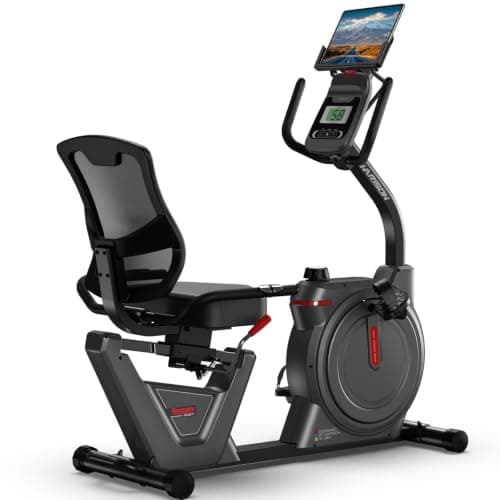
Most of the small decisions that make a recumbent bike usable for an older rider happen before the pedals ever turn: getting on, getting the seat to the right distance, and getting back off. The HARISON HR-B51A is built around the middle of those three. Its seat slides on a rail that the listing says you move with one hand, from the seated position, without bending down and without pulling a two-handed pin. That is a smaller-sounding feature than a big screen or a heavy flywheel, and it is the one we would actually pay for.

The rest of the published picture backs it up. The listing states a 450 lb weight capacity, which ties for the highest of any bike on this site, and an inseam range of 26.5 to 38.9 inches— the 26.5 inch minimum is the lowest we have found published anywhere in this category, which is exactly what a shorter rider needs and rarely gets told.

There is also a noise figure, which almost no manufacturer in this aisle offers. We are glad it is there and we are not going to repeat it as though it were a measurement, because it is not one we can check. More on that below. First, the seat — because it is the reason this bike is on the page at all.

Fit-to-You: the nine measurements

HARISON does not publish 5 of 10 of these. Where that is the case, this panel says so rather than guessing. How we compile these

Step-over heightThe single number that decides whether you can get on at all. Almost nobody publishes it.
Not published by the manufacturer
Seat height from floorDecides whether you sit down onto the seat or lower yourself into it, and whether you can stand back up unaided.
Not published by the manufacturer
Weight capacitySearched directly, and two of the senior-focused competitors omit it entirely.
450 lb

Source: Amazon product listing data (Creators API) · read 2026-07-24

Inseam rangeWhether the seat travels far enough for your leg length without over-extending the knee.
26.5 in to 38.9 in (stated rider height 4 ft 8 in to 6 ft 4 in)

Source: Amazon product listing data (Creators API) · read 2026-07-24

Pedal spacing (Q-factor)How far apart the pedals sit. A narrow pedal spacing reduces the sideways load on arthritic knees.
Not published by the manufacturer
Display character heightCharacter height and contrast. Presbyopia is close to universal past 60.
Not published by the manufacturer
Controls and reachCan it be operated one-handed, by feel, while seated? This is where low-strength and low-vision buyers get stranded.
One-hand sliding seat rail, adjustable without bending or pulling; 16-level resistance on a knob

Source: Amazon product listing data (Creators API) · read 2026-07-24

Assembly and box weightBox weight and how many people it needs. A 130 lb box is a real barrier, not a footnote.
Not published by the manufacturer
Noise (dB)Apartments, shared walls, and a sleeping partner in the next room.
Under 15 dB claimed for the magnetic resistance

Source: Amazon product listing data (Creators API) · read 2026-07-24

FootprintWhether it actually fits the room you have in mind, with clearance to get on and off.
54.6 in long × 25.7 in wide × 46.2 in high

Source: Amazon product listing data (Creators API) · read 2026-07-24

We have not used this machine. Everything above comes from the manufacturer’s published documentation and the dated retailer listing, with the source given for each figure. Where they don’t publish a number, we say so. We can’t tell you how it feels to ride, how quiet it really is, or how it holds up after two years — and anyone who tells you otherwise without owning one is guessing.

What the one-hand seat rail actually changes

On most recumbent bikes, adjusting the seat means one of two things. Either you stand up, bend down to a pin or lever near the floor, pull it, shove the whole seat carriage along the rail, and line the pin back up with a hole — or you do a milder version of the same thing with a knob. Both share a problem for the buyer this site is written for: they ask you to bend, reach low, and use two hands and some grip strength, which is precisely the combination that a stiff back, a weak hand, or a bad knee makes hard.

The HARISON’s listing describes a sliding seat rail you operate with one hand while you are sitting on it. If that is accurate, it removes the bend and the floor-level fumble entirely: you sit down, reach one hand to the adjustment, and slide the seat to where your leg wants it. For someone who lives alone and sets the seat themselves every session, or for a household where two people of different heights share the bike and re-adjust it constantly, that is a genuine daily convenience rather than a spec-sheet line.

Seat distance is not a comfort nicety, either. It is the setting that decides whether the bike is kind to a knee or hard on it. Set too far away and you straighten the leg fully at the bottom of every revolution, which loads the back of the joint; set too close and you crowd the knee into a tight bend at the top. The reason to fuss over it at all is mechanical: the Arthritis Foundation explains that cycling helps a joint because its continuous motion moves it through its range, which is what produces the fluid that lubricates it — a benefit that depends on the seat being set so the revolution is smooth and complete. Getting it right — and being willing to nudge it as your body changes across a session — is the whole game, and a seat you can move without a struggle is a seat you will actually keep adjusting. If you want the full method, we wrote it up in how to set a recumbent bike seat.

The honest caveat is that this is HARISON’s own description of its own mechanism, read from the listing rather than from our hands. We have not used this bike, so we cannot tell you how much force the one-hand slide really takes or how positively it locks. What we can say is that HARISON is the only maker on this page that even claims the seat is a one-handed, seated, no-bending job — and for the right buyer, that claim is worth checking out in person.
450 lb, and the shortest reach on the site

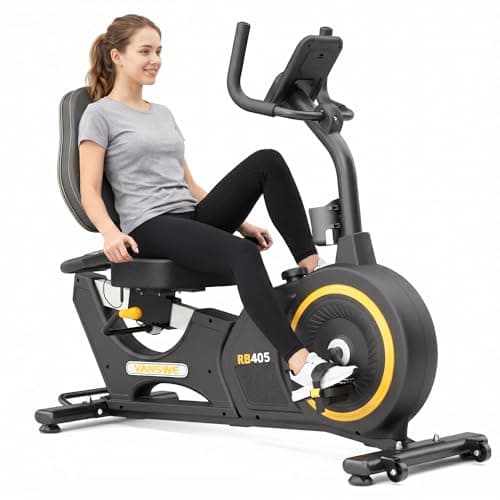
The HR-B51A’s listing states a 450 lb weight capacity. On this site that ties it with the VANSWE RB405 for the highest number we have found published, and it puts the bike comfortably into the range that the lower-rated machines — the ones stuck at 265 or 300 lb — simply rule out. If a stated capacity is your first filter, and for a lot of buyers it correctly is, this is one of only a handful of bikes here that clears it. We argue the whole case on the highest-capacity shortlist, including the important point that a capacity is a floor to stay well under, not a target to ride up against.

The less obvious strength is at the other end of the size scale. The listing gives an inseam range of 26.5 to 38.9 inches, with a stated rider height that starts at 4 ft 8 in. That 26.5 inch minimum is the lowest published figure we have seen on any bike on this site, and it answers a question shorter riders are usually left to guess at: will the seat come close enough that my legs can reach the pedals without stretching? A machine whose seat only slides down to a 29 or 30 inch inseam leaves a short rider perched and over-reaching. This one, on paper, does not.

Put the two together and the HR-B51A covers an unusually wide span of bodies: a heavier rider the low-capacity bikes exclude, and a shorter rider the long-reach bikes strand. That breadth matters for a plain reason: the machine that fits more people in a household is the one those people will actually get their minutes on, and steady seated cycling is one of the low-impact ways to work toward the CDC’s guideline of at least 150 minutes a week of moderate activity for adults 65 and over. That breadth, more than any single number, is the argument for the bike.

The noise claim, and why we won't repeat it as a fact

The listing states that the magnetic resistance runs at under 15 dB. HARISON is one of the very few makers in this category to attach any decibel figure at all, and in a market where “whisper-quiet” is the usual empty phrase, we would rather have a number than not. But we are going to treat it as a marketing claim, not a measurement, and you should too.

Here is the problem with the figure on its face. Under 15 dB is quieter than a recording studio’s noise floor and quieter than most people can hear in a normal room; a whisper at arm’s length is roughly twice that in decibel terms. There is no stated test standard, no distance, and no indication of what was being measured — the flywheel alone, the whole machine under load, or the room it sat in. Without those conditions, the number cannot be checked or compared against anything, so it tells you the resistance is magnetic and therefore quiet, which is true and useful, but it does not tell you how loud the bike will be in your apartment.

The practical read is the reasonable one: a belt-and-magnet recumbent bike is a quiet machine, and this is one, and it will not carry through a shared wall the way a treadmill can. If a sleeping partner in the next room or a downstairs neighbor is the deciding factor, judge it as “magnetic and quiet” rather than as a specific, verified 15 dB, because that specific number is not something anyone has shown its work on.

What HARISON still won't tell you

For all the seat rail, the capacity, and the reach, HARISON leaves several of the measurements we look for blank — and they are not trivial ones.

No step-over height. This is the number that decides whether you can get onto the frame in the first place, and no manufacturer on this site publishes it. HARISON is no exception. The one-hand seat rail helps once you are seated; it does nothing to tell you how high you have to lift a foot to get there. If you can reach one of these in a shop, step-over height takes about a minute to measure yourself.

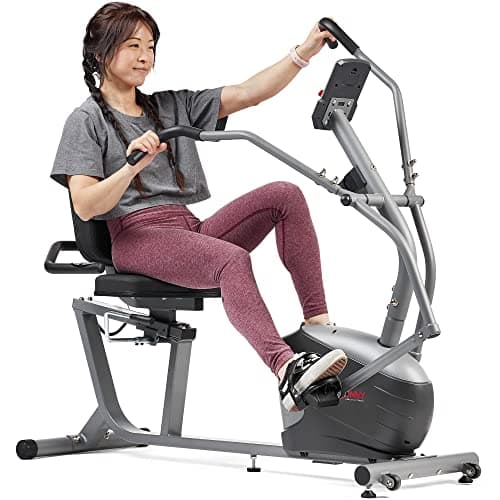
No seat height from the floor.This is the gap that keeps the HR-B51A off the top of our senior shortlist. A published seat height — the kind the Sunny SF-RB420032 gives — lets you check the seat against a dining chair you already own and know whether you sit down onto it or lower yourself into it. HARISON does not state one, so that check is not available to you here.

No box or assembled weight. Some machines on this page tell you the shipping weight so you can plan the trip from the front door to the room. HARISON does not publish either figure, so budget for a two-person lift at the door as a matter of caution rather than knowledge.

No pedal spacing and no display character height.Nobody in this category publishes Q-factor, so the sideways angle through the knee is unknown across the board. And while the listing describes a monitor and a 16-level resistance knob, it does not say how tall the on-screen digits are — the detail that matters most past 60, and one HARISON leaves you to find out on arrival.

Who this suits

Anyone who adjusts the seat alone, every session. The one-hand, seated, no-bending slide is the whole reason to choose this bike, and it pays off most for a rider with a stiff back or a weak grip who cannot easily reach a floor-level pin.

Heavier riders.The listing’s 450 lb capacity ties the highest on this site and clears the buyers that the 265 and 300 lb machines turn away.

Shorter riders. A published 26.5 inch inseam minimum is the lowest here, so the seat should come close enough for legs that longer-reach bikes leave stretching.

Households sharing one bike. Two people of different heights can re-set the seat between sessions without a wrestling match, which is exactly when a difficult adjustment quietly stops getting used.

Who should skip it

Anyone whose first question is “can I get on it?”No published step-over or seat height means the getting-on question is only half answered. If that is your constraint, the Sunny SF-RB420032’s published seat height answers more of it.

Anyone who needs very fine resistance control. Sixteen levels on a knob is plenty of range, but the step between two low settings is fixed. A sensitive knee that lives between level one and level two is better served by an electronically controlled bike.

Anyone who needs to know the weight before it ships. HARISON publishes no box or assembled weight, so if planning the lift from door to room is essential, a machine that states its shipping weight will serve you better.

Anyone buying on the noise number alone.Treat the bike as “magnetic and quiet,” not as a verified 15 dB. If silence is truly the deciding factor, no listing here proves it for you.

General information, not medical advice. Tread & Tone is written by an enthusiast, not a clinician. Nobody here is a doctor, a physical therapist or a trainer, and nothing on this site has been medically reviewed. Talk to your doctor or physical therapist before starting something new, particularly after surgery, a fall, or a change in medication.

Questions people ask

Is the HARISON HR-B51A good for seniors?

For a specific senior it is one of the strongest options here. The one thing it does that no other bike on this site claims is a seat you slide with one hand, seated, without bending down to a floor-level pin — which suits a stiff back or a weak grip. It also states a 450 lb capacity, the joint-highest here, and a 26.5 inch inseam minimum, the lowest here, so it fits an unusually wide range of bodies. The gap is that it does not publish a seat height from the floor, so it cannot answer the 'can I get on and stand back up?' question as directly as the Sunny SF-RB420032 does.

What is the weight limit on the HR-B51A?

The listing states 450 lb, which ties for the highest published capacity of any recumbent bike we cover. Treat a capacity as a floor to stay well under rather than a target to ride up against — a frame worked near its stated limit flexes, and flex on a machine you are climbing onto is the opposite of what you want. Well below the rating is where these frames feel solid.

How quiet is it really? Is the under-15 dB claim true?

We can't verify it, and we would not buy on it. The listing states under 15 dB for the magnetic resistance, but it gives no test standard, no measuring distance, and no indication of what was measured — which makes the specific number impossible to check or compare. What is fair to say is that a magnetic-resistance recumbent bike is a genuinely quiet machine and will not travel through a wall the way a treadmill can. Judge it as 'magnetic and quiet,' not as a proven 15 dB.

Will it fit a shorter rider?

That is one of its strengths. The listing publishes an inseam range of 26.5 to 38.9 inches and a rider height starting at 4 ft 8 in. The 26.5 inch minimum is the lowest published figure we have found on any bike on this site, which is what a shorter rider needs so the seat comes close enough to reach the pedals without over-stretching. It does not publish a seat height from the floor, though, so the separate question of how far you drop to sit down is still unanswered.

How is the seat adjustment different from other recumbent bikes?

Most recumbent seats move by standing up, bending to a pin or lever near the floor, and shoving the seat carriage along a rail with two hands. HARISON's listing describes a rail you slide with one hand while seated, with no bending and no pull-pin. If that holds up in person, it removes the low reach and the grip strength that make seat adjustment hard for the buyers this site is written for. We have not used the bike, so we can't tell you how much force the slide takes — but no other machine here even claims a one-handed, seated adjustment.

Does it help me meet the activity guidelines for older adults?

It can be part of it. The CDC recommends that adults 65 and over get at least 150 minutes a week of moderate-intensity activity plus muscle-strengthening and balance work, and steady seated cycling is a low-impact way to build the aerobic minutes. A recumbent bike removes the balance demand entirely, though, so it covers the endurance part and not the balance part — pair it with separate balance work, and check with your doctor before starting something new.

Sources

Product measurements are cited individually inside each Fit-to-You panel, against the manufacturer page or dated retailer listing they were read from.

Read next