Tread & Tone

The Best Exercise Equipment for Stroke Patients at Home

Almost every piece of home exercise equipment assumes two sides that work the same. After a stroke that assumption is the problem — so this page ranks on what holds the affected limb and what the strong side can drive alone.

By Stephen V.Last updated How we choose

How this is funded: we earn a commission if you buy through our links, at no extra cost to you. It never changes what we recommend, and every page here names at least one thing we would not buy. Full disclosure.

The machine to buy for home use after a stroke is the Exerpeutic 2000M, and it is the published overload protection that puts it first: the listing states that the cranks stop on excessive speed or when the legs cannot rotate freely. That is the precise failure mode a motorised pedal unit creates for somebody with spasticity or a leg that will not follow — and it is the only listing in our registry that addresses it in writing. It pairs that with published adjustable straps on large foldable pedals, which is how the affected foot stays on the pedal at all. Our budget pick is the KEAJVXT arm bike, which costs a fraction of anything with a motor and solves a different one-sided problem: it clamps to the table, so a single strong arm cranking against nothing cannot push it away.

Why this page is not a bike shortlist. If a recumbent bike is already the plan, our recumbent bikes for stroke recovery page ranks those machines against each other. But Google's own suggestions for this query split into arm exercise equipment and legexercise equipment, and that split is the clinical reality: hemiparesis is one-sided, and the arm is very often the side that needs the most work and is served the worst by equipment designed for two matched limbs. So this page ranks arm units alongside leg units, on a single question — what does this machine do when only one side is working?

Three criteria, in this order. First, what holds the affected limb. Straps, calf supports, a clamp to the table, or nothing. A foot that slides off a plate ends the session; a unit that slides across the table ends it faster. Second, whether one side can drive it alone— which almost nothing publishes, and exactly one unit in our registry does. Third, what the machine does when the weak side stops. A motor that keeps turning a limb that has gone into spasm is the thing to design around, and two of these five publish a stop behaviour.

The finding on this page is a single product fact, so we will state it plainly. Exactly one unit in our registry publishes a single-arm independent mode: the Jeogejin hand bike, which states three modes — single-arm independent, both arms synchronised, and standard cycling. Every other arm unit here links the two cranks, which means a weak arm is dragged around the circle by a strong one. That may be exactly what a therapist has asked for, and it may be exactly what they have asked you to avoid. The point is that only one listing lets you choose, and nobody else mentions the question.

What we will not do is tell you what your rehabilitation should look like. The CDC's own page on stroke treatment and recovery is clear that rehabilitation is directed by a clinical team, and its activity guidance for adults with chronic conditions and disabilities says to consult a health care professional or physical activity specialist about what is appropriate — while holding the same 150 minutes a week target and adding the line that matters here: some physical activity is better than none, be as active as you are able. Equipment belongs after that conversation, not instead of it. Ask the physical therapist which of these shapes they want, then buy that shape.

Live prices sit inside the buttons with the date of our last check — our most recent read was November 22, 2026. We have not used any of these machines, and nothing here is medical advice. What we did instead is written down.

Quick picks

Ranked on the published accessibility measurements and on who each machine actually suits. Select a row to jump to the full write-up. The last column is the number of the nine measurements the manufacturer will not publish — we have not used any of these machines, and here is exactly what we did instead.

#MachineBest forSpecs withheldPrice
1
Exerpeutic 2000M Motorized Under Desk Exercise Bike

Exerpeutic 2000M Motorized Under Desk Exercise Bike

When the legs may not rotate freely

Best overall2of 7
$170.01 · Check price on Amazon

Price as of November 22, 2026. #ad How we’re funded

2
PHYCISER Electric Pedal Exercise Bike with Leg Support

PHYCISER Electric Pedal Exercise Bike with Leg Support

Holding the legs in place

Holds the weak leg1of 7
$174.99 · Check price on Amazon

Price as of November 22, 2026. #ad How we’re funded

3
Jeogejin Hand Bike with Three Training Modes

Jeogejin Hand Bike with Three Training Modes

One arm at a time

One arm at a time3of 7
$49.99 · Check price on Amazon

Price as of November 22, 2026. #ad How we’re funded

4
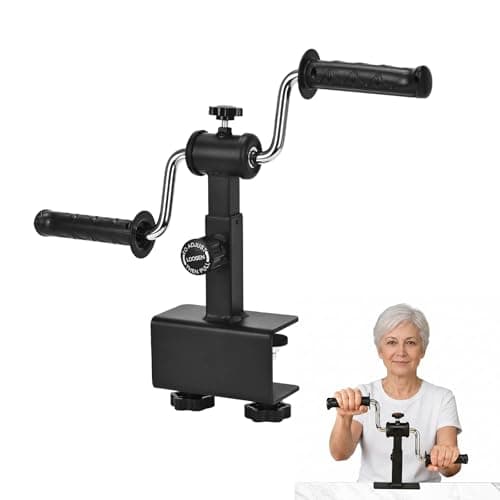
KEAJVXT Arm Bike with Desktop Clamp

KEAJVXT Arm Bike with Desktop Clamp

Arms only, bolted down

Budget pick3of 7
$35.19 · Check price on Amazon

$49.9930% off

Price as of November 22, 2026. #ad How we’re funded

5
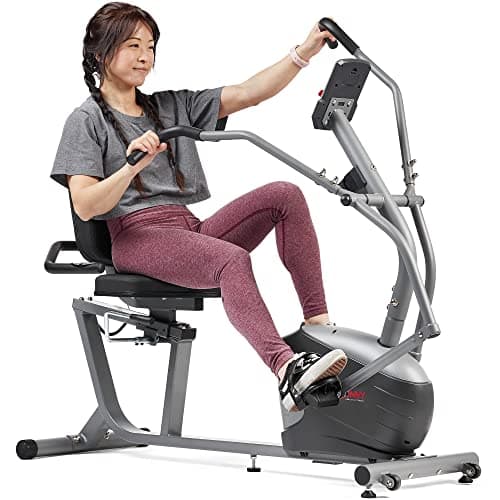
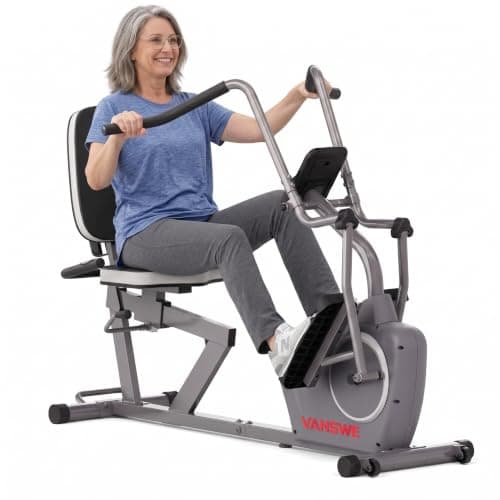
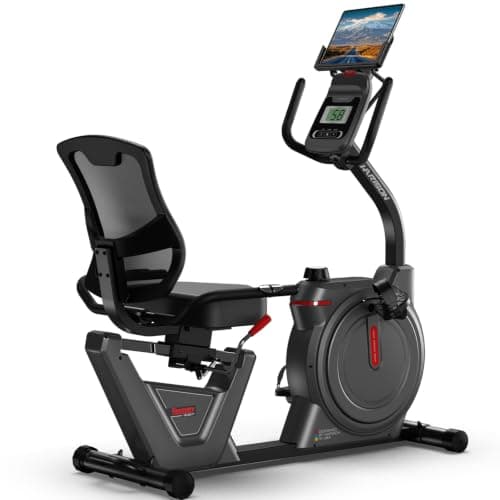
Sunny Health & Fitness Smart Recumbent Elliptical Cross Trainer for Seniors

Sunny Health & Fitness Smart Recumbent Elliptical Cross Trainer for Seniors

A published step-through entry

Arms and legs together9of 10
$363.30 · Check price on Amazon

$449.9919% off

Price as of November 22, 2026. #ad How we’re funded

1.Best overall

Exerpeutic 2000M Motorized Under Desk Exercise Bike(4107)
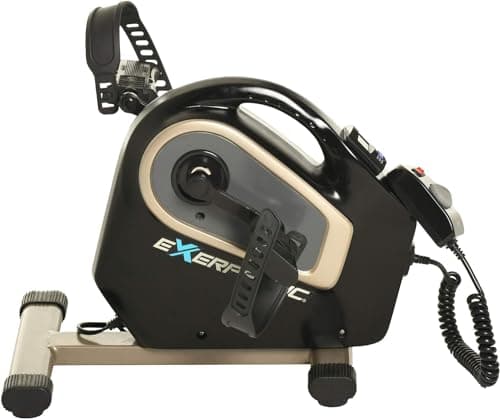
Exerpeutic 2000M Motorized Under Desk Exercise Bike
$170.01 · Check price on Amazon

Price as of November 22, 2026. #ad How we’re funded

The only unit here whose listing describes what happens when the legs stop cooperating: an overload protection that halts the cranks if the pedals cannot rotate freely. That is the specific failure a motorized pedal unit can cause and almost nobody addresses it in writing. Add adjustable foot straps and a named manufacturer behind the brand, and it is the one we would put a relative on.

What it gets right

  • Published overload protection that stops the cranks on excessive speed or when the legs cannot rotate freely — the one safety behavior that matters most on a motorized unit
  • Adjustable straps on large foldable pedals, published, so the feet are held rather than balanced
  • Speed controller on a published 6 ft cord, so settings change without bending down
  • A named manufacturer (Paradigm Health and Wellness) and a published 1-year limited warranty, which most of this category does not have
  • Published floor mat and a built-in carry handle

What to know first

  • The controller is corded, not wireless — 6 ft of cable across the floor near someone unsteady on their feet
  • Published 15-minute automatic session timer when the motor is running, so a longer powered session means restarting it
  • No published user weight capacity
  • At 14.5 in tall it is the second-tallest unit here, which rules out most desks
  • No decibel figure, and no calf or leg supports

Fit-to-You: the nine measurements

Exerpeutic does not publish 2 of 7 of these. Where that is the case, this panel says so rather than guessing. How we compile these

Pedal heightThe clearance under your desk or chair. Get this wrong and the pedals hit your knees.
14.5 in overall height, not adjustable

Source: Amazon product listing data (Creators API) · read 2026-10-03

Resistance rangeHow gently it can be set. The lowest setting matters far more than the highest.
No numbered resistance levels. The listing states the bike "offers more resistance when the motor is off" and that speed is set on the hand-held controller

Source: Amazon product listing data (Creators API) · read 2026-10-03

Weight capacitySearched directly, and two of the senior-focused competitors omit it entirely.
Not published by the manufacturer
Motorized or self-poweredWhether the machine moves your legs or you move it. For very low leg strength that is the whole decision.
Motorized, with published overload protection that stops the cranks on excessive speed or when the legs cannot rotate freely; auto 15-minute session timer when powered

Source: Amazon product listing data (Creators API) · read 2026-10-03

Display and controlsCharacter height and contrast. Presbyopia is close to universal past 60.
Multi-function LCD showing distance, time, calories and total repetitions; hand-held speed controller on a 6 ft cord

Source: Amazon product listing data (Creators API) · read 2026-10-03

FootprintWhether it actually fits the room you have in mind, with clearance to get on and off.
18.2 in × 21 in × 14.5 in

Source: Amazon product listing data (Creators API) · read 2026-10-03

Noise (dB)Apartments, shared walls, and a sleeping partner in the next room.
Not published by the manufacturer

We have not used this machine. Everything above comes from the manufacturer’s published documentation and the dated retailer listing, with the source given for each figure. Where they don’t publish a number, we say so. We can’t tell you how it feels to ride, how quiet it really is, or how it holds up after two years — and anyone who tells you otherwise without owning one is guessing.
2.Holds the weak leg

PHYCISER Electric Pedal Exercise Bike with Leg Support(QH-032026)

PHYCISER Electric Pedal Exercise Bike with Leg Support
$174.99 · Check price on Amazon

Price as of November 22, 2026. #ad How we’re funded

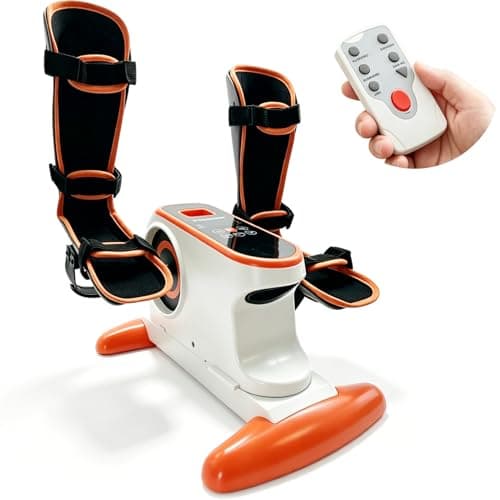
The most complete published spec sheet in this group, and the only one that separates passive cycling, motor-assisted movement and active resistance into three named modes rather than blurring them into "auto and manual". High calf supports hold the legs on the pedals. It is also the only unit here with a decibel figure on the listing, though that figure is the seller's and comes with no test method.

What it gets right

  • Three named modes published — passive cycling, motor-assisted movement, and an active resistance mode — rather than one vague "auto" setting
  • High calf leg supports, published, which hold the lower leg rather than relying on the foot staying put
  • Published auto-pause the listing calls Anti-Spasm: it stops on excessive resistance and resumes after 5 seconds
  • Published as requiring no assembly, with a long-range remote and a high-contrast LCD
  • 20 speed levels and published forward and reverse rotation
  • Published weight of 13.8 lb with a built-in handle

What to know first

  • No published user weight capacity
  • "Anti-Spasm" is the seller's term with no published trigger threshold, so there is no way to know how much resistance it tolerates before it stops
  • The under-40 dB figure is a seller claim with no stated test method
  • The leg supports are a frame you live with — nothing on the listing says they detach, unlike the MOMODA's
  • Its own listing styles the brand two ways, PHY CISER and phyciser, which is a sign of how young the brand is

Fit-to-You: the nine measurements

PHYCISER does not publish 1 of 7 of these. Where that is the case, this panel says so rather than guessing. How we compile these

Pedal heightThe clearance under your desk or chair. Get this wrong and the pedals hit your knees.
9.8 in overall height, not adjustable

Source: Amazon product listing data (Creators API) · read 2026-10-03

Resistance rangeHow gently it can be set. The lowest setting matters far more than the highest.
20 speed levels across three published modes — passive cycling, motor-assisted, and an active resistance mode. No resistance figure in pounds or newtons

Source: Amazon product listing data (Creators API) · read 2026-10-03

Weight capacitySearched directly, and two of the senior-focused competitors omit it entirely.
Not published by the manufacturer
Motorized or self-poweredWhether the machine moves your legs or you move it. For very low leg strength that is the whole decision.
Motorized, forward and reverse, continuous-duty copper motor with no wattage published; auto-pause on excessive resistance resuming after 5 seconds

Source: Amazon product listing data (Creators API) · read 2026-10-03

Display and controlsCharacter height and contrast. Presbyopia is close to universal past 60.
High-contrast LCD plus a long-range remote, so no bending to change settings

Source: Amazon product listing data (Creators API) · read 2026-10-03

FootprintWhether it actually fits the room you have in mind, with clearance to get on and off.
17.7 in × 11.8 in × 9.8 in; 13.8 lb with a built-in handle

Source: Amazon product listing data (Creators API) · read 2026-10-03

Noise (dB)Apartments, shared walls, and a sleeping partner in the next room.
Listing states under 40 dB. A seller claim with no stated test method

Source: Amazon product listing data (Creators API) · read 2026-10-03

We have not used this machine. Everything above comes from the manufacturer’s published documentation and the dated retailer listing, with the source given for each figure. Where they don’t publish a number, we say so. We can’t tell you how it feels to ride, how quiet it really is, or how it holds up after two years — and anyone who tells you otherwise without owning one is guessing.
3.One arm at a time

Jeogejin Hand Bike with Three Training Modes

Jeogejin Hand Bike with Three Training Modes
$49.99 · Check price on Amazon

Price as of November 22, 2026. #ad How we’re funded

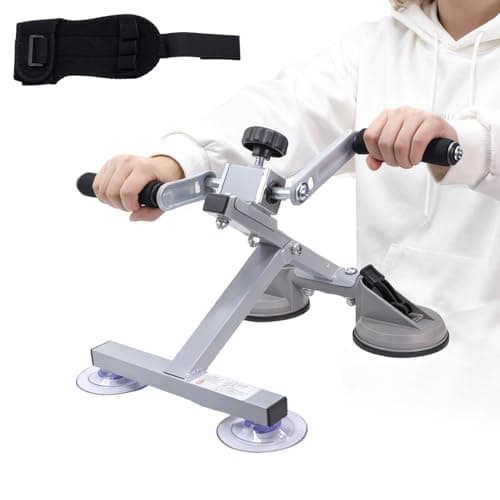
The only unit here that publishes a single-arm mode, and that is the mode that matters after a stroke: one arm works, the other rests, and the machine is not forcing a weak side to follow a strong one around the circle. It is also the flattest and lightest thing on this page at 4.7 in high and 5 lb, which is what makes it the one that gets carried to the kitchen table and back.

What it gets right

  • Three modes published: single-arm independent, both arms synchronized, and standard cycling
  • 4.7 in high and 5 lb published — the flattest, lightest unit on this page
  • Oversized suction cups with anti-slip silicone pads published for the base
  • Assembles with the one included hex wrench, so a single person can set it up
  • Published footprint on all three dimensions, which half of this aisle does not manage

What to know first

  • Arms only, and self-powered — no help if you cannot turn the cranks
  • No resistance range, no number of settings, and no units published
  • No display of any kind
  • The 300 percent adhesion claim has no baseline, so it is a marketing number rather than a specification
  • No published user weight capacity

Fit-to-You: the nine measurements

Jeogejin does not publish 3 of 7 of these. Where that is the case, this panel says so rather than guessing. How we compile these

Pedal heightThe clearance under your desk or chair. Get this wrong and the pedals hit your knees.
4.7 in high, the flattest unit here. It stands on a table, so the crank height is set by the table you put it on

Source: Amazon product listing data (Creators API) · read 2026-10-10

Resistance rangeHow gently it can be set. The lowest setting matters far more than the highest.
Three training modes published — single-arm independent, bilateral synchronized, standard cycling. No resistance range or units published

Source: Amazon product listing data (Creators API) · read 2026-10-10

Weight capacitySearched directly, and two of the senior-focused competitors omit it entirely.
Not published by the manufacturer
Motorized or self-poweredWhether the machine moves your legs or you move it. For very low leg strength that is the whole decision.
Self-powered. You turn the cranks with your hands

Source: Amazon product listing data (Creators API) · read 2026-10-10

Display and controlsCharacter height and contrast. Presbyopia is close to universal past 60.
Not published by the manufacturer
FootprintWhether it actually fits the room you have in mind, with clearance to get on and off.
13.38 in × 12.79 in × 4.7 in; 5 lb; oversized suction cups with anti-slip silicone pads

Source: Amazon product listing data (Creators API) · read 2026-10-10

Noise (dB)Apartments, shared walls, and a sleeping partner in the next room.
Not published by the manufacturer

We have not used this machine. Everything above comes from the manufacturer’s published documentation and the dated retailer listing, with the source given for each figure. Where they don’t publish a number, we say so. We can’t tell you how it feels to ride, how quiet it really is, or how it holds up after two years — and anyone who tells you otherwise without owning one is guessing.
4.Budget pick

KEAJVXT Arm Bike with Desktop Clamp

KEAJVXT Arm Bike with Desktop Clamp
$35.19 · Check price on Amazon

$49.9930% off

Price as of November 22, 2026. #ad How we’re funded

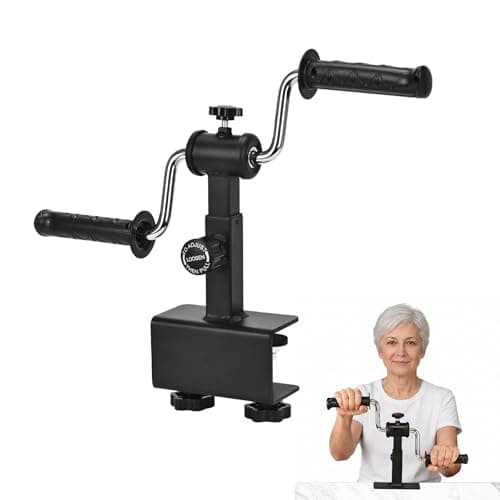
It bolts to the table. Every other unit that advertises arm use is a floor unit you lift onto a surface and then chase around it, and the sliding is the reason arm sessions stop. This one clamps to a tabletop between 0.4 and 1.95 in thick and does not move. It is arms only, it has no motor and no display, and for somebody whose legs are not the part that needs work it is still the best value on this page.

What it gets right

  • Published desktop clamp for tabletops 0.4–1.95 in thick — the listing specifically contrasts it with suction-cup units that move
  • Silicone pad on the clamp, published, to protect the table surface
  • Resistance by tension knob, so the lowest setting is continuous rather than a step
  • Published 3.3 lb and metal construction — light enough to move room to room, heavy-duty enough to clamp
  • Cheapest route in on this page, and the only one that needs no power outlet

What to know first

  • Arms only. No leg use at all, which is most of what this page is about
  • Self-powered, so it does nothing for somebody who cannot turn the cranks themselves
  • The listing describes no display or monitor of any kind — the tension knob is the only control
  • No published resistance range and no published user weight capacity
  • Needs a table edge in the published thickness range; a thick farmhouse table or a glass top rules it out

Fit-to-You: the nine measurements

KEAJVXT does not publish 3 of 7 of these. Where that is the case, this panel says so rather than guessing. How we compile these

Pedal heightThe clearance under your desk or chair. Get this wrong and the pedals hit your knees.
8.5 in high, and it clamps to a table edge rather than standing on the floor, so the crank height is set by your table

Source: Amazon product listing data (Creators API) · read 2026-10-03

Resistance rangeHow gently it can be set. The lowest setting matters far more than the highest.
Adjustable by tension knob; no range published

Source: Amazon product listing data (Creators API) · read 2026-10-03

Weight capacitySearched directly, and two of the senior-focused competitors omit it entirely.
Not published by the manufacturer
Motorized or self-poweredWhether the machine moves your legs or you move it. For very low leg strength that is the whole decision.
Self-powered. You turn the cranks with your hands

Source: Amazon product listing data (Creators API) · read 2026-10-03

Display and controlsCharacter height and contrast. Presbyopia is close to universal past 60.
Not published by the manufacturer
FootprintWhether it actually fits the room you have in mind, with clearance to get on and off.
16 in × 4.7 in × 8.5 in; 3.3 lb. Clamps to tabletops 0.4–1.95 in thick

Source: Amazon product listing data (Creators API) · read 2026-10-03

Noise (dB)Apartments, shared walls, and a sleeping partner in the next room.
Not published by the manufacturer

We have not used this machine. Everything above comes from the manufacturer’s published documentation and the dated retailer listing, with the source given for each figure. Where they don’t publish a number, we say so. We can’t tell you how it feels to ride, how quiet it really is, or how it holds up after two years — and anyone who tells you otherwise without owning one is guessing.
5.Arms and legs together

Sunny Health & Fitness Smart Recumbent Elliptical Cross Trainer for Seniors

Sunny Health & Fitness Smart Recumbent Elliptical Cross Trainer for Seniors
$363.30 · Check price on Amazon

$449.9919% off

Price as of November 22, 2026. #ad How we’re funded

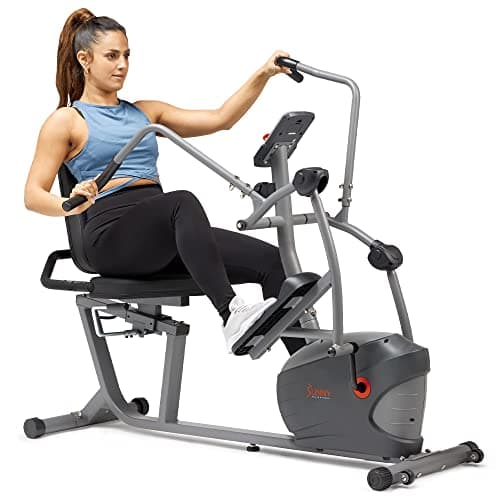
The listing leads with the one word that matters most in this aisle — step-through — and backs it with 8 resistance levels and a dual-function arm-and-leg motion. What it will not tell you is the weight capacity, which is a real gap on a machine sold explicitly to seniors.

What it gets right

  • Step-through design is stated plainly, which is the single feature that decides whether a nervous buyer will use it
  • Publishes 8 resistance levels — an actual count, not just 'adjustable'
  • Dual-function motion works the arms and legs together, and pulse sensors are on the handlebars
  • Connects to the SunnyFit app if you want a session structured for you

What to know first

  • No published weight capacity — the most-searched spec in the category, and its absence is the reason it does not lead
  • No step-over height or seat height, so 'step-through' is a claim rather than a measured number
  • No assembled dimensions in the listing
  • Costs more than the VANSWE above while publishing less about who it fits

Fit-to-You: the nine measurements

Sunny Health & Fitness does not publish 9 of 10 of these. Where that is the case, this panel says so rather than guessing. How we compile these

Step-over heightThe single number that decides whether you can get on at all. Almost nobody publishes it.
Not published by the manufacturer
Seat height from floorDecides whether you sit down onto the seat or lower yourself into it, and whether you can stand back up unaided.
Not published by the manufacturer
Weight capacitySearched directly, and two of the senior-focused competitors omit it entirely.
Not published by the manufacturer
Inseam rangeWhether the seat travels far enough for your leg length without over-extending the knee.
Not published by the manufacturer
Pedal spacing (Q-factor)How far apart the pedals sit. A narrow pedal spacing reduces the sideways load on arthritic knees.
Not published by the manufacturer
Display character heightCharacter height and contrast. Presbyopia is close to universal past 60.
Not published by the manufacturer
Controls and reachCan it be operated one-handed, by feel, while seated? This is where low-strength and low-vision buyers get stranded.
Step-through design; 8 resistance levels; dual-function arm and leg motion; pulse sensors on the handlebars; SunnyFit app

Source: Amazon product listing data (Creators API) · read 2026-08-03

Assembly and box weightBox weight and how many people it needs. A 130 lb box is a real barrier, not a footnote.
Not published by the manufacturer
Noise (dB)Apartments, shared walls, and a sleeping partner in the next room.
Not published by the manufacturer
FootprintWhether it actually fits the room you have in mind, with clearance to get on and off.
Not published by the manufacturer

We have not used this machine. Everything above comes from the manufacturer’s published documentation and the dated retailer listing, with the source given for each figure. Where they don’t publish a number, we say so. We can’t tell you how it feels to ride, how quiet it really is, or how it holds up after two years — and anyone who tells you otherwise without owning one is guessing.
What we found looking for these numbers

We went looking for 38 measurements across the 5machines on this page — the nine that decide whether an older adult can get on, reach the controls, read the screen and hear themselves think. 18 of those 38 are not published by anybody. Not one manufacturer here publishes the full set.

Step-over height is the worst of them. It is the single measurement that decides whether you can get onto a machine at all, and across everything we checked, not one manufacturer states it. That is not an oversight in a category explicitly marketed to seniors, and the count in each panel above is there so you can see who is doing it.

Where a figure exists, we cite it and date it. Where it doesn’t, the panel says Not published by the manufacturer rather than an estimate dressed up as a fact. You can measure step-over height yourself in about a minute — and if a machine is already in your house, that is the fastest way to settle it.

What actually holds the affected limb, unit by unit

This is the criterion that reorders the whole category, and it is worth going through machine by machine because the answers are genuinely different rather than variations on a theme.

The Exerpeutic 2000M publishes adjustable straps on large foldable pedals.A strap is the simplest answer to a foot that will not hold position, and it is the one a lot of people are actually looking for. The cost is that somebody has to fasten it, which on a unit 14.5 inches tall means bending to it — and the Exerpeutic's own controller sits on a 6 ft cord, so changing speed afterwards does not.

The PHYCISER publishes high calf leg supports, which is a structurally different idea: rather than holding the foot to the pedal, it cradles the lower leg so the limb travels as a unit. For a leg with poor distal control that is often the better answer, and it is the reason this unit sits second. It publishes three named modes — passive cycling, motor-assisted movement and an active resistance mode — rather than one vague auto setting, plus an auto-pause it calls Anti-Spasm that stops on excessive resistance and resumes after five seconds. We print that as published and also print the limitation: no trigger threshold is stated anywhere, so there is no way to know how much resistance it tolerates before it gives up. Its supports are also a frame you live with — nothing on the listing says they detach.

The KEAJVXT's answer is to hold the machine rather than the limb. It clamps to a tabletop between 0.4 and 1.95 inches thick, with a published silicone pad to protect the surface. That sounds like a minor convenience and it is not. Every other table-top arm unit sits on suction cups or rubber feet, and a single strong arm cranking asymmetrically is exactly the load that walks one of those across a table. A unit that moves is a unit that stops being used. It is 3.3 lb, metal, and needs no power outlet.

The Jeogejin holds nothing and does not need to, because at 4.7 inches high and 5 lb it is the flattest and lightest unit in our registry and sits on oversized suction cups with anti-slip silicone pads. It is the one that gets carried to the kitchen table and back, which matters more than it sounds: the equipment that gets used is the equipment that is already where you are sitting.

The Sunny recumbent cross trainer holds you rather than a limb. Its listing leads with the word that matters most in that aisle — step-through — and its dual-function motion works arms and legs together on a linked path, with pulse sensors on the handlebars and 8 published resistance levels. What it will not publish is a weight capacity, which is a real gap on a machine sold explicitly to seniors, and it publishes no step-over height, so “step-through” is a claim rather than a measured number.

One side, two sides, and the mode nobody else offers

Linked cranks are the default in this category and they are not neutral. When two handles or two pedals are fixed 180 degrees apart, the strong side drives the weak side through the full circle whether the weak side contributes or not. Depending on the stage of recovery and the clinician, that is either the entire therapeutic point — passive range of motion driven by the unaffected side — or the thing to avoid, because the affected limb learns nothing from being carried.

The Jeogejin is the only unit in our registry that publishes the choice. Three modes: single-arm independent, so one arm works while the other rests and nothing is dragged; both arms synchronised, the conventional linked motion; and standard cycling. That is a specification, printed on the listing, rather than something we inferred from a photograph. Its honest gaps are large — no resistance range, no number of settings, no units, no display of any kind, and no published user weight capacity — and its claim of “300 percent adhesion” has no baseline, which makes it marketing rather than a figure.

The one-sided question also changes which failures matter. Self-powered units are no help at all to someone who cannot initiate the movement, and three of these five are self-powered: the Jeogejin, the KEAJVXT and the Sunny cross trainer. If the affected side cannot start the motion, the only units on this page that will move it are the two with motors, which is the whole reason they sit first and second despite costing several times as much as the arm bikes.

Conversely, if the strong side is strong and the goal is to use it, a motor is a waste of money and possibly of therapy. An arm unit that clamps to a table, costs very little and needs no outlet will get far more repetitions in a week than a mid-priced motorised unit nobody wants to set up. We rank arm units at length on our arm exerciser shortlist, which covers the ones that are not relevant here as well as the two that are.

Standing, walking, and what none of these publishes

Two things are missing from the list above on purpose, and one of them is probably the reason you are reading.

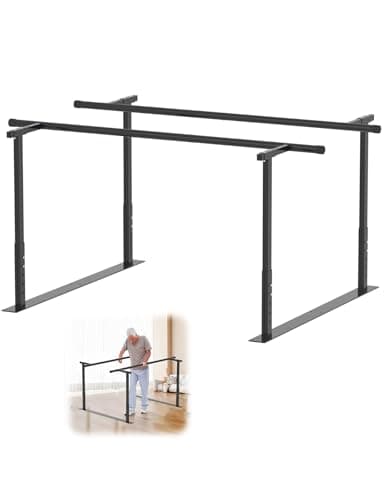
Gait. Nothing on this page trains walking, and we are not going to pretend a seated pedal unit does. If walking practice at home is the goal, the equipment answer is something to hold while you do it, which in our registry means parallel bars and grab bars rather than a machine with a belt. Treadmill gait training after a stroke is a supervised intervention rather than a home-equipment purchase, and we are not going to recommend a moving belt to somebody with one-sided weakness from a web page.

Hand and finger function.Google's suggestions for this query include finger exercise equipment, and our registry has none — no hand therapy putty, no finger exercisers, no grip trainers. Rather than stretch an arm bike into an answer it cannot give, we will say plainly that this page does not cover it.

Now the blanks that run across everything above. Not one of these five publishes a user weight capacity.Not the motorised units, not the arm bikes, and not the Sunny cross trainer — which is the one where it genuinely matters, because it is the only machine here you sit on. Two publish no resistance range in any unit. The decibel figures that exist are seller claims with no test method, which makes them useless for comparing one machine against another.

So, the plain recommendation. If the leg cannot reliably turn a crank, buy the Exerpeutic 2000M for the published overload stop and the straps, and accept its 14.5 inch height and the published 15-minute powered session timer. If the leg needs cradling rather than strapping, buy the PHYCISER for the calf supports and the three named modes. If the arm is the work and the therapist wants the sides independent, the Jeogejin is the only unit that offers it. If the arm is the work and the budget is tight, buy the KEAJVXT, clamp it to the table, and get the repetitions. And if the goal is a single machine the whole household can use, the Sunny cross traineris the step-through option — ranked last here only because the specification it withholds is the one a heavier user needs.

Whatever you buy, buy it after the physical therapist has told you what shape of movement they want. Our seated exercises for limited mobility guide is the no-equipment starting point if that conversation has not happened yet.

General information, not medical advice. Tread & Tone is written by an enthusiast, not a clinician. Nobody here is a doctor, a physical therapist or a trainer, and nothing on this site has been medically reviewed. Talk to your doctor or physical therapist before starting something new, particularly after surgery, a fall, or a change in medication.

Questions people ask

What is the best exercise equipment for stroke patients at home?

The Exerpeutic 2000M motorized pedal exerciser, for the specific reason that it is the only unit in our registry whose listing publishes an overload protection that halts the cranks when the legs cannot rotate freely — the exact failure a motor can cause for somebody with spasticity. It also publishes adjustable foot straps on large foldable pedals, a speed controller on a 6 ft cord so settings change without bending, a named manufacturer and a one-year warranty. What it does not publish is a user weight capacity, and at 14.5 inches tall it will not fit under most desks.

Is there an arm exerciser that works one arm at a time?

One, in our registry: the Jeogejin hand bike, which publishes three training modes — single-arm independent, both arms synchronised, and standard cycling. Every other arm unit we track links the two cranks 180 degrees apart, which means the strong arm drives the weak one around the circle whether it contributes or not. Depending on the stage of recovery that is either the point or the thing to avoid, and only this listing lets you choose. Its gaps are real: no resistance range, no settings count, no display, no published weight capacity.

Are motorized pedal exercisers safe after a stroke?

That depends on a stop behaviour most sellers do not publish, which is why we rank on it first. The Exerpeutic 2000M publishes an overload protection that stops the cranks when the legs cannot rotate freely. The PHYCISER publishes an auto-pause on excessive resistance that resumes after five seconds, with no trigger threshold stated anywhere. The other units in our registry publish nothing on the subject. Spasticity, tone and contracture are precisely the circumstances a physical therapist should rule on before a motor is introduced — the CDC's own guidance for adults with disabilities says to ask one.

What exercise equipment helps a weak arm after a stroke?

A table-top arm bike, and the two things that decide which one are whether it stays put and whether the sides can move independently. The KEAJVXT clamps to a tabletop between 0.4 and 1.95 inches thick with a silicone pad to protect the surface, which stops a single strong arm pushing the unit away — the quiet reason arm sessions stop. The Jeogejin is the one that publishes a single-arm independent mode, at 4.7 inches high and 5 lb on oversized suction cups. Both are self-powered, so neither helps if the arm cannot start the motion at all.

Can you use a recumbent bike after a stroke?

Many people do, and the Sunny Smart Recumbent Elliptical Cross Trainer is our pick on this page because its listing leads with a step-through design and its dual-function motion works arms and legs together, with 8 published resistance levels and pulse sensors on the handlebars. Two honest caveats: it publishes no weight capacity at all, which is the most-searched spec in the category, and it publishes no step-over height, so 'step-through' is a claim rather than a measurement. Whether a linked arm-and-leg motion suits your recovery stage is a question for your therapy team.

What about walking and gait practice at home?

Nothing on this page trains gait, and we will not pretend otherwise. A seated pedal unit moves joints; it does not teach walking. If home walking practice is the goal, the equipment answer in our registry is something solid to hold — parallel bars for practising with support on both sides, or grab bars at the points where transfers happen. Treadmill gait training after a stroke is a supervised intervention, and recommending a moving belt to somebody with one-sided weakness from a web page is not something we are willing to do.

How much exercise should a stroke survivor do?

The CDC's activity guidance for adults with chronic conditions and disabilities keeps the same target as everyone else — at least 150 minutes a week of moderate-intensity activity — and adds the two lines that matter most here: some physical activity is better than none, be as active as you are able, and consult a health care professional or physical activity specialist about appropriate types and amounts. The CDC's own stroke pages are equally clear that rehabilitation is directed by a clinical team. Buy equipment that makes the plan they give you easy to follow at home.

Sources

  • CDC — Treatment and Intervention for Stroke — "Rehabilitation after a stroke begins in the hospital, often within a day or 2 after the stroke"; "Rehab can include working with speech, physical, and occupational therapists"; "Physical therapy uses exercises to help you relearn movement and coordination skills you may have lost because of the stroke" (read October 5, 2026)
  • CDC — Chronic Conditions & Disabilities Activity — "Get at least 150 minutes (for example, 30 minutes 5 days a week) of moderate-intensity aerobic physical activity a week"; "Some physical activity is better than none — be as active as you are able"; and "If you have chronic health conditions or disabilities, consult a health care professional or physical activity specialist about appropriate types and amounts of physical activity" (read October 3, 2026)
  • CDC — Physical Activity for People with Disability — All adults, with or without disabilities, should get at least 150 minutes of aerobic physical activity a week, and the activity "can be broken down into smaller amounts, such as about 25 minutes a day every day"; consult a healthcare professional or physical activity specialist, for example a physical therapist, about how a disability affects what is safe (read October 3, 2026)
  • CDC — Older Adult Activity: An Overview — At least 150 minutes a week of moderate-intensity activity, 2 days of muscle strengthening, plus balance activities for adults 65 and over (read July 24, 2026)
  • National Institute on Aging — Four Types of Exercise Can Improve Your Health and Physical Ability — Endurance, strength, balance and flexibility, with named balance exercises including heel-to-toe walking and standing on one foot (read July 24, 2026)

Product measurements are cited individually inside each Fit-to-You panel, against the manufacturer page or dated retailer listing they were read from.

Read next