Tread & Tone

Drive Medical Deluxe Folding Pedal Exerciser Review

The most common complaint about a cheap pedal exerciser is that it walks away across the floor the moment you push on it. Drive Medical, a maker of mobility equipment rather than gym gear, answers that with four anti-slip pads and a tension knob with nothing electronic to fail. Then it reports its own dimensions two different ways.

By Stephen V.Last updated How we choose

How this is funded: we earn a commission if you buy through our links, at no extra cost to you. It never changes what we recommend, and every page here names at least one thing we would not buy. Full disclosure.

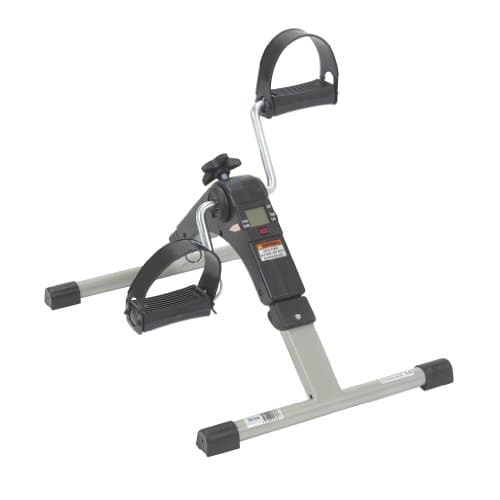
Drive Medical Deluxe Folding Pedal Exerciser RTL10273

Staying put on a hard floor

The medical-supply option: four anti-slip pads so it stays put on a hard floor, a tension knob rather than electronics, and it folds. Drive publishes two different sets of dimensions for it, which is the sort of thing we would rather tell you than tidy away.

Drive Medical does not publish 2 of the 7 measurements we look for. The panel below names which.

A pedal exerciser is the smallest, cheapest way to get seated cardio into a day: a set of pedals on a weighted frame that sits under your armchair, or up on a table for your arms. The Drive Medical RTL10273 comes at that job from an unusual direction. Drive Medical makes mobility and home-medical equipment — walkers, wheelchairs, bed rails — rather than fitness gear, and it shows in the one feature it leads with: four anti-slip rubber pads so the unit stays where you put it.

That sounds minor until you have used a cheap pedal exerciser. The near-universal complaint is that the thing skitters forward across a hard floor as soon as you pedal with any effort, and you spend the session chasing it back. Anti-slip feet are the whole difference between a unit that stays put and one that ends up under the sofa. It is a small, seated way to keep moving, and the Arthritis Foundation notes that a continuous pedaling motion moves the joint through its range.

Where it gets frustrating is the paperwork. The same listing reports two different pedal heights and two different footprints, and it publishes no weight capacity at all. We are going to report both sets of numbers exactly as stated rather than pick the one that reads better, because that contradiction is something you should know before you buy, not after.
Fit-to-You: the nine measurements

Drive Medical does not publish 2 of 7 of these. Where that is the case, this panel says so rather than guessing. How we compile these

Pedal heightThe clearance under your desk or chair. Get this wrong and the pedals hit your knees.
Listing dimension field says 7.6 in high; the same listing's text says 17 in high. Both are published and they disagree

Source: Amazon product listing data (Creators API) · read 2026-07-24

Resistance rangeHow gently it can be set. The lowest setting matters far more than the highest.
Adjustable via a tension knob; no range published

Source: Amazon product listing data (Creators API) · read 2026-07-24

Weight capacitySearched directly, and two of the senior-focused competitors omit it entirely.
Not published by the manufacturer
Motorized or self-poweredWhether the machine moves your legs or you move it. For very low leg strength that is the whole decision.
Self-powered

Source: Amazon product listing data (Creators API) · read 2026-07-24

Display and controlsCharacter height and contrast. Presbyopia is close to universal past 60.
Five-function display: time, revolutions, rpm, calories, and scan

Source: Amazon product listing data (Creators API) · read 2026-07-24

FootprintWhether it actually fits the room you have in mind, with clearance to get on and off.
Reported as both 15.4 × 13 in and 15 × 6.5 in by the same listing

Source: Amazon product listing data (Creators API) · read 2026-07-24

Noise (dB)Apartments, shared walls, and a sleeping partner in the next room.
Not published by the manufacturer

We have not used this machine. Everything above comes from the manufacturer’s published documentation and the dated retailer listing, with the source given for each figure. Where they don’t publish a number, we say so. We can’t tell you how it feels to ride, how quiet it really is, or how it holds up after two years — and anyone who tells you otherwise without owning one is guessing.

The anti-slip pads are the reason to choose it

Drive Medical publishes four anti-slip rubber pads on the base, and on a floor-use pedal exerciser that is the feature that matters most. The physics of the problem are simple: you are pushing a lightweight frame with your feet while sitting in a chair, and unless something holds it down, your push slides it away from you. A unit that walks is a unit you stop using. The pads are Drive Medical bringing its mobility-equipment instincts — stability first — to a category that usually forgets them.

It also folds for storage, which is the other half of what makes a pedal exerciser livable: it can go flat behind a chair or under a bed between sessions instead of sitting out. And it is dual-purpose — put it on the floor to pedal with your legs, or up on a table to turn it with your arms, which is genuinely useful on a day when your legs are not up to it or you simply want to move your shoulders. There is more on getting the most out of one on our guide to using a pedal exerciser.

A tension knob, and nothing to fail

Resistance is a simple mechanical tension knob. Turn it to make the pedals harder to push, turn it back to make them easier. Drive Medical does not publish a numbered range — it is “adjustable” and no more — so we cannot tell you how light the lightest setting is, which is the honest limit of the spec. What we can say is that there is nothing electronic in the resistance to break, which on a budget device that lives on the floor is a genuine virtue.

It is self-powered, meaning you provide every bit of the motion — the pedals do not turn unless you turn them. That is the important distinction between this and a motorized under-desk machine, which drives your legs for you. If starting the motion yourself is the problem — very stiff joints, very low strength — a motorized unit is the right tool. If you can push the pedals under your own steam, a self-powered unit like this gives you an actual workout you control. The display covers the basics with five functions: time, revolutions, rpm, calories and a scan mode that cycles through them.

The numbers that contradict themselves

Now the part we promised to report straight. The RTL10273 listing gives two different pedal heights: its dimension field says 7.6 inches high, while the same listing’s own text says 17 inches. That is not a rounding difference — it is more than double — and pedal height is exactly the spec that decides whether your knees clear the underside of a desk or table. The footprint is reported the same contradictory way: both 15.4 by 13 inches and 15 by 6.5 inches appear on the one listing.

We report both and trust neither over the other, because we have no way to resolve them from the published data. The practical takeaway is to plan around the larger figures if clearance is tight, and to measure the unit when it arrives before you commit it to a spot under a particular desk. If pedal height is the thing you most need to pin down, a unit that publishes a single consistent, adjustable height — there is one on our pedal exerciser shortlist — removes the guesswork this one leaves you with.

The capacity gap, and honest expectations

Drive Medical publishes no weight capacity for the RTL10273. For a device you rest your legs on rather than sit your full weight on, that matters less than it does on a bike, but it is still a number we would rather see stated, and its absence is a small mark against an otherwise sensible unit. There is also no published noise figure, so we will not put a word on how quiet it is.

Set your expectations where they belong. A pedal exerciser is a way to add gentle movement to a sedentary day, not a substitute for a full machine. The CDC asks adults 65 and over for at least 150 minutes a week of moderate activity, and gentle seated pedaling sits at the lighter end of that. The National Institute on Aging’s advice to talk to your doctor before starting something new applies here as anywhere. Used honestly — a bit of movement most days, in a chair you already own — a stable, folding pedal unit like this earns its small price.

Who this suits

Anyone whose last pedal exerciser slid across the floor. The four anti-slip pads are the fix, and they are the reason to pick this one.

Small spaces. It folds flat to go behind a chair or under a bed between sessions.

Arms as well as legs. Put it on a table to turn the pedals by hand on a day your legs are not up to it.

Anyone who wants nothing to break.A mechanical tension knob and a simple display — no motor, no app, no subscription.

Who should skip it

Anyone who needs the pedals moved for them. This is self-powered; if starting the motion is the problem, a motorized unit is the right tool.

Anyone fitting it under a specific desk. The listing gives two different pedal heights, so you cannot confirm the clearance until you measure the delivered unit.

Anyone who wants a stated resistance range.It is “adjustable” with no numbers, so how light the lightest setting is remains unknown.

Anyone expecting a full workout. A pedal exerciser adds gentle movement to a sedentary day; it does not replace a bike or a treadmill.

General information, not medical advice. Tread & Tone is written by an enthusiast, not a clinician. Nobody here is a doctor, a physical therapist or a trainer, and nothing on this site has been medically reviewed. Talk to your doctor or physical therapist before starting something new, particularly after surgery, a fall, or a change in medication.

Questions people ask

Does the Drive Medical pedal exerciser stay in place on the floor?

That is its main selling point. Drive Medical publishes four anti-slip rubber pads on the base, which addresses the most common complaint about cheap pedal exercisers — that they slide forward across a hard floor as you pedal. As a maker of mobility equipment, Drive Medical leads with stability, and on a floor-use unit that is the feature that matters most.

How tall is it, and will my knees clear a desk?

This is the honest catch: the same listing gives two different pedal heights — 7.6 inches in its dimension field and 17 inches in its own text. Since pedal height decides whether your knees clear a desk, that contradiction matters. Plan around the larger figure if space is tight, and measure the unit when it arrives before committing it to a spot under a particular table.

Is it motorized?

No, it is self-powered — you provide all of the motion, and the pedals do not turn unless you turn them. That gives you a workout you control, but it is the wrong choice if the problem is starting the motion at all. If very stiff joints or low strength make self-starting hard, a motorized under-desk unit that drives your legs for you is the better fit.

Can I use it for my arms too?

Yes. Put it on the floor to pedal with your legs, or up on a table to turn the pedals by hand for your arms and shoulders. That dual use is genuinely handy on a day your legs are not up to it, and it folds flat for storage between sessions.

What is the weight capacity?

Drive Medical does not publish one. On a device you rest your legs on rather than sit your full weight on, that matters less than it would on a bike, but we would still rather see it stated. Its absence is a small mark against an otherwise sensible, stable unit.

How much resistance does it have?

It uses a mechanical tension knob to make the pedals harder or easier, but Drive Medical publishes no numbered range — it is simply 'adjustable.' So we cannot tell you how light the lightest setting is. The upside of the simple knob is that there is nothing electronic in the resistance to fail.

Sources

Product measurements are cited individually inside each Fit-to-You panel, against the manufacturer page or dated retailer listing they were read from.

Read next

How to Use a Pedal Exerciser

Where to put it, how to stop it sliding, how to set the tension and how long to go for — the small setup details that decide whether a set of pedals becomes a daily habit or a closet ornament.

Read the guide