Tread & Tone

Cubii JR1 Under Desk Elliptical Review

The pedals travel an oval, not a circle. That is the one mechanical thing that separates a seated elliptical from an ordinary pedal exerciser, and on a sensitive knee it is not a small thing. What is small is how much Cubii is willing to tell you about the rest of the machine.

By Stephen V.Last updated How we choose

How this is funded: we earn a commission if you buy through our links, at no extra cost to you. It never changes what we recommend, and every page here names at least one thing we would not buy. Full disclosure.

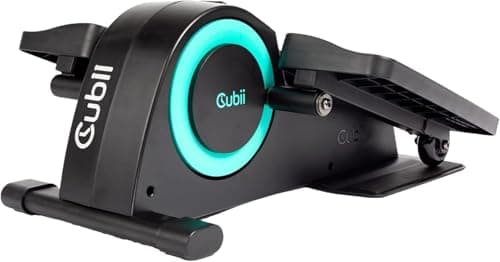
Cubii JR1 Under Desk Elliptical

A gentler stride shape

The best-known seated elliptical, and the elliptical stride is genuinely gentler on the knee than a circular pedal stroke. Cubii publishes remarkably little about it though — no resistance range, no weight capacity, no pedal height — for a unit at the top of this price band.

Cubii does not publish 3 of the 7 measurements we look for. The panel below names which.

$169.99 · Check price on Amazon

$279.9939% off

Price as of August 4, 2026. #ad How we’re funded

If you have pictured an under-desk elliptical, you have almost certainly pictured this one. The JR1 is the machine that made the category familiar, and it comes from a real company with a real support line behind it — which, in an aisle full of near-anonymous listings, is worth more than it sounds. When something breaks or a part goes missing, there is somebody to call.

The reason to care about the shape is mechanical, not marketing. On a pedal exerciser your feet travel a circle, and a circle closes the knee to its tightest angle at the top of every single revolution. The JR1 flattens that circle into an oval, so the joint sweeps through a shallower arc and never has to fold as far. That is a genuine difference in how the knee moves, and it is the whole reason a seated elliptical exists.

We have to set that against the other half of the picture, and we will not bury it. Cubii publishes remarkably little about this machine for a unit sitting at the top of the price band: no resistance range at all, no weight capacity, and no adjustable pedal height. The 10 in overall height is one of the only hard numbers you get.
Fit-to-You: the nine measurements

Cubii does not publish 3 of 7 of these. Where that is the case, this panel says so rather than guessing. How we compile these

Pedal heightThe clearance under your desk or chair. Get this wrong and the pedals hit your knees.
10 in overall height, not adjustable

Source: Amazon product listing data (Creators API) · read 2026-07-24

Resistance rangeHow gently it can be set. The lowest setting matters far more than the highest.
Not published by the manufacturer
Weight capacitySearched directly, and two of the senior-focused competitors omit it entirely.
Not published by the manufacturer
Motorized or self-poweredWhether the machine moves your legs or you move it. For very low leg strength that is the whole decision.
Self-powered

Source: Amazon product listing data (Creators API) · read 2026-07-24

Display and controlsCharacter height and contrast. Presbyopia is close to universal past 60.
Built-in LCD tracking calories, strides and distance

Source: Amazon product listing data (Creators API) · read 2026-07-24

FootprintWhether it actually fits the room you have in mind, with clearance to get on and off.
23.15 in × 17.56 in × 10 in

Source: Amazon product listing data (Creators API) · read 2026-07-24

Noise (dB)Apartments, shared walls, and a sleeping partner in the next room.
Not published by the manufacturer

We have not used this machine. Everything above comes from the manufacturer’s published documentation and the dated retailer listing, with the source given for each figure. Where they don’t publish a number, we say so. We can’t tell you how it feels to ride, how quiet it really is, or how it holds up after two years — and anyone who tells you otherwise without owning one is guessing.

What the oval stride actually changes

Start with the joint, because that is what most people in this audience are shopping for. A circular pedal stroke is efficient for a bicycle, but it drives the knee to a deep bend at the top of the arc, over and over. An elliptical path stretches that arc out lengthwise, which keeps the deepest bend shallower than a circle of the same size can manage. That is not a comfort claim we are making from having ridden it — we have not — it is a description of the geometry Cubii built into the machine.

Why movement of any shape helps is better established than the shape itself. The Arthritis Foundation explains that a joint’s continuous motion moves it through its range and produces the fluid that lubricates it, and separately that movement tends to help osteoarthritis rather than aggravate it. A seated elliptical keeps the legs turning steadily while you sit, which is exactly the kind of low-load continuous motion those pages describe.

Whether the shallower arc makes a difference you can feel is individual, and it is the sort of question a knee answers for itself. If a specific joint is the reason you are shopping, that is a conversation to have with your doctor or physical therapist before you buy, not one to settle from a spec sheet. We lay out the wider case for the format on our guide to whether ellipticals suit seniors.

The 10-inch height, and the space it needs

Cubii publishes an overall height of 10 in and a footprint of 23.15 by 17.56 by 10 inches. Those two numbers do most of the practical work, because they tell you whether the machine physically fits where you want to use it.

The height is the catch. 10 in is fixed — there is no adjustment — so your knee clearance under the desk is decided the moment the pedals turn. Before you order, measure the gap from the floor to the underside of your desk or chair, subtract the height of your foot on the pedal, and be honest about whether your knees clear. This matters more than buyers expect, and it is the single most common regret with any under-desk unit. It is also where the JR1 gives you less to work with than some rivals: one competitor in this aisle publishes both an adjustable height and the desk height it will clear, while Cubii states neither. We walk through that trade-off on the pedal-exerciser-versus-under-desk-elliptical comparison.

The footprint itself is reasonable for the format: a shade over 23 inches long and under 18 inches wide is easy to tuck beside a chair or slide out of the way. What is missing is a published weight for the unit, so we cannot tell you how easily it moves between rooms. For most people it will live in one spot, so that is a minor gap rather than a real one.

What Cubii will not tell you

This is where a well-known brand and a premium price ought to buy you more than they do.

No published resistance range, at all. This is the big one. Cubii does not state whether the resistance adjusts, how many settings there are, or across what span. For a machine at the top of this price band, that is poor. It means you cannot know from the specification whether the JR1 can be set gentle enough for a deconditioned start, or firm enough to feel like work once you are stronger. The lowest setting is the one that matters most for this audience, and it is precisely the one the manufacturer leaves blank.

No published weight capacity. It is consistently among the most-searched specifications in this category, and Cubii simply does not give it. If a firm number is a requirement for you, the absence is itself the answer.

No noise figure. There is no decibel measurement, so any sense of how quiet it is under a desk at work will come from owners, not from us. We have not used it and will not pretend to a judgment we cannot make.

Self-powered, the display, and the app

The JR1 is self-powered. You turn the pedals; nothing turns them for you. That is the correct design for most buyers, but it draws a hard line under one group: if starting and sustaining the motion is itself the barrier — very low leg strength, or the early weeks after an injury — a self-powered unit will not help. A motorized machine that moves the legs for you is a different tool for a different problem, and our under-desk elliptical shortlist covers where that line falls.

A built-in LCD tracks calories, strides and distance, which is enough to see a session add up. The catch is the app: numbers reach it by being typed in by hand from the display, so treat it as a digital logbook rather than an automatic tracker. If you like watching a weekly total build — the CDC asks older adults for at least 150 minutes a week of moderate activity — you will be doing the arithmetic yourself, but the machine gives you the raw figures to do it with.

Who this suits

Someone whose knee dislikes a circular pedal stroke. The oval path keeps the deepest knee bend shallower, and that is the reason to choose a seated elliptical over a plain pedal exerciser in the first place.

A buyer who values a name and a support line. Cubii is the best-known unit in this aisle, and there is a real company to reach when something needs a part.

Anyone who can already turn the pedals unaided. Self-powered is the right format if you have the leg strength to start and keep the motion going.

Who should skip it

Anyone who needs to know the resistance before buying. Cubii publishes no range at all, so you cannot confirm the low end is gentle enough or the high end firm enough. That is a real reason to look elsewhere.

Anyone near a weight limit. With no published capacity, there is nothing to check yourself against, which is a poor position at this price.

Anyone for whom starting the motion is the hard part. A self-powered unit cannot help if the barrier is the first push. A motorized machine is the tool for that.

Anyone counting on a fixed clearance. The 10 in height does not adjust, so if your desk gap is tight, measure carefully before you commit.

$169.99 · Check price on Amazon

$279.9939% off

Price as of August 4, 2026. #ad How we’re funded

General information, not medical advice. Tread & Tone is written by an enthusiast, not a clinician. Nobody here is a doctor, a physical therapist or a trainer, and nothing on this site has been medically reviewed. Talk to your doctor or physical therapist before starting something new, particularly after surgery, a fall, or a change in medication.

Questions people ask

Is the Cubii JR1 good for seniors?

Its main advantage for an older buyer is the elliptical stride: the pedals travel an oval instead of a circle, which keeps the knee bend shallower than a circular pedal stroke, and it comes from a well-known brand with real support. The drawback is how little Cubii publishes — no resistance range, no weight capacity, and a fixed 10 in height — which for a machine at this price is genuinely poor.

What is the resistance range on the JR1?

Cubii does not publish one. There is no stated number of settings and no stated span, which means you cannot confirm from the specification whether it can be set gentle enough for a deconditioned start or firm enough to feel like work later. The lowest setting is the one that matters most for this audience, and it is the one left unstated.

Will it fit under my desk?

The JR1 stands 10 in tall and that height does not adjust, so the fit is fixed the moment the pedals turn. Measure from the floor to the underside of your desk, subtract the height of your foot on the pedal, and check your knees clear before ordering. Unlike some rivals, Cubii does not publish the lowest desk height it will clear, so you have to work it out yourself.

Is it motorized?

No. The JR1 is self-powered — you turn the pedals, and nothing turns them for you. That suits most buyers, but if starting or sustaining the motion is the barrier for you, a self-powered unit will not help; a motorized machine that moves the legs for you is a different tool for that situation.

Does the app track everything automatically?

Not from the machine alone. The built-in LCD shows calories, strides and distance, but the figures reach the app by being typed in by hand from the display. Treat it as a digital logbook rather than an automatic tracker.

Sources

Product measurements are cited individually inside each Fit-to-You panel, against the manufacturer page or dated retailer listing they were read from.

Read next