Tread & Tone

Cubii Alternatives: What Else Does This Job

The Cubii JR1 earned its reputation on the thing it does best — an elliptical stride instead of a circle, in a unit a real company stands behind. What it does not publish is a resistance range or a weight capacity, and the four units here each answer one of those gaps.

By Stephen V.Last updated How we choose

How this is funded: we earn a commission if you buy through our links, at no extra cost to you. It never changes what we recommend, and every page here names at least one thing we would not buy. Full disclosure.

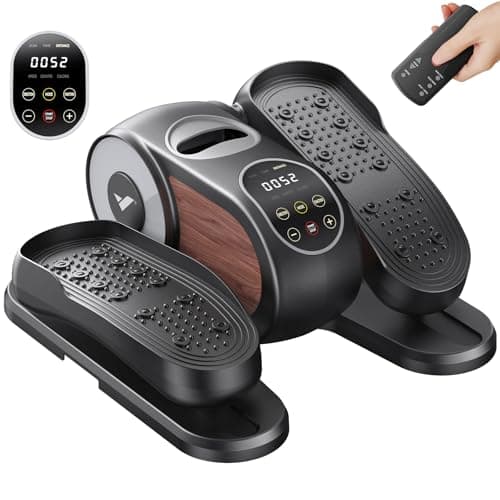
The closest alternative is the MERACH MR-E32, and it is for the reader who wants the same seated stride in something that sits lower and costs less. It is an under-desk elliptical like the Cubii, it publishes a 7.4 inch overall height against the Cubii’s published 10 inches — so it clears a desk the Cubii will not — and it publishes the smallest footprint of any seated unit on this site at 15.6 by 14.9 inches. It is also motorized, with a published 60 W motor, forward and reverse, twelve manual speed levels and twelve automatic programs, which is a capability the Cubii does not claim at all. The budget pick is the Drive Medical RTL10273, a folding pedal unit from a mobility-equipment maker that costs a small fraction of a Cubii and publishes the thing that goes wrong most often at this end of the market: four anti-slip rubber pads, so it stays put on a hard floor.

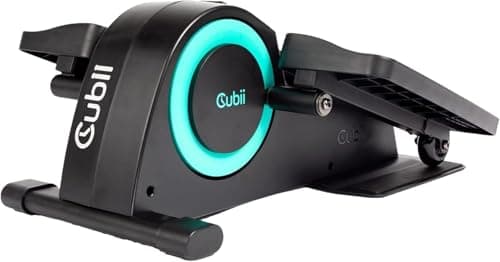
First, what the Cubii JR1 is actually known for, because a good alternatives page should start by being fair to the original. It is the best-known seated elliptical, and that reputation is earned on two real things. The first is the motion: the pedals travel an elliptical path rather than a circle, which keeps the knee angle shallower through the stroke — a genuinely different joint path, not a marketing distinction, and the single best reason to buy one. The second is that there is a real company behind it, with support, a product line and an app, which is more than most of this aisle can say. Its own listing publishes a 10 inch overall height, a 23.15 by 17.56 inch footprint, a built-in LCD tracking calories, strides and distance, and that it is self-powered.

Second, why people search for an alternative at all, and we will put this as plainly as the facts allow. The Cubii JR1’s listing publishes no resistance range and no weight capacity. That is not our assessment of the product — we have not used one — it is a description of what the listing contains, and at the top of this price band it is the gap that sends people looking. The other two commonly cited reasons in the shopping queries around this one are price and height: it sits at the premium end of the seated-unit market, and its published 10 inches of height rules out a lot of desks. If none of those three is a problem for you, buy the Cubii. It is a good machine with a distinctive motion, and our full JR1 review goes through every field in its listing, including the ones that are blank.

Every unit below is one we would actually buy for a specific reason, and each addresses one of those three gaps: a lower profile, a published resistance figure, or a much lower price. What none of them has is the Cubii’s brand support, and one thing worth noting is that the capacity gap is industry-wide rather than Cubii-specific — not a single seated unit on this page publishes a weight capacity either. Where a maker publishes nothing, each panel below says Not published by the manufacturer rather than an estimate dressed up as a fact, and the count sits in the table above.

The reason any of this is worth buying is worth a line. The CDC’s guidance for adults with chronic conditions and disabilities puts it in one line: “Some physical activity is better than none — be as active as you are able”, against a target of at least 150 minutes a week of moderate-intensity aerobic activity. A seated unit in front of an armchair is the lowest-friction way there is to accumulate those minutes. Prices are live and sit in the buttons with the date of our last check, and how we choose is written down.

Quick picks

Ranked on the published accessibility measurements and on who each machine actually suits. Select a row to jump to the full write-up. The last column is the number of the nine measurements the manufacturer will not publish — we have not used any of these machines, and here is exactly what we did instead.

#MachineBest forSpecs withheldPrice
1
MERACH Under Desk Elliptical MR-E32

MERACH Under Desk Elliptical MR-E32

When starting the motion yourself is the problem

Closest match, sits lower2of 7
$89.99 · Check price on Amazon

$99.9910% off

Price as of November 12, 2026. #ad How we’re funded

2
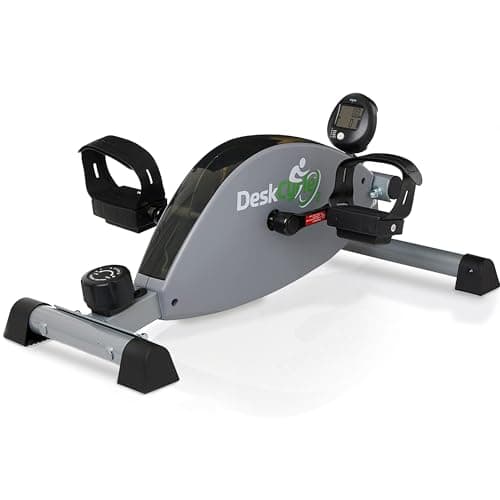
DeskCycle DeskCycle 2 Under Desk Bike

DeskCycle DeskCycle 2 Under Desk Bike

Fitting under a low desk or table

Publishes its resistance3of 7
$159.99 · Check price on Amazon

Price as of November 12, 2026. #ad How we’re funded

3
Sunny Health & Fitness Under Desk Smart Mini Pedal Exerciser

Sunny Health & Fitness Under Desk Smart Mini Pedal Exerciser

The finest control at low resistance

Finest low resistance2of 7
$69.99 · Check price on Amazon

Price as of November 12, 2026. #ad How we’re funded

4
Drive Medical Deluxe Folding Pedal Exerciser RTL10273

Drive Medical Deluxe Folding Pedal Exerciser RTL10273

Staying put on a hard floor

Budget pick2of 7
5
Vive Under Desk Bike Pedal Exerciser

Vive Under Desk Bike Pedal Exerciser

We would skip this one — see below

Extra money for a readout2of 7
$76.99 · Check price on Amazon

Price as of November 12, 2026. #ad How we’re funded

1.Closest match, sits lower

MERACH Under Desk Elliptical MR-E32(MR-E32)
MERACH Under Desk Elliptical MR-E32
$89.99 · Check price on Amazon

$99.9910% off

Price as of November 12, 2026. #ad How we’re funded

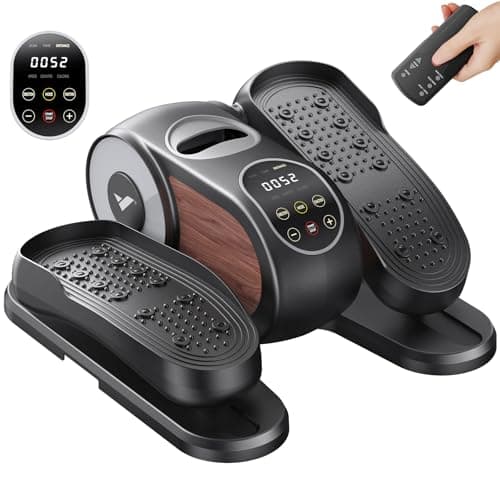
Motorized, and that is the whole point: a 60 W motor moves your legs through the stride so you do not need the strength to start the motion yourself. For someone recovering strength or sitting for long stretches, that is a different product category from a pedal exerciser, not a fancier version of one.

What it gets right

  • Motorized — 12 automatic programs will move your legs for you, which self-powered pedals cannot
  • Forward and reverse motion, published
  • Remote control as well as a touch screen, so no bending to change settings
  • The smallest published footprint of any seated unit here at 15.6 in × 14.9 in

What to know first

  • No published weight capacity or maximum user weight
  • A motorized machine moving your legs is passive movement, which is not the same as exercise you perform
  • 7.4 in tall with no adjustment, so desk clearance is fixed
  • 'Whisper-quiet' with no decibel figure

Fit-to-You: the nine measurements

MERACH does not publish 2 of 7 of these. Where that is the case, this panel says so rather than guessing. How we compile these

Pedal heightThe clearance under your desk or chair. Get this wrong and the pedals hit your knees.
7.4 in overall height, not adjustable

Source: Amazon product listing data (Creators API) · read 2026-07-24

Resistance rangeHow gently it can be set. The lowest setting matters far more than the highest.
12 manual speed levels plus 12 automatic programs (P1–P12)

Source: Amazon product listing data (Creators API) · read 2026-07-24

Weight capacitySearched directly, and two of the senior-focused competitors omit it entirely.
Not published by the manufacturer
Motorized or self-poweredWhether the machine moves your legs or you move it. For very low leg strength that is the whole decision.
Motorized, 60 W, with forward and reverse

Source: Amazon product listing data (Creators API) · read 2026-07-24

Display and controlsCharacter height and contrast. Presbyopia is close to universal past 60.
Touch screen plus remote control; LED shows time, distance, speed and calories

Source: Amazon product listing data (Creators API) · read 2026-07-24

FootprintWhether it actually fits the room you have in mind, with clearance to get on and off.
15.6 in × 14.9 in × 7.4 in

Source: Amazon product listing data (Creators API) · read 2026-07-24

Noise (dB)Apartments, shared walls, and a sleeping partner in the next room.
Not published by the manufacturer

We have not used this machine. Everything above comes from the manufacturer’s published documentation and the dated retailer listing, with the source given for each figure. Where they don’t publish a number, we say so. We can’t tell you how it feels to ride, how quiet it really is, or how it holds up after two years — and anyone who tells you otherwise without owning one is guessing.
2.Publishes its resistance

DeskCycle DeskCycle 2 Under Desk Bike(DSK-SPO-DESKCYCLE-2GRY)

DeskCycle DeskCycle 2 Under Desk Bike
$159.99 · Check price on Amazon

Price as of November 12, 2026. #ad How we’re funded

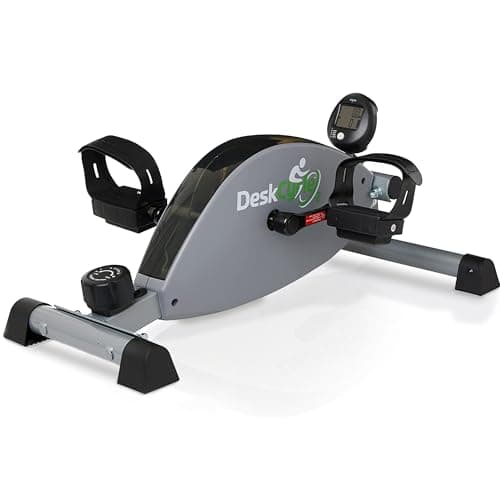
The only pedal exerciser here that publishes its pedal height as an adjustable range — 9 to 10 inches — and states the desk height it clears, 27 inches. That is the number that decides whether your knees hit the desk, and everyone else leaves you to guess it.

What it gets right

  • Publishes an adjustable 9–10 in height and states it clears desks from 27 in — the only unit here doing either
  • Publishes resistance in pounds: 8 settings up to 39 lb
  • High-inertia flywheel spins 14 times per pedal stroke, so the motion is even rather than jerky
  • Detachable LCD, so it can sit where you can actually read it

What to know first

  • Two to three times the price of a basic pedal exerciser
  • No published weight capacity
  • Not motorized — you have to be able to turn the pedals yourself
  • Strap-in pedals need bending down to fit your feet

Fit-to-You: the nine measurements

DeskCycle does not publish 3 of 7 of these. Where that is the case, this panel says so rather than guessing. How we compile these

Pedal heightThe clearance under your desk or chair. Get this wrong and the pedals hit your knees.
Adjustable 9 in to 10 in; stated to fit desks as low as 27 in

Source: Amazon product listing data (Creators API) · read 2026-07-24

Resistance rangeHow gently it can be set. The lowest setting matters far more than the highest.
8 magnetic settings, up to 39 lb

Source: Amazon product listing data (Creators API) · read 2026-07-24

Weight capacitySearched directly, and two of the senior-focused competitors omit it entirely.
Not published by the manufacturer
Motorized or self-poweredWhether the machine moves your legs or you move it. For very low leg strength that is the whole decision.
Self-powered. You turn the pedals

Source: Amazon product listing data (Creators API) · read 2026-07-24

Display and controlsCharacter height and contrast. Presbyopia is close to universal past 60.
Detachable LCD showing rpm, distance, calories and time; resistance on a dial

Source: Amazon product listing data (Creators API) · read 2026-07-24

FootprintWhether it actually fits the room you have in mind, with clearance to get on and off.
Not published by the manufacturer
Noise (dB)Apartments, shared walls, and a sleeping partner in the next room.
Not published by the manufacturer

We have not used this machine. Everything above comes from the manufacturer’s published documentation and the dated retailer listing, with the source given for each figure. Where they don’t publish a number, we say so. We can’t tell you how it feels to ride, how quiet it really is, or how it holds up after two years — and anyone who tells you otherwise without owning one is guessing.
3.Finest low resistance

Sunny Health & Fitness Under Desk Smart Mini Pedal Exerciser(SF-B023005DGY)

Sunny Health & Fitness Under Desk Smart Mini Pedal Exerciser
$69.99 · Check price on Amazon

Price as of November 12, 2026. #ad How we’re funded

Stepless resistance rather than fixed levels, which matters at the bottom of the range: instead of jumping from level one to level two you can dial in something between the two. A carry handle is published, which for a unit that has to move between rooms is not a small thing.

What it gets right

  • Stepless micro-adjustment resistance rather than discrete levels — the gentlest possible starting point
  • Mesh belt drive, described as silent
  • Carry handle published, on a unit light enough to matter
  • Works for arms on a table as well as legs

What to know first

  • 11.7 in tall — the tallest pedal unit here, so desk clearance needs checking first
  • No published weight capacity and no published resistance figures
  • Stepless resistance means you cannot record which setting you used
  • Not motorized

Fit-to-You: the nine measurements

Sunny Health & Fitness does not publish 2 of 7 of these. Where that is the case, this panel says so rather than guessing. How we compile these

Pedal heightThe clearance under your desk or chair. Get this wrong and the pedals hit your knees.
11.7 in overall height, not adjustable

Source: Amazon product listing data (Creators API) · read 2026-07-24

Resistance rangeHow gently it can be set. The lowest setting matters far more than the highest.
Stepless micro-adjustment; no numeric range published

Source: Amazon product listing data (Creators API) · read 2026-07-24

Weight capacitySearched directly, and two of the senior-focused competitors omit it entirely.
Not published by the manufacturer
Motorized or self-poweredWhether the machine moves your legs or you move it. For very low leg strength that is the whole decision.
Self-powered

Source: Amazon product listing data (Creators API) · read 2026-07-24

Display and controlsCharacter height and contrast. Presbyopia is close to universal past 60.
Digital monitor showing speed, time, distance and calories

Source: Amazon product listing data (Creators API) · read 2026-07-24

FootprintWhether it actually fits the room you have in mind, with clearance to get on and off.
17.9 in × 16.1 in × 11.7 in

Source: Amazon product listing data (Creators API) · read 2026-07-24

Noise (dB)Apartments, shared walls, and a sleeping partner in the next room.
Not published by the manufacturer

We have not used this machine. Everything above comes from the manufacturer’s published documentation and the dated retailer listing, with the source given for each figure. Where they don’t publish a number, we say so. We can’t tell you how it feels to ride, how quiet it really is, or how it holds up after two years — and anyone who tells you otherwise without owning one is guessing.
4.Budget pick

Drive Medical Deluxe Folding Pedal Exerciser RTL10273(RTL10273)

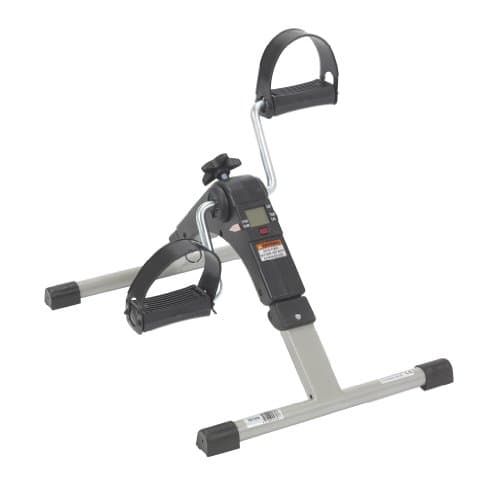
The medical-supply option: four anti-slip pads so it stays put on a hard floor, a tension knob rather than electronics, and it folds. Drive publishes two different sets of dimensions for it, which is the sort of thing we would rather tell you than tidy away.

What it gets right

  • Four anti-slip rubber pads, published — the most common complaint about cheap pedals is that they walk away across the floor
  • Folds for storage
  • Works for arms on a table as well as legs on the floor
  • Simple tension knob with nothing to fail electronically

What to know first

  • The listing gives 15.4 × 13 × 7.6 in in its dimension field and 15 × 6.5 × 17 in in its own description. We report both because we cannot resolve them
  • No published weight capacity
  • No published resistance range — just 'adjustable'
  • Not motorized

Fit-to-You: the nine measurements

Drive Medical does not publish 2 of 7 of these. Where that is the case, this panel says so rather than guessing. How we compile these

Pedal heightThe clearance under your desk or chair. Get this wrong and the pedals hit your knees.
Listing dimension field says 7.6 in high; the same listing's text says 17 in high. Both are published and they disagree

Source: Amazon product listing data (Creators API) · read 2026-07-24

Resistance rangeHow gently it can be set. The lowest setting matters far more than the highest.
Adjustable via a tension knob; no range published

Source: Amazon product listing data (Creators API) · read 2026-07-24

Weight capacitySearched directly, and two of the senior-focused competitors omit it entirely.
Not published by the manufacturer
Motorized or self-poweredWhether the machine moves your legs or you move it. For very low leg strength that is the whole decision.
Self-powered

Source: Amazon product listing data (Creators API) · read 2026-07-24

Display and controlsCharacter height and contrast. Presbyopia is close to universal past 60.
Five-function display: time, revolutions, rpm, calories, and scan

Source: Amazon product listing data (Creators API) · read 2026-07-24

FootprintWhether it actually fits the room you have in mind, with clearance to get on and off.
Reported as both 15.4 × 13 in and 15 × 6.5 in by the same listing

Source: Amazon product listing data (Creators API) · read 2026-07-24

Noise (dB)Apartments, shared walls, and a sleeping partner in the next room.
Not published by the manufacturer

We have not used this machine. Everything above comes from the manufacturer’s published documentation and the dated retailer listing, with the source given for each figure. Where they don’t publish a number, we say so. We can’t tell you how it feels to ride, how quiet it really is, or how it holds up after two years — and anyone who tells you otherwise without owning one is guessing.
5.We would skip this one

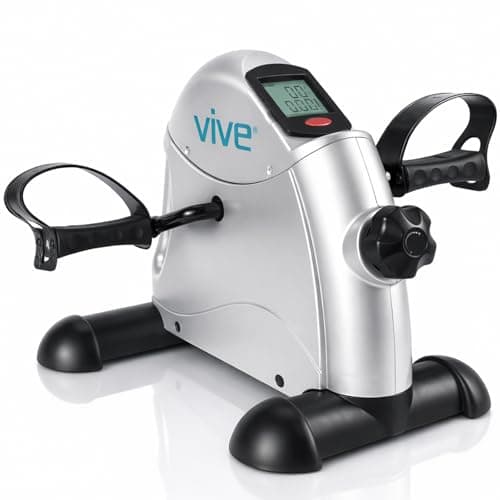
Vive Under Desk Bike Pedal Exerciser(RHB1001)

Vive Under Desk Bike Pedal Exerciser
$76.99 · Check price on Amazon

Price as of November 12, 2026. #ad How we’re funded

The only pedal unit here that publishes a full workout readout — RPM, time, speed, distance and calories on one button — plus adjustable toe loops so it works for arms as well as legs. It also costs about $30 more than the Drive Medical unit that does the same job, and unlike the Drive it needs assembling.

Why we would skip it

Skip this one unless you specifically want the readout. It is the most expensive pedal unit on this page by about $30, and the Drive Medical does the same job for less, arrives assembled where this one needs putting together, and folds. What the extra money buys is real but small: an LCD that counts RPM, time, speed, distance and calories, and adjustable toe loops with finger grips so it works for arms as well as legs. If you will actually look at the numbers, buy it. If you will not, you are paying $30 for a screen you will ignore.

What it gets right

  • One-touch LCD showing RPM, time, speed, distance and calories
  • Adjustable toe loops and molded finger grips, so the pedals work for arms as well as legs
  • Non-slip, non-marking feet published as holding on carpet, tile or wood
  • Publishes its own weight: 12.9 lb

What to know first

  • About $30 more than the Drive Medical unit that does the same job
  • Needs assembling. The listing calls the setup simple and includes the tools, but it does not arrive ready to use
  • No published resistance range and no published weight capacity
  • Its own listing gives two different heights — 12.5 in in the bullets, 7.7 in in the dimensions table. We print both because we cannot resolve it

Fit-to-You: the nine measurements

Vive does not publish 2 of 7 of these. Where that is the case, this panel says so rather than guessing. How we compile these

Pedal heightThe clearance under your desk or chair. Get this wrong and the pedals hit your knees.
12.5 in in the listing bullets; the same listing's dimensions table says 7.7 in. Both are published and they contradict each other

Source: Amazon product listing data (Creators API) · read 2026-09-29

Resistance rangeHow gently it can be set. The lowest setting matters far more than the highest.
Adjustable tension knob; no range published

Source: Amazon product listing data (Creators API) · read 2026-09-29

Weight capacitySearched directly, and two of the senior-focused competitors omit it entirely.
Not published by the manufacturer
Motorized or self-poweredWhether the machine moves your legs or you move it. For very low leg strength that is the whole decision.
Self-powered

Source: Amazon product listing data (Creators API) · read 2026-09-29

Display and controlsCharacter height and contrast. Presbyopia is close to universal past 60.
One-touch LCD showing RPM, time, speed, distance and calories; character height not published

Source: Amazon product listing data (Creators API) · read 2026-09-29

FootprintWhether it actually fits the room you have in mind, with clearance to get on and off.
16 in × 12.5 in × 7.7 in listed dimensions; 12.9 lb

Source: Amazon product listing data (Creators API) · read 2026-09-29

Noise (dB)Apartments, shared walls, and a sleeping partner in the next room.
Not published by the manufacturer

We have not used this machine. Everything above comes from the manufacturer’s published documentation and the dated retailer listing, with the source given for each figure. Where they don’t publish a number, we say so. We can’t tell you how it feels to ride, how quiet it really is, or how it holds up after two years — and anyone who tells you otherwise without owning one is guessing.
What we found looking for these numbers

We went looking for 35 measurements across the 5machines on this page — the nine that decide whether an older adult can get on, reach the controls, read the screen and hear themselves think. 11 of those 35 are not published by anybody. Not one manufacturer here publishes the full set.

Step-over height is the worst of them. It is the single measurement that decides whether you can get onto a machine at all, and across everything we checked, not one manufacturer states it. That is not an oversight in a category explicitly marketed to seniors, and the count in each panel above is there so you can see who is doing it.

Where a figure exists, we cite it and date it. Where it doesn’t, the panel says Not published by the manufacturer rather than an estimate dressed up as a fact. You can measure step-over height yourself in about a minute — and if a machine is already in your house, that is the fastest way to settle it.

If you want the stride shape: the MERACH MR-E32

This is the alternative that matches the Cubii on the thing the Cubii is bought for. It is an under-desk elliptical, same category, same reason to exist — a stride rather than a circle. Where it goes further is on two published numbers and one capability. The numbers: 7.4 inches of overall height against the Cubii’s published 10 inches, which is the difference between clearing a low desk and not, and a 15.6 by 14.9 inch footprint, the smallest of any seated unit we track and considerably smaller than the Cubii’s published 23.15 by 17.56 inches. The capability is the motor.

That motor deserves care rather than enthusiasm, because it changes what the product is. MERACH publishes a 60 W motor with forward and reverse, twelve manual speed levels and twelve automatic programs, a touch screen plus a remote control so nothing needs bending down to. For somebody who cannot reliably start the pedal motion themselves — recovering strength, very deconditioned, sitting for long stretches — that is not a luxury version of a Cubii, it is a different and better answer. For somebody who can turn pedals perfectly well, it is worth knowing that a machine moving your legs is passivemovement, which is not the same as exercise you perform. The MERACH publishes no weight capacity, its 7.4 inch height is fixed with no adjustment, and “whisper-quiet” comes with no decibel figure. Our full MR-E32 review goes through the lot, and we rank the motorized aisle properly on our exercise pedals for disabled adults shortlist.

If what you want is the elliptical path without a motor, the honest answer is that the registry does not have one cheaper than the Cubii that publishes more about itself — which is itself worth knowing before you spend an afternoon looking. In that case the real choice is between paying the Cubii premium for the stride shape, or switching to a circular pedal unit and getting published numbers instead. The next two picks are what that second road looks like, and we lay the two motions side by side in pedal exerciser versus under-desk elliptical.

If you want published numbers: the DeskCycle 2 and the Sunny

The DeskCycle 2 is the unit that fills the Cubii’s biggest documentation gap head-on. It is the only seated unit on this site that publishes its resistance in pounds— eight magnetic settings up to 39 lb — and the only one that publishes its pedal height as an adjustable range, 9 to 10 inches, together with the desk height it clears, 27 inches. If you have ever measured the underside of a desk and then tried to find a unit that states whether it will fit, you will understand why we rank that so highly. It also publishes a high-inertia flywheel that spins fourteen times per pedal stroke, which is what makes the motion even rather than jerky, and a detachable LCD you can put where you can actually read it.

Its costs are real: it is two to three times the price of a basic pedal exerciser and in the same band as the Cubii rather than below it, it publishes no weight capacity either, it is self-powered so you must be able to turn the pedals, and its strap-in pedals need bending down to fit your feet. It is also a circular pedal stroke, not an elliptical one — so if the Cubii’s shallower knee angle is why you were looking at a Cubii, this is a trade rather than an upgrade. Our full DeskCycle 2 review covers every field.

The Sunny mini pedal exerciser is third and is the pick for the gentlest possible start. Rather than eight or twelve discrete levels, it publishes stepless micro-adjustment resistance: instead of jumping from level one to level two you dial in something between the two, which at the bottom of the range is the difference between a usable session and a sore knee. It publishes a carry handle, which on a unit that has to move between rooms is not a small thing, a mesh belt drive described as silent, and a digital monitor. Its costs: 11.7 inches of overall height, the tallest pedal unit here, so desk clearance needs checking first; no published weight capacity and no numeric resistance figures at all; and because the resistance is stepless, you cannot record which setting you used, which matters if a therapist has asked you to.

If you want to spend far less, and the one to skip

The Drive Medical RTL10273 is the budget pick and the most sensible purchase on this page for a lot of readers, because it is honest about being simple. It publishes four anti-slip rubber pads — and the single most common complaint about cheap seated pedals is that they walk away across a hard floor, so that is the right thing to publish. It uses a tension knob with nothing to fail electronically, it folds, it carries a five-function display showing time, revolutions, rpm, calories and scan, and it works for arms on a table as well as legs on the floor. It comes from a mobility-equipment maker rather than a consumer-fitness brand, which is why it is the one the medical-supply aisle actually stocks.

Its published flaw is bookkeeping and we report it rather than tidy it away: Drive’s listing gives 15.4 by 13 by 7.6 inches in its dimension field and 15 by 6.5 by 17 inches in its own description, and we print both because we cannot resolve them. There is no published weight capacity and no published resistance range — just “adjustable”. Against a Cubii, what you are giving up is the elliptical motion, the brand support and the app; what you are keeping is the exercise, at a fraction of the money.

The Vive pedal exerciser is our skip, and it is a narrow skip rather than a verdict on the product. It is a decent unit: a one-touch LCD showing RPM, time, speed, distance and calories, adjustable toe loops with molded finger grips so it works for arms as well as legs, published non-slip feet for carpet, tile or wood, and a published 12.9 lb weight. The problem is what sits next to it. The Drive Medical does the same job for about thirty dollars less, arrives assembled where the Vive needs putting together, and folds where the Vive does not. So the rule is simple: the extra money buys a readout. If you will genuinely look at RPM and distance, buy it and ignore us; if you will not, you are paying thirty dollars for a screen you will stop reading in a fortnight. Its own listing also gives two different heights — 12.5 inches in the bullets, 7.7 inches in the dimensions table — and we print both because we cannot resolve it.

General information, not medical advice. Tread & Tone is written by an enthusiast, not a clinician. Nobody here is a doctor, a physical therapist or a trainer, and nothing on this site has been medically reviewed. Talk to your doctor or physical therapist before starting something new, particularly after surgery, a fall, or a change in medication.

Questions people ask

What is the best alternative to a Cubii?

The MERACH MR-E32, because it matches the Cubii on the thing a Cubii is bought for and goes further on two published numbers. It is an under-desk elliptical with the same stride-rather-than-circle motion; it publishes a 7.4 inch overall height against the Cubii's published 10 inches, so it clears a desk the Cubii will not; and it publishes the smallest footprint of any seated unit we track. It is also motorized, with a published 60 W motor and twelve automatic programs, which the Cubii does not claim. Like the Cubii, it publishes no weight capacity.

Is there a cheaper alternative to the Cubii JR1?

Several, and the cheapest one we would actually buy is the Drive Medical RTL10273 — a folding pedal unit from a mobility-equipment maker that costs a small fraction of a Cubii. It publishes four anti-slip rubber pads, which addresses the most common complaint about cheap seated pedals (that they slide away on a hard floor), uses a tension knob with nothing to fail electronically, folds, and works for arms on a table as well as legs. What you give up is the elliptical motion, the brand support and the app. What you keep is the exercise.

What does the Cubii do that the alternatives do not?

Two things, and they are the reasons its reputation is deserved. The motion: the pedals travel an elliptical path rather than a circle, which keeps the knee angle shallower through the stroke — a genuinely different joint path. And the company: there is a real manufacturer behind it with support, a product line and an app, which is more than most of this aisle offers. If either of those is your deciding factor, buy the Cubii. The alternatives here answer the gaps in its listing, not the strengths of its design.

Does the Cubii publish a weight capacity?

Its listing does not, and nor does any other seated unit on this page — so this is an industry-wide gap rather than a Cubii-specific one, and it is worth knowing before you spend an evening comparing listings. The same is true of a published resistance range: the Cubii's listing gives none, and the only unit on this site that publishes resistance in actual pounds is the DeskCycle 2, at eight magnetic settings up to 39 lb. Where a maker publishes nothing, our panels say so rather than estimating.

Which seated unit fits under a low desk?

Two publish the numbers you need. The DeskCycle 2 publishes an adjustable 9 to 10 inch pedal height and states it clears desks as low as 27 inches — the only unit on this site that publishes both. The MERACH MR-E32 publishes 7.4 inches of overall height, the lowest here, though it is fixed with no adjustment. The Cubii's published 10 inches rules out a lot of desks, and the Sunny mini at 11.7 inches is taller still. Measure the underside of your desk from the floor before you buy anything in this category.

Cubii or DeskCycle — which should I buy?

It depends on whether you are buying the motion or the numbers. The Cubii gives you an elliptical stride, which keeps the knee angle shallower, and brand support. The DeskCycle 2 gives you a circular stroke and the best documentation in the category: resistance published in pounds, an adjustable pedal height published as a range, and the desk height it clears. They sit in a similar price band, so this is a trade rather than an upgrade in either direction. If a sore knee is the reason you are shopping, the stride shape is the more relevant of the two.

Are motorized seated units a good alternative to a Cubii?

They are, for one specific reason: when you cannot reliably start or sustain the pedal motion yourself. The MERACH MR-E32's published 60 W motor will move your legs through the stride, which a self-powered unit like the Cubii cannot do. What you should be clear about is that a motor moving your legs is passive movement, which is not the same as exercise you perform. It is the right choice when the alternative is no movement at all, and the wrong one if you can turn the pedals and simply like the idea.

Sources

  • CDC — Older Adult Activity: An Overview — At least 150 minutes a week of moderate-intensity activity, 2 days of muscle strengthening, plus balance activities for adults 65 and over (read July 24, 2026)
  • CDC — What Counts as Physical Activity for Older Adults — What qualifies as moderate-intensity activity, including brisk walking, and how the weekly minutes can be split (read July 24, 2026)
  • CDC — Chronic Conditions & Disabilities Activity — "Get at least 150 minutes (for example, 30 minutes 5 days a week) of moderate-intensity aerobic physical activity a week"; "Some physical activity is better than none — be as active as you are able"; and "If you have chronic health conditions or disabilities, consult a health care professional or physical activity specialist about appropriate types and amounts of physical activity" (read October 3, 2026)
  • Arthritis Foundation — Biking is Great for Your Joints — Cycling's continuous motion moves the joint through its range, which produces the synovial fluid that lubricates it (read July 24, 2026)

Product measurements are cited individually inside each Fit-to-You panel, against the manufacturer page or dated retailer listing they were read from.

Read next