Tread & Tone

DeskCycle 2 Under Desk Bike Review

Almost every pedal exerciser leaves you guessing whether your knees will clear the desk. The DeskCycle 2 does not: it publishes an adjustable 9 to 10 inch pedal height and states the desk height it will fit under. On a machine you have to slide beneath furniture, that one honest number is the whole point.

By Stephen V.Last updated How we choose

How this is funded: we earn a commission if you buy through our links, at no extra cost to you. It never changes what we recommend, and every page here names at least one thing we would not buy. Full disclosure.

DeskCycle DeskCycle 2 Under Desk Bike

Fitting under a low desk or table

The only pedal exerciser here that publishes its pedal height as an adjustable range — 9 to 10 inches — and states the desk height it clears, 27 inches. That is the number that decides whether your knees hit the desk, and everyone else leaves you to guess it.

DeskCycle does not publish 3 of the 7 measurements we look for. The panel below names which.

The single hardest thing to find out about an under-desk pedal exerciser is whether it will actually go under your desk. It sounds absurd, but it is true: most listings describe the machine as “compact” and leave the number that decides everything — the pedal height — unstated. You order, you slide it under, and you find out whether your knees hit the desk the hard way.

The DeskCycle 2 is the one unit here that refuses to leave you guessing. It publishes an adjustable pedal height of 9 to 10 inches and states that it clears desks as low as 27 inches. That is the measurement that decides whether the machine works in your room, and it is the only pedal exerciser on this site that gives you either half of it, let alone both.

It backs that up with a second piece of honesty that is rarer than it should be: it publishes its resistance in pounds — 8 magnetic settings up to 39 lb — rather than as mystery “levels” you cannot compare to anything. You do pay for this. The DeskCycle 2 costs several times what a basic pedal exerciser does, and that is the honest trade at the heart of the machine.

Fit-to-You: the nine measurements

DeskCycle does not publish 3 of 7 of these. Where that is the case, this panel says so rather than guessing. How we compile these

Pedal heightThe clearance under your desk or chair. Get this wrong and the pedals hit your knees.
Adjustable 9 in to 10 in; stated to fit desks as low as 27 in

Source: Amazon product listing data (Creators API) · read 2026-07-24

Resistance rangeHow gently it can be set. The lowest setting matters far more than the highest.
8 magnetic settings, up to 39 lb

Source: Amazon product listing data (Creators API) · read 2026-07-24

Weight capacitySearched directly, and two of the senior-focused competitors omit it entirely.
Not published by the manufacturer
Motorized or self-poweredWhether the machine moves your legs or you move it. For very low leg strength that is the whole decision.
Self-powered. You turn the pedals

Source: Amazon product listing data (Creators API) · read 2026-07-24

Display and controlsCharacter height and contrast. Presbyopia is close to universal past 60.
Detachable LCD showing rpm, distance, calories and time; resistance on a dial

Source: Amazon product listing data (Creators API) · read 2026-07-24

FootprintWhether it actually fits the room you have in mind, with clearance to get on and off.
Not published by the manufacturer
Noise (dB)Apartments, shared walls, and a sleeping partner in the next room.
Not published by the manufacturer

We have not used this machine. Everything above comes from the manufacturer’s published documentation and the dated retailer listing, with the source given for each figure. Where they don’t publish a number, we say so. We can’t tell you how it feels to ride, how quiet it really is, or how it holds up after two years — and anyone who tells you otherwise without owning one is guessing.

The two numbers nobody else publishes

Start with the height, because it is the reason this machine leads. The DeskCycle 2 states an adjustable pedal height of 9 to 10 inches, and it goes one step further than any rival by naming the desk it clears: it will fit under a desk as low as 27 inches.

Here is why that pairing matters. The pedal height sets how far your knee rises at the top of each stroke; the desk clearance is the gap that knee has to travel in. Get either wrong and your knees knock the underside of the desk on every revolution, which is the fastest way to abandon a machine to the back of a closet. Because the DeskCycle 2 publishes both, you can settle the question before you buy instead of after: measure the gap from the floor to the underside of your desk, and if it is 27 inches or more you are almost certainly clear. Almost every competitor makes you find that out by trial.

The adjustability is the quiet advantage. A fixed-height unit gives you one answer and no recourse; a 9 to 10 inch range lets you drop the pedals for a lower desk or a taller chair. We explain why this is the make-or-break specification on our guide to what a pedal exerciser is good for.

Resistance in pounds, not mystery levels

Most pedal exercisers give you a dial marked with numbers or nothing at all, and those numbers mean whatever the manufacturer decided they mean — you cannot compare one brand’s “level 3” to another’s. The DeskCycle 2 publishes 8 magnetic settings running up to 39 lb, which is a real unit you can reason about.

For this audience the useful end of that scale is the bottom, not the top. The point of seated pedaling is steady, low-load motion, and the Arthritis Foundation notes that cycling’s continuous motion moves the joint through its range and helps produce the fluid that lubricates it. A published lowest setting means you can start genuinely gentle and add load only as it starts to feel too easy — and a machine with eight honest steps gives you somewhere to go as you get stronger. Minutes at that gentle pace still count toward the 150 minutes a week of moderate activity the CDC asks of older adults, and the weekly total can be built up in short sessions.

The flywheel and the even stroke

One specification here is easy to skip past and shouldn’t be: the DeskCycle 2 uses a high-inertia flywheel that, per its listing, spins roughly fourteen times for every turn of the pedals. Inertia is what carries the motion through the “dead spots” of a stroke — the points where your legs are between pushes — so a heavier, faster-spinning flywheel smooths the pedaling into an even circle rather than a jerky one.

That smoothness matters most at low resistance, which is exactly where this audience lives. On a light setting a cheap pedal exerciser can feel like it stutters between pushes; a machine that keeps the wheel spinning delivers a steadier, more predictable motion, which is easier on a sensitive knee and simply more pleasant to keep doing. It is a spec you feel rather than watch, and it is a large part of why the DeskCycle 2 sits at the price it does.

The honest costs

None of this is free, and we will be plain about what you give up.

It is expensive for what it is.The DeskCycle 2 costs several times the price of a basic pedal exerciser. If your budget is tight and your desk clearance is generous, a plain unit will turn the same circles. You are paying for the published height, the resistance in pounds, and the flywheel — real things, but things a bargain buyer can live without.

No published weight capacity. Like most of this aisle, the DeskCycle 2 does not state a capacity, so there is no firm number to check yourself against. It is a genuine gap, if a common one.

It is self-powered, with strap-in pedals.You turn the pedals yourself, so it does nothing for you if the barrier is starting the motion at all — that is a job for a motorized unit, and the comparison with a recumbent bike walks through where a seated pedal unit stops being enough. The pedals also strap in, which means bending down to fit your feet each time — worth knowing if reaching your feet is difficult.

The detachable LCD is a small, genuine kindness in the other direction: it lifts off the machine so you can set it where you can actually read the rpm, distance, calories and time, rather than squinting down at the floor.
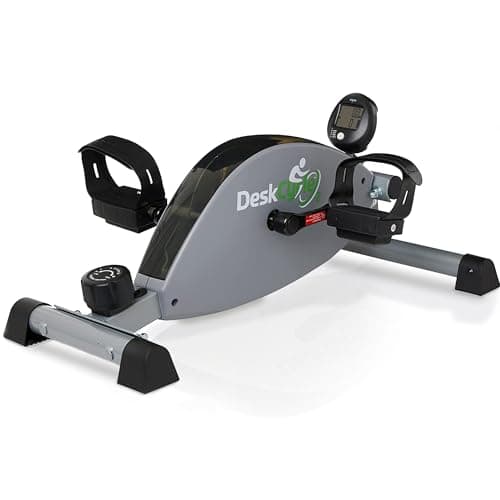
Who this suits

Anyone with a low desk or a tight knee gap. The published 9 to 10 inch adjustable height and the stated 27 inch desk clearance let you confirm the fit before you buy, which nothing else here allows.

A buyer who wants to control resistance meaningfully. Eight settings published in pounds, up to 39 lb, give you a gentle start and somewhere to progress as you get stronger.

Someone who will use it often. The high-inertia flywheel makes the low-resistance motion even and predictable, which is the pedaling you will actually keep coming back to.

Who should skip it

A tight budget with a roomy desk. If your knees already clear with inches to spare, a basic pedal exerciser turns the same circles for a fraction of the price.

Anyone who cannot start the motion unaided. The DeskCycle 2 is self-powered. If the first push is the problem, you want a motorized machine instead.

Anyone who struggles to reach their feet. The pedals strap in, so fitting your feet means bending down each session.

Anyone who needs a stated weight limit. No capacity is published, so there is no firm figure to check against.

General information, not medical advice. Tread & Tone is written by an enthusiast, not a clinician. Nobody here is a doctor, a physical therapist or a trainer, and nothing on this site has been medically reviewed. Talk to your doctor or physical therapist before starting something new, particularly after surgery, a fall, or a change in medication.

Questions people ask

Will the DeskCycle 2 fit under my desk?

This is the machine's strongest point. It publishes an adjustable pedal height of 9 to 10 inches and states that it clears desks as low as 27 inches — the only pedal exerciser here to give you either figure. Measure the gap from the floor to the underside of your desk; if it is 27 inches or more, you are almost certainly clear.

How much resistance does it have?

Eight magnetic settings, published as running up to 39 lb. Stating resistance in pounds rather than unlabeled levels is unusual and useful, because you can reason about it. For most older buyers the important end is the bottom: a genuinely gentle lowest setting to start with, and steps to add load as you get stronger.

Is it worth the extra money over a basic pedal exerciser?

It depends on your desk. If your knee gap is generous and your budget is tight, a basic unit turns the same circles for far less. You pay the DeskCycle 2 premium for three real things: the published adjustable height and desk clearance, resistance stated in pounds, and a high-inertia flywheel that keeps the motion even at low resistance. If fit or a smooth stroke matters to you, that is money well spent.

Is it motorized?

No. It is self-powered — you turn the pedals yourself. That is the right design for most buyers, but if the barrier is starting the motion at all, a self-powered unit will not help and you want a motorized machine instead.

What is the weight capacity?

DeskCycle does not publish one, which is common across this category but still a gap. If a stated capacity is a firm requirement for you, that absence is worth weighing before you buy.

Sources

Product measurements are cited individually inside each Fit-to-You panel, against the manufacturer page or dated retailer listing they were read from.

Read next