How Far Should a Senior Walk Each Day?
Minutes beat steps, and the CDC's guidance is written in minutes for a reason. What the target is and how to build to it.
Read the guide‘Moderate intensity’ has an actual number behind it. Here’s how to estimate your own range, why the talk test is often more useful than a watch, and how to hit the target without overdoing it.
How this is funded: we earn a commission if you buy through our links, at no extra cost to you. It never changes what we recommend, and every page here names at least one thing we would not buy. Full disclosure.
The short answer
Moderate-intensity walking sits around 64 to 76 percent of your maximum heart rate, and maximum is roughly 220 minus your age. But the talk test — able to talk but not sing — gets most people to the same place without a watch, and it isn’t thrown off by medication.
“Moderate intensity” is the phrase every activity guideline hangs on, and it is usually left undefined, as if you were supposed to already know what it feels like. It does have a number behind it. But the number is softer than it looks, and for a lot of people over 60 the honest answer is that a simpler test works better. Here is the arithmetic, and here is why we would not lean on it too hard.
The headline target rarely changes. The CDC’s guidance for adults 65 and over is at least 150 minutes a week of moderate-intensity activity, plus two days of muscle strengthening and some balance work. That is the whole prescription, and walking is the most common way people meet the first part of it.
Two words in that sentence are doing all the work: moderate and intensity. The CDC’s page on what counts as physical activity is clear that brisk walking is a moderate-intensity activity — you do not need a machine, a class, or anything more exotic than a pace that is meaningfully quicker than a stroll. A slow amble to the mailbox does not count toward the 150 minutes. A walk with some purpose in it does.
The 150 minutes also do not have to arrive in one piece. Three ten-minute walks in a day count the same as one thirty-minute walk, and for a lot of people rebuilding a habit, short and frequent is easier to keep than long and occasional. So the real question is not how far or how long — it is how hard, and that is where heart rate comes in.
Here is the actual figure. The CDC’s guide to measuring exercise intensity puts moderate-intensity activity at 64 to 76 percent of your estimated maximum heart rate. Vigorous activity sits higher, from 77 to 93 percent. So “moderate” is not a vague feeling — it is a band, a little under two-thirds up to about three-quarters of your maximum.
Which raises the next question: what is your maximum? The common estimate is 220 minus your age. That is the rule of thumb you will see everywhere, and it is worth being honest about what it is: a rough approximation, not a precise clinical measurement. Real maximum heart rates vary widely between two people of the same age. The formula gives you a starting sketch, nothing more.
Worked through for a 65-year-old, so you can see the mechanics:
So a 65-year-old walking at a moderate intensity would, on paper, see a heart rate somewhere between roughly 99 and 118 beats a minute. Do the same sum with your own age and you get your own band. But read the word roughly in that sentence as if it were underlined. Because the maximum was an estimate to begin with, your real moderate range could sit noticeably above or below those figures, and there is no way to know from arithmetic alone. This is a ballpark to aim near, not a line to obey.
The same CDC page that gives you the percentages also offers a second method that needs no device at all: the talk test. At a moderate intensity you can talk but you cannot sing. Push into vigorous effort and you can only get a few words out before you need a breath. For most walkers over 60, that first line is the entire target — a pace where you could hold a conversation but would struggle to sing a verse.
It sounds crude next to a heart-rate percentage, but it has three real advantages. It costs nothing and needs no charging. It gives you an answer in the moment, with no arithmetic. And, most importantly, it does not depend on the shaky 220-minus-age estimate underneath the whole heart-rate approach.
That last point matters more than it first appears, and it is the reason we lead with the talk test rather than the number. Many medications change heart rate. Beta blockers, prescribed for blood pressure and a range of heart conditions, deliberately slow the heart down — including during exercise. If you are on one, a target of 64 to 76 percent of an estimated maximum can be actively misleading: chasing that number could have you working far harder than is sensible to reach a heart rate your medication is designed to keep you below. The talk test sidesteps the problem entirely, because it reads your actual effort rather than a number a drug has quietly moved.
If you take beta blockers, or any other medication that affects your heart rate, this is a conversation to have with your doctor rather than a website. They can tell you what intensity is right for you, and whether a heart-rate target means anything in your case. Nobody at Tread & Tone is a clinician, and a percentage off a chart is no substitute for that.
Plenty of people still want a number, and there is nothing wrong with that as long as you hold it loosely. Two common ways to get one are a wrist-worn fitness watch and the metal pulse grips built into many treadmills. Both are useful and both are approximate.
Wrist watches read your pulse with an optical sensor shining light through the skin, and that reading drifts. A loose strap, cold hands, tattoos, and brisk arm movement can all throw it off, and the number often lags a few seconds behind reality. Treadmill pulse grips are in the same boat — you have to hold them steady, which changes your walking posture, and they estimate rather than measure. Neither is wrong, exactly. Neither is precise enough to treat as gospel.
The practical rule is to use a watch for trends, not for single readings. Over weeks it can show you that the same walk is getting easier, which is genuinely encouraging. What it should not do is override your body: if the screen says you are below your target but you are already breathing hard, believe your lungs, not the watch, and do not push harder to satisfy a number. If you want a simple wearable and are weighing one up mainly for peace of mind, our page on fall-detection watches covers the simpler end of that category, including the subscription costs that are easy to miss.
Whichever method you use, the mistake to avoid is starting inside the zone on day one. Begin below it. Walk at a comfortable pace where talking is easy for the first week or two, let your legs and your routine settle, and only then start nudging the pace up until conversation gets a little harder. The 150-minute-a-week target is a destination measured in weeks and months, not a standard to meet on the first walk.
The order of building matters too: change one thing at a time. Add a few minutes, or add a day, or lift the pace — but not two at once. That way, if something starts to ache or feel like too much, you know which change caused it. Intensity is only one dial; duration and frequency are the other two, and for someone returning to activity they are usually the safer ones to turn first.
Before any of this, though, there is a step worth taking seriously. The National Institute on Aging’s summary of the health benefits of exercise is enthusiastic about what regular activity does for older adults — and it also advises talking to your doctor before starting something new. That is not boilerplate. If you have a heart condition, take medication that affects your heart rate, or have not exercised in a long while, a short conversation first is the single most useful thing on this page.
Once you are moving, the questions of how long and how far take over from how hard. How far should seniors walk works through sensible distances and how to build them, and if walking outdoors is not practical year-round, our treadmills-for-seniors shortlist covers walking the same target indoors, safely. The heart-rate zone is just one number in a bigger habit, and it is the one you should worry about least.
General information, not medical advice. Tread & Tone is written by an enthusiast, not a clinician. Nobody here is a doctor, a physical therapist or a trainer, and nothing on this site has been medically reviewed. Talk to your doctor or physical therapist before starting something new, particularly after surgery, a fall, or a change in medication.
Moderate-intensity walking sits at roughly 64 to 76 percent of your estimated maximum heart rate. Since maximum is very roughly 220 minus your age, a 65-year-old lands somewhere around 99 to 118 beats a minute. Treat that as a wide, approximate band rather than a precise target, and remember it is an estimate the CDC itself calls rough. If you take heart medication, the number can be misleading — ask your doctor.
The common rule of thumb is 220 minus your age, so a 70-year-old gets an estimated maximum of about 150 beats a minute. It is genuinely just an estimate — real maximums vary widely between people of the same age, and it was never meant to be an exact clinical figure. Use it to sketch a range, not to chase a specific number, and do not treat crossing it as a medical event.
It is a way to judge effort by how you can speak. The CDC describes moderate intensity as being able to talk but not sing, and vigorous as only managing a few words before needing a breath. For walking after 60, that first line is the target: a pace where you could hold a conversation but would struggle to belt out a song. It needs no device and no arithmetic.
They can, and this is a doctor question rather than a website one. Beta blockers and some other heart medications lower how fast your heart beats during exercise, so a percentage-of-maximum target can send you working harder than you should to hit a number that no longer applies to you. If you are on anything that affects heart rate, ask your doctor what intensity is right and lean on the talk test instead.
They are approximate. Wrist optical sensors and treadmill pulse grips both estimate rather than measure directly, and they drift — loose straps, cold hands, and hard walking all throw them off. A watch is fine for spotting rough trends over weeks, but do not treat a single reading as truth or push harder because the screen says you are below a target. The talk test is often the more honest guide.
For most people a brief spike on a hill is not an emergency, but persistently pushing into hard, breathless effort is not the point of walking for health and it raises the odds of overdoing it. If you feel chest pain or pressure, unusual breathlessness, dizziness, or an irregular heartbeat, stop and contact your doctor — none of that is ordinary exercise discomfort, and nobody here is a clinician.
Product measurements are cited individually inside each Fit-to-You panel, against the manufacturer page or dated retailer listing they were read from.
Minutes beat steps, and the CDC's guidance is written in minutes for a reason. What the target is and how to build to it.
Read the guideBest Treadmill
Step-up height, minimum speed and handrail length — the three numbers that decide it, and which machines publish them.
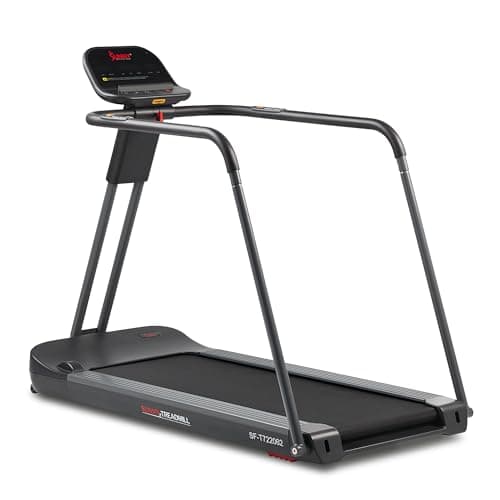
Top pick: Sunny Health & Fitness Treadmill with Extended Safety Handrails, Low Deck
Best Fall Alert
The monthly subscription is the real price, and only one of these publishes it. What each device actually does when someone falls.
Top pick: Fajocru Fall Detection Watch for Seniors