Tread & Tone

Horizon Fitness 5.0R Recumbent Bike Review

The finest resistance control of any bike on this site, and the only console anyone publishes in millimeters. Also the only machine whose own two sources disagree about what it will hold.

By Stephen V.Last updated How we choose

How this is funded: we earn a commission if you buy through our links, at no extra cost to you. It never changes what we recommend, and every page here names at least one thing we would not buy. Full disclosure.

Horizon Fitness 5.0 R Recumbent Bike

The finest resistance control

The only machine here that publishes its console window in millimeters — 60 × 127 mm, about 2.4 by 5 inches of high-contrast LCD — and the only one with 0–100 electronically controlled resistance, so the step between the two lowest settings is genuinely small. Note that Horizon's own page and its Amazon listing disagree about the weight capacity.

Horizon Fitness does not publish 5 of the 10 measurements we look for. The panel below names which.

This is the machine we recommend when a knee is the reason you are shopping, and it comes down to one published specification: 0 to 100 electronically controlled resistance levels.

That number sounds like spec-sheet inflation until you think about how a sensitive joint actually works. You will not be riding at level 60. You will be somewhere near the bottom, and what you need is the ability to express something between “barely anything” and “slightly more than barely anything”. An eight-level bike jumps straight over that. A hundred steps does not.

Horizon also does something no other manufacturer on this site does: it publishes its console window as a physical measurement, 60 by 127 millimeters. That works out to about 2.4 by 5.0 inches of high-contrast LCD. It is not a character height — nobody publishes those — but it is the closest anyone comes to a readability specification, and for a display you have to read without glasses it is genuinely useful.

And then there is the discrepancy. Horizon’s own specification page says the maximum user weight is 300 lb. Its Amazon listing says 350 lb. We go with the manufacturer, and so should you.

Fit-to-You: the nine measurements

Horizon Fitness does not publish 5 of 10 of these. Where that is the case, this panel says so rather than guessing. How we compile these

Step-over heightThe single number that decides whether you can get on at all. Almost nobody publishes it.
Not published by the manufacturer
Seat height from floorDecides whether you sit down onto the seat or lower yourself into it, and whether you can stand back up unaided.
Not published by the manufacturer
Weight capacitySearched directly, and two of the senior-focused competitors omit it entirely.
300 lb per Horizon's own specification. The Amazon listing claims 350 lb — the two disagree

Source: Horizon Fitness product page, 5.0 R Recumbent Bike · read 2026-07-24

Inseam rangeWhether the seat travels far enough for your leg length without over-extending the knee.
Not published by the manufacturer
Pedal spacing (Q-factor)How far apart the pedals sit. A narrow pedal spacing reduces the sideways load on arthritic knees.
Not published by the manufacturer
Display character heightCharacter height and contrast. Presbyopia is close to universal past 60.
High-contrast LCD window of roughly 2.4 in × 5.0 in, plus 3 LEDsHorizon publishes the LCD window as 60 × 127 mm. Converted at 25.4 mm to the inch: 60 ÷ 25.4 = 2.36 in, 127 ÷ 25.4 = 5.00 in. Character height is still not published.

DerivedSource: Horizon Fitness product page, 5.0 R Recumbent Bike · read 2026-07-24

Controls and reachCan it be operated one-handed, by feel, while seated? This is where low-strength and low-vision buyers get stranded.
0–100 resistance at the touch of a button; seat adjusts horizontally on an aluminum rail; QuickZip pedals

Source: Horizon Fitness product page, 5.0 R Recumbent Bike · read 2026-07-24

Assembly and box weightBox weight and how many people it needs. A 130 lb box is a real barrier, not a footnote.
123 lb assembled; ships in a 66.5 × 11.2 × 31 in carton

Source: Horizon Fitness product page, 5.0 R Recumbent Bike · read 2026-07-24

Noise (dB)Apartments, shared walls, and a sleeping partner in the next room.
Not published by the manufacturer
FootprintWhether it actually fits the room you have in mind, with clearance to get on and off.
66 in long × 25.2 in wide × 52.2 in high

Source: Horizon Fitness product page, 5.0 R Recumbent Bike · read 2026-07-24

We have not used this machine. Everything above comes from the manufacturer’s published documentation and the dated retailer listing, with the source given for each figure. Where they don’t publish a number, we say so. We can’t tell you how it feels to ride, how quiet it really is, or how it holds up after two years — and anyone who tells you otherwise without owning one is guessing.

The resistance system, and why it is the point

Every other conventional bike on this site uses a stepped system: eight levels, 16, or 25 on the Schwinn. Those steps are fixed at manufacture and you take what you are given.

Horizon’s is electronically controlled across 0 to 100, adjusted from buttons on the console. Practically, that means the increment between adjacent settings is small enough to be almost imperceptible — which is exactly what you want when the difference between comfortable and uncomfortable is narrow.

It also means you can record where you were. “Level 12 for fourteen minutes” is a repeatable session; “the knob about a third of the way round” is not. For anybody working through a graded return to activity — which after a joint problem is most people — that repeatability is worth more than it looks.

Paired with a published 15.4 lb aluminum flywheel, the pedal stroke carries through the dead spots rather than lurching, and lurching at low resistance is what a sensitive knee notices most. Only three bikes on this site publish a flywheel weight and this is the heaviest.

The weight capacity conflict, in full

We are going to labor this slightly, because it is the sort of thing most sites tidy away.

Horizon’s own product specification page: max user weight 300 lb.

The Amazon listing for the same machine:“a max user weight of 350 pounds”, stated in the listing copy.

They cannot both be right, and a 50 lb discrepancy on a load-bearing specification is not a rounding difference. Retailer listings are transcribed by people who are not engineers and get edited over a product’s life, so the manufacturer’s figure is the one to trust.

Treat this bike as a 300 lb machine.If you are near either figure, the sensible move is a different bike entirely — two machines on this site publish 450 lb at a lower price, with no ambiguity attached.

We flag it because it is a useful general lesson: when two published sources for the same product disagree, that is information about how much confidence any single published figure deserves.
123 lb, and the honest logistics

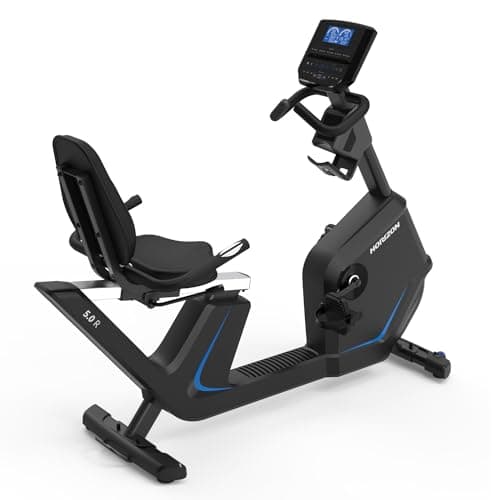
This is the heaviest bike on the site at 123 lb assembled, and Horizon publishes both that and the shipping carton at 66.5 by 11.2 by 31 inches — which is unusually complete disclosure and lets you check your doorway before ordering.

Two consequences. The carton is 66.5 inches long, so measure your hallway and any turn. And 123 lb assembled means it stays where you put it — there is a transport handle and wheels, but this is a two-person reposition across carpet.

Assembled footprint is 66 by 25.2 by 52.2 inches. Add roughly two feet of clearance on whichever side you mount from, and you are planning for a space about 66 by 50 inches in practice.

Horizon does not publish an assembly time. Delivery options include room-of-choice and white-glove services where assembly is included, which at this price point is worth pricing.

What it doesn't publish

Six of the nine measurements are unpublished, which is the same score as the Schwinn and worse than the Sunny.

No step-over height.Horizon describes the step-through frame as “easy to get on and off” and states it as an accessibility feature — which is more than most manage — but declines to measure it.

No seat height. The seat glides on an aluminum rail with lumbar support and is described as extra-large, but there is no floor-to-seat figure. This is where a much cheaper Sunny machine wins outright.

No inseam range. The seat adjusts horizontally on the rail, and Horizon does not say how far.

No pedal spacing.The pedals are named “Black QuickZip”, which tells you about the strap system and nothing about the geometry.

No noise figure. A premium cooling fan is published, which will make some noise of its own.

Who this suits

Anyone whose knee needs very light, precisely repeatable resistance.The 0–100 electronic system is the best answer to that on this site, and nothing else comes close.

Anyone who struggles to read a small display. The published 60 by 127 mm high-contrast LCD window is the only readability specification anyone in this category offers.

Anyone under about 270 lb who wants a brand-name machine with a real support channel and a published shipping carton they can measure a doorway against.

Anyone working through a graded return to activityafter a joint problem, where recording “level 12 for fourteen minutes” and repeating it matters.

Who should skip it

Anyone near 300 lb. The published figures conflict by 50 lb, and the conservative reading is 300. Two machines on this site publish 450 lb for less money and no ambiguity.

Anyone whose constraint is getting on and standing back up. No step-over height, no seat height, no inseam range. A Sunny bike at roughly half the price publishes a seat height.

Anyone who needs to move the machine. 123 lb assembled is the heaviest here, and the 66.5-inch carton is the longest.

Anyone on a budget. If you will ride at a comfortable moderate resistance and never think about it again, the fine control is capability you are paying for and will not use.

General information, not medical advice. Tread & Tone is written by an enthusiast, not a clinician. Nobody here is a doctor, a physical therapist or a trainer, and nothing on this site has been medically reviewed. Talk to your doctor or physical therapist before starting something new, particularly after surgery, a fall, or a change in medication.

Questions people ask

What is the weight limit on the Horizon 5.0R?

Horizon's own specification page says 300 lb. Its Amazon listing says 350 lb. The two disagree by 50 lb on a load-bearing specification, and we go with the manufacturer's figure — treat it as a 300 lb machine. If you are near either number, buy something that publishes 450 lb without ambiguity, and two machines on this site do for less money.

Is the 0–100 resistance actually useful?

If a knee is why you are shopping, yes, and it is the reason to buy this bike. You will ride near the bottom of the range, and 100 steps means the increment between adjacent settings is almost imperceptible — where an eight-level bike jumps straight over the adjustment you need. It also makes sessions repeatable: 'level 12 for fourteen minutes' is something you can record and return to.

How big is the display?

Horizon publishes the LCD window as 60 by 127 mm, which converts to about 2.4 by 5.0 inches, plus three LEDs. It is smaller than the Schwinn's 7-inch screen but it is the only console in this whole category published as a physical measurement, and Horizon describes it as high-contrast. Character height is still not published — nobody publishes that.

How heavy is it and will it fit through my door?

123 lb assembled, and Horizon publishes the shipping carton at 66.5 by 11.2 by 31 inches — so you can check your hallway and any turn before ordering, which most manufacturers do not let you do. Assembled it is 66 by 25.2 by 52.2 inches, plus about two feet of mounting clearance in practice.

Is it easy to get on?

Horizon states the step-through frame is easy to get on and off and presents it as an accessibility feature, but it does not publish a step-over height or a seat height, so we cannot tell you and neither can anyone else. If you can get to one in a shop, measuring the step-over takes about a minute — our guide explains how.

How does it compare to the Schwinn 290?

Finer resistance (0–100 against 25), a published console measurement, a heavier flywheel and a published shipping carton — against a smaller screen, a lower capacity of 300 lb versus 330 lb, and 15 lb more assembled weight. For a knee-driven purchase the Horizon is the better machine. For a bigger display and slightly more capacity, the Schwinn. Neither publishes what you need to know about getting on.

Sources

Product measurements are cited individually inside each Fit-to-You panel, against the manufacturer page or dated retailer listing they were read from.

Read next