Tread & Tone

Schwinn 290 Recumbent Bike Review

The best-known machine in this category, and the one that most clearly demonstrates that price does not buy accessibility documentation. It publishes plenty. Just not the parts you need.

By Stephen V.Last updated How we choose

How this is funded: we earn a commission if you buy through our links, at no extra cost to you. It never changes what we recommend, and every page here names at least one thing we would not buy. Full disclosure.

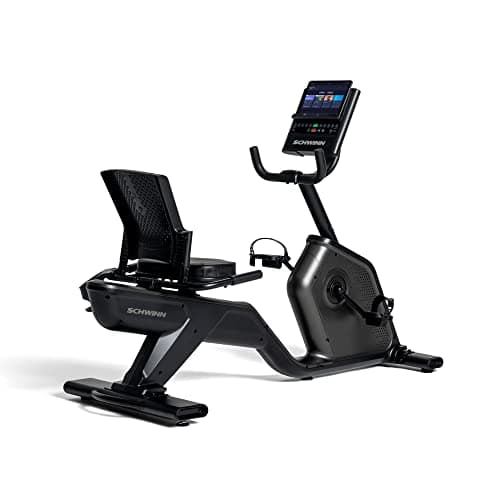
Schwinn Fitness 290 Recumbent Bike

The largest, clearest display

A 7-inch display and 25 resistance levels from a brand with a real parts channel, and Schwinn publishes the numbers a buyer normally has to guess at — 330 lb capacity, 107.6 lb assembled, exact assembled dimensions. It is also the most expensive bike here by a wide margin, and it still won't tell you the step-over height.

Schwinn Fitness does not publish 5 of the 10 measurements we look for. The panel below names which.

$899.99 · Check price on Amazon

$999.0010% off

Price as of July 24, 2026. #ad How we’re funded

The Schwinn 290 is probably the machine you had in mind before you started reading about this category. It is the brand name, it has the big screen, and it costs three to five times what the budget step-through bikes cost.

It is also a genuinely well-documented product by the standards of this industry. Schwinn publishes the assembled dimensions to a tenth of an inch, the assembled weight at 107.6 lb, the maximum user weight at 330 lb, 25 magnetic resistance levels and a 7-inch LCD with 13 programs — all on its own site, not just on a retailer listing.

And it still does not publish a step-over height, a seat height, a pedal spacing, a box weight or a noise figure. Which is the point worth taking away from this review: the most expensive bike in a shortlist is not necessarily the one that tells you whether you can use it. On our shortlist it sits below a machine costing about a third as much, for exactly that reason.

Fit-to-You: the nine measurements

Schwinn Fitness does not publish 5 of 10 of these. Where that is the case, this panel says so rather than guessing. How we compile these

Step-over heightThe single number that decides whether you can get on at all. Almost nobody publishes it.
Not published by the manufacturer
Seat height from floorDecides whether you sit down onto the seat or lower yourself into it, and whether you can stand back up unaided.
Not published by the manufacturer
Weight capacitySearched directly, and two of the senior-focused competitors omit it entirely.
330 lb

Source: Schwinn Fitness product page, 290 Recumbent Bike (100948) · read 2026-07-24

Inseam rangeWhether the seat travels far enough for your leg length without over-extending the knee.
Not published by the manufacturer
Pedal spacing (Q-factor)How far apart the pedals sit. A narrow pedal spacing reduces the sideways load on arthritic knees.
Not published by the manufacturer
Display character heightCharacter height and contrast. Presbyopia is close to universal past 60.
7 in LCD; character height not published

Source: Schwinn Fitness product page, 290 Recumbent Bike (100948) · read 2026-07-24

Controls and reachCan it be operated one-handed, by feel, while seated? This is where low-strength and low-vision buyers get stranded.
Stationary handlebars specified as aids for entry and exit; 25 resistance levels; weighted strapped pedals

Source: Schwinn Fitness product page, 290 Recumbent Bike (100948) · read 2026-07-24

Assembly and box weightBox weight and how many people it needs. A 130 lb box is a real barrier, not a footnote.
107.6 lb assembled; box weight not published

Source: Schwinn Fitness product page, 290 Recumbent Bike (100948) · read 2026-07-24

Noise (dB)Apartments, shared walls, and a sleeping partner in the next room.
Not published by the manufacturer
FootprintWhether it actually fits the room you have in mind, with clearance to get on and off.
66.4 in long × 28 in wide × 47 in high

Source: Schwinn Fitness product page, 290 Recumbent Bike (100948) · read 2026-07-24

We have not used this machine. Everything above comes from the manufacturer’s published documentation and the dated retailer listing, with the source given for each figure. Where they don’t publish a number, we say so. We can’t tell you how it feels to ride, how quiet it really is, or how it holds up after two years — and anyone who tells you otherwise without owning one is guessing.

What the money genuinely buys

Four things, and they are real rather than marketing.

25 resistance levels.The most of any conventional bike on this site bar the Horizon’s electronic system. More levels across a similar range means smaller steps between them, which matters most at the bottom where you will actually be riding. This is the single most useful thing the price buys.

A 7-inch LCD.The largest screen on any bike here except the Teeter’s 9-inch color display. Schwinn does not publish character height — nobody does — but a bigger panel is more likely to have bigger digits, and 13 built-in programs means the machine can structure a session for you.

A support and parts channel. Underrated, and hard to quantify. Schwinn will exist in five years and will sell you a replacement console. Several of the budget brands on this site may not, and a $200 bike with a dead console is a $200 problem.

Stationary handlebars specified for entry and exit. Schwinn describes them explicitly as aids for getting on and off rather than as an incidental feature, which is a small piece of evidence that somebody thought about the mounting problem even if they would not measure it.
The subscription question

This needs saying because it changes the value calculation and the marketing does not lead with it.

Several of the display’s more interesting capabilities — adaptive workouts, the 200-plus virtual courses, and the Terrain Control feature that adjusts resistance automatically during elevation changes — require a JRNY membership. Schwinn publishes this plainly, and offers two months free with the machine, but it is an ongoing cost on top of the purchase.

The bike works perfectly well without it. You get the 25 resistance levels, the 13 built-in programs and the metrics. You do not get the app-driven content that a lot of the marketing is about.

For the buyer this site is written for, that is close to irrelevant — nobody shopping for a machine they can get onto safely is buying it for virtual courses through Tuscany. But if the app content is the reason you are paying the premium, budget for the subscription as part of the price.

107.6 lb, and what that means practically

Schwinn publishes an assembled weight of 107.6 lb and assembled dimensions of 66.4 by 28 by 47 inches. It does not publish a box weight, which is the number that actually determines whether you can get it indoors.

What 107.6 lb means once built: it has transport wheels, and it is not moving between rooms without help, particularly across carpet. Decide where it lives before it arrives, and account for roughly two feet of clearance on the side you will mount from — 28 inches of width plus mounting space is the real footprint, not 28 inches.

Schwinn also directs you to the owner’s manual for assembly detail rather than publishing an assembly time or a pre-assembled percentage. If assembly is a genuine barrier, budget for the retailer’s assembly service — at this price point it is a small proportional addition.

The five things it won't tell you

Six of the nine measurements we look for are unpublished on this machine — the same count as on a bike costing a fifth as much.

No step-over height, so the central accessibility question is unanswered. No seat height, so you cannot tell whether you will stand up from it comfortably — and this is where a much cheaper Sunny machine beats it outright. No pedal spacing. No display character height, despite the screen being a headline feature. No box weight. No noise figure.

None of that makes it a bad machine. It makes it an unassessable machine on the dimensions this site cares about, and it means a buyer whose constraint is physical rather than performance-related is paying a premium for information they still do not have.

If you can get to one in a shop, measuring the step-over yourself takes about a minute and settles the only question that really matters.

Who this suits

Someone who wants finer resistance control than a budget bike offers but does not want to spend Horizon money. 25 levels is a real improvement over eight.

Someone who values a support channel. If a console failing in year three would be a serious annoyance, a brand that still exists and sells parts is worth paying for.

Someone who will genuinely use the display. 7 inches, 13 programs, and app integration if you take the subscription. If a structured session helps you keep going, that is a legitimate reason to pay more.

A rider between 265 and 330 lbwho wants a brand-name machine — the 330 lb capacity comfortably clears the Sunny’s 265 lb ceiling.

Who should skip it

Anyone whose constraint is getting on and off. It publishes nothing about step-over or seat height. A Sunny bike at about a third of the price publishes a seat height, and on that specific question a third of the price buys you more.

Anyone over 330 lb. Two mid-priced machines on this site publish 450 lb.

Anyone on a tight budget. The seated pedaling motion is essentially the same on a $160 step-through bike. What you are buying here is resolution, display and support, not a fundamentally different exercise.

Anyone who needs to move the machine regularly. 107.6 lb is not a one-person job across carpet, and the lightest full-size bike on this site is 63.8 lb.

$899.99 · Check price on Amazon

$999.0010% off

Price as of July 24, 2026. #ad How we’re funded

General information, not medical advice. Tread & Tone is written by an enthusiast, not a clinician. Nobody here is a doctor, a physical therapist or a trainer, and nothing on this site has been medically reviewed. Talk to your doctor or physical therapist before starting something new, particularly after surgery, a fall, or a change in medication.

Questions people ask

Is the Schwinn 290 good for seniors?

It is a solid machine with a step-through frame, 25 resistance levels and a 330 lb capacity, and Schwinn publishes more about it than most makers publish about anything. But it publishes no step-over height and no seat height, so on the specific question of whether you can get on and stand back up, it tells you nothing — and a Sunny bike at roughly a third of the price publishes a seat height.

What is the weight limit on the Schwinn 290?

330 lb, published by Schwinn on its own product page. That comfortably clears the 265 lb ceiling of our top pick, but it is well below the 450 lb published by two mid-priced machines on this site. If capacity is your binding constraint, the premium brands are the wrong aisle.

Do I need the JRNY subscription?

No. The bike works fully without it — 25 resistance levels, 13 built-in programs, all the metrics. The subscription adds adaptive workouts, 200-plus virtual courses and the Terrain Control feature that adjusts resistance automatically. Two months come free. For a buyer whose priority is getting on the machine safely, none of that is what you are paying for, so treat it as optional rather than as part of the value.

How much does the Schwinn 290 weigh?

107.6 lb assembled, published by Schwinn. The box weight is not published, which is the figure that actually matters for getting it into the house. Assembled, it has transport wheels but is not a one-person job across carpet — decide where it lives before it arrives.

Is it worth the extra money over a Marcy or a VANSWE?

It depends entirely on your constraint. For finer resistance, a bigger screen and a support channel, yes — those are real and the budget machines do not have them. For getting on and off, no: it publishes no more about that than a $160 bike does, and less than a $360 Sunny. Buy it for resolution and longevity, not for accessibility.

How noisy is it?

Schwinn publishes no figure, so we mark noise as unpublished. It is a magnetic-resistance bike, which is inherently quieter than fan or friction resistance, but that is reasoning from the mechanism rather than a measurement. Only one bike on this site publishes a decibel claim at all, and this is not it. If a shared wall is the concern, nobody in this category will give you a number to plan with.

Sources

Product measurements are cited individually inside each Fit-to-You panel, against the manufacturer page or dated retailer listing they were read from.

Read next