The short answer
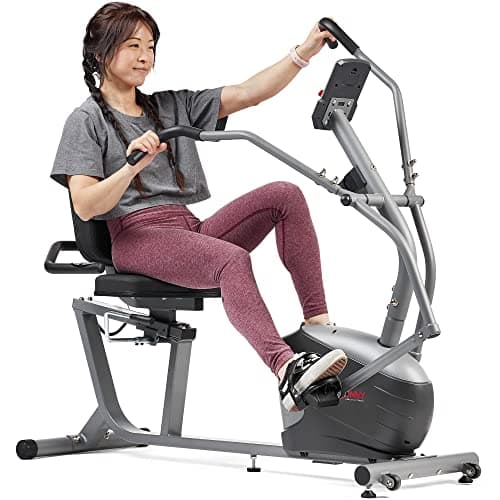
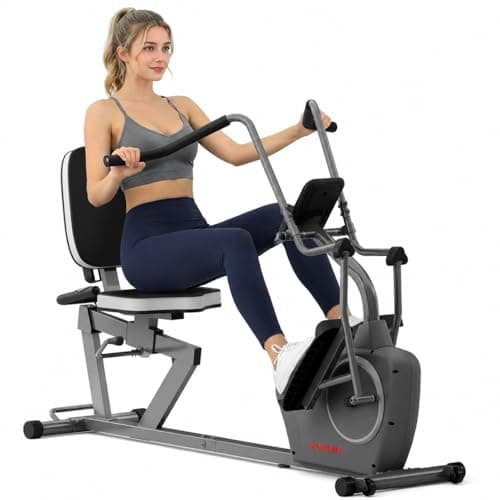
Buy the recumbent bike unless you have a specific reason not to: it is cheaper, better documented, and the exercise is much the same. Choose the recumbent cross-trainer for one of two reasons — the circular pedal motion of a bike bothers your knee (a longer stride keeps the joint in a shallower range), or you want the moving handles to work your arms as well as your legs. Same seat, different foot path.
Two seated machines, side by side on what separates them.| What you care about | Recumbent bike | Recumbent cross-trainer |
|---|
| Seated and back-supported | Yes | Yes |
|---|
| Foot motion | A tight circle (pedaling) | A long elliptical or straight-line stride |
|---|
| Knee joint angle | Closes tighter at the top of each turn | Stays in a shallower, more open range |
|---|
| Upper body | Only if it has moving arms | Yes — moving handles are standard |
|---|
| Balance demand | None | None |
|---|
| Price | Lower, for the same seated posture | Higher — you pay for the stride and arms |
|---|
| How well documented | Better — more publish seat height and capacity | Thinner — most withhold capacity |
|---|
| Buy it when | You want simple, cheap, seated cardio | The circular motion hurts, or you want arms |
|---|
The circle versus the stride
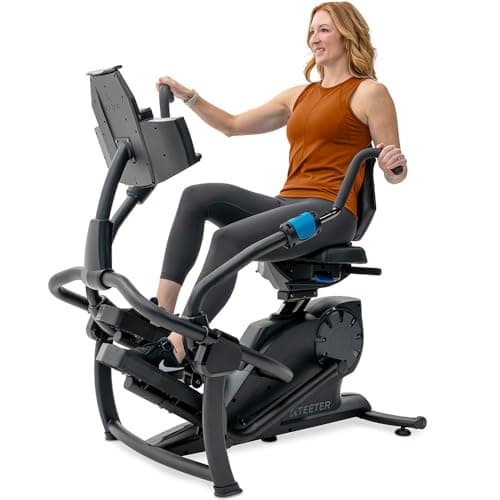
Everything here comes down to the shape your feet trace. On a recumbent bike the pedals turn a circle, and at the top of every revolution the knee closes to its tightest angle. On a cross-trainer the feet travel a longer, flatter path — an ellipse, or on the Teeter a straight line — and the joint never closes as far.
For most people that difference is invisible; a bike is comfortable and the cheaper machine is the right one. But some arthritic knees object to the flexion arc itself, not to the effort or the load, and for them no resistance setting on a bike helps, because the arc is fixed by the geometry of a circle. The Arthritis Foundation supports low-impact continuous motion for arthritic joints because moving the joint through its range produces the fluid that lubricates it — the only question is which range your knee tolerates. If the tight part is the sore part, the machine that avoids it wins.
This is the single best reason to pay more for a cross-trainer, and it is a real mechanical one rather than a marketing distinction. It is also the reason our arthritis shortlist puts a straight-line machine at the top.
The arms: the cross-trainer’s other advantage
A plain recumbent bike leaves your upper body idle. A cross-trainer’s moving handles work it — a genuine second exercise for shoulders and arms that are often stiffening at the same time as the knees. The Arthritis Foundation’s list of low-impact options treats whole-body movement as useful, and for someone whose stiffness is not confined to the legs, that upper-body involvement is worth something on its own.
One honest caveat: on most cross-trainers the arms and legs move together rather than independently, so an arms-only session on a bad-leg day is not usually described. If you want to be able to work the arms alone, check the specific listing carefully — most don’t publish it.
What you give up by choosing the cross-trainer
Two things, and they are the reason the bike remains the default.
Money. A cross-trainer costs more than a comparable recumbent bike for the same seated posture. You are paying for the stride shape and the arms, and if neither is something you need, it is money spent on nothing.
Documentation.The bike category is better-published. More recumbent bikes state a seat height, an inseam range and a weight capacity, and one publishes a real seat-height number that no cross-trainer matches. Cross-trainers are thinner on specs — several withhold the weight capacity entirely, which is why our cross-trainer shortlist ranks them largely on which makers are willing to state one.
How to decide
Start with the bike. If seated pedaling is comfortable and you only want cardio, buy the recumbent bikeand spend the difference on something else — a balance pad, say, which addresses the one thing neither seated machine does.
Move to the cross-trainer only if the circular motion has actually bothered your knee before, or if working your arms matters to you. In that case it resolves a real problem, and our shortlistranks the honest options. And if the knee is post-surgical or recently changed, neither machine is the first step — a physical therapist is, because they can watch the joint move and tell you what range and load it should be working in.