Tread & Tone

Sunny Recumbent Elliptical Cross Trainer Review

A recumbent cross-trainer seats you like a bike but moves your feet along a stride instead of a circle, and works your arms at the same time. Sunny states the one feature that decides this category for a nervous buyer — step-through — and then declines to publish the spec most people search for.

By Stephen V.Last updated How we choose

How this is funded: we earn a commission if you buy through our links, at no extra cost to you. It never changes what we recommend, and every page here names at least one thing we would not buy. Full disclosure.

Sunny Health & Fitness Smart Recumbent Elliptical Cross Trainer for Seniors

A published step-through entry

The listing leads with the one word that matters most in this aisle — step-through — and backs it with 8 resistance levels and a dual-function arm-and-leg motion. What it will not tell you is the weight capacity, which is a real gap on a machine sold explicitly to seniors.

Sunny Health & Fitness does not publish 9 of the 10 measurements we look for. The panel below names which.

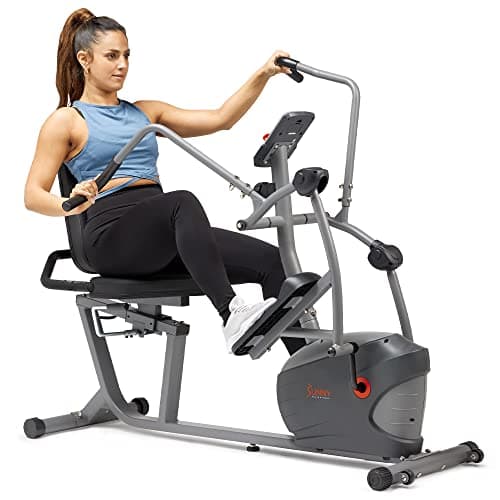
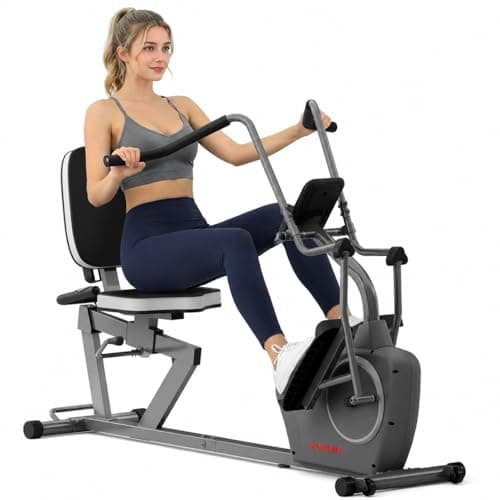
The Sunny recumbent elliptical cross trainer is a hybrid: you sit in it the way you sit in a recumbent bike, back supported and feet out in front, but the pedals travel a stretched stride rather than a tight circle, and moving handles work your arms in time with your legs. That is a genuinely different machine from a bike, and for some riders a genuinely better one — the difference is laid out on our bike-versus-cross-trainer comparison.

What Sunny gets right on the listing is the first word out of its mouth: step-through. In this category that is the feature that decides whether a wary buyer will use the machine at all, because a step-through frame has no bar to lift a leg over — you walk in from the side and sit down. Movement is the whole aim, and the Arthritis Foundation is clear that movement helps osteoarthritis rather than aggravating it, so the machine you can actually get onto is the one doing you good.

The problem is everything Sunny does notsay. It publishes no weight capacity, no step-over height, no seat height, and no assembled dimensions — and it costs more than budget recumbent bikes that publish all of those. On a machine sold explicitly to seniors, the missing capacity in particular is a real gap, and it is the reason this write-up is as much about what is absent as what is present.
Fit-to-You: the nine measurements

Sunny Health & Fitness does not publish 9 of 10 of these. Where that is the case, this panel says so rather than guessing. How we compile these

Step-over heightThe single number that decides whether you can get on at all. Almost nobody publishes it.
Not published by the manufacturer
Seat height from floorDecides whether you sit down onto the seat or lower yourself into it, and whether you can stand back up unaided.
Not published by the manufacturer
Weight capacitySearched directly, and two of the senior-focused competitors omit it entirely.
Not published by the manufacturer
Inseam rangeWhether the seat travels far enough for your leg length without over-extending the knee.
Not published by the manufacturer
Pedal spacing (Q-factor)How far apart the pedals sit. A narrow pedal spacing reduces the sideways load on arthritic knees.
Not published by the manufacturer
Display character heightCharacter height and contrast. Presbyopia is close to universal past 60.
Not published by the manufacturer
Controls and reachCan it be operated one-handed, by feel, while seated? This is where low-strength and low-vision buyers get stranded.
Step-through design; 8 resistance levels; dual-function arm and leg motion; pulse sensors on the handlebars; SunnyFit app

Source: Amazon product listing data (Creators API) · read 2026-08-03

Assembly and box weightBox weight and how many people it needs. A 130 lb box is a real barrier, not a footnote.
Not published by the manufacturer
Noise (dB)Apartments, shared walls, and a sleeping partner in the next room.
Not published by the manufacturer
FootprintWhether it actually fits the room you have in mind, with clearance to get on and off.
Not published by the manufacturer

We have not used this machine. Everything above comes from the manufacturer’s published documentation and the dated retailer listing, with the source given for each figure. Where they don’t publish a number, we say so. We can’t tell you how it feels to ride, how quiet it really is, or how it holds up after two years — and anyone who tells you otherwise without owning one is guessing.

What a recumbent cross-trainer actually is

On a recumbent bike the pedals turn a circle. On this machine they trace an elongated oval — a stride rather than a rotation — which spreads the movement across a longer, flatter path. For a knee that dislikes the tight top-of-the-circle bend a bike asks for on every rotation, that flatter path can feel easier, which is the whole reason the category exists. It is not a marketing distinction; it is a different joint motion.

The second difference is the arms. This is a dual-function trainer, so the handles move with the pedals and you can drive the stride with your upper body as well as your legs. Pulse sensors sit on the handlebars for a rough heart-rate read. Whether that is a plus depends on you: it lets you spread the effort across more muscles, but a rider who wants only a gentle leg spin may find the moving handles more than they were after. If a straightforward seated pedal is what you want, a plain recumbent bike is the simpler tool. If the gliding stride appeals, our guide to whether ellipticals are good for seniors covers the same trade-offs from the standing-elliptical side.

Step-through, stated plainly

Give Sunny its due on the thing that matters most here. “Step-through” is a phrase that gets stretched across the category, but Sunny leads with it, and on a seated cross-trainer it is the single feature that decides whether a hesitant buyer keeps using the machine. No top tube to swing a leg over means you approach it like a chair and sit down — for a stiff hip or a wary knee, that is frequently the difference between a machine that gets used and one that becomes an expensive clothes rail.

Sunny also publishes an actual resistance count — 8 levels — rather than the vague “adjustable” that fills this aisle. Eight is on the modest side, but for gentle regular cardio it is more than most riders will leave the bottom of. The CDC’s 150 minutes a week of moderate activity for older adults does not require a long ladder of settings; it requires a machine you will use. There is also SunnyFit app connectivity if you want a session structured for you, which for many buyers in this bracket is a feature they will try once and forget — no harm in that.

The capacity Sunny won't publish

Here is the gap, and we are going to sit on it rather than gloss over it: Sunny publishes no weight capacity for this machine. Weight capacity is the most-searched spec in the whole category, and its absence on a product marketed to seniors is the reason this cross-trainer does not lead our recumbent cross-trainers shortlist. A capacity number tells you whether the frame is built for your body with headroom to spare; without it, you are trusting a machine you cannot size to yourself.

It does not stop there. There is no published step-over height, no seat height, and no assembled footprint, so “step-through” is a claim rather than a measured number, and you cannot plan the floor space before it arrives. If you are set on this machine, the sensible move is to ask Sunny’s support line directly for the weight capacity and the assembled dimensions before you buy, and to measure the step-over yourself if you can reach one — there is a one-minute method on our guide to step-over height.

The honest comparison: it costs more and tells you less

The uncomfortable truth for this machine is that budget recumbent bikes exist that publish everything it hides and cost less. A bike like the VANSWE RB661states a 380 lb capacity and a full inseam range at the bottom of the price ladder, while this cross-trainer sits a tier higher and publishes neither. If your priority is a documented fit — a capacity you can check, a seat range you can trust — a bike is the more honest buy.

So the case for this Sunny rests entirely on the one thing a bike cannot give you: the stride. If the tight circular pedal stroke is what bothers your knee, and the gliding elliptical path is the reason you are shopping cross-trainers in the first place, then the motion is the feature you are paying for, and the disclosure gaps are the price of admission. If the stride is not a hard requirement, we would point you at a bike that tells you more about itself.

Who this suits

A knee that dislikes the circular stroke.The elongated stride is a genuinely different joint path from a bike’s rotation, and it is the reason to choose this over a recumbent bike.

Anyone wary of getting on.Sunny leads with a step-through frame — no bar to lift a leg over — which is the feature that decides use in this category.

A rider who wants arms in the workout. The dual-function handles let you drive the stride with your upper body as well as your legs.

Someone who will call Sunny first. If you are willing to confirm the capacity and dimensions with support before buying, the machine may still suit you.

Who should skip it

Anyone who needs a published weight capacity.There isn’t one — the most-searched spec in the category is simply absent, which we treat as a reason to look elsewhere.

Anyone who just wants a simple seated spin. A plain budget recumbent bike publishes more and costs less.

Anyone planning a tight space. With no assembled dimensions published, you cannot lay out the room before it arrives.

A heavier rider. Without a capacity figure, there is no way to confirm the frame is built with headroom for you.

General information, not medical advice. Tread & Tone is written by an enthusiast, not a clinician. Nobody here is a doctor, a physical therapist or a trainer, and nothing on this site has been medically reviewed. Talk to your doctor or physical therapist before starting something new, particularly after surgery, a fall, or a change in medication.

Questions people ask

What is a recumbent cross-trainer?

It seats you like a recumbent bike — back supported, feet out in front — but the pedals travel a stretched elliptical stride instead of a tight circle, and moving handles work your arms in time with your legs. The flatter stride can feel easier on a knee that dislikes the top-of-the-circle bend a bike asks for on every rotation. It is a different joint motion, not just a different name.

What is the weight capacity of the Sunny recumbent cross trainer?

Sunny does not publish one, and that is a real gap on a machine marketed to seniors — weight capacity is the most-searched spec in the category. If you are considering this machine, ask Sunny's support line for the capacity before you buy rather than assuming. The absence is the main reason it does not top our recumbent cross-trainers shortlist.

Does it have a step-through frame?

Yes — Sunny leads with it, and it is the machine's strongest feature. A step-through frame has no bar to swing a leg over; you walk in from the side and sit down, which for a stiff hip or a wary knee is often the difference between a machine that gets used and one that does not. What Sunny does not publish is a step-over height in inches, so it is a design claim rather than a measured number.

How many resistance levels does it have?

Eight, which Sunny states as an actual count rather than the vague 'adjustable' common in this aisle. Eight is modest but more than enough for gentle regular cardio, where you will spend your time in the lowest few settings. It also connects to the SunnyFit app if you want a guided session.

Is it better than a recumbent bike?

Only if the stride is what you need. Its advantage over a bike is the elongated elliptical path, which suits a knee that dislikes the circular stroke. Its disadvantage is disclosure: budget recumbent bikes publish a weight capacity and seat range and cost less, while this cross-trainer publishes neither. If the stride is not a hard requirement, a bike is the more honest buy.

How much room does it need?

Sunny does not publish assembled dimensions for this machine, so you cannot plan the floor space before it arrives — another reason to ask support for the numbers first. As a rule, any seated recumbent-style machine needs roughly two extra feet of clearance on the side you get on from, on top of its own footprint.

Sources

Product measurements are cited individually inside each Fit-to-You panel, against the manufacturer page or dated retailer listing they were read from.

Read next